
 Română
 Русский
Juvenile Justice: the Situation in the Transnistrian Region of Moldova

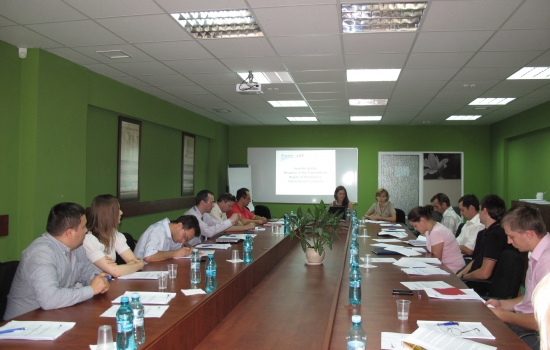 A report on the topic: “Juvenile Justice: the Situation in the Transnistrian region of Moldova in Relation to International Standards” was released on 30 July 2013, during a roundtable discussion. The report was prepared by Ms. Miranda Merkviladze (LLM in International Human Rights Law). A combined methodology was used for the report to include desk research, requests of information and interviews with various stakeholders and actors, and field visits.
The purpose of this report was to present the results of the study on the state of juvenile justice in the Transnistrian region of Moldova. The report aims to compare the de facto laws, policies and practice of the Transnistrian juvenile justice with the relevant international standards and to identify possible weaknesses or gaps. The research tried to learn in particular if there were strategies for preventing juvenile delinquency and juvenile rehabilitation programs, and what procedural safeguards are provided in legislation and practice of the de facto prosecution and judicial proceedings, if the de facto legislation provides for alternative non-custodial measures and if they are used in practice, if juvenile detainees have access to vocational training/educational courses, etc.
In her presentation, the author of the report referred to the obligation to protect and promote human rights in the context of juvenile justice, obligations of both the constitutional authorities of Moldova and Russia and the de facto administration of the region under customary international law. The report describes the de facto legal and institutional framework of juvenile justice in place in the region, as well as certain policies and practices present at the regional level. In this regard, the report highlights several problematic issues.
According to the author of the report, a very serious problem is the approach of the de facto regional administration to juvenile justice, which is quite punitive and less based on the rights of children. Another set of problems is related to the abusive and unjustified application of detention, including prolonged detention, as a measure of punishment in most cases, even when the de facto law provides for non-custodial measures. In this respect, the author mentions that the range of alternative measures available for juveniles is limited. The de facto legal framework does not specify the exact duration of detention, thus leaving room for abuse. No limit is specified to the number and duration of juvenile interrogations; there is no clarity with regard to interrogation methods; the de facto practice limits, in an improper and unreasonable manner, the communication between detained juvenile offenders and their families.
The author also mentioned other issues, such as: the superficiality and formal character of the legal aid offered to juveniles in court proceedings; the lack of mediation in restorative justice practices; the absence of effective prevention and rehabilitation programs at the regional level; the lack of psychological assistance services to juveniles in detention; their lack of access to education.
The report also included a number of recommendations aimed at improving the situation of juvenile justice in the region, for both the constitutional authorities and de facto regional administration. Ms. Merkviladze also formulated some recommendations for the civil society. In this respect, the author noted that in the Transnistrian region, there are no nongovernmental organizations that would deal namely with the issue of juvenile justice. On the other hand, human rights organizations from the right bank do not get involved in this field either.
The participants at the roundtable noted the importance of this report, citing in that regard the lack of any official and comprehensive reports, studies and statistics. The present report is only a first step in tackling the problem of juvenile justice in the Transnistrian region.
The report was prepared as part of a under the 2013 Internship Program for an Open Society, conducted by the author in Moldova, with the Promo-LEX Association. The Internship Program is part of the collaboration between the Human Rights and Governance Grants Program (HRGGP) of and Scholarship Program (SP) of the Open Society Foundations.
The electronic versions of the report in Romanian and English will soon become available on the Promo-LEX website.
For details please contact: Olga Manole, Project Coordinator, Promo-LEX Association
Tel: (+373 22) 449626 | Fax: (+373 22) 450024 | Email: [email protected]