
 Română
 Русский
The ECtHR made public a decision of admissibility with respect to the following applications: Căldare and 42 others v. Moldova and Russia, Catan and 27 others v. Moldova and Russia and Cervaschi and 98 others v. Moldova and Russia

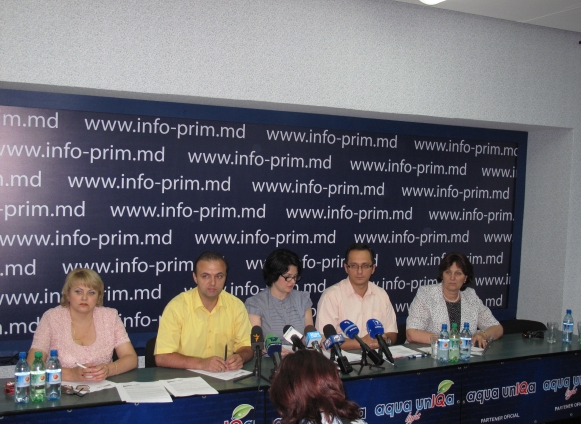 At a meeting on the 15th of June 2010, the fourth section of the European Court of Human Rights unanimously passed a decision of admissibility in the cases of: Căldare and 42 others v. Moldova and Russia (application nr. 8252/05); Catan and 27 others v. Moldova and Russia (application nr. 43370/04); and Cervaschi and 98 others v. Moldova and Russia (application nr. 18454/06). The respective decision was conveyed to respresentatives for the claimants on July 2, 2010.
The claimants in these three cases are 170 citizens of the Republic of Moldova who live in the ‘Moldovan Republic of Transnistria’ (MRT). Each application concerns a different school teaching in Romanian in the Latin script in the separatist region, and was submitted by a group of parents, children and teachers.
The claimants told the The European Court that they continue to be intimidated by the MRT authorities for their desire that the schools continue giving lessons in Romanian using the Latin script, and according to the curriculum approved by the Education Ministry of the Republic of Moldova.
In particular, the claimants cited to the court the violation of the right to non-discrimination, based on Art. 14 of the European Convention on Human Rights -and, taken separately and together with this, the right to respect for private and family life, in conformity with Art. 8 of the Convention- for the ban imposed by the MRT on Moldovans in the region from studying, speaking and from transmitting their inherited Moldovan culture (language, writing and traditions). Claimants also cited Art. 2 of Protocol nr. 1 to the Convention, in connection with the denial of the right to instruction in Latin script.
Analysing the matter of the exhaustion of internal routes for redress, the Court decided that the claimants cannot apply to the competent bodies of the Russian Federation, on the grounds that these do not recognise jurisdiction over this territory. The Court considers it irrelevant to address the competent bodies of the Republic of Moldova, since, even if there existed a decision made by these courts, it is unlikely that it would be executed on the territory of the Transnistrian region. On the question of addressing the bodies set up and existing in the Transnistrian region, the Court considers that there is no evidence that approaching these courts would be effective, seeing as the measures concerning the claimants were taken by MRT authorities with a view to ensuring respect for MTR ‘legislation’.
The Court, examining the subjects of the violation of Art. 8 of the Convention and Art. 2 of the additional Protocol, and of both these articles in conjunction with art. 14 of the Convention, consider that the complaint under these articles raises serious problems of fact and of law, and that their decision will be reached once the case has been examined in depth.
Taking into account the findings, the Court decided unanimously upon the admissibility of Article 8 of the Convention and Article 2 of the Additional Protocol, and of both these articles in conjunction with Article 14 of the Convention, reserving an examination of the merits of the case for a later date.
The Court gave the claimants until September 20, 2010, to prepare any additional observations, and to present information in connection with just satisfaction.
The claimants were represented at the court, as well as at public hearings, by Ion Manole, Alexandru Postica and Doina Ioana Străisteanu, lawyers at the ‘Promo-LEX’ Association.
Note: for more information contact Alexandru Postica of the Promo-LEX Legal Department, tel. 211622.