
 Română
 Русский
Promo-LEX findings: most of the decision-making processes in the Parliament’s activity are not transparent

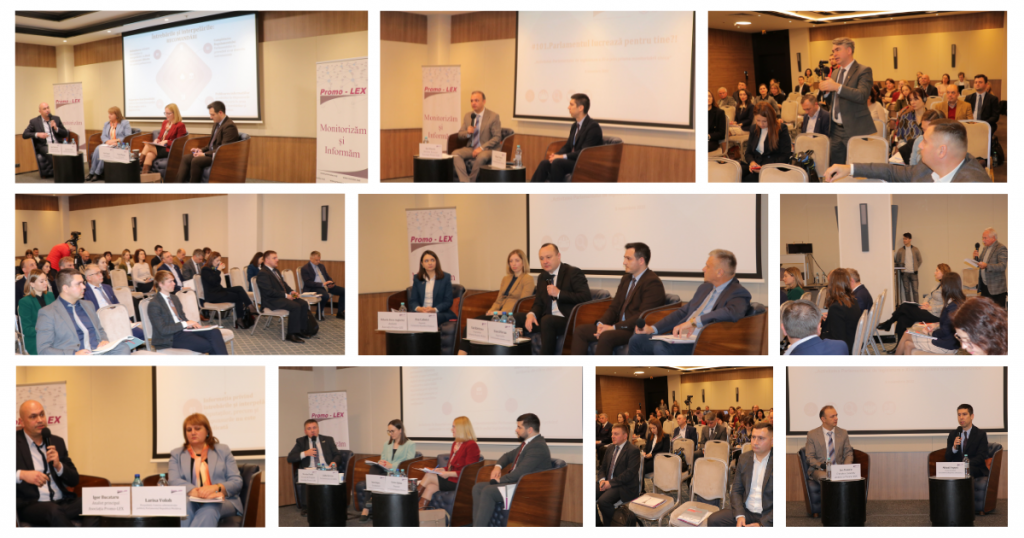
During the first year of activity of the 11th legislature, the Promo-LEX Association has monitored Parliament’s compliance with the legislative procedure, the activity of standing committees, the exercise of the parliamentary monitoring function, communication with citizens and parties concerned, as well as budgetary and administrative management. Analysts’ findings and recommendations, as well as MPs’ opinions on them, have been addressed, today, in the public discussion “The Activity of the 11th Legislature through the Prism of Civic Monitoring”.
The event was attended by MPs, analysts, representatives of public authorities, donors and civil society.
The executive director of Promo -LEX, Ion Manole, mentioned that in 2021, the Association set the goal to expand its efforts in monitoring the activity of the Parliament, thus helping it to become more open and closer to citizens. “At the same time, as exponents of civil society, we want to consolidate the decision-making processes, to determine MPs and the legislature to ensure proactive transparency in their activity, to use and publish data in an open format, to communicate as efficiently as possible with citizens, as well as to inform the society about their and the institution’s activity”, mentioned Ion Manole.
Based on the first year of monitoring, Promo-LEX has developed an annual report, providing a series of findings on the Parliament’s activity, as well as recommendations addressed to both the legislative institution and MPs.
Thus, the conclusions on the degree of compliance with the legislation on decision-making transparency have been formulated based on the analysis of 621 draft normative acts introduced in the legislative procedure. The analysts found that the decision-making transparency was largely disrespected, and at certain stages, it was even seriously affected by legislature’s failure to publish certain documents, by a low rate of public consultations on draft laws, by a high degree of ignoring certain recommendations or even by the lack of certain documents.
As for the activity of the three parliamentary commissions subject to monitoring, the Association found a low level of citizens’ information about their activity, in particular, in organizing hearings and reacting to petitions.
Questions and interpellations, as instruments of parliamentary control, seem to be frequently confused by MPs. This mechanism of parliamentary control is most often used by the opposition, which asked 37 out of 38 registered questions. At the same time, we emphasize the fact that the Parliament’s website does not provide information to the general public about the use of these tools.
Parliament’s communication with citizens and the parties concerned is another monitored area. The findings relate to hearings and meetings with citizens, petitions and requests for access to information, quality of the official web page, as well as presence on social networks.
The monitors found that there are no clearly established mechanisms for informing citizens about the scheduled audiences and MPs’ visits to the territories; there is no record of the audiences and visits made. As for request for access to information, Promo-LEX has described its own experience, when out of 19 requests, about half of the responses came exceeding the legal deadline, and 20% were too general or incomplete.
In the opinion of Promo-LEX, the official webpage of the Parliament has a complicated and obsolete architecture, which does not cover information of public interest, it is not intuitive and friendly for users with disabilities, it does not contain open data sets. Many headings are empty or the information there is outdated. At the same time, the parliamentary institution is active on social networks, although the information is not updated on all accounts. In their turn, MPs do not sufficiently capitalize on the opportunities offered by social media platforms to inform citizens of the actions carried out.
Another area subject to monitoring is budgetary and administrative management. The monitors analyzed information of public interest related to the approval and execution of the Parliament’s budget, as well as other important aspects such as remuneration of MPs, expenses for business trips, transparency of public procurement. We found a reduced degree of transparency and information of citizens with regard to monthly financial remuneration of each MP. In this context, Promo-LEX expressed its disagreement with the legislature’s refusal to present the information claiming personal data protection.
In conclusion, the document presents 68 recommendations on improving the legislative processes and procedures for all monitored areas. The recommendations are addressed to the Parliament, the Standing Committee, the Permanent Parliamentary Commissions, the Secretariat of the Parliament and the MPs.
In the period of 2021–2025, the activity of the Parliament of the Republic of Moldova is subject to an exhaustive monitoring within the Promo -LEX Program “Democracy, Transparency and Responsibility” carried out with the financial support of the United States Agency for International Development (USAID). The purpose of monitoring is to increase the transparency of the institution, to contribute to the improvement of legislative procedures and to consolidate the interaction between MPs and citizens.
For additional information:
Elena Căpățînă, communications officer, Promo -LEX Association
GSM: 079454344; [email protected]