
 Română
 Русский
Farmers from Dubasari District – Double Victims of Transnistrians and of the Pandemic

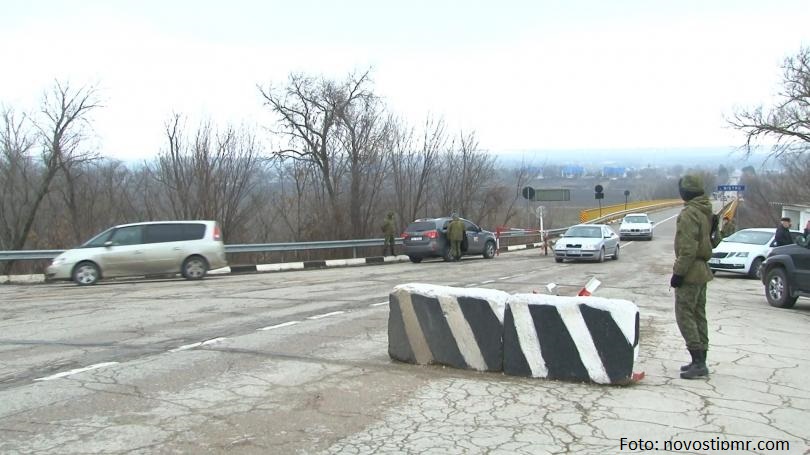
The secessionist regime from Tiraspol blocked the access of the owners of lands that are located to the east of the national road Ribnita-Tiraspol invoking the Covid 19 pandemic.
In the middle of spring agricultural works, the separatist regime in the Transnistrian region blocked again the access of the owners of lands located beyond the Ribnita-Tiraspol road. The secessionist authorities qualified their actions as measures to prevent the coronavirus pandemic, only that these actions target only the residents of villages under the jurisdiction of Chisinau. In villages that are controlled by Tiraspol, the agricultural works are done as usually.
The Head of SRL Agro-Tiras, Stefan Driga, from Cocieri, Dubasari, farms over 200 ha of land that is located beyond the national road Rabnita-Dubasari. ‘Due to the lockdown, they installed [military] posts right around the village [Cocieri]. Before that, the posts were installed on Ribnita-Tiraspol road, but now they are installed around the village’, told us the farmer.
According to a employee of the local mayoralty, concrete blocks were installed on the territory of the village, which harms seriously the owners because they cannot farm their land.
COCIERI COMMUNE IS SURROUNDED BY MILITARY POSTS
Another farmer, Valeriu Bacioi, from Dorotcaia, rents over 1,500 ha in that region. He told us that he notified immediately the Bureau for Reintegration Policies of the Republic of Moldova about this blockage.
‘Currently, all movement are blocked. Neither those who have Transnistrian passports are allowed to pass these posts’.
Nina Diordiev, the Secretary of Dorotcaia Local Council stated that ‘about four business entities’ in the village farm those lands. ‘People started to farm these lands in the autumn of 2018 and didn’t have any problems so far.’ The works were stopped due to the coronavirus pandemic’, noted the employee of the Mayoralty.
At the same time, farmers informed us about the fact that agricultural works in the regions controlled by Tiraspol are done as usually. This fact proves that the actions taken by the separatist regime are nothing else but measures aimed to intimidate the inhabitants under the jurisdiction of the Republic of Moldova.
According to the cadastral engineer of Parata Mayoralty, six business entities from this village lease land in that region. The women explained that most of the residents have 35 acres each beyond this road and for them it is not convenient to farm this land individually. The same source told us they sent to the Agriculture and Cadastre Division of Dubasari District Council a list of individuals and agricultural machinery provided by the business entities, who will be able to farm the lands that were occupied after the installation of control posts.
The Head of Agriculture and Cadastre of Dubasari District Council, located in Cosnita village, Sergiu Guvir, confirmed that he had requested the five mayoralties to draft a joint list of business entities, a list of individuals and agricultural equipment units that will have access to that area in order to perform the spring works.
THE BUREAU FOR REINTEGRATION POLICIES ‘TAKE ALL THE NECESSARY EFFORTS’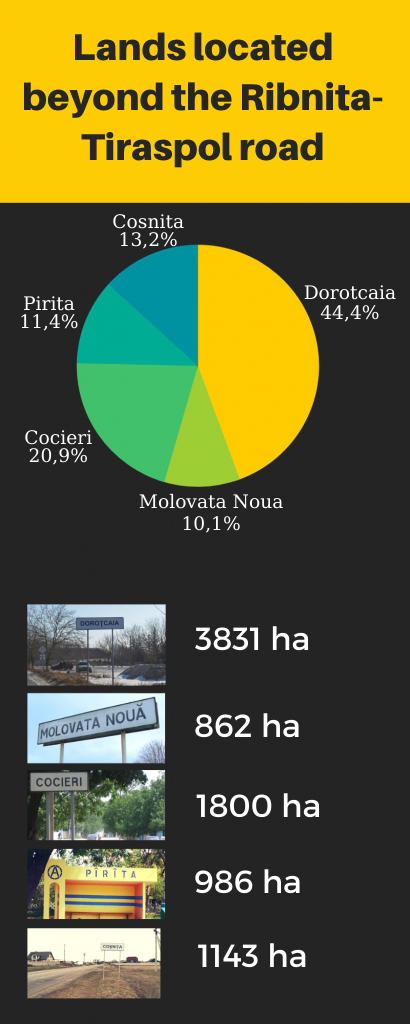
According to Sergiu Guvir, the villages Molovata Noua, Dorotcaia, Cocieri, Parata and Cosnita from Dubasari district have 6,496 ha of land that are located beyond the Ribnita-Dubasari-Tirspol road. These lands are owned by the inhabitants of the above-mentioned villages and are currently leased by 40 business entities, said Sergiu Guvir.
Asked to comment the measures applied by the Tiraspol regime to ‘fight’ the coronavirus pandemic, the Minister of Agriculture, Regional Development and Environment, emphasised that ‘there are no restrictions for performing the spring agricultural works provided that the imposed sanitary rules are observed’.
The head of the Division for Reintegration Policies under the Bureau for Reintegration Policies, Aurelia Barbaros, told us that Moldovan officials ‘take all the necessary efforts’ in order to unblock the farmers’ access to their lands.
The issue related to the agricultural lands located east of the national road Tiraspol-Dubasati-Ribnita emerged in 1998. At that time, the secessionist administration from Tiraspol installed posts on the Tiraspol-Ribnita road. In 2004, the secessionist regime from Tiraspol prohibited the access of more than 5,000 owners to 8,600 ha of land.
HOW THE PROBLEM OF LANDS EMERGED
The land located east of that road comprises the lands of Dubasari district inhabitants and the lands owned by state. It is about forest buffers, parts of lakes etc.
As a result, the lands were not farmed and the agricultural associations incurred huge losses. Moreover, certain enterprises went bankrupt, but small individual households were the most affected.
About 1,400 landowners were affected only in Dorotcaia village. This village faced the most serious problem because about 92% of its agricultural lands are located east of the road Ribnita-Tiraspol, which is controlled by the separatist administration from Tiraspol.
In 2006, the crisis of lands was solved through a palliative following the pressures of international bodies. The farmers signed three-year contracts with Dubasari district administration controlled by Tiraspol on the basis of which they were allowed to farm their lands.
Beginning with 2009, when the contracts expired, the farmers did not have access to their lands until two years ago.
THE IDENTIFIED SOLUTION IS AGAINST THE CONSTITUTIONAL RIGHTS
Moldovan authorities covered some of the losses provoked by this uncertainty. For example, the Government of the Republic of Moldova offered MDL 1,229 per ha to each owner of agricultural land in this area.
In August 2018, following the negotiations between the RM Government and the Tiraspol regime, the mechanism established in 2006 was reactivated. This time, the administration of Dubasari district, controlled by Tiraspol, offered certificates valid for 20 years to 40 business entities that were to farm the land rented from the locals.
But this solutions is against the national law. Although the constitutional authorities of Chisinau recognised the property rights of the inhabitants of Dubasari district over the lands, the peasants are forced to accept the certificates imposed by the secessionist regime of Tiraspol.
Note that the separatist regime of Tiraspol considers that those nine villages that are still under the jurisdiction of Chisinau are ‘territories temporary under the occupation of the Republic of Moldova’. This statement is propagated with intensity by the local TV and radio channels, including during the crisis.
Ion Manole, the Executive Director of Promo-LEX Association, organisation that provides legal aid to landowners from this area, stated that the Tiraspol authorities take systemic measures to worsen the situation of the inhabitants of Dubasari district.
‘Tiraspol does not give up this theory and tries to apply the method of carrot and stick. On the one hand, it attracts the inhabitants with certain facilities, on the other hand, it creates conditions to intimidate them.’
When speaking about the situation around these plots of land, the former member of the Joint Control Commission, ISS Colonel Ion Leahu, mentioned that Tiraspol regards the Camenca-Tiraspol road section as a border.
‘Farmers were affected by the measures aimed to combat the coronavirus pandemic. I believe that Tiraspol will allow the farmers to farm their land because now it is the time when investments are made. Based on previous years’ experience, Tiraspol could ban the harvesting so that people who are close to the separatist regime could take over the crops.
ECHR JUDGEMENTS IN CASE OF LANDOWNERS FROM DUBASARI DISTRICT
As regards this legal dispute, the European Court of Human Rights (ECHR) issued in July 2018 the first judgement – case ‘Sandu and others v Moldova and Russia’, in favour of those 1,646 owners of agricultural lands and of those three agricultural businesses.
ECHR obliged Russia to pay EUR 1,500 to each farmer and EUR 5,000 to agricultural businesses as non-pecuniary damages. At the same time, ECHR ordered the Russian Government to pay EUR 245,800 as pecuniary damages to those three agricultural businesses. Moreover, Russia has to pay EUR 20,000 for representation expenses. The Russian authorities have to pay a total of EUR 2,749,800. In February 2020, ECHR issued a judgement in another case that involved farmers from Dubasari district – ‘Oprea and others v Moldova and Russia’.
The High Court found that Russia was responsible for violating the right of ownership and the right to use the lands. As stated by Promo-LEX in a press release, ECHR ordered to collect EUR 63,000 in favour of those 42 applicants for the as non-pecuniary damage and other EUR 4,000 for representation expenses and costs.
 According to Ion Manole, Russia did not pay a single penny to these people. Actually, it did not pay damages for any legal disputes concerning violations on the left bank of Nistru River, except for the Pisari case.
‘For us, lawyers and human rights defenders, representatives of victims of abuses and human rights violations from the Transnistrian region of the Republic of Moldova, it is important to have the possibility to monitor the situation on the site without any obstacles, as well as efficient tools to defend them when abuses and violations are found. The fundamental human rights cannot be negotiated, they should be promoted, guaranteed and defended.’
This article is developed under the ‘Strengthening the Observance of Human Rights in the Transnistrian Region’ Project, implemented by Promo-LEX Association with the financial support of the National Endowment for Democracy.