Promo-LEX submitted the Report No 3 of the Election Observation Mission for the 20 October Elections

Promo-LEX Association released today the third report from the Observation Mission (OM) regarding the presidential elections and the constitutional republican referendum scheduled for 20 October. This report includes insights gathered between 18 September and 1 October. The report mainly highlights the commencement of the electoral campaign, the legal framework pertinent to this process, the performance of the electoral competitors, and the efforts of the electoral bodies in preparation for the elections on 20 October.

Legal Framework. Promo-LEX OM highlights the lack of a clear legal framework concerning the consolidation of elections, the unique aspects of running electoral campaigns for two simultaneous elections, and the participation of unregistered entities in the campaign for one of these elections. As a result, independent candidates in the presidential elections and initiative groups find themselves at a disadvantage, as the legislation does not provide them with the same rights as political parties or electoral blocs that are registered as competitors in both elections.

Furthermore, while legal regulations have been established to penalize the involvement of religious denominations in the electoral campaign, instances of electoral agitation by their representatives have also been noted in this election. In 2016, the Constitutional Court made it clear that the participation of religious denominations in elections constitutes a violation of the Constitution.

Promo-LEX OM advises representatives of religious denominations to refrain from participating in electoral agitation activities. Additionally, the Police should thoroughly investigate and penalize instances of involvement by religious denominations in such activities.

Electoral Bodies and Public Administration During the monitoring period, the Central Electoral Commission (CEC) made 106 decisions and accredited a total of 527 observers, including 425 national and 102 international observers. At the local level, the district electoral councils (DECs) operated effectively, although there were a few exceptions. Changes to the nominal composition of members were made in three DECs, and several instances of intimidation directed at DEC officials were reported.

A specific issue arose within DEC no. 38, which was responsible for only two of the five electoral bureaus for polling stations established by CEC in the Russian Federation. Note that CEC is the sole authority that can determine the number of polling stations set up abroad in coordination with the Ministry of Foreign Affairs (MFA). Promo-LEX OM emphasizes that MFA and DEC no. 38 must adhere to legal requirements and CEC decisions to ensure timely organization of elections abroad.

Electoral Litigation. The section on electoral litigation outlines the complaints lodged with the Central Electoral Commission (CEC) and district electoral councils (DECs) concerning legal violations, including the misuse of administrative resources, donations, the involvement of minors in the campaign, and inappropriate electoral agitation. CEC adhered to the established deadlines for addressing these complaints.

A total of eight lawsuits were filed in court, addressing issues such as the exclusion of political parties from the list of eligible candidates, the establishment of polling stations, and refusals to register individuals as trusted representatives. These cases were adjudicated by the courts within a timeframe of 2 to 10 days, although the legal deadline was exceeded in two instances.

Designation and Registration of Electoral Competitors After verifying signatures, 11 candidates were registered, of whom five were independent, five supported by parties, and one by an electoral bloc. Igor Munteanu was rejected due to the lack of valid signatures. Overall, 14% of the signatures were invalidated, a lower percentage compared to the previous election. Compared to the 2020 presidential election, the total number of candidates increased, and the proportion of female candidates reached 36%.

In the constitutional referendum, 15 participants were registered, most supporting the “YES” option.  Three requests for registration as a participant were rejected on procedural grounds.

Performance of Electoral Competitors In the first ten days of the campaign, Promo-LEX observed at least 792 promotional activities by electoral competitors and for the constitutional referendum. Most of these activities were organized by PAS and Maia Sandu, followed by Alexandr Stoianoglo (PSRM) and Renato Usatîi. Chisinau hosted the highest number of events, accounting for 16%, followed by Balti and other regions. RP/PB Victory organized electoral meetings through private channels and encouraged anti-referendum and anti-EU protests by compensating participants.

Electoral advertising was identified in at least 1,404 instances, with the predominant formats being visibility materials and printed informational brochures. PAS and Maia Sandu led in the use of electoral advertising as well. Additionally, 32 instances of administrative resource abuse were reported, primarily targeting PAS and Maia Sandu (PAS). Other issues included the organized transportation of voters to electoral events, the involvement of religious groups, and acts of voter bribery.

During the monitoring period, reports emerged of goods and food being offered in exchange for voter attendance at electoral events, specifically targeting PB Victory.

Allegations of intimidation against competitors were also noted. Two representatives from PCRM were apprehended while handing out flyers advocating for the “NO” option in the referendum, which were confiscated without adequate explanations. Additionally, candidate Irina Vlah was denied access to a campaign venue by law enforcement officials.

Election and Campaign Financing. The candidates for presidential elections reported a total revenue of nearly 13 million lei during 20 and 30 September 2024, with the majority coming from political party funds. Maia Sandu, Alexandr Stoianoglo, and Renato Usatîi accounted for 89% of the total revenues reported. For the referendum, only PAS disclosed revenues, which were sourced from state budget allocations and donations.

Total reported expenditures surpassed 8.3 million lei, with 90% attributed to three candidates: Maia Sandu, Renato Usatîi, and Alexandr Stoianoglo. The largest expenses were mainly for promotional materials, as well as the production and airing of advertising spots. For the referendum, PAS reported expenditures exceeding 1.2 million lei, primarily for promotional materials and the organization of electoral activities.

Civic monitoring conducted by Promo-LEX identified inconsistencies between the estimated and declared expenses of electoral competitors. Observers calculated costs for various activities, including volunteer compensation, promotional materials, and online advertising, based on minimum market prices.

In the presidential campaign, undeclared expenses were estimated to exceed 2.2 million lei, with the majority (88%) allocated to promotional materials. Additionally, discrepancies were noted regarding the compensation of agitators, event organization, and transportation. Candidates with the highest undeclared expenses were Alexandr Stoianoglo (PSRM), Vasile Tarlev (FMP), and Irina Vlah (IC).

In the context of the constitutional referendum, undeclared expenses reached over 1.1 million lei. These expenses primarily targeted promotional materials (50%), social media advertising (23%), and other related costs. The participants in the referendum for whom these expenses were assessed included RP/PB Victory, PCRM, PAS, and MAN.

Hate Speech and Incitement to Discrimination. Between 9 and 22 September 2024, at least 14 instances of hate speech were documented, with the majority occurring in political and electoral contexts. Among these, six cases were directly linked to the elections, garnering over 134,000 views and 368 shares. Discriminatory incidents were also noted, including negative associations made between politicians and mental health issues, as well as sexist and homophobic messages.

The Observation Mission is financially supported by the United States Agency for International Development (USAID), the European Union, the German Marshall Fund of the United States, the Government of the United Kingdom, the International Organization of La Francophonie, and the Soros Foundation Moldova. This mission is conducted under the auspices of the Civic Coalition for Free and Fair Elections.


ДОКЛАД № 2 | МИССИЯ ПО НАБЛЮДЕНИЮ: ПРЕЗИДЕНТСКИЕ ВЫБОРЫ И КОНСТИТУЦИОННЫЙ РЕСПУБЛИКАНСКИЙ РЕФЕРЕНДУМ 20 ОКТЯБРЯ 2024 Г.


Promo-LEX released the second report of the Observation Mission for the election on 20 October

The Promo-LEX Observation Mission for the Presidential Elections and the Republican Constitutional Referendum released today its second monitoring report covering the period 20 August – 17 September.

The report mainly reflects the process of nominating and registering electoral competitors, the legal framework relevant to this process, the performance of electoral competitors, as well as the work of electoral bodies in preparation for the presidential elections and the referendum on October 20.

Legal framework. The Observation Mission (OM) report highlighted an important aspect related to the participation of the incumbent President in the 20 October election. The Constitutional Court had previously emphasized that the President must be apolitical, and the nomination of Maia Sandu by PAS raised questions about her neutrality. Given the impossibility of suspending the incumbent President from office for the period of the electoral campaign, Promo-LEX OM recommends that the President should refrain from participating in official public events that could be perceived as electoral campaigning activities and should minimize the use of administrative resources during the electoral campaign.

Promo-LEX OM also raised concerns over the refusal of the Central Electoral Commission (CEC) to register some initiative groups, citing reasons such as political affiliation of candidates. Although CEC claims that political independence is a prerequisite for running as an independent candidate, the legislation does not expressly regulate such a ground for refusing registration of initiative groups. Promo-LEX recommends clarifying these issues in order to ensure transparency and predictability of the electoral process.

Electoral bodies. The electoral councils were set up within the deadline provided for by the legislation. For the majority of councils (95%), 11 members were appointed. The gender equality is uneven, with the majority of members being women (71%). According to the findings, only 17 out of 37 councils are accessible to people from vulnerable groups. Moreover, three councils (ECEC no. 36 ATUG, no. 37 – for localities on the left bank of the Dniester and no. 38 – for polling stations constituted abroad) did not have adequate premises for carrying out their activities one week after their establishment.

In total, 2,221 polling stations were set up for the autumn election, including 30 polling stations for voters from the left bank of the Dniester and 234 polling stations for voters from abroad set up by CEC in accordance with the provisions of the Electoral Code. Promo-LEX OM observers found that most polling stations (81%) were located in houses of culture and educational institutions, including pre-schools.

The organisation of polling stations abroad was carried out according to a legal framework established by the Electoral Code and CEC regulations. The main criterion for establishing polling stations is voter turnout in the last three elections, with other complementary criteria such as pre-registration and information provided by the Ministry of Foreign Affairs. A novelty in the electoral legislation for diaspora voting is the introduction of postal voting, with 1,994 citizens registered for this type of voting. CEC approved three polling stations for postal voting.

Promo-LEX has noted some differences between its estimates for the distribution of polling stations abroad and those established by CEC, in particular for Italy and the UK.

As regards the organisation of polling stations for the left bank of the Dniester, even if the number of polling stations has been reduced from 41 (2021) to 30, we believe that access to voting will generally not be affected. One issue remains the freedom to vote, as previous observation experience has shown that one of the main challenges is to counter and sanction organized transportation of voters, as well as possible cases of corruption.

Electoral disputes. During the observation period, Promo-LEX noted that at least eight complaints were submitted to the CEC, most of which were declared inadmissible. A number of complaints concerned allegations of use of administrative resources, electoral campaigning and others. Promo-LEX warns that it is necessary that the resolution of complaints should be carried out within the deadline stipulated by the Electoral Code (3 days, with the possibility of extension by 2 days) and that the complainants should be informed about the remedies available.

During the monitored period, four complaints were filed in court against CEC decisions. Three of them were rejected and in one case the court obliged CEC to issue a reasoned decision.

Nomination and registration of electoral competitors. Between 21-31 August 2024, the Central Electoral Commission received 23 applications for the registration of initiative groups (IGs) in support of 19 presidential candidates, of which 13 were accepted. Three applications were rejected and two did not receive the required number of votes.

Out of the 13 IGs to which subscription lists were issued, 9 candidates submitted their subscription lists and registration files to the CEC, out of which 4 were registered as electoral competitors. CEC received 14 applications for registration as participants in the Constitutional Referendum, registering 10 participants, out of which 8 chose YES and 2 NO.

Performance of electoral competitors. Promo-LEX observed that 12 out of 13 registered IGs carried out 475 activities to collect signatures in support of presidential candidates, with the highest activity in the case of Ion Chicu (PDCM), Renato Usatii (NP (OP)) and Maia Sandu (PAS) – who cumulatively carried out 71% of the total observed activities. No signature collection activities were observed for IG Victoria Furtună (IC).

The activities took place predominantly in Chisinau, but also in other cities (Balti, Dondușeni, Ialoveni, Causeni), and the collection period ranged from 3 to 24 days. Promo-LEX observers found that in the case of at least three candidates, signatures were collected by unauthorized persons.

In the context of the constitutional referendum, the electoral campaign seems to have started ahead of schedule, in violation of the legal provisions, with multiple promotional activities with electoral overtones, including sponsored postings and distribution of information materials. Moreover, violations were identified, such as the lack of complete information on advertising materials.

Misuse of administrative resources. Promo-LEX identified 13 cases of misuse of administrative resources by various political groups and local authorities. Among them, PAS was targeted in 8 cases related to signature collection and EU promotion, BE Împreună (EB Together) and BP Victorie (PB Victory) were involved in using educational resources and organising events serving political purposes, as well as presenting donations as being made by the party. PDCM and LPA were also cited for misuse of administrative resources in the process of collecting signatures and promoting political speeches, respectively.

Activities with voter corruption potential. During the monitored period, activities with voter corruption potential involving PB Victory and PVM (Party for Moldova’s Future) were observed. PB Victory distributed school bags and school supplies to students from socially vulnerable families and provided wheelchairs to some individuals, with reported cases of promises of money against signatures. The PVM was also involved in collecting signatures through unauthorized persons who were allegedly paid for these services.

Election and electoral campaign financing. Most of the IGs have appointed treasurers and reported the opening of the „Electoral Fund” accounts, with the exception of IGs Alexandru Arseni (IC) and Alexandr Stoianoglo (PSRM). Some IGs encountered difficulties in opening accounts thus affecting their activity. In terms of financial reporting, most of the IGs submitted information on financing, albeit with some errors, meeting deadlines. However, irregularities were found in the reporting of expenses. 12 out of 13 registered IGs reported revenues totalling 2,009,727 MDL, of which 292,076 MDL – from material donations (15% of total declared revenues).

For the signature collection activities carried out by 11 IGs, Promo-LEX estimated unreported expenses of at least 580,321 MDL. The highest unreported expenses were in the case of IG Irina Vlah (IC) – 43%, followed by IG Maia Sandu (PAS) – 23%. The most frequent unreported expenses were for promotional materials (52%).

Hate speech. Between 20 August and 8 September 2024, at least 40 cases of hate speech and other expressions of intolerance were identified. Most cases were spread via social media (19 cases) and mobile apps (10 cases). Most often, hate speech was based on political affiliation (12 cases), sexual orientation/gender identity (8 cases) and sex/gender (6 cases).

All 40 cases of hate speech had over 3 million views and more than 23 thousand shares.

As a reminder, Promo-LEX Association launched on 20 August the Observation Mission for the Presidential Elections and Constitutional Referendum. The observation will cover the whole electoral period, including election day and, if necessary, the second round.

Report no. 2 of the Observation Mission can be accessed here.

The Observation Mission is financially supported by the United States Agency for International Development (USAID), the European Union and the German Marshall Fund of the USA, the Government of the United Kingdom of Great Britain and Northern Ireland, the International Organization of Francophonie, and Soros Foundation Moldova. The Observation Mission is carried out under the aegis of the Civic Coalition for Free and Fair Elections.


REPORT NO.1| Observation Mission: presidential elections and republican constitutional referendum October 20, 2024


Promo-LEX Association has launched the Observation Mission for the election of 20 October 2024

Promo-LEX Association has launched the Observation Mission for the presidential election and constitutional referendum of 20 October 2024. The observation will cover the entire election period, including election day and, if necessary, the second round of voting.

The core team of the Mission and 45 long-term observers (LTOs), together with about 740 short-term observers (STOs), will monitor the election at national level, acting as static observers in 600 polling stations, as well as in 70 mobile teams that will visit all other polling stations during the election day. In addition, all polling stations open to voters from the Transnistrian region will be covered with static observers, and at international level observation will be carried out in over 50 polling stations. Promo-LEX will also monitor hate speech and discrimination through seven monitors.

The Promo-LEX Observation Mission will monitor the observance of democratic principles and the national legal framework in the work of electoral bodies, registration of electoral competitors and electoral campaigning, financing of the electoral campaign, and other relevant aspects. On election day, Promo-LEX observers will supervise the opening and closing of polling stations, the voting process, the accessibility of premises, and the summing up of results. Likewise, they will carry out rapid counting of votes. Four interim reports will be presented (five in the event of a second round), and one final report, as well as press releases on election day.

In the context of the launch of the Observation Mission, Promo-LEX presented its first report, which analyzes the social and political background, legal framework, preparations for the presidential election and the constitutional referendum of 20 October, as well as other issues characteristic to the pre-election period.

Background to the election of 20 October 2024. The presidential election and the constitutional referendum this autumn will take place in a context marked, from the point of view of domestic politics, by a comfortable parliamentary and governmental stability for the Action and Solidarity Party (PAS), but also by a complicated relationship with the opposition, both in the Parliament and outside it.

A total of 64 parties have the right to participate in these voting events, and so far, at least 17 potential competitors have shown intention to participate in the presidential race and/or in the referendum. The competitiveness of this election is underpinned by both its dual nature and the 2025 parliamentary elections, seen as a major political opportunity.

The integrity of democratic processes in the Republic of Moldova is further challenged by the problem of illegal financing of political and electoral processes. It has long exceeded the limits of an internal political competition and has become, rather, a manifestation of the hybrid war of the Russian Federation against the Republic of Moldova. Although Ilan Shor’s party was declared unconstitutional in 2023, political activity continues through the political bloc “Victorie-Победа” [Victory], significant funds being allocated for its promotion.

Voting this autumn will also have very strong geopolitical valences. The geopolitical insecurity generated by the war of the Russian Federation against Ukraine has determined the acceleration of European integration processes, Moldova having managed to open EU accession negotiations in 2023. Against this background, the question asked at the referendum and the presidential election will once again test the West-East geopolitical division in society, with potential effects not only on the Constitution, but also on the social and political life in Moldova and even in the region.

Legal framework. This year’s election is being held under the new Election Code, in force since January 2023, which had been amended several times up to a year before the election. Some of these changes were technical in nature, while others were more significant.

The legislature removed the ban from holding presidential or parliamentary elections along with a constitutional referendum. Promo-LEX criticized this change on the grounds that it could affect the equal opportunities of competitors and the voters’ freedom to form opinions.

In April 2024, the Parliament adopted the law on partial implementation of postal voting. Promo-LEX welcomed the introduction of this alternative method of voting, but also expressed some reservations, especially regarding the decision-making process and the lack of a broad political consensus on this issue.

Related legislation has also been amended. The law on political parties was supplemented with provisions designed to clarify some procedures and legal effects of limiting the activity of political parties. In addition, the amounts of fines for violations admitted in the electoral process and the sanctions for passive electoral corruption were amended in the Contravention Code.

Electoral bodies. The Central Electoral Commission is the authority responsible for organizing and conducting national elections. It adopted and amended several regulatory acts relevant to the election of 20 October 2024, approved the decision on the calendar program and at least 20 other decisions on the organization and conduct of elections.

The CEC’s activity is generally transparent, all meetings being public and broadcast on online platforms. The Commission also conducts various information campaigns for voters. However, the Promo-LEX OM also found some deficiencies related to the publication of information about the adopted draft regulatory acts and decision-making transparency on the institution’s website.

Nomination of candidates and actions with electoral tint. Candidates for presidential election can be officially nominated starting 60 days before the election and up to 30 days before the vote. So, tomorrow, 21 August, the process of nominating presidential candidates officially begins. So far, several candidates have expressed their intention to participate. Promo-LEX emphasizes that this is not a violation, but the electoral promotion of potential candidates before the start of the official campaign can affect the principle of equality of competitors.

Promo-LEX noted that at least eight potential candidates carry out promotional activities, such as setting up tents, distributing fliers, placing sponsored posts in social media, or organizing events. In connection with the constitutional referendum, campaigns for and against were observed, with activities that can influence the vote.

The Promo-LEX Observation Mission found two projects with potential for electoral corruption, coordinated by Ilan Shor, which, through their impact, can affect voters’ freedom to form their opinion in the election. One of them is the initiative to pay allowances of 2,000 MDL through the Russian bank Promsvyazbank to pensioners from certain regions of the country. The other project, GagauziyaLand, was opened on 18 August, with the promise that the entrance and all attractions for children and adults would be free.

Use of administrative resources. During the election period, the use of administrative resources by candidates is prohibited. Although the Venice Commission’s Code of Good Practice on Referendums allows the state to express its opinion for or against the text put to the vote, it still has the obligation to maintain its neutrality and, in particular, not to use public money to promote its opinion.

Between 8 July 2024 and 18 August 2024, the Government of Moldova conducted the information campaign “Europe for You”. The Promo-LEX Observation Mission found that this campaign was planned and promoted from public money after the announcement of the election date, being implemented also during the election period, which can be interpreted as having the purpose of attracting political capital in support of the referendum. In this context, Promo-LEX reiterates the recommendation that such practices should be banned even outside the election period.

Finally, the Promo-LEX report underlines the importance of competitive and transparent elections in Moldova. The association aims to inform the public and authorities about observed trends and to help prevent violations of electoral legislation.

Report no. 1 of the Observation Mission can be accessed here.

The Observation Mission is financially supported by the United States Agency for International Development (USAID), the European Union and the German Marshall Fund of the USA, the Government of the United Kingdom of Great Britain and Northern Ireland, the International Organization of Francophonie, and Soros Foundation Moldova. The Observation Mission is carried out under the aegis of the Civic Coalition for Free and Fair Elections.
Responsibility for the opinions expressed in this report lies with the Promo-LEX Association and does not necessarily reflect the position of the donors. In case of discrepancies between the text in Romanian and its translation into another language, the Romanian version of the report will prevail.

For further information please contact:

Dumitrița Ciuvaga
Communications Manager
Promo-LEX Association
Tel.: +373 68 800 827


SUMMARY REPORT: Implementation of the Central Electoral Commission and Center for Continuous Electoral Training Strategic Plans


Assessment findings on the implementation of CEC and CICDE’s strategic plans

Today, 11 July 2024, Promo-LEX presented its report entitled “Implementation of Strategic Plans of the Central Electoral Commission and the Centre for Continuous Electoral Training” (Annual assessment: 2023 and Summing-up report: 2020 – 2023). The report presents an analysis of the development priorities and activities scheduled by CEC and CICDE for the monitored period.

CEC and CICDE’s 2023 achievements

In 2023 CEC committed to achieve 44 tasks related to 20 strategic activities. According to the Promo-LEX assessment, the electoral authority managed to achieve only 36% (16 out of 44) of all planned tasks, while 34% (15 out of 44) were partially achieved and 30% (13 out of 44) remained unachieved. The main achievements include amended regulatory framework, funding supervision and control for political parties and pre-election campaigns, renewed technical equipment to be used by electoral bodies, and election-related training of judges, prosecutors and journalists. However, CEC was challenged by publishing data on the funding of political parties and pre-election campaigns, the functioning of the financial control system and the creation of a voter profile.

As for CICDE, in 2023 the institution committed to achieve 40 tasks related to 16 strategic activities. Promo-LEX estimated that CICDE achieved 88% (35 out of 40) of all planned tasks, while 7% (3 out of 40) were partially achieved and 5% (2 out of 40) remained unachieved. CICDE’s main achievements include diversified partnerships and attracted external funds, as well as promotion of electoral education in schools and universities. However, CICDE had some challenges in having the training courses accredited and retaining experienced trainers.

Degree of CEC and CICDE’s entire strategic plan implementation (2020-2023)

In 2020-2023, CEC obtained the following results: 42% (39 out of 94) of all planned tasks were achieved, while 36% (34 out of 94) were partially achieved and 22% (21 out of 94) remained unachieved. CEC’s main achievements included optimized work processes and established sanctions for violating party funding rules. During the same period, CICDE achieved 91% (62 out of 68) of all planned tasks, while 8% (5 out of 68) were partially achieved and 1% (1 out of 68) remained unachieved. CICDE’s main achievements included electoral education integrated in schools and universities and an improved remote learning platform.

“As for CEC’s activity, certain challenges were identified that prevented the implementation of the Strategic Plan. Here we should mention that the elections were organized and carried out under new provisions, companies were identified that could develop software applications, and the implementation of some activities within the Strategic Plan was not within the institution’s competence. CEC’s results are moderate, despite the considerable effort that has been made. Thus, 44% of the tasks were taken and included in the new Strategic Plan 2024-2027. CICDE also faced certain challenges, among them the amended electoral legislation and the limited availability of experienced trainers. CICDE obtained very good results, having achieved 91% of the proposed tasks”, stated Mariana Dobrovolschi, electoral analyst, Promo-LEX.

Recommendations

Having monitored how CEC and CICDE’s 2020-2023 activities were implemented, Promo-LEX Association formulated several recommendations, such as:

  • Include major activities of strategic value in Strategic Plans;
  • Monitor on a regular basis the implementation of activities and assess the results achieved;
  • Adjust annual Strategic Plans;
  • Maintain constant collaboration with public authorities, civil society organizations and development partners;
  • Continue efforts to accomplish unachieved and partially achieved tasks.

“This report concludes the effort to monitor the Strategic Plans of the Central Electoral Commission and the Centre for Continuous Electoral Training for 2020-2023. The Central Election Commission and the Centre for Continuous Electoral Training have already approved strategic programs for the next period of 2024-2027. In this regard as well, our recommendations focus on the way to formulate tasks, objectives, activities and indicators, as well as on the way to implement them”, said Mihaela Duca-Anghelici, head of the analysis and research team, Promo-LEX.

The report “Implementation of Strategic Plans of the Central Electoral Commission and the Centre for Continuous Electoral Training” (Annual assessment: 2023 and Summing-up report: 2020 – 2023) can be accessed here.

The report “Implementation of Strategic Plans of the Central Electoral Commission and the Centre for Continuous Electoral Training” (Annual assessment: 2023 and Summing-up report: 2020 – 2023) was prepared within the “Democracy, Transparency and Accountability” program funded by the United States Agency for International Development (USAID). Promo-LEX Association has been monitoring the activity of CEC and CICDE since 2016 to strengthen the authorities’ accountability towards citizens and ensure fair, representative and competitive elections. The opinions expressed in the monitoring report belong to the authors and do not necessarily reflect the views of the funders.


For further information please contact:

Dumitrița Ciuvaga
Communications Manager
Promo-LEX Association
Tel.: +373 68 800 827


SUMMARY REPORT: Financing of political parties in the Republic of Moldova. 2023 Retrospective


Political party funding in Moldova. Retrospective 2023: Growing dependence on state budget appropriations and unreported expenditures

Today, Promo-LEX presented its report on “Political party funding in Moldova. Retrospective 2023”. The document contains civic monitoring findings on the funding of political parties through the lens of their 2023 activities. The event brought together representatives of state institutions, such as the Parliament, CEC, the State Tax Service, the National Anti-corruption Centre, the Constitutional Court and the Court of Accounts, representatives of political parties and CSOs, as well as development partners.

According to the report, 2023 was marked by the entry into force of new legal provisions pertaining to political party funding. The most important changes concerned the prohibition for political parties to organize charitable (philanthropic) or sponsorship activities; the lowering of the cash donations ceiling to one average salary per economy; and the elimination of the limit of 3 average salaries per economy for donations made by citizens with income earned abroad, etc.

For the first time in Moldova, a political party has been outlawed after the Constitutional Court declared the Shor party unconstitutional, which led to its removal from the state register of political parties.

The monitoring revealed that the resources and efforts of investigative authorities have been activated in an unprecedented manner for Moldova to check the financing of political parties and preelection campaigns. Thus, a number of criminal cases were started against political parties for submitting fake financial reports, as well as for knowingly accepting funding from an organized crime group.

Political party income reporting

Promo-LEX found that the SSI “Control Financiar” information system, which is the main tool used for financial reporting, had operated with faults. This had a negative impact on the submission of financial reports, in the prescribed timelines and format, both for first quarter and annual reporting.

For 2023, 75% political parties submitted annual financial reports. Respectively, 92% submitted reports for the first quarter and 87% – for the second quarter. The reporting deadlines are July 15 for the first quarter, January 15 for the second quarter and March 31 for annual reports.

In the reporting period, only 34 out of the 61 registered political parties reported revenues totaling MDL 54.9 million. Another 22 parties reported “zero” income. The highest revenues were reported by PAS (41%), PSRM (18%), PSDE (9%), PCRM (7%), PN and PPPDA (6% each).

Once again, we found an increase in political party dependence on public funding sources – 84%, which is 2 p.p. more than in 2022. Income originating from state budget appropriations was reported by 23 political parties, totaling MDL 45.7 million. The largest share went to PAS (41%), PSRM (22%), PSDE (11%), PN and PPPDA (7% each). In the case of 10 parties, this was the only source of income. For comparison, in the European Union, the ratio of public and private sources in party revenues is 65% to 35% (in the newer democracies in Eastern Europe) and 55% to 45% (in consolidated democracies).

“The Republic of Moldova has far exceeded the EU average. This is a worrying trend in a context where most political parties seem to make no effort to attract financial support from citizens. We believe that political parties need to work more to involve and politically empower citizens, which will also help diversify the sources of funding for party activities. In this regard, the possibility should be considered to revise how state budget funds are provided depending on the amount of income obtained by parties from private sources”, said Mariana Focșa, finance analyst, Promo-LEX.

Income obtained from financial donations was reported by 18 parties, totaling MDL 4.8 million. According to the declared sources of income, 90% donations originated from salaries, 5% – from pensions, 3% – from unemployed people, and 1% – from scholarships and social benefits. In this context, only 19% of the total donations made by individuals exceeded the amount of 3 average monthly salaries per economy, to be verified by CEC.

Promo-LEX estimations of unreported expenditures by political parties

Promo-LEX identified several categories of expenditures in which the Association’s estimates are different – in some cases significantly – from the information reported to CEC. As a reminder, in the civic monitoring process, Promo-LEX estimates the parties’ expenditures on political promotion activities and compares them to those reported to CEC.

In 2023, the Association observed more than 2,500 political promotion activities organized by 24 parties, as well as 38 political activities carried out by the ex-PSPS/Ilan Shor’s Team. These included the distribution of political information materials, parties’ statutory activities and national travels. Most were reported for PAS, PSRM, ex-PPȘ/Ilan Shor’s Team and PR and CUB.

Thus, Promo-LEX estimated unreported expenditures of at least MDL 20.3 million by 24 parties and the formation lacking a legal status, ex-PPȘ/Ilan Shor’s Team. Of these, almost MDL 17 million (82%) were estimated for the ex-PPȘ and its affiliates – ȘANSĂ and PR. Most estimated expenses were made for political promotion events (46%), press and promotional materials (20%) and the renting/maintenance of premises (18%).

During the event, Promo-LEX made several recommendations to state institutions and political parties.

“A specific recommendation to the Parliament concerns the retrospective legal and impact assessment of the new legal framework relevant to the funding of political parties and preelection campaigns. Our advice is to regulate political and electoral funding by third parties. The Central Electoral Commission is advised to systematically publish information on started proceedings as a result of its political party funding supervision and control activities with a view to increasing transparency, as well as to extend the criteria for checking donations made to political parties beyond those exceeding 3 average salaries per economy”, said Mihaela Duca-Angelici, head of the analysis and research team, Promo-LEX.

The report on “Political party funding in Moldova: Retrospective 2023” is available here.

During 26 July 2016 – 31 March 2025, Promo-LEX Association is implementing the Democracy, Transparency and Accountability program funded by the United States Agency for International Development (USAID). As part of this project, the Association aims to monitor the funding of political parties, in particular, by observing and estimating the costs of their activities, as well as party finances as reported to CEC as the mandated authority.


For additional information please contact:

Dumitrița Ciuvaga
Communicator
Promo-LEX
Tel: +373 68 800 827


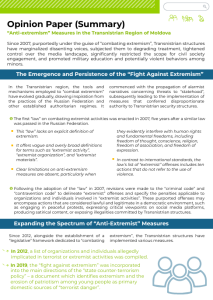
Opinion Paper / “Anti-extremism” Measures in the Transnistrian Region of Moldova (summary)