Dubasari farmers could be forced to pay illegal land taxes – Promo-LEX lawyer Pavel Postica

How did the situation regarding the right to freedom of movement in Transnistria change after the publication of Promo-LEX’s 2008 report, which outlined the impediments to exercising this fundamental human right?

On 25 July 2008, Promo-LEX published a study on the right to the freedom of movement in the eastern region of the Republic of Moldova, in which we intended to express our opinion about the multiple problems facing the population in the Transnistrian region in what concerns the exercise of this right. We have constantly tried to bring these problems to the attention of the competent authorities and solve them, and also to raise public awareness, through mass media, press releases, interviews, etc. But today we find with regret that the situation has not changed significantly and that the problems identified in that study mostly remain to this day. The greatest part of the blame for the failure to solve these problems, we can say, should be on the constitutional authorities, because many problems are generated by the shortcomings of the legal framework existing in Moldova.

What are the areas that are most affected by these problems?

Well, the right to freedom of movement cannot be examined separately, as it is connected to many other rights guaranteed by the national legislation and international treaties. It also has to be mentioned that the exercise of this right has four components; the free movement of persons, of goods, of services, and of capital. It would not be correct to try to compare the problems in these areas, and say that the hurdles are bigger here and smaller there. It is obvious that such a comparison would be subjective. However, today, in times of economic crisis, particular attention is paid to social safeguards and, from this perspective, it would be fair to say that the problems relating to the payment of age pensions and the problem of indexed savings are affecting quite a large part of the population in the Transnistrian region. Also, the issuing of identity documents for persons born in the region after the conflict raises rather serious concerns, and the consequences of this process are difficult to predict.

Which Moldovan laws are, in your opinion, discriminatory against the people who live on the eastern bank of the Nistru?

We have already mentioned the problems concerning the payment of age pensions, the indexation of savings, and the recognition of civil status documents. I’d also add here the problem faced by individuals when passing goods through internal customs checkpoints. For example, one person goes to Chisinau for shopping in search of bargains, and then returns to his place in Balti; no problems here, no matter how much that person paid for the goods. But when it comes to crossing the so-called administrative border that separates the territory controlled by the legitimate authorities and the Transnistrian region, one would be faced with a host of problems, and that is true both for those who reside in the nearby communities and for those who don’t. Whereas for the first category, after the publication of our study, amendments were made to enable those people to transit goods under 200 euros without paying any duty, the situation for the others remains unchanged and they have to pay taxes. Of course, it is not the case to talk about the necessity to monitor that segment of territory to avoid violations of the law, but I’m sure that solutions can be found to replace prohibitive methods. For example, the selling of goods brought into the Transnistrian region by business entities without any tax must be punished, but such violations can be detected by the law enforcement agencies without prohibiting or blocking the movement of goods in the region.

What are the problems encountered by the persons who drive cars with Transnistrian registration plates?

This is also an issue that deserves increased attention, because, in my opinion, it stems from two contradictory elements. De jure, the circulation of such automobiles on the territory of the country is forbidden, as it is forbidden on any territory outside of the Transnistrian region. But de facto, the authorities do nothing to prevent it. It should be remarked that the constitutional authorities have remained indifferent toward this problem for 19 years now, a period during which the population in the region has had to abide by the rules imposed by the separatist authorities, while some Moldovan as well as Ukrainian citizens have taken advantage of these shortcomings, and for profit, too. Let me also remark that the previous government initiated some changes to respond to this problem, but for various reasons those initiatives haven’t been brought to completion; they were classified and shelved. The current government coalition should include this issue on its agenda and I hope in the near future there will be a solution to this problem, which if delayed may cause serious consequences, bearing in mind that its the cars of 160,000 persons that we are talking about.

What is the situation of those who live in the villages under Chisinau’s jurisdiction and who own farmland beyond the Ribnita-Tiraspol roadway?

From the information that we possess, the situation has not changed. There is a risk that they will be barred from farming their land. The checkpoints placed by the separatist authorities along the roadway haven’t been removed. So, there is a possibility that in the 2010 farming season those wanting to work the land will be forced to pay illegitimate taxes to be able to farm their plots.

What is the attitude of the current government toward the disrespect for the freedom of movement in Transnistria? What instruments does it have to settle the problem?

I think it is too early to conclude anything about the effects of the measures taken by the current government. What is certain is that the problems associated with the Transnistrian issue are on the authorities’ agenda. To compare, the representatives of the current government are more transparent and open to the public. While the representatives of the previous government said they were discussing the settlement of the Transnistrian issue in general, today there is more specificity about which particular problems are being addressed, and it should be mentioned that the issue of the freedom of movement, together with other matters, is always present whenever the Transnistrian conflict is discussed.
Concerning the measures that should be taken to solve the problem of the freedom of movement, there is just one suggestion I would like to mention. The Transnistrian conflict is a huge aggregation of problems, which will never be solved if tackled as a whole. What’s more, the problems are caused both by the separatist authorities and by the legitimate ones. Therefore, each problem must be handled separately, by identifying the causes and the circumstances that favor them and take targeted steps. Let me give one example: is there a better solution to pay pensions to the beneficiaries living in the region than to amend the legislation? Because, at present, it’s the legislation that obstructs this process. The solution is simple, it remains to find will and attitude. Of course, we shouldn’t neglect the financial aspect, but, in my opinion, this is not the most important thing when fundamental freedoms are at stake.

www.info-prim.md


Entrepreneurial activity in the security zone in danger of extinction

Entrepreneurial activity in the security zone is on the verge of extinction, say businessmen working in the area and the jurists of the Promo-LEX Association, which protects their interests, Info-Prim Neo reports.

Recently, the Chisinau Court of Appeals upheld a decision passed by a Chisinau court, whereby it ordered manufactures of entrepreneurs operating in the security zone to be confiscated because they were brought from a clothes factory in Tiraspol without documents of origin, and were to be sold in the municipality of Chisinau. For their part, the entrepreneurs say the goods were made by the patent holders working in Varnita village in the municipality of Bender.

When the goods were being transported to Chisinau, officers of the Bender Police Commissariat that are under the Moldovan Ministry of Interior’s administration confiscated the car and its contents, though they were presented receipts for the purchased raw material and documents allowing the holders to manufacture clothes.

The executive director of the Promo-LEX Association Alexandru Postica has told Info-Prim Neo that entrepreneurial activity is very difficult or even impossible in the security zone, due mainly to the internal customs posts, police posts and peacekeeper posts set up over ten years, and to officials’ attitude. The barriers to transporting goods make the security zone unattractive for doing business. Local producers and entrepreneurs have to spend many hours crossing the ‘border’ and taking goods to their destination. Furthermore, public servants have a negative attitude to local entrepreneurs, considering them smugglers that sell Transnistrian good on the right bank of the Nistru at much higher prices.

Speaking about the confiscation of the goods belonging to the entrepreneurs in Varnita, Postica said that the decisions made violate the right to property of these businessmen, as the Code of Administrative Offenses does not provide for the confiscation of the goods. He also said that this ‘support’ provided by the constitutional authorities to the entrepreneurs working in the security zone represents an additional obstacle to unifying the society.

www.info-prim.md


Leases signed with Transnistrian separatist authorities are absurd

“The Moldovan authorities must find another solution than the signing of contracts between the people and the separatist authorities in order to make sure that the residents of the Transnistrian villages that are under the administration of the Moldovan constitutional authorities have access to the land they own beyond the Dubasari – Tiraspol route,” the executive director of Promo-Lex Association, jurist Alexandru Postica has told Info-Prim Neo.

According to him, by accepting these contracts under which the Transnistrian administration leases out plots of land to the Moldovan people, the constitutional authorities recognize that these plots do not belong to them.

“We ask their permission to cultivate our land. These contracts are absurd. They have no legal power,” said Postica, adding that the Moldovan authorities must promote other strategies for solving the problems faced by the farmers in Dubasari. “Next spring, they may again encounter difficulties as nothing is done to solve the problem.”

Through the agency of Promo-Lex, 1,800 farmers in Dubasari appealed to the European Court of Human Rights, complaining that their right to property was violated.

Earlier, the head of Dubasari district Grigore Policinski told Info-Prim Neo that the international organizations cannot intervene and force the separatist regime to observe the legal or event moral norms in the relations with the Moldovan citizens, including in the area of private property.
He said the Transnistrian leader Igor Smirnov banned the signing of contracts allowing the farmers to cultivate their land located beyond the Dubasari – Tiraspol route. According to Policinski, Smirnov said the terms stated in the old contracts expire on December 1, 2009 will be extended by one year, but no new contracts will be signed.

www.info-prim.md


Twenty-one days of hunger strike in Tiraspol jail

A man aged 33 has been on hunger strike for 21 days in penitentiary No. 3 in Tiraspol. He demands that his prosecutor be changed and that his rights be respected.

Ion Manole, the president of Promo-Lex Association, has told Info-Prim Neo that the young man was arrested on September 1, but a lawyer was appointed to him only on December 17, after he went on hunger strike. Manole said he found out from the man’s relatives that before he was arrested, he was taken to the Nistru by representatives of the Transnistrian security ministry and threatened with the gun.

“This way, the militiamen wanted to make him admit that he committed the crime of which he was accused – swindle. He has no rights in the prison where he is held. We are concerned about the man’s mental health and ask the authorities and the mediators and observers in the Transnistrian conflict settlement talks to take measures,” Manole said. He also said that the man must be immediately examined. “He needs special medical assistance. He must be hospitalized”.

“We know the situation in the penitentiaries working on the right bank of the Nistru, where there are constitutional authorities, civil society and international missions. But we can only imagine what the situation in the Transnistrian jails is like,” Manole said.

www.info-prim.md

Interview by Jurnal TV with Alexandru Zubco, Lawyer at Resource and Development Center for Transnistria / Promo-LEX


Forum of Transnistrian NGOs

_article_1262073306Civil society from the Transnistrian region has been always characterized as being an emerging segment of the associative environment, influenced by the development trends from the right bank of the Nistru river, but under the pressure of the local authorities.
However, the effort of representatives of NGOs in strengthening third sector determine the vector of development oriented to performance and competitiveness. This is confirmed by the interest expressed by Transnistrian NGOs in events, organized by NGOs from the right bank, focused on local NGOs.
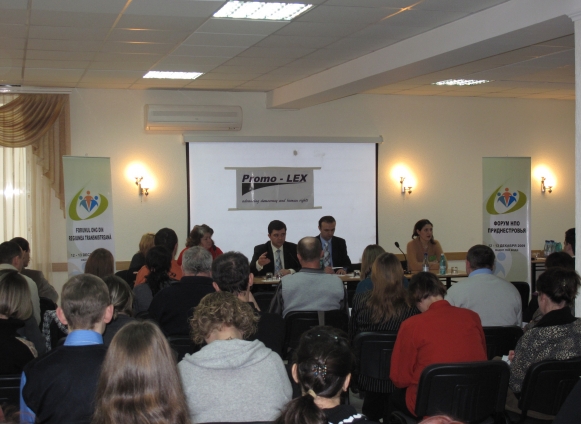
In this regard, the “Forum of Transnistrian NGOs”, held on 12-13 December 2009 (at the Complex “Odisseu”), organized by the Promo-LEX Association in partnership with the Association “Rodoliubet” for the second consecutive year, is practically the most important event for civil society from the left bank of the Nistru.

The 2009 edition of the “Forum of Transnistrian NGOs” set the following objectives:
– create a discussion platform for representatives of NGOs from the region;
– facilitate and strengthen cooperation between NGOs from the region, and: the donor environment, organizations from the right side of the Nistru river, and other international NGOs;
– identify opportunities for capacity building of NGOs from the region.
In order to achieve the fallowing objectives the event was held in a new format, Open Space – “Cafe of Ideas”. Topics of the Cafe of Ideas concerned the following aspects of NGO activity in the region: The image of NGOs in society; Nongovernmental sector development prospects / expectations for 2010; Financial sustainability of NGOs from the region; Prospects for the possibilities of partnership relations with foreign NGOs.

The Cafes of Ideas were moderated so as to provide the time for each participant to express his/her ideas and thoughts concerning the aforementioned topics. The participation at the event of the 58 representatives of NGOs / Initiative Groups from the region contributed to identifying, from multiple perspectives, the real problems that they face whilst realizing their activities. The role of discussion was not only to determine and systematize problems, but also to formulate recommendations / conclusions on the subject matter. The set of final suggestions concerned issues of activity at a local level, but also recommendations addressed to donors.

The second day of the Forum was dedicated to a meeting between civil society representatives with delegations and representatives of donor organizations and NGOs from the right bank. This session of discussion and presentation of the organizations helped to involve all participants in a common work platform, in order to facilitate the development of the NGO sector from the region, as part of Moldova. In this context, participants discussed the idea of creating a Coordinating Council of NGOs in the region, and opinions were very different. Concerning this issue, representatives of NGOs from the right bank expressed their opinion that it would be premature to develop such a structure. However, the initiative was welcomed and remains to be discussed locally between interested NGOs. This fact shows not only the advanced level of the third sector from the region, and the good results achieved by the stakeholders, but also the need to unify efforts, consolidate, and develop solidarity in order to achieve the public good.

The event represents the first step of the Forum of Transnistrian NGOs: the second phase is planned to be launched in February 2010 and will aim to facilitate contacts between NGOs / local Initiative Groups, and NGOs from abroad interested in developing partnerships and projects in the region.

The event was organized by the Promo-LEX Association in partnership with the organization “Rodoliubet”, with financial support from the Czech organization “People in Need”, the Czech Foreign Ministry’s program “Transition”, and the OSCE Mission in Moldova.
The Forum is part of the activities performed by the Resources and Development Center for Transnistria, a Promo-LEX Association project, funded by the National Endowment for Democracy.


Transnistrian civil society to discuss problems and propose solutions

Representatives of the civil society of Transnistria will be participating in a Forum of Transnistrian NGOs in Vadul lui Voda town on December 12 and 13. They will try to identify possibilities for strengthening Transnistrian nongovernmental organizations’ capacities and for facilitating and developing cooperation between the NGOs working on the two banks of the Nistru and with the donor community, Info-Prim Neo reports.

According to Natalia Gligor, coordinator of the Resource and Developemnt Center for Transnistria Project implemented by “Promo-LEX” Association, the aim of the second edition of the forum is to create a platform for discussion for the representatives of the Transnistrian NGOs and better conditions for their economic stability.

”We want to establish a direct connection between the representatives of the civil society and the donors. The communication will help them better understand the real situation in the region and the necessities of the NGOs. Sometimes, the Transnistrian NGOs cannot fulfill the conditions for participating in the contests organized by backers as they meet difficulties even in translating the documents into English,” said Gligor. At the end of the forum, the participants will formulate 10 recommendations for the donor community.

The open-space forum will center on the following subjects: image of the NGOs in the society, the prospects of developing the nongovernmental sector in Transnistria in 2010, the financial durability of the NGOs and the possibility of developing partnership relations with foreign nongovernmental organizations. The NGOs will present progress reports, while the organizations that achieved good results in promoting the human rights in the Transnistrian region will be awarded.

The event is organized by Promo-LEX Association in partnership with the organization “Rodoliubets”, with financial support from the Czech organization “People in Need”, the Czech Foreign Ministry’s program “Transition” and the OSCE Mission in Moldova.

www.info-prim.md


Detainees sew up lips with needle and thread

Eight persons held in a remand center in Rybnitsa sewed up their lips with needle and thread and went on a hunger strike in protest against the inhuman treatment against them. After two days of strike, the detainees were fed by force and treated by doctors.

“The incident happened 10 or 20 days ago. We do not know when exactly because we have two sources that give two different dates,” the president of the Human Rights Association Promo-LEX Ion Manole has told Info-Prim Neo.

The jurists of Promo-LEX were informed about the incident by local residents.”According to our sources, the detainees protest against the inhuman treatment. They are humiliated and forces to sign false statements against themselves,” Ion Manole said.

He also said that they could not yet find out the names of the eight detainees and their place of birth. A member of the Association traveled to Rybnitsa, which is located in Transnistria, to find relatives of the detainees.

“Promo-LEX informed the Moldovan authorities and international organizations working in Chisinau about the incident. Somebody should have unlimited access to such institutions in the Transnistrian region. We plan a meeting with the authorities to tell them about this,” Ion Manole said.

Earlier, 90 persons detained in a remand center in Tiraspol also went on hunger strike. Neither the international organizations such as the OSCE nor the Moldovan NGOs could enter the center to clarify the situation.


Human Rights in the Republic of Moldova: Contributing Factors in 2007-2008 and the 2009 Situation

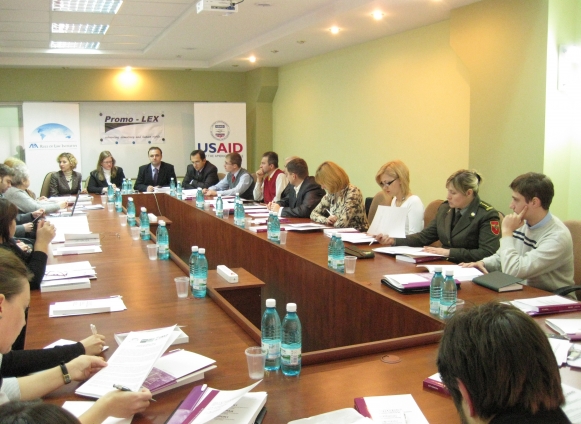
_article_1259075479On November 24, 2009, in Chisinau, Promo-LEX held the roundtable “Human Rights in the Republic of Moldova: Contributing Factors in 2007-2008 and the 2009 Situation.” This roundtable is a continuation of the work of the Promo-LEX Association, which provides legal assistance, monitors human rights and carries out strategic litigation and advocacy in the area of human rights. As part of the roundtable, Promo-LEX presented the report, “Human Rights in Moldova 2007-2008,” published with ABA ROLI assistance, through the financial support of the United States Agency for International Development.

Ion Manole, Promo-LEX Director, said, “From the findings of Promo-LEX and others, we can conclude that during 2007-2008, there were a number of systematic problems that led to violation of various rights guaranteed by international treaties to which Moldova is a party. The legal framework currently in place requires that complaints of illegal treatment be fully examined, yet the situation in this respect is quite critical, showing many instances in which, for various reasons, investigations proceed slowly and inefficiently.”

The findings and recommendations of this report are summarized below:

Right to Liberty. The study shows a decrease in the number of people deprived of liberty. However, based on data gathered in 2007-2008, 30 percent of those detained under criminal law were deprived of their liberty without the issuance of an arrest warrant. At the same time, the tendency to deprive people of liberty arbitrarily for administrative offences continued, this often being done with the intent of subsequently investigating a person’s criminal involvement. Figures show that about 60 percent of administrative detentions are under the categories of offences related to insubordination, resistance or provocation of law enforcement agents.

Right to Due Process. The report records examples of failure by prosecutors to respect the presumption of innocence, to adhere to reasonable time limits when examining cases, to adequately investigate allegations of torture, and to conduct criminal proceedings transparently.

Electoral Law. In the period covered by the report, Promo-LEX recorded changes made to electoral law that have in general, aroused suspicion among the public. The threshold for gaining representation in parliament, for instance, was raised from 4 percent to 6 percent of the public vote. Additionally, the rights of those with dual or multiple nationality were restricted, and electoral blocs were banned. All these changes were made without public debate.

Property Rights. The study found that violations of property rights continued unabated. In particular, Promo-LEX noted the rights violation of former deportees and political prisoners; illegitimate privatization; violation of property rights in the eastern region of the country; the non-transparency of various fiscal transactions; and expropriation of land without adequate compensation.

Access to Information. Access to information has become a serious problem, especially as the authorities tend to impede access to information for merely formal reasons, without justification. There is an obvious discrepancy between official declarations regarding the importance of access to information and transparency in the decision-making process on one hand, and reality on the other. There is also a great need for objective and consistent application of law in this area by government and parliament.

Right to Assembly. In 2007, many cases regarding violations of the right to free assembly were recorded. Owing to the new law on assembly which came into force on February 22, 2008, a positive change was noted with respect to the right to free assembly; nevertheless, the end of 2008 saw extraordinary actions on the part of authorities which blatantly and intentionally violated this right.

Labor and Social Welfare Rights. In the period 2007-2008, the right to employment and social protection was frequently violated. Although projects have been implemented in this area and a series of relevant decisions have been adopted by the government, the number of cases of violations of the right to a decent life, to social assistance and protection, to health care and to protection against unemployment continues to grow. According to some estimates, 40 percent of the population lives below the poverty line.

Transnistrian Region. The situation for inhabitants of the Transnistrian region remains grave. They do not benefit from social assistance and protection from the state. The constitutional authorities have justified their inability to ensure social rights on the political situation, on the existence of a separate system of social protection in the territory, and on the obstacles facing implementation of relevant laws. The rate that people are deprived of liberty in the Transnistrian region is over six times greater than the average amongst Council of Europe member countries.

The study is available in English, Romanian and Russian languages here.


Human Rights and Democratic Institutions in the Post-election Period in Moldova, 6 April – 1 July 2009

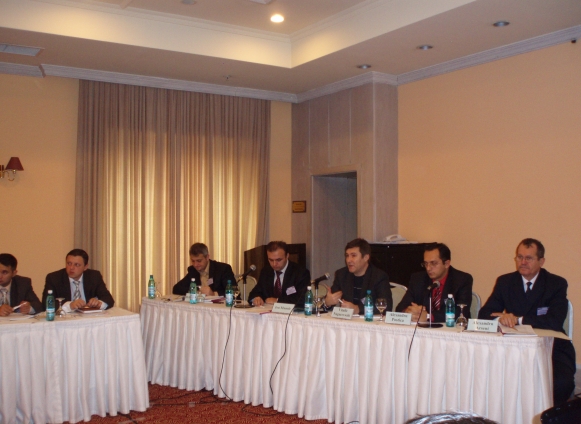
_article_125846496211 November 2009 / The Promo-LEX Association presented a study focussed on an analysis of the situation with respect to freedom of assembly, liberty and security of person and the right not to be tortured, freedom of mass-media/freedom of expression, and the functioning of state democratic institutions, during the post-election period in Moldova (6 April- 1 July).

The authors of the study presented their findings based on objective assessments of the causes and consequences of the dramatic events seen in Moldova in the aforementioned period, outlining at the same time concrete recommendations for the authorities and other concerned bodies.

Present at the opening of the event, President of the Parliamentary Committee set up to investigate the April events, Vitalie Nagacevschi, stated that, following the parliamentary elections on April 5 2009, human rights were flagrantly violated, and that democratic institutions were inappropriately influenced by politics. The most prevalent violations involved the use of torture on the part of the police. The existing mechanisms, he said, were not efficient enough to guarantee respect for human rights.

Alexandru Postica talked about the rights and obligations of the local public authorities with respect to cooperating with the police and organisers of assemblies, outlining the rights and obligations of all parties. If public order is violated during an assembly, then, according to the law, police and representatives of the local public administration should disperse the meeting in conformity with legal provisions, first giving warning of the measures that will be taken. He warned that, in cases where the law is not respected, organisers and participants will be held accountable, in conformity with legal provisions. Police employees who act illegally must also be held accountable. The author elaborated a set of recommendations for all the relevant parties: Local public administration bodies, firstly, should: co-operate closely with the police, facilitate the notification procedure and organisation of meetings, and ensure realisation of the right to assembly. Organs of the Interior Ministry should: take measures to build public confidence in the capabilities of the police, develop skills and tactics to combat inappropriate and aggressive behaviour, and encourage better co-operation between the police and the local public administration. The prosecution bodies should: start an investigation (carried out by the Prosecutor General) into both cases of violations of the right to free assembly and cases of police inaction, and sanction the senior officers of the law enforcement bodies who did not fulfil their duties. The parliament should: change the law so as to clearly establish the duties and rights of both the local administrative bodies and the police, and supplement chapter V of the Law on Assemblies with a new article clearly indicating the responsibility for violating the Law, and including stipulations on the possibility of collecting for moral and material damages caused by the local authorities and police actions.

Legal expert Ion Manole highlighted violations of Rule-of-Law principles during the April events, as well as abuses committed by precisely those organs charged with ensuring respect for the rule of law: arbitrary detention, maltreatment and torture during detention, violations of procedural norms, delays made to the efficient and swift investigation of cases of abuse and death, and the troubling findings of medical/legal experts. The author emphasised in particular the tolerant and supportive attitude shown by authorities towards certain troubling developments – which led to violations of the rule of law- and the lack of official reaction. He presented to the parliamentary commission recommendations that should be implemented to better elucidate the aforementioned events (transparency, the involvement of foreign specialists and civil society groups, the objective establishment of the truth) and proposed a change to the legislation with a view to preventing the re-emergence of factors that could lead, once again, to the violations seen in April. Manole stressed the readiness of civil society groups to get involved in the proposed measures.

Expert Petru Macovei displayed the results of the monitoring and evaluation of how mass-media portrayed the post-election events in Moldova, affirming that most TV stations violated ethical principles when presenting the developments. The stations Moldova1, NIT, N4 and Prime TV presented the news selectively, informed citizens in a non-objective fashion, and manipulated text and images, all in a manner that favoured the Communist Party. The national television channel Moldova 1 presented information that was biased in favour of the then ruling party. The expert made recommendations for the press: to present events in an objective and impartial manner, to extend the right of reply to all the parties involved, to present a review of the conflict using alternative sources, and to take into account the political beliefs of different sections of the population. He also advised that the Coordinating Council for audiovisual media conduct a self-review, and take measures to ensure the delivery of complete, objective and truthful information, the right to free expression, and the free communication of information via mass media.

Prof. Alexandru Arseni explained how, in the period under study, the functioning of the democratic institutions in Moldova left a lot to be desired. He noted how the parliament in office on April 6 was to form a parliamentary committee, but did not do so. The new parliament elected on April 5 created a committee under Vladimir Turcan, but the latter did not submit any progress report. After much delay, a parliamentary committee was created which has recently started to function. Arseni added that delays in investigations make it more likely that potential evidence for criminal cases will be lost or destroyed. Arseni had strong words of criticism for the Supreme Magistrates’ Council concerning the performance of the judges who examined the cases of the protestors, and the fact that it did not task itself with examining cases in which arrest warrants were issued in the offices of prosecuting officers. The expert welcomed various positive changes seen in the work of the advisory council to the Constitutional Court, stating that information is first debated in this council, and then examined by the Court.

Natalia Belitser from the ‘Institute for Democracy Pylyp Orlyk’ in Kiev took part in the round-table as a special invitee. Mrs Belitser presented a view of the April events from the perspective of a neighbouring country, Ukraine. Participants at the discussion were given the chance to learn that, during the dramatic April events, several Ukrainian journalists and citizens were denied access to Moldovan territory. Both at constitutional-authority checkpoints, and at those under illegal Transnistrian control, customs officials behaved in a similar fashion, and used the same arguments to refuse entry into Moldova. In Mrs Belitser’s view, this shows that the actions were co-ordinated from a single point. The Ukrainian expert believes that the dramatic events in Moldova have changed the view of many regarding the situation there.

Present at the event were representatives of civil society, deputies and representatives of various state bodies, representatives of diplomatic missions, lawyers, and those who were direct victims of abuse at the hands of the authorities in April.

The study in Romanian and English is available here.

The study was made with financial support from the Black Sea Trust for Regional Cooperation /A Project of the German Marshall Fund.


Comparative study reveals the situation of the right to liberty and security of person in conflict and post-conflict zones

_article_1257433930On November 4 2009, the association ‘Promo-LEX’ published a study on the right to liberty and security of person in 4 conflict regions (Moldova, Georgia, the Russian Federation and the former Yugoslavia).

The study attempts to identify viable solutions to ensure that human rights are respected in the Transnistrian region, through a thorough analysis of different situations in other regions that have been, or which remain, areas of conflict. The study offers new ideas, solutions and recommendations for civil society, the Moldovan authorities and the international bodies involved in the peaceful resolution of the Transnistrian issue.

Experts identified the most relevant cases involving violations of the right to liberty and security in the aforementioned areas of conflict.

Expert Doina Ioana Straisteanu reveals serious violations committed by Russian authorities during police and military operations in the North Caucasus (Chechnya and Inghushetia). In particular, the author notes how anti-terrorism laws have resulted in various abuses of the right to liberty and security, and how prosecution bodies have failed to combat and prevent these abuses. Secret places of detention, (such as the private prisons of the Chechen President, Ramzan Kadyrov) are a major problem in the region, as is documented in reports of the CPT (European Committee for the Prevention of Torture). The inefficiency of the law enforcement bodies in the North Caucasus, and the impunity which they enjoy, leaves people vulnerable to violations of their liberty and security. The European Court of Human Rights has recognized violations of Article 5 of the European Convention on Human Rights in over 100 cases brought against the Russian Federation.

Expert Nicoloz Legashvili notes the destabilizing nature of the presence of Russian peacekeeping troops in the regions of Abkhazia and South Ossetia. He further notes the active role played by these troops in military acts of aggression that took place in these regions at different times during the 1990s, and in abuses committed against both combatants and civilians. The issue of dual jurisdiction constitutes an obstacle to securing the rights and freedoms of Georgian citizens, since the secessionist authorities have established their own legal structures. On the other hand, a positive example of a mechanism for securing constitutional jurisdiction came in the form of parallel elections in South Ossetia, which opened the way for the creation of a legal government in the region.

Expert Goran Miletic notes how, although the situation in the lands of the former Yugoslavia is now calmer, nevertheless, in the regions of Serbia, Montenegro and Bosnia, there remains the risk of arbitrary detention, and the problem that cases involving violations of liberty and security of person are insufficiently examined. The Serbian expert recommends that the Moldovan authorities explore the possibility of ratifying and signing all the relevant international treaties and mechanisms concerning security, so as to ensure maximum security for people in areas of conflict. A particularly important step would be ratification of the Statute of the International Criminal court, which hitherto Moldova has not recognized.

Expert Ion Manole reiterates his position regarding the lack of guarantees for people in the Transnistrian region. In particular, he highlights the inaction and omissions of the constitutional authorities, who have performed inconsistently, and without well-defined objectives, leading to the current deadlock. The author suggests that the Moldovan authorities create a national strategy for ensuring personal rights and freedoms in the Transnistrian region. The case studies that have been discussed in society in recent years have shown that nobody there can feel free and secure. Not even collaborators from the constitutional law enforcement bodies are protected, being often humiliated, detained or ‘arrested’. The problems of the region’s ‘penitentiary institutions’, including centres of preventive detention, are very serious, and require the immediate attention of civil society, the constitutional authorities, and the international community. As a result of the conditions in these ‘institutions’, and according to statistics, the majority of those detained in the region remain under the real risk of infection with various illnesses, including HIV/AIDS and tuberculosis. Another major problem for the security and liberty of person in the region is the forced enlistment of all young males into illegal paramilitaries.

The study is available in English, Romanian and Russian languages here.

The study was realized with financial support from The Black Sea Trust for Regional Cooperation and The Balkan Trust for Democracy / a project of the German Marshall Fund.