“Unreported expenses amounting to about 4 million lei and increased financial dependence on state budget subsidies” are the main findings of Promo-LEX regarding party funding in 2021

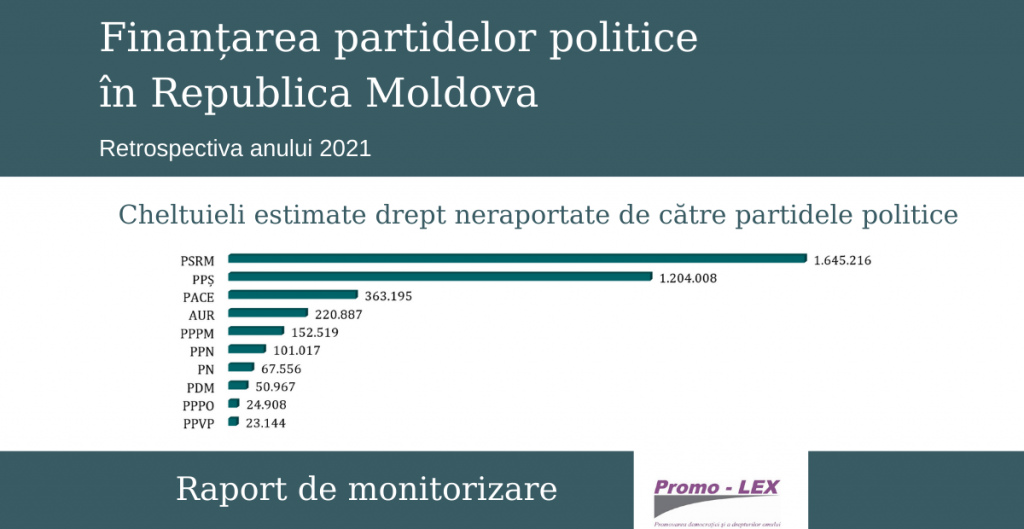
Promo-LEX estimated that in 2021, 18 political parties in the Republic of Moldova failed to report expenses of approximately 4 million lei. Of these, most account for the Party of Socialists of the Republic of Moldova (PSRM) – 42%, the Political Party of Sor (PPS) – 31%, the PACE (We Build Europe at Home) – 9% and the Alliance for the Union of Romanians (AUR) – 6%.

The data have been presented in the Promo-LEX Monitoring Report on “Financing of political parties in the Republic of Moldova. 2021 Retrospective” recently presented by the Association.

According to the REPORT, the expenses estimated as unreported were used for remuneration (50%), lease of headquarters (18%), organization of public events (17%), promotional and press materials (10%) and travels in the country and abroad (4%). Compared to 2020, there is a decrease in unreported expenses, which were estimated at 8.5 million lei.

Another finding of Promo-LEX refers to the revenues of political parties. Compared to the previous periods, there is an alarming increase in the financial dependence of political parties on state subsidies and a significant decrease in their direct support by the citizens. Thus, in 2021, financing of political parties was distributed in the following way: state budget subsidies (70%), financial donations (23%), party membership fees (3%) and other revenues (4%). In total, the revenues accumulated by 33 political parties amounted to approximately 47 million lei, of which 90% were reported by 8 parties and only 10% – by the other 25 parties. Most revenues were reported by the PAS – 25%, the PSRM – 19% and the PN – 12%.

According to Promo-LEX, political parties must make greater efforts to collect membership fees and donations, which would hold party members accountable and motivate citizens to be financially involved in party activities, by making conscious and voluntary donations.

This is even more important given that, in the last two years, the number of party members has doubled: from 152,640 in 2019 to 304,713 in 2021 (due to the increase in the number of registered parties from 46 in 2019 – to 55 in 2021), while the share of membership fees and donations, on the contrary, decreased. Moreover, considering that party statutory provisions make the payment of membership fees mandatory, it seems that in some cases, the party leaders themselves do not honor their obligation to pay membership fees. In 2021, the party that declared the biggest number of party members was the PPS (74,777 members), followed by the PACE (20,000 members), the PSRM (15,399 members), the PPPDA (14,000 members) and the PAS (12,648 members).

The report contains several recommendations for authorities, including the Parliament, Government and the CEC on the amendment of the national legislation. Thus, Promo-LEX recommends consolidating the capacities of the CEC to exercise the oversight and control of political party funding, by allocating the necessary resources (financial, material, human, etc.). Political parties are advised to develop the process of collecting membership fees and to encourage donors and contributors to make payments to party accounts by bank transfer.

We remind you that the Promo-LEX Association started monitoring the financing process of political parties in 2015.

The report “Financing of political parties in the Republic of Moldova. 2021 Retrospective” has been developed as part of the “Democracy, Transparency and Accountability” Program, funded by the United States Agency for International Development (USAID). The views expressed in the Report are those of the authors and do not necessarily reflect the views of the funders.

For further information, please contact:
Elena Capatina, communication officer of Promo-LEX;
GSM: (+373) 79454344, [email protected]


The Promo-LEX Association presented its reports on monitoring the financing of political parties and the activity of CEC and CICDE in 2021

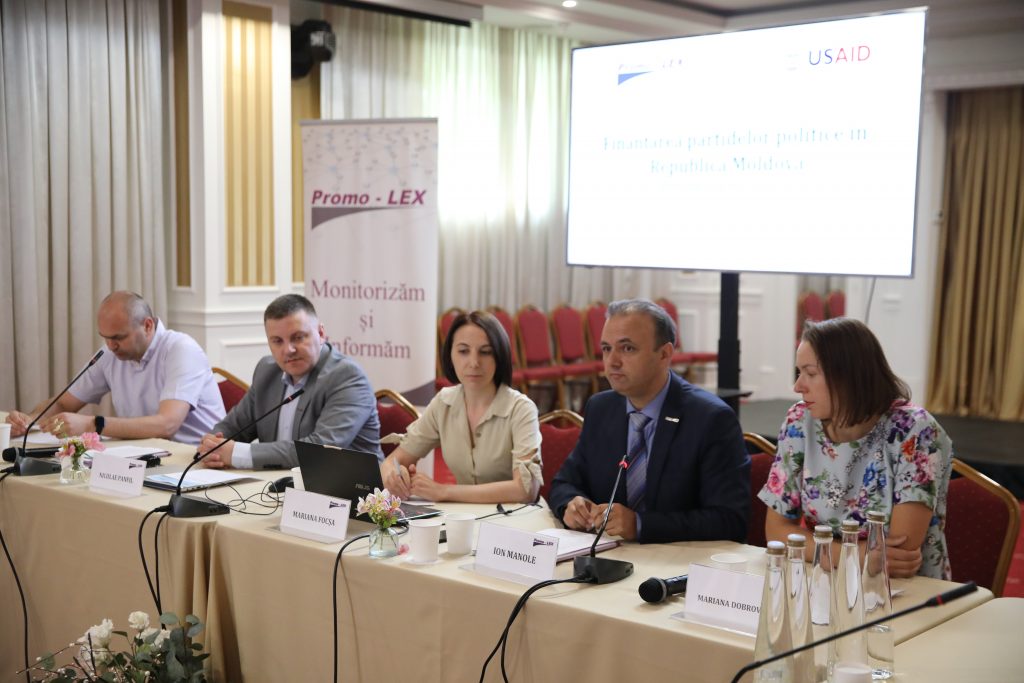
The Promo-LEX Association presented, in a public event held today, its Reports on “Financing of political parties in the Republic of Moldova” and “Implementation of the strategic plans of the CEC and CICDE”, 2021 retrospective.

In the opening part of the event, Ion Manole, executive director of Promo-LEX, mentioned that through these monitoring exercises, the Association promotes correct and qualitative reporting on party funding, as well as on the activity of the CEC and CICDE, ensuring the implementation of their strategic plans. The purpose of such documents is to improve the transparency of the financing of political parties and the activity of electoral bodies.

The REPORT entitled “Financing of political parties in the Republic of Moldova. 2021 Retrospective” analyzes the annual financial reports of political parties, the revenues reported by them, as well as the expenses estimated as unreported. It also examines the evolution of national legislation in the field.

The document provides a series of recommendations for authorities, including the Parliament, Government and the CEC on the amendment of the national legislation. Moreover, Promo-LEX recommends consolidating the capacities of the CEC, by allocating the necessary resources (financial, material, human, etc.) to exercise the powers of oversight and control of political party funding.

In the second REPORT entitled “Implementation of the Strategic Plans of the Central Election Commission and the Center for Continuous Electoral Training (CICDE)”, Promo-LEX assessed the level of implementation and the impact of CEC’s and CICDE’s activities, included in their strategic and annual plans for 2021. The document analyzes the major achievements and arrears of the institutions. At the same time, the experts recommend that the CEC and the CICDE analyze the reasons for failure to fulfill their undertakings and carry out the unfulfilled or partially fulfilled actions.

The event was attended by representatives of central public authorities, political parties, development partners and non-governmental organizations.

The Promo-LEX Association has been monitoring financing of political parties since 2015, and in 2017, it launched the analysis of the implementation of the CEC’s and CICDE’s strategic plans.

The event has been organized by the Promo-LEX Association, as part of the “Democracy, Transparency and Accountability” Program, funded by the United States Agency for International Development (USAID).

Opinions expressed during the event, as well as in the Monitoring Reports presented, belong to the authors and do not necessarily reflect the point of view of the funders.

 For further information, please contact:
Elena Capatina, Promo-LEX press officer;
GSM: (+373) 79454344, [email protected]


CALM, IDIS Viitorul and Promo-LEX decided to create a “Coalition for Decentralization”

On Tuesday, June 21, 2022, the Congress of Local Authorities from Moldova (CALM), the Institute for Development and Social Initiatives “Viitorul” (IDIS Viitorul) and the Promo-LEX Public Association (Promo-LEX) constituted the “Coalition for Decentralization” by signing a Memorandum of Collaboration and establishing an action plan.

In a press conference, the representatives of the 3 organizations presented the initiative, explained why more decentralization and local autonomy is needed, as well as what actions the Coalition intends to take to achieve its goal.

The “Coalition for Decentralization” aims at building and activating a discussion platform that will ensure a more complex and multilateral approach to the public administration reform in order to accelerate and deepen the process of decentralization and consolidation of local autonomy.

Key objectives of the Coalition are:

1. Contributing to defining the objectives of decentralization and consolidation of local autonomy and their promotion by bringing together actors interested in this process;

2. Stimulating an inclusive and comprehensive dialogue, with the involvement of a wide circle of subjects, who will discuss, agree on and establish the main directions of public administration reform;

3. Informing society about the reform of local public administration (reform options, implementation stages, etc.).

In practice, the “Coalition for Decentralization” will coordinate and manage several platforms of support and dialogue between the central government and local authorities to set, by common agreement, a national agenda for the most important legislative changes and institutional adjustments in the field of local public administration.

The Coalition has set the following priorities for the next period:

1. Consolidation of decentralized governance in the Republic of Moldova, leading to the strengthening and expansion of subsidiarity, local autonomy and optimization of the functions and resources of local authorities;

2. Expansion of the base of local finances under conditions of transparency, effectiveness and legality of local authorities’ decisions in the state.

3. Active, responsible and qualified participation in all stages of recalibration of level I and II local powers, offering all their support and skill in identifying reform options, optimal scenarios, impact assessment and bringing together local and regional actors in order to implement these reforms.

The Coalition is a voluntary initiative of the 3 associations. The idea of creating the Coalition started from the need to identify and promote solutions commensurate with the obligations undertaken by the Republic of Moldova was part of the Congress of Local and Regional Powers of the Council of Europe, as well as the much more complex commitments that the status of a candidate country in the process of accession to the European Union brings along.


Findings of Promo-LEX Observation Mission on the New Local Election of May 29, 2022

Promo-LEX observers monitored the conduct of the new local elections in 10 settlements of the country, where elections for the position of mayor and local councilors were held. At the same time, the Observation Mission carried out a parallel vote counting, which confirmed the preliminary results, announced by the Central Election Commission. The information was collected and reported by 18 short-term observers, who monitored the electoral process in each polling station.

Thus, in the first round, residents of Horodiste, Rezina district; Moara de Piatra, Drochia district; Tataresti, Straseni district; Zaicani, Rascani district, Hagimus, Causeni district elected their mayors and voters of Lozova,  Straseni district and Bobeica, Hincesti district elected their  representatives in communal councils. On June 12, 2022, the second round of elections will be organized in Ghetlova, Orhei district, Glinjeni, Falesti district and Zastanca, Soroca district.

The monitoring on the Election Day revealed that the polling stations were opened regularly and all the democratic principles and legislation were respected. The Observation Mission found that voting was organized efficiently and there were no irregularities.

At the same time, Promo-LEX observers reported six incidents. Namely, there was a case of electoral campaigning within 100 meters of the polling station 30/24 Lozova. In the polling stations Ghetlova, Zastinca and Lozova, there were four cases of ballot photographing and in the polling station 20/07 Bobeica, members of the polling station stopped the mandatory video recording during the vote counting process.

There was also a big difference between the number of domicile voting applications submitted in the settlements, where the election took place. Most of them were requested in the villages of Glinjeni, Moara de Piatra and Zaicani, registering 46, 51 and 66 applications respectively. On the other hand, from 2 to 4 such applications were submitted in other five polling stations. We remind you that according to international practice, the use of mobile ballot boxes is not recommended, as it is accomanied by a high risk of counterfeiting.

Another finding of the Mission concerns the accessibility of polling stations. About 67% of them do not meet the minimum accessibility requirements and do not have a ramp for people with locomotor disabilities.

The polling stations closed regularly. In most of the cases, electoral bureaus counted the ballots quickly, except for Zastanca village, Soroca district. About 1/3 of the polling stations ignored the rule on the mandatory counting of the ballots by a single member.

You can see in the table below the results of the parallel vote counting for the settlements, where the mayors were elected in the first round.

No. Settlement Elected mayor Preliminary results of the CEC Preliminary results of Promo-LEX Difference
1. Moara de Piatra, Drochia District. Bejenaru Valentina (BECS) 332 (63,84%) 332 (63,85%) +0,01%
2. Horodiste, Rezina District. Iurcu Dorel (PAS) 406 (89,23%) 406 (89,23%)
3. Tataresti, Straseni District Celeev Vladimir (PPO) 382 (64,53%) 382 (64,53%)
4. Hagimus, Causeni District Cucerovschi Veaceslav (PLDM) 530 (59,02%) 530 (59,02%)
5. Zaicani, Rascani District Tăbirta Victor (BECS) 811 (91,02%) 811 (91,02%)


It should be noted that the formulas i = c + j and j = i-c could not be applied correctly in the case of one protocol. Thus, either the unused and canceled ballots or the signatures from the electoral lists were incorrectly counted.

Since 2009, this has been the 23rd Mission organized by the Promo-LEX Association, involving more than 16,400 national observers. The Observation Mission of the new local elections of May 29, 2022is held with the financial support of the United States Agency for International Development (USAID).

________________________________________________________________________________________________

For more information please contact:

Mariana Novac, program coordinator, Promo-LEX Association, Tel: 069339700


Promo-LEX supports the amendment of the national electoral law

Chisinau, May 25, 2022 – Promo-LEX experts have drawn up and submitted for examination more than 260 proposals to improve the national electoral law. The proposals have been debated today during the presentation of the draft Electoral Code and proposals to amend the related legislation, organized by the Central Election Commission in partnership with the Promo-LEX Association.

Representatives of central authorities, political parties, civil society and development partners participated in the debates; they analyzed and presented their views on electoral reform.

At the opening of the event, the executive director of Promo-LEX Ion Manole mentioned that the 260 proposals on the amendment of electoral legislation, drawn up by the experts, are based on the analysis of the recent developments in electoral field in Europe, the 30-year-experience of multipartyism in the Republic of Moldova and some decisions of Constitutional Court, the provisions of which are mandatory, as well as on the findings of numerous election observation missions.

The opinion of Promo-LEX on the recommended amendments  was presented by the Association’s program director, Nicolae Panfil, who referred to most chapters of the existing Electoral Code, including the right to vote and to be elected, electoral bodies, material provision of elections and financing of electoral campaigns, electoral rolls, nomination and registration of candidates, etc.

The speaker welcomed the initiative to perpetuate the activity of electoral bodies and to ensure that and the CEC has in its composition 7 members, 2 of which will proportionally represent the parliamentary majority and the opposition. At the same time, to avoid the risk that the CEC members appointed by the Parliament and the Government represent only the parliamentary majority, Promo-LEX recommends that one of the two members that is to be appointed by the Government represent civil society organizations, as well as one of the two members appointed by the Superior Council of Magistracy should be a doctor of law.

Other regulations provide for the extension of categories of personal data from the financial statements of political parties and electoral contestants to be made public. These data will include the first and last name, place of employment and the public office or dignitary position held where applicable, as well as the date of the donation, the amount donated and the manner in which the donation was made.

Likewise, considering that about  80-85% of the expenses of the electoral contestants account for advertising, Promo-LEX appreciates the intention of the CEC to check more closely these costs by requesting the media service providers to present weekly, during the electoral period, information on the revenues obtained from political/ electoral advertising. However, experts consider it necessary that this information, along with the data on the conditions of providing the advertising spot (including the price / minute) be made public on the CEC’s webpage.

The adjustment with regard to the organization of elections during two days is accepted by Promo-LEX, but it comes with the insistent recommendation to establish in the Electoral Code the list of objective reasons for which such a derogation will be allowed.

The Association also appreciated the intention of the CEC to organize polling stations for one or several settlements, in which, according to the Ministry of Foreign Affairs and European Integration, there are at least 500 citizens of the Republic of Moldova with the right to vote, temporarily or permanently domiciled abroad.

In the same vein, Promo-LEX supports the improvement of the mechanism for setting up polling stations for voters in the Transnistrian region, by comparing the data from the State Register of Voters with the dynamics of participation in the last 3 national polls. However, Promo-LEX is categorically against discretion in the organization of elections for the voters of Transnistrian region  and considers that it is the duty of the Republic of Moldova to ensure minimum conditions for all its citizens to execute their voting rights.

Promo-LEX experts want to have a  transparent process of public consultations, expertise and analysis of modernization of electoral legislation and recommend that the authorities follow all the necessary procedures.

For more details on the adjustments proposed by the Promo-LEX Association to the Electoral Code and recommendations for its improvement, please access the OPINION of  Promo-LEX.


The Central Election Commission announced, at the beginning of this year, the initiation of the elaboration and public consultation of the draft decision “On the submission of proposals to amend the Electoral Code and related legislation”.

______________________________________________

For more information:

Mariana Novac, Program Coordinator, Promo-LEX Association, mob: (+373) 69339700


Promo-LEX Association launches the Observation Mission of New Local Elections of 29 May 2022

Promo-LEX Association launches today, 21 April 2022, the Observation Mission (OM) of New Local Elections of 29 May 2022. In 8 out of the 10 communities, the elections will be held for the position of mayor[1]. The need to elect a new mayor emerged as a result of death (6 persons) and resignation (2 persons) of the local elects. In other two communities, the local councils were dissolved due to their failure to pass any decision during 6 consecutive months, and hence new local councils need to be elected[2].

Electoral observation will cover the electoral period and the election day (including the second round in the communities where it will be held), and will be conducted by the central team, as well as 4 long-term observers (LTOs) and a short-term observer (STO) in each polling station.

The Observation Mission will traditionally monitor the elections organisation and conduct for compliance with democratic principles and the legal framework. The findings will cover the activity of electoral bodies and other relevant institutions, the performance of electoral contenders and of political parties, including the funding of the electoral campaign. On the election day, we will monitor the opening and closing of polling stations, voting process, accessibility of offices, and ballot counting. Promo-LEX OM will also perform the parallel vote tabulation. As a result, on the second day after the elections we will issue a press release for each round of elections, and the general monitoring outcomes, along with the Mission’s conclusions and recommendations, will be included in a final report.

At the same time, based on the experience of monitoring the New Local Elections of 2019 and the New Local Elections of 2021, Promo-LEX reminds about some constant problematic aspects found previously and that can be repeated during these elections, as well. We thus draw the attention to the need to ensure equal conditions between parties and independent candidates at the signature collection stage by introducing the obligation for all candidates to collect signatures, not only the independent ones. We also reiterate the need to regulate expressly the conditions for organisation and conduct of the second round of elections, in particular: regulate the special conditions for organisation and conduct of the second round of elections when one or both candidates who passed to the second round are de-registered/withdraw; electoral campaign starting date for the second round; procedure and deadlines for challenging the outcome of the first round of elections in cases when there is a second round.

Promo-LEX is a non-governmental organisation with the richest experience in national election monitoring. Since 2009, Promo-LEX has monitored 22 elections (local, parliamentary and presidential), involving over 16 thousand national observers. Observation missions have the goal to inform people how elections are organised and conducted, as well as increase people’s trust in the electoral process.

Promo-LEX Association carries out the Observation Mission for the New Local Elections with the financial support of the United States Agency for International Development (USAID) through the Democracy, Transparency and Responsibility Program.


For more information, please contact:
Andrei Dudnic,
Press Officer
GSM: 060505109
e-mail: [email protected]

________________________________________________________________________________________________

[1] Elections for the position of mayor: Ghetlova com., Orhei district; Horodiște com., Rezina district; Zastânca v., Soroca district; Moara de Piatră v., Drochia district;  Tătărești v., Strășeni district; Glinjeni v., Fălești district; Zăicani v., Râșcani district and Hagimus v., Căușeni district. Elections for new members of local councils:  Bobeica com., Hâncești district and Lozova com., Strășeni district.

[2] Elections for new members of local councils:  Bobeica com., Hâncești district and Lozova com., Strășeni district.


Opinion on the Draft Law No 123 amending some regulatory acts passed by the Parliament of the Republic of Moldova in the first reading on 7 April 2022

18 April 2022
Addressed to Speaker of the Parliament of the Republic of Moldova
Esteemed Speaker,
Esteemed members of the Committee for Culture, Education, Research, Youth, Sport and Mass-media,

On 5 April 2022, the Draft Law No 123 of 05 April 2022 amending some regulatory acts (hereinafter Draft) was registered with the Parliament and was already passed in the first reading on 7 April 2022. The draft defines some terms, such as ‘disinformation’, ‘false information’ and ‘information that affects the security of the public information space’, the adjustment of administrative and civil penalties, as well as the establishment of other legal norms.

Promo-LEX Association acknowledges the urgency of the problem of disinformation and manipulation, including through the media and websites. We are aware of some groups and individuals in the society who produce and promote untruthful information, thus contributing to the spread of hate speech and incitement to discrimination. Disinformation and spread of false information have intensified, in particular, in the context of the Russian military aggression in Ukraine, which represents a major concern, including for the national security.

Based on this context, Promo-LEX Association appreciates and supports the efforts of the Parliament of the Republic of Moldova to prevent and counteract the spread and/or use of untruthful public information that infringes the rights and interests of individuals and society in general.

Nonetheless, we cannot admit these particularly important amendments to be carried out hastily without analysing the risks and consequences of the established limitations, of the granted competences and of the response mechanism when some imperative norms of the law are not respected.

Analysing the briefing note and the text of the draft law passed in the first hearing, in the absence of the views and opinions of some key institutions such as the Security and Intelligence Service and the Broadcasting Council, to the extent of competences and expertise available to Promo-LEX Association, please consider this opinion and take note of our arguments and recommendations.

I. In respect to procedures

a. Promo-LEX Association finds the failure to follow main steps to ensure decision-making transparency. The Draft should have been put up for public consultations before the first hearing, and the results of the public consultations, together with other acts should have been submitted and presented to the meeting of the Standing Bureau to be included in the agenda (Article 57 of the Parliament Regulation).

b. No justification was provided for the urgency under which the Draft was examined and passed in the first reading, although the General Legal Directorate of the Parliament examined and issued a notice as a matter of urgency (within 2 days out of 30 working days) and during the plenary session of 7 April 2022, it was declared that the draft was included in the legislative procedure as a matter of priority.

c. At the same time, we note that the Government’s legal opinion was neither requested nor received before the draft was passed in the first hearing. According to the briefing note, the Draft does not require financial expenditure and additional funds from the state budget, but given that the Security and Intelligence Service and the Broadcasting Council are assigned new competences, we anticipate that some costs will be incurred in this regard.

d. In the absence of legal opinions from the bodies stated in the law, such as the Security and Intelligence Service and the Broadcasting Council, it is not clear whether they have capacity and experience to handle the new legal duties. Similarly, no opinion has been issued by relevant international institutions or well-known organisations involved in human rights protection and monitoring, especially in the area of freedom of expression.

In the light of the above, we would like to note one more time the efforts made by Promo-LEX Association over the past four years to pass in the second reading the draft Law No 301 on the regulation of bias-motivated crimes. Regrettably, we note that the Parliament was not proactive enough and did not pay adequate attention to the Draft Law No 301/2016, as it could also contribute to combating the manipulation of public opinion and disinformation in the society, including the manifestation of these phenomena in the context of the Russian Federation invasion of Ukraine. In this regard, Promo-LEX Association urges the Parliament of the Republic of Moldova to resume the discussion and to pass the Draft Law No 301/2016 in the second reading to solve the issues tangentially, including a number of issues reflected in the briefing note of the Draft Law No 123.

II. In respect to proposed amendments

Promo-LEX Association draws attention to the fact that the solutions proposed to the Draft Law No 123 for the issue of disinformation and manipulation may fundamentally affect a number of essential acts concerning fundamental freedom in the Republic of Moldova, especially freedom of expression. Moreover, we draw attention to the fact that powers limiting these fundamental rights are being transferred to some institutions that do not have prior experience and abilities to apply such limitations in practice.

In the following, we will try to elaborate on some aspects of the Draft as follows:

a. The amendments to the Law No 753/1999 on the Security and Intelligence Service of the Republic of Moldova

The proposal to broaden the powers of SIS for it to apply measures restricting the right to freedom of expression is apparently intended to prevent a possible triggering of some processes that would infringe national security. On the other hand, SIS is proposed to become an authority that can examine and qualify some information as false and therefore limit, in the first place, freedom of expression. Implicitly, SIS will act as a defendant in a court proceeding, which also implies judicial control of these decisions.

Therefore, we draw attention to the fact that the criteria for qualifying some information as false, as well as the position of the authority (SIS) regarding the readiness and preparedness to undertake new duties and how to carry out these duties are neither presented clearly nor explained in the Draft Law. Thus, there is a too wide margin for arbitrary decisions and apparently, the broadcaster will be in charge of submitting counter-arguments, whereas according to the Draft Law, a court proceeding does not suspend the content blocking decision. In the same vein, it is not clear how the principles outlined in the Administrative Code will be applied in respect to these procedures, once this act will not be amended.

b. The amendments to Law No 64/2010 on freedom of expression seem to be controversial

The proposed text seeks to define a very abstract notion such as ‘false information’. However, the same article of the law includes a definition that may create even more confusion. The legislator has already defined the phrase – value judgment without sufficient factual basis – value judgment that is based on facts that did not occur or on facts that did occur but their disclosure is distorted to the point of falsity.

Thus, the introduction of the ‘false information’ phrase will create confusion in private relations, whereas the Law aims to ‘guarantee the exercise of the right to free expression, as well as a balance between ensuring the right to free expression and the protection of honour, dignity, professional reputation and the private and family life of individuals’. Therefore, we suggest that the definition of ‘false information’ be excluded, as it is not a legal definition and is the opposite of ‘true information’.

In respect to other amendments to Article 2 of the Law, by introducing other definitions, we point out that the legislator has already regulated restrictions in the context of freedom of expression (see Article 3(3) of the Law). In addition, the provision of Article 3(4/1) of the Law has already established the prohibition to use information that is contrary to public order and national security.

Concerning the ‘information affecting the security of public information space’, we point out that it is exaggerated and dangerous to provide a definition including some information that is ‘hostile to democratic values and processes’, ‘endangers public goods, such as democratic rule, national security, social cohesion, public safety, public health, ecological balance and others’ or that ‘by its amount and area of dissemination establishes the prevalence of an ideology over others’. At the same time, the expression ‘likely to generate panic, tension or military conflicts’ is too general and unclear.

Concerning Article 6/1 of the Law, only paragraphs 1 and 2 are to be included, as for the rest, we believe that it is not necessary to define again the role and procedures undertaken by SIS, because these procedures are already defined in Law No 753.

c. Amendments to the Criminal Code, like the amendments mentioned above, raise many questions

Regarding the inclusion of new provisions in Article 181 of the Criminal Code – Hindering the free exercise of election rights or the activities of electoral bodies, we highlight that during the electoral campaign it is important to ensure the right of citizens and contenders to discuss freely and in all aspects the electoral programmes of electoral contenders, candidates’ political, professional and personal qualities, as well as to carry out electoral campaigning during meetings, rallies, meetings with the electorate using means of the media, displaying electoral posters or through other forms of communication (Article 52 of the Electoral Code).

Thus, during the electoral campaign, the abusive designation of information as affecting the informational security space and the restriction of the right to electoral campaigning could lead to the violation of the voters’ right to choose and to be elected. This norm can affect the right of election observation missions to analyse and criticise election procedures, as it is not clear who will assess the information as true or false and how.

In this context, we draw attention to the fact that the European Court for Human Rights (ECHR) ruled in the case of  Salov v. Ukraine (2005) that the criminal prosecution for ‘dissemination of false information’ under the electoral law of Ukraine infringed the right to freedom of expression under Article 10 of the European Court for Human Rights (ECHR). In this case, the Court stated that Article 10 of ECHR ‘as such does not prohibit discussion or dissemination of information received even if it is strongly suspected that this information might not be truthful’ (paragraph 113).

At the same time, ECHR ruled on a provision of the electoral law in Poland, whereby election contenders can submit a request to the court to issue an order prohibiting the publication of campaign materials or statements that include ‘untruthful data or information’ within ‘24 hours’. Thus, the Court found that national courts ‘immediately classified as a lie’ the statements made by a local politician during the elections and as a result of such an approach ‘national courts deprived him of the protection provided by Article 10’ (Brzeziński v. Poland).

Similarly, with regard to the procedure to eliminate ‘false information’, in the case of Kwiecień v. Poland (2007), the Court stated that ‘as desirable as the expeditious examination of election-related disputes may be, it should not result in the undue curtailment of the procedural guarantees afforded to the parties to such proceedings, in particular the defendants.’ (paragraph 55).

In the case of Kita v. Poland (2008), the Court observes that the Polish courts unreservedly qualified all of them as statements which lacked any factual basis ‘without examining the question whether they could be considered to be value judgments groundless’ (paragraph 44).  In conclusion, this norm cannot be promoted as it stands.

d. The amendments to the Law No 212/2004 on the regime of the state of emergency, curfew and state of war which propose the establishment of certain prohibitions, also contain certain interpretable clauses. The providers do not have the needed competences to assess the information and qualify it as false. In addition, in the absence of such assessment and qualification carried out by the National Extraordinary Committee for Public Health, it will not be possible to ensure uniform application of this provision by all providers, which may have repercussions not only for information security but also for the competitiveness between providers.

e. Amendments to Article 365/4 of the Contravention Code

There is a similar dilemma about spreading disinformation or information that affects the information security of the Republic of Moldova, in particular referring to qualifying the action as disinformation and qualifying the information as affecting the public information space. We underline that spreading disinformation is a tautology, and that this rule is not clear. It is not clear who should qualify a certain piece of information as inaccurate and determine the extent to which information security is affected. The arguments stated in the above ECHR case-law are relevant, considering the duties assigned to SIS.

f. Amendments to Code of Audiovisual Media Services

Note that the definition of ‘disinformation’ contains several vague expressions and poses the risk of wrong interpretation and interference with the freedom of expression. Given the lack of a general international consensus about the definition of ‘disinformation’, we draw your attention to several elements used by the European Commission[1] to explain this concept: (1) factual and misleading character of the information; (2) intent; (3) harm and (4) economic gain.

Thus, we note that:

  • The first part of the definition is ambiguous, referring to ‘spreading false information that is disseminated…’ It is necessary to clarify what ‘disinformation’ means: only ‘spreading’ false information, or ‘creating, presenting and disseminating’ it. We draw the attention that a narrow interpretation of this definition (‘spreading’) poses a much higher risk to freedom of expression, as it is not always possible to check an information spread by someone to determine its accuracy and authenticity.
  • The need for clarifications in the first part of the definition for ‘disinformation’ is not clear –reflected in a distorted manner, with fabricated, exaggerated content taken out of context or placed in another context, (interested) opinions taken over and transformed into valid information, with biased arguments etc.’, once the legislator recommended to include a definition for ‘false information’ in Law no. 64/2010 on freedom of expression.
  • At the same time, expressions like ‘propaganda hostile to democratic values and processes and false information that threatens democratic, political or policy development processes’, potential threats to ‘public assets’, ‘information security’ are vague and general, and do not help understand and review a potential case of disinformation.
  • Spreading false information with the purpose to ‘deceive the audience’ is a too broad expression used in this context.
  • The reference to the effect of ‘causing a public damage’ broadens the scope to cover any type of false information, including in a commercial context.

Considering the above, note that the signatory organisations[2] of Joint Declaration on freedom of expression and ‘fake news’, disinformation and propaganda of 2017 underlined that ‘general prohibitions on the dissemination of information based on vague and ambiguous  ideas, including “false news” or “non-objective information”, are incompatible with  international standards for restrictions on freedom of expression’.

Another general principle of the Joint Declaration states that: ‘State mandated blocking of entire websites, IP addresses, ports or network protocols is an  extreme measure which can only be justified where it is provided by law and is necessary  to protect a human right or other legitimate public interest, including in the sense of that it  is proportionate, there are no less intrusive alternative measures which would protect the  interest and it respects minimum due process guarantees’.

We also draw the attention to the fact that the amendments to Articles 55, 63 and 66 are contrary to the European Convention on Transfrontier Television, in particular Article 16, and points 267-277 of the Explanatory Report on this Convention. This was the main argument used by the Constitutional Court to declare non-constitutional a similar provision introduced in Article 66(7), on 23.11.2021. According to the said international acts, the mere fact that a channel runs targeted advertising may not serve as grounds for banning its retransmission.

g. Amendments to Law on electronic communications

Lack or incomplete contact data on websites cannot affect the information security, and hence may not serve as grounds to block access to those websites. This is a disproportional measure. Obliging individuals to publish their contact data is inconsistent with the rules on personal data protection.

As for legal entities, the reasons behind the requirement to publish data about the Managing Director are not clear, as the former is not the holder of the website. These contact data belong to the legal entity. To put it differently, the contact data of the Managing Director are the company’s data. Blocking a website that does not contain any illegal content on grounds of not displaying any contact data is obviously a disproportionate measure, affecting  unduly the freedom of expression and the right to access to information, as well as the right to association.

III. Conclusions

As the Parliament of the Republic of Moldova intends to amend some primordial legislative acts on freedom of expression, we believe that all requirements for a genuine consultation process should be complied with, requesting the legal opinion of bodies affected by these amendments.

We also believe that the proposed definitions for ‘false information’, ‘information that affects the security of the public information space’ and ‘disinformation’ should be redefined, so that there is no room for interpretation, abusive qualification of information as false or affecting the security of the public information space is avoided, and freedom of opinion and freedom of public expression are observed. At the same time, other proposed norms that can be interpreted differently, wrongly and abusively should be removed as well.

_______________________________________________________________________

[1]Disinformation is ‘verifiably false or misleading information that is created, presented and disseminated for economic gain or to intentionally deceive the public, and may cause public harm’.

[2]The United Nations (UN) Special Rapporteur on Freedom of Opinion and Expression, the  Organization for Security and Co-operation in Europe (OSCE) Representative on Freedom of  the Media, the Organization of American States (OAS) Special Rapporteur on Freedom of  Expression and the African Commission on Human and Peoples’ Rights (ACHPR) Special  Rapporteur on Freedom of Expression and Access to Information.


PUBLIC CALL Promo-LEX Association calls on the Parliament of the Republic of Moldova to fully address the electoral recommendations of the Constitutional Court

To: The Parliament of the Republic of Moldova
Committee on legal affairs, appointments and immunities
Copy: The Central Electoral Commission


On 10 March 2022, the Parliament approved, in the first reading, the Draft Law No 390 of 13.12.2021 amending some regulatory acts, which provides for the execution of some addresses and decisions adopted by the Constitutional Court between 2011 and 2021. The draft law was developed as result of the Constitutional Court’s request for information on the extent to which its decisions and addresses are implemented.

Promo-LEX Association appreciates and supports the efforts of the Parliament of the Republic of Moldova to address the deficient provisions or poor implementation of legislation, but unfortunately, it notes that:

  • of the total of 7 addresses in electoral matters identified by the Association as unresolved between 2011 and 2021, only one is included in the draft law.
  • no public consultations were organised and held, including ones with the participation of civil society organisations.

In this regard, Promo-LEX Association calls on the Parliament of the Republic of Moldova to hold public consultations and urgently address the following issues identified by the Constitutional Court:

  • Address No PCC-01/139e-34/1 of 13.12.2016, which highlights the need to clarify the law on the examination of complaints regarding the organisation and conduct of elections, suggesting the explicit regulation of how complaints shall be reviewed for various types of elections, for two rounds of voting, including on election day.
  • Address No PCC-01/139e-34/2 of 13.12.2016, whereby the Constitutional Court deems it necessary for the Parliament to include additional criteria for establishing the number of polling stations abroad and their geographical distribution.
  • Address No PCC-01/139e-34/5 of 13.12.2016, which reveals the need for the Parliament to regulate urgently some prompt and immediate sanctioning mechanisms, including criminal sanctions, for any attempt to involve religious cults in election campaigns.
  • Address No PCC-01/139e-34/6 of 13.12.2016, which highlights the need for the Parliament to amend the legislation on broadcasters’ liability during election campaigns and to establish efficient tools, which would allow applying immediately enforceable and dissuasive sanctions, such as the suspension of broadcasting rights during the campaign.
  • Address No PCC-01/40a-24 of 27.07.2017, which stated that in order to exclude contradictory interpretations of the competence of the Parliament to declare a referendum, the legislator shall align the term for declaring a referendum on the dismissal of the President of the Republic of Moldova with the term for declaring a referendum;
  • Address No PCC-01/130a/461 of 08.10.2020 which highlights the need for the Parliament to provide for some mechanisms of control and rapid sanctioning, in order to prevent and address hate speech among electoral contenders, including the one happening online and on social media.

In conclusion, we emphasise that the need for resolve the addresses in electoral matters is even more urgent in the context of the upcoming general local elections to be organised and held in 2023. We would like to remind that the legislation should be amended in time before the election to ensure that the principle of electoral law stability is respected.

Thus, for the second reading, we call on the Parliament of the Republic of Moldova to examine and propose solutions for the above-mentioned addresses of the Constitutional Court. Otherwise, the Parliament could address the recommendations of the High Court during the review of the electoral law initiated by the Central Electoral Commission.


War Crimes at Sea: Shelling of Merchant Ships in Ukraine’s Territorial Waters

Introduction

On the morning of 24 February 2022, Russian troops crossed the administrative border between the Kherson region and the Autonomous Republic of Crimea, as well as the state border between the Russian Federation and Ukraine in the North and Northeast of Ukraine. Almost immediately afterwards, armed conflict spread – including at sea. Investigators from “Truth Hounds” have established that a number of military operations at sea violated international humanitarian law (IHL) and are likely to qualify as war crimes.

Violation of International Humanitarian Law at Sea

On 24 February, a missile hit the bulk carrier ship “Yasa Jupiter,” which flies the flag of the Marshall Islands1, near the port of Odessa. The ship was on its way to Romania from Ukraine. Fortunately, there were no casualties. On 25 February a Russian warship fired at the chemical tanker “Millennial Spirit,” which flies the Romanian flag, when it was 12 nautical miles from the Ukrainian Port of Yuzhny. Two crew members were injured in the attack and the ship was badly damaged. On the same day, the bulk carrier “Namura Queen,” flying the flag of Panama, was hit in the stern by a missile while anchored at place No. 358 of the roadstead in the Port of Yuzhny resulting in some of the vessel’s equipment being damaged, and a crew member sustaining injuries.

Merchant ships, a category to which all three aforementioned vessels belong, are civilian objects and accordingly may not lawfully be the objects of attack. Merchant ships lose protection only if they are used for military purposes. The crew members of merchant ships are civilians (Article 50 of the Geneva Convention IV – GC IV) and are not, therefore,

lawful targets of attack. GC IV and Additional Protocol I to the Geneva Conventions (AP I), as well as customary rules of IHL, guarantee the protection of merchant ships and their crew. Interlocutors widely recognize the San Remo Manual on Armed Conflicts at Sea as an authority on customary international law as applicable to armed conflict at sea.

All three ships subject were merchant vessels flying the flags of countries which are not party to the conflict. Attacks on neutral merchant ships are prohibited, except as expressly provided for in paragraph 67 of the San Remo Manual, which considers attacks on merchant ships that are effectively contributing to military action. Based on the information available, there is no reason to believe that Yasa Jupiter, Millennial Spirit, or Namura Queen were contributing to military action in any way. In addition, in the case of the attack on the chemical tanker Millennial Spirit, there was a threat of serious, widespread and long-term environmental damage as a result of chemical leakage. This entails violation of the provisions of Article 55 AP I and paragraph 44 of the San Remo Manual.

Thus, the shelling of the Yasa Jupiter bulk carrier, the Millennial Spirit chemical tanker and the Namura Queen bulk carrier by the Russian air force qualify as serious violations of IHL because they amount to deliberate attacks on a civilian object (under the ambit of Article 85(3) (a) AP I and Article 8(2)(b)(ii) of the Rome Statute of the International Criminal Court) or, unless intent can be established beyond reasonable doubt, as an indiscriminate attack that caused damage to a civilian object and potentially endangered the environment (under the ambit of Article 85(3)(b) of AP I and Article 8(2)(b)(iv) of the Rome Statute).

In addition to the direct attacks on ships flying the flags of neutral states, on 27 February Russian Navy vessels seized the merchant ships “Afina,” IMO 8029272, and “Princess Nikol,” IMO 8319392. Both ships were sailing under the Ukrainian flag, and were transporting grain from Nikolaev in Ukraine to Constanta in Romania. In total, there were around 50 crewmembers on board the ships.2

These civilian ships were 18 nautical miles from the Crimean Peninsula, south of Cape Tarkhankut.3 Reportedly, Russian military threatened to destroy the vessels with missiles if they did not stop. Detaining and capturing enemy merchant ships is permissible under the San Remo Manual, mentioned above (paragraphs 59-60), as well as under Article 53 of the Hague Regulations. But IHL requires that the private individuals who own the vessel receive compensation for the seizure; there is no indication that Russia has or will compensate the owners of Afina and Princess Nikol for their seizure.

Conclusion

The large-scale military operations, which intensified on 24 February after the incursion of Russian troops into the territory of Ukraine, are continuing not only on land, but also at sea. Actions that violate IHL are particularly dangerous for the civilian population and civilian objects and the consequences of the likely violations of IHL described here exacerbate the already severe humanitarian catastrophe caused by armed conflict, and should therefore receive the sustained attention of the international community.


________________________________________________________________________________

1. Facebook post at 7:02, 24/02/2022, from the Cabinet of Ministers of Ukraine, with reference to the Ministry of Infrastructure of Ukraine, available through link: https://www.facebook.com/100064831804750/posts/320500073454384/ (in Ukrainian).

2. Facebook post at 14:30, 27/02/2022, from the Southern Regional Directorate of the State Border Guard Service in Ukraine, available at: https://m.facebook.com/story.php?story_fbid=255038626818705&id=100069377072398 (in Ukrainian).

3. Vessel geolocation, available at: https://www.vesselfinder.com/en/?imo=8319392.


CSP Statement Regarding Russia’s War Against Ukraine

Regarding Russia’s War Against Ukraine

Statement by members of the Civic Solidarity Platform

25 February 2022

We, the undersigned members of the Civic Solidarity Platform, an international coalition of civil society organisations from the countries of the OSCE area, deplore Russia’s aggression against Ukraine in strongest terms and urge the OSCE executive bodies and all OSCE participating States to act on their condemnation of Russia’s invasion of Ukraine—a brazen violation of the Minsk Agreements, OSCE commitments, the Council of Europe obligations, UN obligations, and numerous international norms. The future of Europe and the entire world is at stake, and a united, immediate, and strong reaction is required.

We thank the OSCE leadership and participating States for their condemnation of the Russian invasion of Ukraine. As the OSCE Chairman-in-Office Zbigniew Rau and OSCE Secretary General Helga Maria Schmid stated on February 24, 2022,

“We strongly condemn Russia’s military action against Ukraine. This attack on Ukraine puts the lives of millions of people at grave risk and is a gross breach of international law and Russia’s commitments. We call for the immediate cessation of all military activities.”

US Deputy Secretary of State Wendy Sherman stated before the OSCE Permanent Council in Vienna on February 22, 2022:

“President Putin is testing our international system, he is testing our resolve. He wants to demonstrate that through force, he can make a farce of the international order.  

In this moment, no one, not one of us, can stand on the sidelines. We must remain united in support of Ukraine’s sovereignty and territorial integrity—and, indeed, of the right of all sovereign nations to choose their own paths, free from the threat of coercion, subversion, or invasion.”

The situation has rapidly deteriorated in the past two days, showing Russia’s leadership’s far-going aggressive plans and its complete disregard to numerous appeals to stop the invasion. These tragic developments call for immediate strong international actions to stop the war. It is time for words to give place to actions.

We, civil society representatives, cannot and will not stand on the sidelines. In solidarity with our Ukrainian colleagues and the people of Ukraine, we put forward the following demands to OSCE participating States and all other concerned states:

  1. The immediate establishment of maximum economic sanctions against Russia, including disconnecting the country from SWIFT and a total trade embargo;
  2. Blocking assets and immediately initiating travel bans, including denial of visas, for Russian officials and their family members;
  3. Blocking assets and immediately initiating travel bans, including denial of visas, for Russian oligarchs and their family members;
  4. The provision of immediate large-scale financial and humanitarian assistance to Ukraine;
  5. Support Ukraine with everything necessary to allow it to preserve its independence and territorial integrity, and resist the aggression.

In his statement announcing Russia’s invasion of Ukraine, President Putin threatened the rest of the world in the event of intervention in defence of the Ukrainian people. We do not bow to this threat, and no one should. This cannot stand. We urge all OSCE participating States to continue to speak and decisively act against this aggression and the violation of Ukraine’s sovereignty. The future of Ukraine, Europe, and, indeed, the world, depends upon our solidarity and concrete action to condemn and stop Russia’s unprecedented violations of international norms and the sovereignty of Ukraine. The war must be stopped by strong, immediate, and united international action!

Let us reiterate: This act of aggression by Russia, despite being an OSCE participating State, constitutes a grave breach of its obligations under international law and fundamental OSCE principles and is fully incompatible with its participation in the OSCE itself.

In solidarity with the people of Ukraine,

List of organisations supporting the statement:

  1. Crude Accountability, USA
  2. Human Rights Center “Viasna”, Belarus
  3. Norwegian Helsinki Committee, Norway
  4. Human Rights Club, Azerbaijan
  5. The Barys Zvozskau Belarusian Human Rights House, Belarus/Lithuania
  6. Netherlands Helsinki Committee, Netherlands
  7. Swiss Helsinki Committee, Switzerland
  8. Legal Policy Research Centre, Kazakhstan
  9. Kazakhstan International Bureau for Human Rights and Rule of Law, Kazakhstan
  10. Public Foundation Notabene, Tajikistan
  11. Solidarus e.V., Germany
  12. Citizens’ Watch, Russia
  13. Center for Participation and Development, Georgia
  14. The Georgian Centre for Psychosocial and Medical Rehabilitation of Torture Victims – GCRT, Georgia
  15. Helsinki Committee for Human Rights in Serbia, Serbia
  16. The Swedish OSCE Network, Sweden
  17. DRA – German-Russian Exchange, Germany
  18. International Partnership for Human Rights (IPHR), Belgium
  19. Human Rights in Mental Health-FGIP, international organization
  20. Albanian Helsinki Committee, Albania
  21. Bir-Duino Movement, Kyrgyzstan
  22. Human Rights Center Memorial, Russia
  23. Bulgarian Helsinki Committee, Bulgaria
  24. Centre for the Development of Democracy and Human Rights, Russia
  25. Center for Civil Liberties, Ukraine
  26. Libereco, Germany/Switzerland
  27. Public Verdict Foundation, Russia
  28. Helsinki Committee for Human Rights, North Macedonia
  29. Helsinki Association for Human Rights, Armenia
  30. Public Association “Dawn”, Tajikistan
  31. Freedom Files, Poland
  32. Helsinki Foundation for Human Rights, Poland
  33. Human Rights Center ZMINA, Ukraine
  34. Lawyers’ Committee for Human Rights YUCOM, Serbia
  35. Helsinki Citizens’ Assembly – Vanadzor, Armenia
  36. Public Association “Dignity”, Kazakhstan
  37. Human Rights Monitoring Institute, Lithuania
  38. Belarusian Helsinki Committee, Belarus
  39. Promo-LEX, Moldova