Promo-LEX has become a founding member of the “Civic Solidarity” Platform

On 4 December 2011 Promo-LEX Association became a founding member of the International Cooperation Platform “Civic Solidarity”. The founding Declaration of the Platform was signed at a Conference in Vilnius. The event was held in parallel with the OSCE Conference, and the Platform’s founding Declaration was handed to the Lithuanian chairmanship of the OSCE represented by Audronius Ažubalis, Lithuania’s Minister of Foreign Affairs.

The Platform is based on such values as human rights and human dignity; non-violence and the culture of peace; and supremacy of human rights and freedoms over state interests.

The main goals of the “Civic Solidarity” Platform include:
• strengthening the rule of law to uphold and advance fundamental human rights and freedoms;
• strengthening mutual support and solidarity between civic activists;
• enhancing the role and capacity of civil society in decision making processes at national and international levels;
• improving public oversight of state institutions and international organizations to ensure democratic governance;
• lowering the levels of xenophobia and intolerance in the region.

These goals will be accomplished by undertaking diverse joint activities that will include: mobilization of civil society organizations in the region to create and advance common positions on human dimension issues; creation and promotion of new international norms and standards in the field of human rights and the rule of law, while strengthening the existing principles and approaches; advocating for institutional reforms of intergovernmental organizations, including the UN, the OSCE, the Council of Europe and the European Union, based on joint civil society recommendations; building of broad alliances among civil society activists in the region to address common problems.

The Platform will build upon the achievements and traditions of the international Helsinki movement which for several decades played a key role in advancing the goals and principles of the Helsinki process.

The founding Declaration was signed by a number of independent civil society organizations from the OSCE region.

In the documents below you can find the list of the founding organizations and the principles of organizing the Platform in English and Russian.

For more details please contact: Alexandru Postica, Lawyer: Tel: (22) 31 09 45, GSM: 069104851,
e-mail: [email protected].


DOC  – Founding Members of the International Cooperation Platform
“Civic Solidarity”

PROVISIONAL Organizational Principles of the Platform


PRESS RELEASE

Promo-LEX is deeply concerned by the harassment and intimidation of members, observers, reporters and supporters of the Russian election monitoring organization Golos.

Furthermore, Promo-LEX is profoundly disappointed by the unilateral decision of the Russian authorities to open polling stations on Moldova’s territory at variance with the norms of international law and against the will of Moldova’s legitimate authorities.

The non-governmental organization Golos has been carrying out short-term and long-term election monitoring missions in Russia since 2000. Golos has been conducting its work in full conformity with the Russian legislation, being properly registered as a non-governmental organization, and receiving funding according to democratic rules, in a transparent manner and from open sources, offered by various international donors. These sources don’t differ from country to country or from organization to organization, are regarded as assistance and support in various areas and are greatly appreciated by the states and a modern and civilized civil society. Moreover, Golos has an irreproachable reputation at national and international level (being a member of the European Network of Election Monitoring Organizations (ENEMO) and of the Global Network of Domestic Election Monitors (GNDEM).

Just a few days before the elections on 4 December 2011, Golos has been subjected to coordinated pressures by governmental structures. Those actions have been directed exclusively against the image and reputation of the organization Golos, against its independent activity, specifically taking the form of obstacles in monitoring the elections and counting votes.

At the same time, Promo-LEX Association is profoundly upset by the unilateral decision announced on 28 November 2011 by the Russian Embassy in the Republic of Moldova to open 25 polling stations on Moldova’s territory, at variance with the norms of international law and against the will of Moldova’s legitimate authorities. Promo-LEX Association is also concerned that the great majority of these stations – 24 – will be opened on a territory that is not under the control of Moldova’s legitimate authorities, in the Transnistrian region, which once again compromises the status of the Russian Federation as a mediator, peace-keeper and impartial negotiator in the Transnistrian settlement format.

We draw attention to the fact that he right of Russian citizens to vote is guaranteed by Russia’s legislation, and Russian authorities are obliged to make maximum efforts to ensure the exercise of this right. Thus, we are certain that conducting of elections on a territory which is not under the control of legitimate authorities, where basic elements for the recognition and validation of results are missing, may partially or totally compromise the outcome of elections in Russia.

Furthermore, Promo-LEX Association calls the attention of the Russian authorities, Russian citizens residing in the Republic of Moldova and of all those concerned to the fact that according to the Russian federal legislation the Embassy was required to open the polling stations 50 days before election day. The Russian Embassy had the possibility to use a legal method, which is also used in the Russian Federation, and allow voters to exercise their right to vote starting 15 days prior to election day.

This way, the Embassy had the legal possibility to extend the period to exercise one’s right to vote from 12 hours to 15 days, specifically by using the method of sending a mobile ballot box in localities which are controlled by legitimate authorities. This would have been in compliance with Moldo-Russian bilateral agreements, with international law principles, with Moldova’s sovereignty and integrity, and with the human rights law. It should be remarked that the Russian Embassy used this method on the territory controlled by Moldova’s legitimate authorities (in the towns of Comrat and Balti) only for a period of 12 hours.

In connection with the formulated concerns and regrets, Promo-LEX Association is asking the Russian Embassy to convey to the federal authorities of Russia the following requests:
1. To stop the harassment and intimidation campaign against the members, observers, reporters and supporters of the Russian organization Golos;
2. To abide by the legislation of Moldova, the norms of international law and the principle of mutual respect when initiating procedures of opening polling stations in the Republic of Moldova, including the Transnistrian region;
3. To use legal methods of exercising one’s right to vote, such as mobile ballot boxes and advanced voting, and to ensure that such violations do not repeat themselves during Russia’s presidential elections which are scheduled for March 2012.

Sources for additional details:
http://www.golos.org/news/4492
http://www.mfa.gov.md/comunicate-presa-md/489833/
http://www.moldova.mid.ru/press-slujba/pr_10_129.htm

European Network of Election Monitoring Organizations[1] (ENEMO) expresses its support to the “GOLOS” as an organization and its members and fully seconds the activities that are part of the organizations’ mission to work on the development of the democratic processes.


[1] http://www.enemo.eu/


A P P E A L in connection with the formal “5+2” meeting to be held in Vilnius

Considering and welcoming the fact that a formal “5+2” meeting has been scheduled to take place during November 30 – December 1, 2011 in Vilnius;

Recalling that the “5+2” format is the only internationally recognized format for making decisions concerning the settlement of the Transnistrian issue;

Relying on the principles and values of democracy, based on respect for human dignity, promoted by and enshrined in key international documents like the Universal Declaration of Human Rights and the European Convention for the Protection of Human Rights and Fundamental Freedoms;

Remaining continuously concerned by the human rights situation in the Transnistrian region and by the absence of a legal and effective mechanism to protect persons;

Saluting the involvement of “5+2” actors in solving individual cases of human rights violations, in particular welcoming the efforts undertaken to secure the release of persons from illegal detention, including Boris Mozer, Alexandru Bezrodnyi, Ernest Vardanyan, Ilie Cazac, Pavel Belozyorov and others;

Trusting that the common efforts undertaken by the “5+2” actors primarily aim at settling the Transnistrian issue, according to the official declarations pledging respect for international law principles as well as reciprocal respect;

Acknowledging and trusting that all the actors involved in the “5+2” negotiation format, apart from the primary goal of settling the Transnistrian issue, are also paying attention to individual cases of human rights violations;

Reminding to all the stakeholders that there are still illegally detained people in the “custody” of the Tiraspol administration, including Vitalie Eriomenco, Alexandru Ursu, Iurie Matcenco, Alexandru Baluta, Eugen Antonov, Eduard Elitov, Vasile Fricatel, Oleg Filin, Ostap Popovschii and Mihail Rotari, whose cases are already pending before the European Court of Human Rights, as well as many other people arbitrarily deprived of freedom in the region;

WE REQUEST:

• That besides general issues to be discussed at the formal “5+2” meeting the agenda also includes specific issues concerning the situation and the immediate and unconditional release of illegally detained persons, in particular of Vitalie Eriomenco, Alexandru Ursu, Iurie Matcenco, Alexandru Baluta, Eugen Antonov, Eduard Elitov, Vasile Fricatel, Oleg Filin, Ostap Popovschii, Mihail Rotari, and of others.

• That the stakeholders discuss and urgently undertake all the measures available to them to ensure that the rights of all the persons, without exception, who are in the “custody” of the Tiraspol administration, are respected and that these persons are not subjected to torture or inhuman treatment;

• That measures are taken to identify and implement legal and credible mechanisms and instruments to guarantee the rights and freedoms of the people living in the Transnistrian region.

For further details contact: Alexandru Postica, Lawyer, Promo-LEX Association, Phone: (22) 21 16 22,
GSM: 069104851, e-mail: [email protected].


Ilie Cazac is free!

On October 31, Ilie Cazac was released from detention. According to Promo-LEX he is now at his home in Bender city.

Ilie Cazac, 26, formerly an officer at the Fiscal Inspectorate of the Tighina municipality, a town under the de facto jurisdiction of the illegal Tiraspol authorities, was arrested on March 19 by the officers of the self-styled Ministry of Security of the unrecognized Transnistrian republic on charges of “high treason and spying for the Republic of Moldova”.

On April 21, 2010 Promo-LEX lodged the case of Ilie Cazac before the European Court of Human Rights, alleging the violation of art. 3, 5 and 13 of the Convention. The case was registered under no. 22365/10.

On 9 February 2011, following a non-transparent so-called trial and being deprived of basic rights such as access to an independent lawyer and communication and visitation rights, the young man received a cruel “sentence” jailing him for 14 years.

On July 17, 2011 World Organization Against Torture, expressed concern about the physical and psychological integrity of Ilie Cazac, more information here.

Ilie Cazac and his family reside in Bender city, which is a zone of high security regime. Thus, Promo-LEX requested constitutional authorities to provide individual security measures and an investigation by a physician.

Promo-LEX Association would like to thank all those who were involved in activities of monitoring the situation and facilitate the release of Ilie Cazac.

For more details, contact: Ion Manole, Executive Director “Promo-LEX” Association,
Tel: (22) 450024, GSM: 069070800, e-mail: [email protected]


PRECEDENT in April 2009 Victims’ Cases

Nicolae Bairactari has become the first victim of the 7 April 2009 events to receive justice in court. On October 19, the Supreme Court of Justice ruled in favor of the young man who was ill-treated by investigators in April 2009, ordering the state to pay him 55,000 lei in compensation for moral damages.

The young man was arrested on the night of 7 into 8 April 2009 during peaceful demonstrations in the Great National Assembly Square, being subsequently ill-treated and humiliated, detained in very poor conditions without adequate food and sanitation. He was charged with “mass disorder”, specifically being accused of active involvement in damaging government buildings. Nicolae Bairactari was detained at Penitentiary no.13 in Chisinau, being held in the same cell with persons charged with serious and very serious crimes, where his humiliations continued. He was also denied the right to a lawyer’s assistance. Further, the applicant’s image behind bars appeared on video footage and photographs showed by a number of media outlets which associated him with the persons who fomented violence and ransacked government buildings.

It was only on 29 October 2009 that the young man was notified by the Chisinau Prosecutor’s Office that prosecution against him had been terminated on grounds that the act hadn’t meet the elements of an offense, without affording him any moral or material damages. On 1 December 2009, Nicolae Bairactari took action in court requesting public apologies from the Prosecutor General’s Office as well as compensation for the inflicted moral and material damages.

On 16 July 2010, the Riscani District Court satisfied the claim. This decision was subsequently appealed by the Ministry of Finance and the Prosecutor General’s Office. Nicolae Bairactari and his lawyer, Alexandru Postica, requested the rejection of the appeal as unfounded.

On 24 March 2011, the Civil and Administrative Chamber of the Chisinau Appellate Court accepted the appeal and reduced the amount of the compensation for moral damages from 80,000 lei to 5,000 lei. At the same time, the Appellate Court upheld the remainder of the district court’s judgment, specifically the part ordering the Prosecutor General’s Office to apologize publicly to Nicolae Bairactari. Eventually, the Supreme Court of Justice set the size of the compensation for moral damages at 55,000 lei.

The “Promo-LEX” Association notes with satisfaction that the decision of the Civil and Administrative Chamber of the Chisinau Appellate Court is a demonstration of the fact that ECHR precedents can be applied domestically and urges all the courts in Moldova to follow suit.

Nicolae Bairactari was represented in court by lawyer Alexandru Postica of the Promo-LEX Association.

For further details contact: Alexandru Postica, Lawyer, Phone: (22) 21 16 22, GSM: 069104851,
e-mail: [email protected].


The Human Rights in Moldova Report: 2009-2010 Review

_article_1319444422At a roundtable on October 18, the Promo-LEX Association released the Human Rights in Moldova Report. The Report is at its 4th edition and it offers a picture of the human rights situation in the Republic of Moldova during 2009-2010; the picture is more complex since it reviews the human rights situation in the Transnistrian region. Its 16 chapters were compiled by a group of experts representing 9 human rights NGOs.

Whereas after the April 2009 events a modestly positive tendency has been registered in the territory controlled by the legitimate Moldovan authorities in what concerns respect for the right to liberty and security of person, then in the Transnistria region the situation has worsened, with abusive arrests being one major issue. However, the Moldovan legitimate authorities have perpetuated the tradition to ignore the problems faced by the people living in that region and have shown little interest in identifying mechanisms to guarantee access to justice and observance of their fundamental rights.

Another issue placed high on the roundtable’s agenda was the situation in the justice system. According to legal expert Vladislav Gribincea: “The biggest problem is not in the legislation, but rather in the way this legislation is applied in practice. This nonobservance of the legal framework is due to a number of key factors including inadequate training of the bench, or corruption-related factors”. The expert also noted that in 2010 the judiciary saw perhaps the biggest dip in trust ratings in the reporting period.

Another human rights problem that has grown into a social phenomenon is domestic violence. Criminalizing domestic violence in 2010 was an important step by the Moldovan authorities in fighting violence against women. An important aspect that needs to be mentioned is the problem concerning the issuance of protection orders, which in most cases take 3 or 4 weeks to get, and in the meantime the victims continue to be subjected to domestic violence.

Concerning the right to vote and be elected, the roundtable participants highlighted the electoral reform that culminated in November 2010, when roughly 40% of the Election Code was amended. Pavel Postica noted: “It is important to remark that this reform was widely debated by civil society and a special parliamentary commission was created to coordinate the amendments both with civil society and political parties, even though in the end the final decisions were adopted by the governing alliance”.

The right to respect for one’s private and family life is a relative novelty for the Moldovan legislation. However, according to the author, it is ignored by both the authorities and the citizens, most probably because of a lack of awareness and of mechanisms to protect this right.

The roundtable’s participants appreciated the fact that it was for the first time ever that a human rights report in Moldova included a separate chapter dedicated to the rights of recruits and conscripts, a less numerous yet important group of citizens.

The event was attended by government representatives, civil society members and representatives of international organizations. Attending the event, Ombudsman Tudor Lazar has noted that the Report is a comprehensive study that reflects the situation of the observance of human rights in the country and also highlights the need for cooperation between civil society and authorities in promoting respect for human rights in Moldova.

The 2009-2010 Human Rights in Moldova Report is the result of a project in cooperation with Civil Rights Defenders. The opinions expressed in the Report belong to the authors and does not necessarily reflect the position of the Promo-LEX Association and of Civil Rights Defenders.

The Report is available in Romanian, English and Russian.

For further details please contact: Carolina Bondarciuc, Public Relations Officer
Tel: (22) 45 00 24, GSM: 069637849, e-mail: [email protected]


Another victim of April 7 events seeks justice at the ECHR

The European Court of Human Rights communicated to the Government of the Republic of Moldova the case of Radu Calancea v. Moldova (No 50425/11). The applicant is represented before the Court by Mr A. Postica, Mr P. Postica, Ms N. Hriplivii, Ms L. Potang, lawyers from the “PromoLEX” Association.

Born in 1991, Radu Calancea is one of the young people who had suffered arrests, maltreatment and abuse of police in April 2009.

In the evening of 7 April 2009 the applicant was attending a peaceful manifestation in front of the Government building. At approximately 10.20 p.m. a group of police officers arrested and beat him with batons, kicked and punched him all over his body for approximately ten minutes. Later the applicant was taken to the Buiucani Police Station where the ill-treatment continued. On 9 April 2009 the applicant was examined by a doctor who found multiple signs of ill-treatment on his body and face. On 13 April 2009 the applicant lodged a criminal complaint with the Proscutor’s Office about his ill-treatment. The applicant was released from detention on 16 April 2009.

On 8 July 2009 the Prosecutor’s Office dismissed the applicant’s complaint on the ground that his allegations had been ill-founded. The Prosecutor’s Office relied on the statements of the arresting police officers who denied having ill-treated the applicant. The applicant appealed against this decision and, on an unspecified date, an investigation judge quashed it and ordered repeated investigation into the applicant’s allegations.

The applicant complains under Article 3 of the Convention about the ill-treatment received at the hands of the police, the inhuman and degrading conditions of his detention, lack of medical assistance during detention, failure to provide him with food for one day, transportation in the trunk of a car and failure to conduct an effective investigation into his allegation of ill-treatment.

The applicant also complains under Article 13 of the Convention that he had no effective remedy against the alleged ill-treatment to which he had been subjected.

For further details contact: Alexandru Postica, Lawyer, Promo-LEX Association: Phone: (22) 21 16 22,   GSM: 069104851, e-mail: [email protected].


Respect for Human Rights in Eastern Partnership Countries: Best Practices and Challenges

_article_1315920436In early 2010 the idea was born to strengthen civil society efforts at Eastern Partnership level in promoting and defending human rights. The idea was supported by a number of organizations from Moldova, Georgia, Armenia and Azerbaijan and materialized in the project “Respect for Human Rights in Eastern Partnership Countries: Best Practices and Challenges”. The project was implemented by the Promo-LEX Association (Moldova) in partnership with the Union “Article 42 of the Constitution” (Georgia), the Public Interest Citizen Initiative Union (Azerbaijan) and the Open Society Institute Armenia Foundation.

The project was carried out from May 2010 to June 2011 and included 4 implementation stages during which 4 study visits were made to Georgia, Armenia, Azerbaijan and Moldova. The agenda of the study visits focused on the following themes: Strategic litigation – instrument to promote and protect human rights in the countries of the Eastern Partnership, The impact of the European Convention on Human Rights and of other international human rights instruments on laws and legal practices in Eastern Partnership countries, The practice of human rights monitoring in Eastern Partnership Countries and Human Rights Advocacy Initiatives in Eastern Partnership Countries.

The goal of the project was to promote greater respect for, observance and protection of human rights in the countries included into the Eastern Partnership Initiative through an experience exchange and strengthening of the regional cooperation between civil society organizations from Moldova, Georgia, Armenia and Azerbaijan.

Promo-LEX launches the Brochure “Respect for Human Rights in Eastern Partnership Countries: Best Practices and Challenges”. This publication includes a brief description of the context, goals and activities of the project, as well as a general overview of the human rights situation in Georgia, Armenia, Azerbaijan and Moldova. This Brochure also includes a perspective on the practices of strategic litigation and human rights monitoring, a perspective on human rights advocacy campaigns and an analysis of the impact of the European Convention on Human Rights and of other international human rights instruments on the legislation and legal practices in Moldova. In addition, the Brochure contains the main conclusions and recommendations formulated by the project participants on how to promote and defend human rights in Georgia, Armenia, Azerbaijan and Moldova.

The project was implemented with the support of the East East: Partnership Beyond Borders Program (EE:PBBP) of the Soros Foundation-Moldova, the Open Society Georgia Foundation, the Open Society Armenia Foundation, and the Open Society Azerbaijan Foundation.

The Brochure is available in English, Romanian and Russian languages.

For more details, contact: Olga Manole, Project Coordonator, Promo-LEX Association, [email protected]


Rights of recruits and servicemen discussed at International Conference

The rights of recruits and servicemen in the Eastern Region of Moldova is virtually a taboo issue for the authorities in Chisinau, as civil society has undertaken to ring alarm bells on the illegalities and difficult situations faced by them. Young men are recruited and enrolled forcibly in illegal paramilitary units, and once there, they are humiliated and often subjected to inhuman treatment, without being able to defend their most basic rights. This formed a key part of discussions at the International Conference titled “The Rights of Recruits and Servicemen in Moldova’s Eastern Region: A Parallel with other Conflict Areas in the CIS”, which took place in Chisinau on September 8.

According to Ion Manole, the director of the Promo-LEX Association, the Republic of Moldova is a unique state. “There are three different kinds of armed forces on its territory: the legitimate armed forces (The National Army), the Russian Army (which is stationed against the will of the Moldovan authorities and at variance with the commitments assumed at the international level by the Russian Federation), and the illegitimate paramilitary forces. This leads to severe violations of human rights of thousands of people living in the region. On one hand, the region’s administration has been violating the legal norms and human rights for twenty years now, while the Moldovan authorities have limited themselves to monitoring the situation, thus neglecting their positive duty to protect the rights and interests of the people living in the area. This amounts to discrimination of over 500,000 people by the Moldovan authorities”, said Ion Manole.

Attending the event, Brig. Gen. Iurie Dominic, Chief of the General Staff and Commander of the National Army, emphasized the importance of establishing a dialogue between the armed forces and civil society and the necessity of undertaking joint initiatives to raise awareness and understanding of human rights among both the military and civilians.

The conference participants also spoke about the army reform processes in the CIS countries, the conflict regions of South Ossetia and Abkhazia, and about the status and observance of the rights of military personnel, with information presented by representatives of the Moldovan Ministry of Defense as well as civil society members from Ukraine, Russia, Belarus, Armenia and Tajikistan.

In an attempt to explain the legal status of military forces in the Eastern Region of Moldova, Prof. Valeriu Cuşnir, Habilitated Doctor of History, said that the non-state military formations in the region were formed in contravention of the national and international law. “According to the Constitution of the Moldavian SSR, only the Supreme Soviet, as the highest organ of state power, was authorized to adopt measures within the limits allowed by the Constitution for the state’s defense and security. Any other authority, body or person had no legal power in the field of state defense and security, including the authority to set up military units. In other words, the paramilitary formations created on the eastern side of the Nistru are illegal in essence; moreover, they pose an increased social threat to national security”, said Valeriu Cuşnir.

Maj. Gen. (res.) Victor Gusleacov said the paramilitary forces in the Transnistrian region were established under the 1992 Ceasefire Agreement between Moldova and Russia. As the document was never ratified by the Moldovan Parliament or by the Russian Duma, as dictated by international norms, it remains illegal, and so is the presence of the paramilitary forces.

Pavel Shmakov, an independent expert based in Khabarovsk, Russia, after visiting one Russian military unit stationed in the Transnistrian region, highlighted the deficiencies in the local norms that are supposed to protect the rights of military personnel. According to him, a very serious issue is that servicemen are unable to get effective remedy for abuses and violations.

Concerning the rights of the military in the Transnistrian region, lawyer Alexandru Zubco of Promo-LEX stated: “The young recruits in the Transnistrian region, who are in fact citizens of Moldova, are forced, on the territory of Moldova, to serve an illegitimate regime by being enrolled into illegal paramilitary units. If they refuse ‘enrollment’, they are prosecuted, penalized and sentenced to prison. According to unofficial statistics, each year over 400 young men become wanted persons for ‘draft evasion’. Conscripts often complain of physical abuse, ill treatment, extortion and other forms of violence in the military units based in the Eastern Region. According to the lawyer, the phenomenon of ‘forcible enrollment’ essentially amounts to kidnapping.

International experts and civil society members from the countries participating in the Conference highlighted the importance of such an event for consolidating efforts and capacities to promote international standards for the observance of recruits’ and conscripts’ rights.

The event was attended by representatives from the Moldovan Parliament, the National Army, the Ministry of Internal Affairs, the Prosecutor General’s Office, Military Centers and District Military Division, as well as by international experts and civil society members, including from the Transnistrian region.

The conference was held as part of the trans-border cooperation project titled “Transnational Human Rights Network for Conscripts: Empowering Young People under State-Enforced Discrimination” funded by the European Union through its European Instrument for Democracy and Human Rights (EIDHR). The project is implemented by the London School of Economics and Political Science and the Promo-LEX Association as one of the local project partners.

For more details, contact: Carolina Bondarciuc, Public Relations Officer
Tel: (22) 450024, GSM: 069637849, e-mail: [email protected]
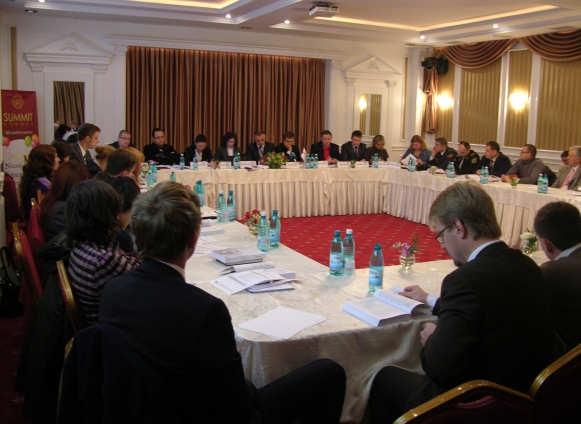


Rights of recruits and servicemen discussed at International Conference

_article_1315581685The rights of recruits and servicemen in the Eastern Region of Moldova is virtually a taboo issue for the authorities in Chisinau, as civil society has undertaken to ring alarm bells on the illegalities and difficult situations faced by them. Young men are recruited and enrolled forcibly in illegal paramilitary units, and once there, they are humiliated and often subjected to inhuman treatment, without being able to defend their most basic rights. This formed a key part of discussions at the International Conference titled “The Rights of Recruits and Servicemen in Moldova’s Eastern Region: A Parallel with other Conflict Areas in the CIS”, which took place in Chisinau on September 8.

According to Ion Manole, the director of the Promo-LEX Association, the Republic of Moldova is a unique state. “There are three different kinds of armed forces on its territory: the legitimate armed forces (The National Army), the Russian Army (which is stationed against the will of the Moldovan authorities and at variance with the commitments assumed at the international level by the Russian Federation), and the illegitimate paramilitary forces. This leads to severe violations of human rights of thousands of people living in the region. On one hand, the region’s administration has been violating the legal norms and human rights for twenty years now, while the Moldovan authorities have limited themselves to monitoring the situation, thus neglecting their positive duty to protect the rights and interests of the people living in the area. This amounts to discrimination of over 500,000 people by the Moldovan authorities”, said Ion Manole.

Attending the event, Brig. Gen. Iurie Dominic, Chief of the General Staff and Commander of the National Army, emphasized the importance of establishing a dialogue between the armed forces and civil society and the necessity of undertaking joint initiatives to raise awareness and understanding of human rights among both the military and civilians.

The conference participants also spoke about the army reform processes in the CIS countries, the conflict regions of South Ossetia and Abkhazia, and about the status and observance of the rights of military personnel, with information presented by representatives of the Moldovan Ministry of Defense as well as civil society members from Ukraine, Russia, Belarus, Armenia and Tajikistan.

In an attempt to explain the legal status of military forces in the Eastern Region of Moldova, Prof. Valeriu Cuşnir, Habilitated Doctor of History, said that the non-state military formations in the region were formed in contravention of the national and international law. “According to the Constitution of the Moldavian SSR, only the Supreme Soviet, as the highest organ of state power, was authorized to adopt measures within the limits allowed by the Constitution for the state’s defense and security. Any other authority, body or person had no legal power in the field of state defense and security, including the authority to set up military units. In other words, the paramilitary formations created on the eastern side of the Nistru are illegal in essence; moreover, they pose an increased social threat to national security”, said Valeriu Cuşnir.

Maj. Gen. (res.) Victor Gusleacov said the paramilitary forces in the Transnistrian region were established under the 1992 Ceasefire Agreement between Moldova and Russia. As the document was never ratified by the Moldovan Parliament or by the Russian Duma, as dictated by international norms, it remains illegal, and so is the presence of the paramilitary forces.

Pavel Shmakov, an independent expert based in Khabarovsk, Russia, after visiting one Russian military unit stationed in the Transnistrian region, highlighted the deficiencies in the local norms that are supposed to protect the rights of military personnel. According to him, a very serious issue is that servicemen are unable to get effective remedy for abuses and violations.

Concerning the rights of the military in the Transnistrian region, lawyer Alexandru Zubco of Promo-LEX stated: “The young recruits in the Transnistrian region, who are in fact citizens of Moldova, are forced, on the territory of Moldova, to serve an illegitimate regime by being enrolled into illegal paramilitary units. If they refuse ‘enrollment’, they are prosecuted, penalized and sentenced to prison. According to unofficial statistics, each year over 400 young men become wanted persons for ‘draft evasion’. Conscripts often complain of physical abuse, ill treatment, extortion and other forms of violence in the military units based in the Eastern Region. According to the lawyer, the phenomenon of ‘forcible enrollment’ essentially amounts to kidnapping.

International experts and civil society members from the countries participating in the Conference highlighted the importance of such an event for consolidating efforts and capacities to promote international standards for the observance of recruits’ and conscripts’ rights.

The event was attended by representatives from the Moldovan Parliament, the National Army, the Ministry of Internal Affairs, the Prosecutor General’s Office, Military Centers and District Military Division, as well as by international experts and civil society members, including from the Transnistrian region.

The conference was held as part of the trans-border cooperation project titled “Transnational Human Rights Network for Conscripts: Empowering Young People under State-Enforced Discrimination” funded by the European Union through its European Instrument for Democracy and Human Rights (EIDHR). The project is implemented by the London School of Economics and Political Science and the Promo-LEX Association as one of the local project partners.

For more details, contact: Carolina Bondarciuc, Public Relations Officer
Tel: (22) 450024, GSM: 069637849, e-mail: [email protected]