Resolution on the Steps to be Taken to Ensure the Right to Education in the Eastern Region of Moldova (Transnistria)

We, the undersigned, counsels of the applicants in the case of Catan and others v. Moldova and Russia, (applications nos. 43370/04, 8252/05 and 18454/06) and the principals of the Latin-script schools based on the eastern side of the Nistru: Theoretical Lyceum “Evrika” in Rybnitsa, Theoretical Lyceum “Alexandru cel Bun” in Bender, Theoretical Lyceum “Stefan cel Mare si Sfint” in Grigoriopol,

considering the judgment of the European Court of Human Rights of 19 October 2012 which recognized the violation of the right to education of the 170 applicants by the Russian Federation,

considering the findings as well as the conditions that led to the violation of the applicants’ right to education,
in hopes that the crisis of the education system in the eastern region of Moldova will be overcome,

Are requesting the authorities of the Republic of Moldova; Ukraine as a state involved in mediating the settlement of the Transnistrian conflict; the U.S., the EU and the OSCE as observer parties; and in particular the Russian Federation, which was recognized as a state responsible for violating the right to education in the region by extensively supporting the separatist regime, to take all the steps towards carrying out the Judgment of the European Court of Human Rights of 19 October 2012 on the aforementioned case.

In particular, we are requesting that all the diplomatic and coercive actions available to the parties be taken to ensure the following:

1. Remove all provisions from the so-called legislation of the region which restrict the use of the Romanian language within the eastern territory of Moldova (Art.6 of the “Law on the Use of Languages”, Art.12 of the “MTR Constitution”, Art.200/3 of the “Code of Administrative Offenses”, Decision of 18 August 1994 on the prohibition of the use of the Latin script in educational institutions).

2. Annul the decisions of the so-called local authorities of the towns of Rybnitsa, Bender and Grigoriopol on the eviction of the aforementioned Lyceums from their original buildings.

3. Return the building on 14 Gagarin St, Rybnitsa, to the Theoretical Lyceum “Evrika”, which it used until eviction; provide the Theoretical Lyceum “Alexandru cel Bun” in Bender with a building appropriate for the needs of its educational program; return the building to the Theoretical Lyceum “Stefan cel Mare” in Grigoriopol, which it used until its eviction in 2002.

4. Annul the requirement of educational institutions that follow a curriculum approved by the Ministry of Education of Moldova, or which are willing to use such a curriculum in the region, to register and obtain authorization with the so-called registration bodies of the MTR.

5. Remove any restriction on the bringing in of books, textbooks and other materials necessary for the good functioning of the educational institutions using the Latin script.

6. Forbid discrimination and intimidation campaigns, which have been tolerated and at times orchestrated by the separatist administration, in particular acts of vandalism and hooliganism, against those willing to receive education in Romanian.

7. Ensure that all payments in respect of damages and costs awarded by the Judgment are made within the specified time.

Further, we are calling on the Russian Federation to cease its open support, at variance with its international commitments, for a regime that seriously violates human rights, which support has been specified in paragraphs 39 – 41 of the ECHR Judgment.
At the same time, the Promo-LEX Association will further monitor the observance of the right to education in the Transnistrian region as well as the process of carrying out the Judgment of 19 October 2012.

Signers
Ion MANOLE, Counsel, Executive Director of the Promo-LEX Association,
Alexandru POSTICA, Counsel, Lawyer, Promo-LEX Human Rights Program Director,
Eugenia HALUS, Principal of the Theoretical Lyceum “Evrika”, Rybnitsa,
Maria ROIBU, Principal of the Theoretical Lyceum “Alexandru cel Bun”, Bender,
Eleonora CERCAVSCHI, Principal of the Theoretical Lyceum “Stefan cel Mare”, Grigoriopol

22 October 2012


The European Court of Human Rights finds Russia guilty in the cases of Moldovan schools using the Latin script in the Transnistrian region of Moldova

The European Court of Human Rights finds Russia guilty in the cases of Moldovan schools using the Latin script in the Transnistrian region of Moldova

On October 19th, 2012, the Grand Chamber of the European Court of Human Rights ruled on the cases of Catan and v 27 Others v. Moldova and Russia (no. 43370/04), Elena Căldare and 42 Others v. Moldova and Russia (no. 8252/05), Eleonora Cercavschi and 98 Others v. Moldova and Russia (no. 18454/06).

The European Court of Human Rights held, unanimously, that there had been a violation of Article 2 of Protocol No. 1 (right to education) in respect of the Russian Federation and, that there had been no violation of Article 2 of Protocol No. 1 to the European Convention on Human Rights in respect of the Republic of Moldova. Additionally, the Court held that it was not necessary to examine separately the applicants’ complaints under Article 8 or under Article 14 in conjunction with either Article 2 of Protocol No. 1 or Article 8. The Court held that Russia is to pay one million and twenty thousand EUR in respect of non-pecuniary damage and fifty thousand EUR for costs and expenses.

The applicants are citizens of the Republic of Moldova and inhabitants of the Transnistrian region, part of the sovereign territory of the Republic of Moldova but currently under the de facto control of Russian Federation-backed separatists. The cases were logged before Court in 2004 and 2006 by parents, teachers and pupils from Ribnita, Tighina (Bender) and Grigoriopol from Transnistrian region of Republic of Moldova and concerns violations of the rights to education, private life and freedom from discrimination.

In 1992 control of the eastern part of Moldova was taken by violence and military support from outside. The self-proclaimed administration initiated the adoption of a “law” which sought to prohibit the use of Latin alphabet for Romanian language (defined as Moldovan) from all public fields of life in the region. Thus, the Cyrillic alphabet was imposed on the region’s educational institutions, pupils and parents were forced to accept this linguistic anomaly, a combination of spoken and written language, which is not widely used even in the region.

The applicants in this case, were forced to accept the education of their children against their own beliefs or to resist to many and various pressures from illegal administration in the region.
They have insisted that their institutions remain under the jurisdiction and educational programs of constitutional authorities, the teaching being conducted in Romanian language in its natural form, with Latin script. As a result they were subject to an orchestrated liquidation policy through the siege and blockade of Latin-script schools, intimidation and prosecution, detention and „criminal investigation” of teachers, and threats and harassment of pupils and parents.

Two cases were lodged in the fall of 2004 and the third one was lodged in the spring of 2006. First public hearing was held on 9 June 2009, the case was declared partly admissible 15 June 2010. On 14 December 2010 the Chamber to which the case had been allocated relinquished jurisdiction in favour of the Grand Chamber which held the hearing of 25 of January 2012.

Ion Manole and Alexandru Postica from Promo-LEX Association, representatives of the victims in these cases stated that: “Today’s decision is an historic one given the findings that were made and its consequences on the human rights situation in the region”. We hope that after this decision, the situation of these schools will improve. We will continue our efforts in promoting and defending human rights and democratic values in this region that is dominated by impunity. Human rights are supreme values recognized by the international community and they must triumph in enclosed spaces where grave human rights abuses occur. Thus, we welcome this historic decision long awaited by people from the Transnistrian region of Moldova”.

On behalf of Promo-LEX Association and 170 applicants, Ion Manole and Alexandru Postica express sincere thanks to our litigation partners INTERIGHTS; Open Society Institute, National Endowment for Democracy and Civil Rights Defenders for support; Promo-LEX team involved in litigation process; Rehabilitation Centre for Torture victims “Memoria”, Independent Analytical Centre “Expert Grup”, Educational Centre PRO DIDACTICA, as well as to all those who, during eight years, were involved in preparations, analysis, documentation, expertise, litigation, translation, etc.

For more details please contact:
Alexandru Postica
Human Rights Program Director
Promo-LEX Association
069104851

Ion Manole
Executive Director
Promo-LEX Association
069070800


European Court of Human Rights finds Russia violated right to education of ethnic Moldovans living in Transdniestria

(London 19 October 2012) European Court of Human Rights finds Russia violated right to education of ethnic Moldovans living in Transdniestria.

The Court, in a judgment delivered today, awarded compensation for violations of the right to education of ethnic Moldovans living in Transdniestria, a breakaway region in the territory of Moldova. The applicants – children, parents and teachers – took the case as a result of the adoption of a law by the separatist administration in Transdniestria banning and criminalising the use of Latin script in schools.

The case was taken against Moldova, where the territory is situated, and Russia, as it was critical to the establishment and maintenance of the separatist administration in the region.

Following the introduction of the law in 1994, parents of Moldovan ethnicity faced a dilemma: either to educate their children in a way that was illegal or subject them to an educational system conducted in a way that would leave them without functional literacy skills. Many bravely fought to maintain their linguistic and cultural identity and sent their children to schools that were opened in defiance of the administration and that continued to provide education using the Latin script. The applicants in this case all suffered serious violations of their rights in pursuing these goals. The separatist administration subjected the applicants to harassment, forcing the closure of schools that defied the ban. Parents of children attending these schools were threatened with losing their parental rights and their jobs. The children were forced to attend premises without adequate facilities, where electricity and water supplies were purposely cut off. They were also forced to undertake long journeys to and from school and were subjected to overbearing and intimidating security measures such as bag searches and identity checks.

This campaign reached its height between 2002 and 2004 and its purpose and effect must be considered in the context of the political, social and cultural circumstances in Transdniestria. The breakaway administration, in seeking to align the region with the Russian Federation, has discriminated against ethnic Moldovans resident in Transdniestria and sought to marginalise them. It has, with the support of the Russian administration, introduced measures with the aim of bringing the region closer, in political, social and cultural terms, to the Russian Federation. The Court found that the actions of the separatist administration in this case were consistent with its overall aim to enforce the ‘Russification’ of the Moldovan community living in Transdniestria.

The actions of the Russian-supported administration are a blatant example of discrimination on grounds of language and ethnicity. In that regard it is worth noting that the situation that lead to today’s case has been described by the OSCE as ‘linguistic cleansing’ of ethnic Moldovans from a territory moving ever closer to the Russian Federation. It forms part of the broader cultural and political marginalisation and discrimination of that ethnic group and the geo-political, cultural and ethnic realignment with the Russian Federation.
The Court awarded each of the applicants €6,000 in damages as well as €50,000 jointly in costs and expenses.

The case was taken by lawyers from PROMO LEX, an NGO based in Moldova, assisted by INTERIGHTS, the International Centre for the Legal Protection of Human Rights, based in London.

Alex Postica from Promo-LEX, stated that:
“The decision of the court in the applicants’ favour is important not just because it recognises violations that took place a number of years ago but also because these violations continue to the present day. The Court has asserted the rights of the applicants to be educated in their national language and has directly confronted the illegal actions of the Russian-supported administration within the territory of Moldova. The decision affirms that the rights of people of Moldovan ethnicity cannot be trampled on by an unlawful administration seeking the ‘Russification’ of the territory.”

Padraig Hughes of INTERIGHTS said that:
“The decision of the Grand Chamber is a welcome signal that it will not tolerate legal ‘black holes’ in the territory of the Council of Europe. The Court, through its decision, has ensured that in this case the European Convention on Human Rights has been given meaningful effect and affirmed that ethnic Moldovans in Transdniestria are entitled to legal protections on the same basis as individuals throughout the territory of the Council of Europe.”

More INFORMATION:

Alex Postica, Promo-LEX: 37369070800; [email protected]
Padraig Hughes, INTERIGHTS: +44 (0) 2072783230; [email protected]
www.interights.org/catan


APPEAL regarding the constitutional authorities’ involvement in the case of Alexandru Bejan from Tiraspol

The issue on the functioning of the Latin script teaching schools from the Transnistrian region of the Republic of Moldova remains an actual one. During the last 20 years, the administration of the Transnistrian region has undertaken countless acts of intimidation, persecution and blocking of the activity of educational institutions from the Transnistrian region, which haven’t accepted the control of the administration from Tiraspol, insisting thus to remain under the jurisdiction of the constitutional authorities from R. Moldova. These institutions, parents, scholars, teachers or administrations have been constantly exposed to several attacks of the regional, local administrations and other structures in the region. The last serious attack of these institutions was registered in the summer of 2004, when some of these institutions have been devastated. Thanks to the intervention of international specialized organizations, the activity of those institutions has been resumed. Shortly, after the examination of cases and hearing the parties, the European Court is to decide on 3 of the cases in which parents and teachers complained that their rights are violated.

This time, civil society and constitutional authorities have been informed by Alexandru Bejan and his relatives about the manufacture of a case against him. Alexandru Bejan, supported by his classmates, teachers and relatives, considers that this action is an attempt of the regional administration to compromise again the image of Latin script teaching schools from Transnistrian region.

Bejan Alexandru, born in 1994, has lived until 2009 in Tocmazeia village, Grigoriopol district (which is being controlled by the regional administration, Transnistria), where he has studied in a Moldovan (Romanian) with Cyrillic script teaching school. In 2009, Alexandru together with his family came to Tiraspol. Because except schools teaching in Cyrillic script there has been also functioning “Lucian Blaga” High School (Moldovan (Romanian) with Latin script teaching school), he has chosen to attend this institution in order to study in his native language with Latin script, following his own beliefs. He has been accepted for studying in this high school beginning with the winter session on January, 11th, 2010, even if some of his relatives have advised his parents to forbid him studying at this high school because this might have negative consequences towards their family (due to “increased” attention of the local and regional administrations and structures).

On October, 11th, 2009, Alexandru Bejan assisted, without interfering, in a clash (quarrel) where his classmate was involved. The “investigation bodies” from the region have qualified his colleague’s deed as an aggravated hooliganism and have considered Alexandru’s presence as co-participation (complicity).

Being minor, lacking lawyer’s assistance, in the absence of his parents, maltreated and detained, being under pressure Alexandru has admitted his guilt, without understanding the sense, the circumstances and the consequences. For a sanction which foresees the suspension of execution, Alexandru has unconsciously admitted his guilt. Finally, Alexandru has been sentenced to 6 years of imprisonment with suspension of the sentence execution for 4 years.

On June, 6th, 2012, a release has appeared on the web page of the so-called “Security Ministry” of the Transnistrian region, announcing that a postal terrorist has been identified and brought to justice. Instead, Alexandru Bejan was announced only on June, 12th about the presumed accusation and handed the “indictment.”

On June, 14th, 2012 Promo-LEX Association has been notified by Alexandru Bejan, who communicated us that he is persecuted by the “law enforcement bodies” from Transnistrian region of the Republic of Moldova. Moreover, by using violence, he has been forced to admit committing a presumed terrorist offence. Accusation is entirely based on samples (evidence) obtained by blackmail, violence, pressure and violation of the right to defense. The social context in which Alexandru is being harassed for his beliefs and the fact that he studies at a scholar institution dissident to the illegal regime from Tiraspol can’t be excluded. After June 14th, 2012 mass media on the right bank of Nistru River has published multiple articles about Alexandru’s situation and that he is prosecuted by the “special” services of the regime.

Following these news, on June, 25th, 2012, a release has appeared on the web page of the so-called “Ministry of Security” (http://kgb-pmr.com/news/80), offering compromising information about Alexandru’s personality. Moreover, by the end of the release there can be observed a direct threat towards Alexandru Bejan, concerning his imprisonment. Thus, the risk of Alexandru’s Bejan imprisonment is rather founded.

On October, 15th, 2012 the next “court hearing” will take place and a final sentence might be pronounced. Along the way, Alexandru Bejan has been assisted by two “lawyers” from the Eastern region of Moldova, but both of them have finally refused providing him legal assistance, because they have strongly recommended him to admit his guilt and he has been categorically denying committing any offence.

We want to mention that the practice of applying pressure, blackmail and limitations of any kind is widely used by the so-called law enforcement bodies from the Transnistrian region which are investigating criminal cases. This practice has been repeatedly reported in several cases lodged before the European Court of Human Rights.

In the light of the above described situation, we request:
– to set a general ban on using illegal practices in documenting alleged crimes;
– to allow the monitoring of the situation of detainees who have been sanctioned by the so-called courts in the region;
– to intervene in the situation of Alexandru Bejan and not allow his conviction based on alleged evidence obtained by threats and unacceptable methods.


DOC – APPEAL regarding the constitutional authorities’ involvement in the case of Alexandru Bejan from Tiraspol


Promo-LEX Association and Association for Efficient and Accountable Governance is selecting an International Expert – Extended deadline for applications

Promo-LEX Association and Association for Efficient and Accountable Governance is selecting an International Expert

*Extended deadline for applications

During the period 19.09.2012 – 19.09.2014, Promo-LEX Association, in partnership with Association for Efficient and Accountable Governance (AGER) will implement the Project “Monitoring justice sector reform for increased Government’s accountability”. The project is funded by the European Union through the European Instrument for Democracy and Human Rights.

The overall objective of this action is to strengthen the capacity of the civil society to perform democratic oversight of the reform processes undertaken in the Republic of Moldova.

The project will concentrate its efforts in monitoring the implementation of the Justice Sector Reform Strategy (JSRS) throughout the country by involving a network of 43 national observers. In Chisinau, experts will also provide input on legislative drafts, adopted laws and regulations, on their conformity with the declared reform objectives and European standards.

During the first stage of the project, a Monitoring and Evaluation Methodology should be designed. It will then be applied throughout the project for assessing the progress made in implementing the JSRS.

For more details about the Justice Sector Reform Strategy please visit
Strategy for Justice Sector Reform 2011-2015

In this regards, Promo-LEX and AGER request for expression of interest from International Expert, who will, in cooperation with one National Expert, develop the M&E Methodology and a concise advocacy toolkit, which will help the implementing organizations to promote their recommendations among stakeholders.

The international expert is expected to perform the following tasks:
• Lead and manage the mission;
• Design the detailed monitoring and evaluation scope and methodology (including the methods for data collection and analysis) and of the advocacy toolkit;
• Decide the division of labour within the experts’ team;
• Participate in half day presentation and launching conference;
• Lead the one and half day training session on M&E techniques for the observers;
• Submit the final version of the M&E methodology and the advocacy toolkit.

Qualifications of Expert
Qualifications:
• Master degree in law, human rights or public policies.

General Professional Experience
• Minimum 8 years of relevant professional experience in justice and home affairs sector;
• Experience in developing M&E methodologies shall constitute strong advantage.

Specific Skills
• Fluency in written and oral English. Good working knowledge of Romanian or Russian language will constitute strong advantage.
• Excellent understanding of the central public authorities reform strategies and approaches, with focus on justice sector;
• Good communications skills with relevant stakeholders;
• Recent previous working experience in Moldova and Eastern European countries is an advantage.

To apply, interested candidates should submit the following documents:
• CV;
• The technical offer, comprising a concept of the M&E Methodology to be developed;
• Financial offer;
• List of activities/outputs produced previously, relevant to this assignment

For further details, please consult the attached ToR.

The application should be submitted in English at: [email protected]
Deadline for applications was extended till October 18, 2012

For additional information please contact:
Olga Manole, Project Coordinator.
Tel: (+373 22) 44 96 26
Fax: (+373 22) 45 00 24
E-mail: [email protected]

* Please note that only shortlisted candidates will be contacted.


DOC – ToR_International_Expert


Defending human rights in the Transnistrian region is not an option, it’s an imperative!

_article_1348753923During 21-23 September 2012, Promo-LEX Association held a training event themed “Defending human rights in the Transnistrian region by using national and international instruments and mechanisms”.

The training was organized as part of the project “Strengthening Civil Society Capacity to Promote and Defend Human Rights in the Transnistrian Region of Moldova”, implemented with financial support offered by Civil Rights Defenders.

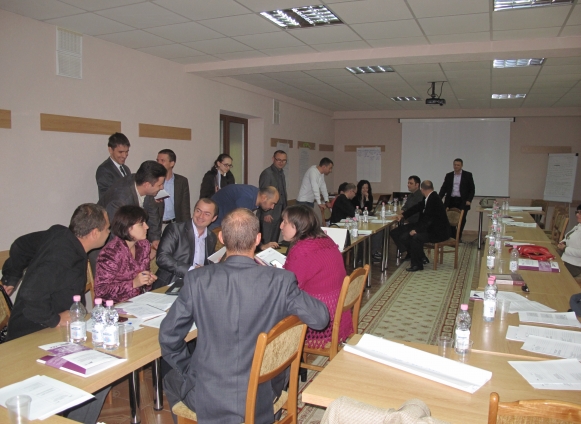
The main goal of the training was to improve expertise and skills of NGO representatives, lawyers and human rights activists in employing national and international mechanisms for defending human rights in the Transnistrian region of Moldova.
The training’s theoretical sessions discussed the following issues: basic human rights concepts; the importance of human rights observance in conflict areas; findings by the UN, CPT and other special rapporteurs on the human rights situation in Transnistria; the application of alternative, non-legal mechanisms for defending human rights and the protection of human rights defenders; defending human rights in Transnistria based on the de facto legislation applied in the region; the obligations of the Moldovan authorities with respect to the human rights violations in the region and the limits of capacities of the law enforcement agencies; the role of the Joint Control Commission, the role of mediators and other foreign stakeholders; the responsibilities of Russia following ECHR judgments on human rights violations in the Transnistrian region; and others.

During practical sessions, participants used actual cases as examples to try on the roles of different actors in the process of defending certain rights, acting as representatives of either the victim or the government and proposing steps for settling the problem. The participants also simulated the procedure of complaining to the ECHR of human rights violations, using as examples actual cases from Promo-LEX Association’s case-load.

The training participants, mostly lawyers, agreed that people living in the eastern districts should enjoy their rights equally with all the residents of the Republic of Moldova. “It is unjust that they cannot make use of the national or international human rights defense mechanisms to which Moldova is a party”, said one participant. The participants also appreciated the way the trainers, Promo-LEX experts, presented and provided arguments for the practical aspects of defending human rights in the region.

“It is extremely important that every resident of the Transnistrian region is aware that he or she is under the protection of the European Convention [on Human Rights], ever since Moldova ratified the Convention on 12 September 1997, and it’s our duty to explain this to as great as possible number of persons”, said Ion Manole, executive director of Promo-LEX Association.

Pavel Postica, Promo-LEX lawyer, said: “The eastern region of Moldova is home to roughly 500,000 people who are under the de facto jurisdiction of two governments, of Moldova and that of Russia. It is unfortunate that the people living in the region and the human rights defenders don’t make full use of this advantage by taking their complaints to the ECHR, the only court of law that can impartially administer justice. At the same time, we would like to praise those who already had the courage and initiative to complain to the European Court of human rights violations committed by representatives of the region’s administration or by agents of the governments of Moldova or Russia”.

Promo-LEX Association has a vast experience in defending human rights before the European Court. Since 2004, Promo-LEX has lodged over 40 applications with the ECHR concerning human rights violations committed in the Transnistrian region. In 2010-2011, the Court notified in an urgent manner the respondent governments, Moldova and Russia, on 10 of those applications, and hearing for some of them was fast-tracked. Further, on three applications where Promo-LEX represents 170 plaintiffs, (Catan and others vs Moldova and Russia, Căldare and others vs Moldova and Russia, and Cercavschi vs Moldova and Russia) the Court on 15 June 2010 pronounced admissibility decisions and, following public hearings on 25 January 2012, a judgment on the merits is now expected to be pronounced by the European Court’s Grand Chamber.


Appeal to the Russian Authorities to Reject Repressive Draft Legislation on “Foreign Agents”

On July 6, the State Duma of the Russian Federation passed in the first reading a package of amendments to existing legislation that would allow a broad spectrum of Russian NGOs to be classified as “Foreign Agents.” Such a designation would not only stigmatize organizations, but would subject them to discriminatorily severe auditing and reporting requirements, and potentially catastrophic financial and/or legal sanctions for any violations. Although supporters of this legislation paint it as the equivalent of Foreign Agent Registration legislation in other countries, this is patently untrue. The Russian draft not only applies to organizations operating in the interest of foreign governments but to any non-commercial organization that receives money from any foreign source for any purpose while also engaging in any type of “political activities,” including such broadly-accepted work as policy advocacy on a national or even local level. This legislation clearly violates the Russian Federation’s international commitments to respect its citizens’ rights to freedom of association and participation in political affairs. The Duma should reverse course and reject the draft law. If passed by the Duma it should be rejected by the Federation Council or vetoed by President Putin.

The full text of the Appeal can be here.

The Civic Solidarity Platform unites 46 civil society organizations committed to improving the human rights situation in Europe, Eurasia and the US. It provides a common space for these groups to share their experience in conducting research, advocacy, and public organizing and to find new channels of communication and improved methods for working cooperatively. Its aim is to serve as a conduit through which civic activists can build alliances, strengthen mutual support and solidarity, and improve their influence on national and international human rights policy. The Civic Solidarity Platform was born out of recognition that nongovernment groups need to work in a more effective and coordinated way in order to counteract negative trends in the field of state protection for human rights and defense of democratic principles.


APPEAL in connection with the upcoming formal 5+2 negotiations in Vienna

On 21 July 2009, ALEXANDRU URSU, an officer of the Moldovan Ministry of Internal Affairs (police inspector in the village of Hagimus, Căușeni district) was arrested by the illegitimate militsiya forces in Bender town. Later, an illegitimate court arbitrarily deprived him of freedom, sentencing him to 15 years in prison.

According to his family and lawyers, Alexandru Ursu is now being held in Prison no.1 in Hlinaia, Grigoriopol. He is held in a cell with inmates who suffer from hepatitis, tuberculosis and HIV/SIDA. In January 2012, Alexandru Ursu suffered a stroke, which may reoccur because of the inhuman detention conditions.

Promo-LEX Association , which monitors the situation of human rights in the Transnistrian region, expresses its concern for the security and freedom of the police officer “sentenced” by the de facto authorities. Art.29 of Law no.416 on Police states that “the police officer is an inviolable person and enjoys state protection. His/her personality, honor and dignity are protected by law”.

Promo-LEX Association considers that Alexandru Ursu’s detention is a serious problem for the Moldovan authorities, as the residents and citizens living in the eastern region of Moldova continue to remain defenseless against human rights violations.

On 21 July 2012 it will be three years since Ursu Alexandru was sentenced by the illegitimate forces in Tiraspol. Throughout this period, the Moldovan authorities haven’t undertaken serious efforts to free the police officer from illegal detention.

Considering the above and in light of the upcoming formal 5+2 negotiations on the Transnistrian settlement in Vienna on 12-13 July 2012, as well as noting the statements of the Moldovan government concerning the intention to discuss this case during the 5+2 meeting in Vienna, we REQUEST:

the INCLUSION on the Vienna meeting agenda of discussions on the situation of Alexandru Ursu with a view to securing his immediate and unconditioned release from illegal detention;

– the active and effective INVOLVEMENT in defending the rights of the illegally sentenced police officer Alexandru Ursu;

the INTENSIFICATION of efforts to identify a reliable, legal and effective instrument for defending and guaranteeing fundamental human rights and freedoms for the residents and citizens living in the Transnistrian region.

For further details please contact: Alexandru Postica, Lawyer, Promo-LEX Association Program Director: Phone: (22) 31 09 45, GSM: 069104851, e-mail: [email protected]


DOC – APPEAL in connection with the upcoming formal 5+2 negotiations in Vienna


APPEAL in Support of Victims of Torture

June 26 is the United Nations International Day in Support of Victims of Torture, an occasion for us to recall to the entire world that torture is a severe human rights violation. Torture destroys people’s sense of dignity and human worth. In some cases, torture is part of a deliberate state policy of instilling fear and intimidating its population. Its consequences are extremely serious for women, men or children alike. It is in light of this that we find with deep regret that twenty-five years since the entry into force of the Convention against Torture, this cruel and dehumanizing practice remains pervasive in some regions around the globe. Even when regimes change, torture often persists and a culture of impunity remains, constituting an obstacle to progress in society.

Rehabilitation can help victims of torture continue and rebuild their lives after trauma. However, rebuilding the life of a person whose dignity has been hurt or destroyed through inhuman treatment and torture necessitates time and can be only the result of a complex long-term assistance – medical, psychological, legal and social.

On the occasion of the International Day in Support of Victims of Torture:

1) we express our solidarity with the numerous victims of torture in the Republic of Moldova, including in the Transnistrian region, who suffered or continue to suffer acts of torture or their consequences, as well as with their families;

2) we recall the obligation of the Republic of Moldova not only to prevent torture, but also to provide all torture victims with effective and prompt redress, compensation and appropriate social, psychological, medical and other forms of rehabilitation;

3) we insist that urgent and unconditioned steps be taken to comprehensively monitor and defend fundamental human rights and freedoms of persons held in prisons in Moldova’s Transnistrian region, in particular of the persons who sought assistance on claims of torture and inhuman treatment;

4) we urge the Government to contribute to the United Nations Voluntary Fund for Victims of Torture (UNVFVT), alongside other State Parties to the UN Convention Against Torture.

This Fund is very important for numerous torture survivors worldwide as it is one of the major specific sources of funding for rehabilitation services around the world. Most rehabilitation centers worldwide, including RCTV “Memoria”, rely financially on this Fund to realize one of the most basic rights of the victims of torture – the right to free medical and social rehabilitation, which is guaranteed by all the relevant international instruments, including Art.14 of the Convention Against Torture, to which Moldova is a party.

We recall that the Rehabilitation Center for Torture Victims “Memoria” is the only of the kind in Moldova. Since its inception in 2000 it has made considerable efforts to meet the rehabilitation needs of torture survivors from the present and the past, including from the Transnistrian region, without adequate support from the state.

We are expecting concrete actions and a positive reaction to this Appeal, both from the authorities of Moldova and from the international institutions accredited in Moldova and for which democratic values and respect for human rights represent a priority.

Only by providing direct support to victims of torture can we prove the unequivocal determination and commitment to fight torture and impunity!

26 June 2012
Chisinau, the Republic of Moldova

For additional details contact:
– Ludmila Popovici, RCTV Memoria,
– Ion Manole, Promo-LEX,
– Lela Metreveli, „Human Rights Embassy”,
– Natalia Mozer, „Mothers for Human Rights”.


The Member organizations of the Platform

The Member organizations of the Platform for International Cooperation “Civic Solidarity” have signed a joint APPEAL to the European Union about its policies on human rights in Central Asia.

It is five years since the European Union adopted its Strategy for a New Partnership with Central Asia. As European Union foreign ministers prepare to take stock of progress so far, the civil society organizations, undersigned an Appeal where would like to suggest ways to improve the effectiveness and impact of EU action to promote human rights in Central Asia.

The EU Central Asia Strategy, which was endorsed by the EU governments in June 2007, provides a framework for increased cooperation between the EU and Kazakhstan, Kyrgyzstan, Tajikistan, Turkmenistan and Uzbekistan in political, economic and other areas. It also identifies human rights as a key element in EU-Central Asia relations and sets out that the EU will step up support for human rights in the region, inter alia by conducting “regular and results-oriented” human rights dialogues with the Central Asian governments and by cooperating closely with the UN, the OSCE and other international actors in this area.

Promo-LEX Association as a member of the Platform for International Cooperation “Civic Solidarity”, since 2011, undersigned the Appeal.

Created in 2011 the “Civic Solidarity” Platform includes over 40 organizations from Europe and Asia and is based on values such as human rights and human dignity, non-violence and peace culture, human rights and freedoms rule against state interests.

The text of the Appeal is available here.

For more detailed information please contact: Alexandru Postica, Lawyer of the Association Promo-LEX: Tel: (22) 31 09 45, GSM: 069104851, e-mail: [email protected]