The short film contest within the “16 days of actions on combating violence against women” Campaign selected its winners

_article_1386599400On December 9, 2013 took place the winners selection Ceremony of the short films within the “16 Days of Actions on combating  Violence against Women” campaign.

The jury selected the following winners:

I Place – Pietraru Victor
II Places – Bejinaru Valeria
III Place – Gușan Adrian

The Ceremony was opened by Victoria Melnic, rector of Academy of Music, Theatre and Fine Arts, which underlined the need to eliminate the phenomenon of domestic violence in society and welcomed the involvement of students in a public awareness raising campaign on this topic.

During the event, nine short films were projected, and after the jury deliberation, the winners were nominated and awarded.

“The idea of ​​the public awareness raising campaign on domestic violence and the activities that were carried out belongs to Promo-LEX team,  which in the absence of any financial support, got involved voluntarily, because great things can be achieved including without expecting a financial remuneration. It is important to participate, contribute, get involved in solving the problems that surround us, “said Ion Manole, Executive Director, Promo-LEX Association.

Greetings and a message of encouragement to young people came from Ion Bodrug, Chief of the General Inspectorate of Police: “Only through a joint effort we are able to combat domestic violence, especially by involving young people who must discuss and send the message of non-violence “.

“Cinema sometimes makes mistakes, by filling the screens with violence and all sorts of spectacular and then weak or sensible viewers try to repeat what they see on the screen. So, we are doing the opposite thing in order to attract attention and to solve these problems for our century, such as violence against women”, said Vlad Druc, Film Director, Head of Multimedia Department within the Academy of Music, Theatre and Fine Arts

The prizes were awarded by the State Enterprise “Cartuș” and consisted of an electronic tablet for the first place, second place – a portable hard drive and third place – a USB memory stick.

The event is part of the activities carried out in the social campaign to prevent and combat domestic violence implemented by Promo-LEX and the General Inspectorate of Police during the period 25 November to 10 December 2013.

For more details, contact: Carolina Bondarciuc, Press Officer: GSM 069637849, Tel / Fax (+373 22) 450024, e-mail [email protected].


Films against domestic violence

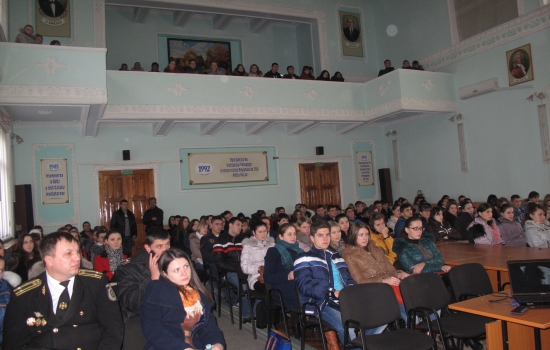
_article_1386238047On 3 and 4 December 2013 took place two social evenings within the “16 Days of Actions on combating Violence against Women” campaign. 9 short films that were created by second year students of the Multimedia Department, of Academy of Music, Theatre and Fine Arts were shown during the events. At the same time, discussions on domestic violence were held.

The social evening took place in the premises of high education institutions in Cahul and Balti cities, State University “B.P Hașdeu” and State University “Alecu Russo”. The events were attended by 250 young people.

The organizers of the events, Promo-LEX and the General Police Inspectorate talked about preventing and combating domestic violence.

During the discussions, the students had the possibility to ask questions about the causes of domestic violence, protection measures for victims, punishment of offenders and where victims and perpetrators can get help. Young people were also informed about the legal framework on domestic violence, authorities responsible for law enforcement, protection and enforcement measures, as well as about the services provided by specialized nongovernmental organizations, including Promo-LEX .

The films presented during events, participate in a Contest launched by Promo-LEX and the General Police Inspectorate. The best three of them that will be awarded. We invite you to watch movies/short films and appreciate the one you liked the most. These can be found on Promo-LEX Association Facebook webpage and YouTube channel.

For more details, contact: Carolina Bondarciuc, Press Officer: GSM 069637849, Tel / Fax (+373 22) 450024, e-mail [email protected].


No significant progress in Justice Sector Reform Implementation was made during the third quarter of 2013

_article_1384530092During a Round table on 15 November 2013, Promo-LEX and the Association for Efficient and Responsible Governance launched the Third Quarterly Monitoring Report on the implementation of the Justice Sector Reform Strategy (monitoring period 1 July – 30 September 2013).

The monitoring effort focused on the observation of 2 basic components: assessing the implementation of actions included in the Justice Sector Reform Strategy Action Plan, and monitoring court trials. The Report analyzed 2 categories of actions, as follows: actions due for implementation by the end of third quarter of 2013 and actions overdue by 30 July 2013.

According to experts one cannot speak of significant progress in implementing the actions outlined under the Action Plan for JSRS implementation. Thus, of a total 209 actions due for completion by 30 September 2013, only 126 were completed, while the 83 remain unfulfilled by the end of Quarter III, 2013, which represents a total completion rate of 60% (compared with 59% at the end of the previous Quarter). It is also true that the Government confronted with a major political crisis, which delayed certain processes, including the signing of an agreement on the delivery of EU budgetary support to the justice sector. After the confirmation of a new Government, some of the planned actions were accelerated, but the responsible institutions must make considerable efforts to fulfill the overdue actions along with the actions due for the next period.

Referring to the performance of the institutions involved in the implementation of the JSRS and found the following. In 2012 and the first three Quarters of 2013, National Legal Aid Council and the Ministry of Internal Affairs implemented less than a half of the actions in their responsibility, achieving n implementation rate of 40% and 25% respectively. The National Anticorruption Center, Ministry of Justice, Prosecutor General’s Office, and the Center for Human Rights of Moldova achieved a better implementation rate. There are several institutions that reached a 100% implementation rate, and these are the National Integrity Commission and National Council for Reforming the Law Enforcement Bodies. However, the Action Plan contained a very small number of actions to be implemented by these institutions, and, most importantly, the actions assessed as implemented in accordance with the performance indicators need to be monitored in terms of their real impact.

The electronic version of the Report is available under Publications on www.promolex.md and www.monitor.md.

This Report was implemented as part of the project “Monitoring the Justice Sector Reform Strategy to Increase Government’ Accountability”, implemented by Promo-LEX and the Association for Efficient and Responsible Governance with the financial support of the European Union.

For more details, please contact: Carolina Bondarciuc, Press Officer, GSM:069-637-849, Tel/Fax (+373 22) 450-024, Email [email protected]


The manslaughter case of Vadim Pisari will be examined in an urgent manner by the ECHR

The case of the 18-year old man, Vadim Pisari, killed on 1 January 2013 by a Russian soldier of the peacekeeping mission, will be examined in an urgent manner by the European Court of Human Rights.

Recently, the European Court of Human Rights, communicate to the defendant Governments the case of Vadim Pisari vs. Republic of Moldova and the Russian Federation (case nr. 42139/12). The plaintiffs are the parents of Vadim Pisari, who live in Parata, Dubasari rayon.

On 1 January 2013, at approximately 7am, Vadim Pisari, who was driving a car, was passing the territory of a peacekeeping post, installed between the town of Vadul lui Voda, Chisinau, and the village of Parata, Dubasari. The Russian soldier had shot from behind the moving vehicle, and had wounded, deadly, Vadim Pisari, who died in the Emergency Hospital from Chisinau on the same day.

The authorities of the Republic of Moldova have initiated a criminal investigation on this case. Despite this, the Russian soldier was not detained, but instead was transferred by the authorities of the Russian Federation to a military unit in the region of Breansk, Russian Federation, where he is currently residing.

The Prosecutor General of Moldova has recognized the status of a victim of the plaintiffs during its criminal investigation procedures. Later, the same institution has informed the plaintiffs that it issued an international search warrant for the Russian soldier who killed Vadim Pisari. In December 2013, the Prosecutor General office of Moldova informed the plaintiffs about the refusal of the Russian authorities to cooperate within the investigation and the fact that the Russian soldier was acquitted of any accusation, because in his facts lacked the elements of a criminal offence. The same institution, in March 2013, informed the plaintiffs about the need to suspend the criminal procedures because they lacked access to the suspect who had evaded responsibility. At the moment, the case is suspended because there is a need for procedural actions to be taken by the Russian Federation.

The Russian Minister of Foreign Affairs had announced that the Russian authorities would carry out a parallel investigation to shed light on the circumstances of the case, and the results of the investigation would be announced by the end of January 2012.  The requests of the plaintiffs addressed to the Russian Federation were ignored repeatedly, and the plaintiffs were refused the access to the procedural documents and were refused to be recognized as victims in the case that was initiated by the Prosecutor General of the Russian Federation. At the end of 2012 the plaintiffs were informed about the fact that the criminal case initiated on the fact of death of Vadim Pisari was terminated. At the same time, the plaintiffs were not sent any prescript in this regard. The other attempts of the parents of Vadim Pisari to find out other data or information about the investigation carried out by the Russian authorities, have failed.

In front of the High Court, the plaintiffs have claimed the breach of Article 2 of the Convention (the right to life) as well as the fact that the investigation of the circumstance of the killing of their son, undertaken by both the authorities of the Republic of Moldova and those of the Russian Federation, were not efficient.

The plaintiffs are being represented by the attorneys and lawyers of the Promo-LEX Association.

For further details, please contact: Alexandru Postica, Director of the Human Rights Program, Promo-LEX Association, attorney, phone: (22) 450024, cell: 069104851, e-mail: [email protected].


Judges and Prosecutors Trained to Protect Personal Data

_article_1383747695A seminar on “Uniform procedures for prosecuting cases of human rights violations in Transnistria – reception and transmission of personal data” was held on 6 November 2013. During the event, several judges and prosecutors were trained and discussed the protection of personal data as well as procedures for prosecuting cases of human rights violations in the Transnistrian region.

Veronica Mocanu, PhD of Law, lecturer at the State University of Moldova, taught on the general principles of processing and protecting personal data; limitations of access to personal data; and a comparative approach to cross-border exchange and transfer of personal data.

Promo-LEX Executive Director, Ion Manole, said, with referrence to the cooperation between state institutions and similar bodies from the left bank of Nistru river entailing exchanges of personal data: “In certain situations and cases we stated an actual collaboration, although largely informal and not public. We do not see a problem in that sense so long as the law is observed, and, in terms of protecting personal data, we do not see a problem in the collaboration so long as state agencies do not provide these data to groups or institutions on the left bank, thus violating the law. We see this collaboration only in one direction, that is to say that bodies from the left bank could provide certain information to the central constitutional authorities to help them manage certain situations. We cannot admit however situations when the constitutional bodies provide information to illegally formed groups that control a part of the ​​Moldovan territory.”

“On the other hand,” Ion Manole added, “transmitting personal data to individuals or entities that are not subject to national or international legislation constitutes a serious violation of the principles of personal data protection, provided by the Convention for the Protection of Individuals, with regard to automatic processing of personal data, and general observance of human rights.”

Attention was drawn to the need to tackle the issue of personal data transfers in the context of the General Prosecutor Office’s criminal proceedings against representatives of the separatist regime, and the general obligations of the national authorities with regard to human rights violations in the Transnistrian region.

A session of the seminar was devoted to presentations and discussions about the national and international jurisprudence on the protection of personal data. Examples were brought from the ECtHR practice, when privacy violations occurred from undue handling of personal data, but also from the practice of national courts, when damages were paid for violating personal data management procedures.

The event was organized by the National Institute of Justice, with support from the Promo-LEX Association. The event was part of the project “Promoting Human Rights and Strengthening Civil Society in the Transnistrian Region of Moldova”, implemented by Promo-LEX with the financial support of the National Endowment for Democracy (NED).

For more details, please contact: Carolina Bondarciuc, Press Officer, GSM: 069-637-849, Tel/Fax (+373 22) 450-024, Email [email protected]


INFORMATIVE NOTE on the Law on ensuring and restoring public order during public events

To Mr. Dorin Recean,
Minister of Interior of Republic of Moldova

Dear Mr. Minister,

Promo-LEX noted the draft Law on ensuring and restoring public order during public events (hereinafter the bill) prepared by the Ministry of Interior and submitted for public discussion.

In this context, we wish to inform you that, on 2 October 2012, Promo-LEX organized a public debate on the mentioned bill, where objections to the bill were presented. Similarly, lawyers of the Association repeatedly participated in discussions with the authors of the adapted bill, and put forth objections to certain provisions, which are inconsistent with existing legal norms.

Promo-LEX does not preclude the necessity of completing Law No.26 with provisions that regulate the maintenance and restoration of law and order, but following a repeated analysis of the bill, we are concerned with the intention of limiting freedom of assembly expressed in the bill, and suggest to revision the need to adopt an organic law on this matter. In our opinion, this bill has the hidden purpose to remove from use the already enforced Law no.26 on public meetings.

I also want to note that, even if it will be submitted and approved, this bill will fall into disuse. On the other hand, the bill contains several deficiencies, which conflict with existing legislation and the latest reforms promoted by the Ministry.

Without providing an extensive list, we reiterate that the biggest criticisms refer to the duplication or divergence between some norms provided in Law no.26 on public meetings and the debated bill, including:

  • A double notification procedure by requiring organizers of public meetings to notify in writing both the local government and the “territorial authority of the MOI”;
  • Principle of the Law – excluding one of the principles guaranteed by Law No.26, and namely the presumption in favor of holding a public meeting, which may result in the suspension of certain peaceful public meetings;
  • Obligations of the organizers to present an extensive list of information about the public meeting, especially if the meeting will be attended by foreigners;
  • Actors responsible for maintaining and restoring public order – this allows interference of political subdivisions of the MOI (after the MOI reform, it is presumed that the ministry is politically controlled, while some of its subdivisions, namely GPI, are apolitical, based on the method of appointment of the leadership) in the event of interruption of public meetings, and may exclude the police, which is a separate apolitical entity within the MOI, from maintaining and restoring public order;
  • Extended list of situations when a public assembly can be suspended, etc.- if, in its current reading, Law No. 26 provides three situations in which a public meeting may be suspended, the bill in discussion extends this list to 17 situations, which represents a clear and unfounded limitation of freedom of assembly. Moreover, some situations provided in the bill, such as the right to suspend public meetings for breach of public morality, operate with very vague terms that are not defined in the law and could lead to discrimination against certain decisions of the organizers and participants to the meeting.

While we do not want to dwell in detail, taking into account that we had presented the Association’s position on these issues before, we note that this general list of deficiencies is not complete, but we want to draw attention to the most important problems and shortcomings of bill. Moreover, the position of the Association in this regard is identical to the arguments used by the CNP and other specialized organizations.

In the following paragraphs, we will try to provide arguments that confirm the position of the Association of the need to revise the intention of the MOI to promote this bill.

Indeed, according to Art. 2 p. 2 of Law No.26, religious assemblies in the form of official divine services or other traditional events, sports events, cultural, artistic and other entertainment are not subject to the provisions hereof. In discussions, the authors of the bill noted that these meetings are to be handled with utmost care.

However, Art. 24. p. 2 of Law No.26 provides that until the adoption of special laws, the actions referred to in Article 2 para. (2) shall be conducted under the provisions of the current law. Thus separating the conduct of meetings by notifying the MOI, provided in the bill, has no relevance so long as specific rules for the organization of meetings specified in Art. 2 o.2 of Law no. 26 have not been established.

We believe that the introduction of compulsory notification of the MOI for these meetings is not intended to ensure public order, but is a direct interference in the right to conduct these types of meetings. The legislature expressly stated that special legal rules shall be adopted that establish the organization and conduct of these meetings. Thus the bill should not contain any specific rules on notification, therefore Arts. 5 and 6 contain abusive provisions.

With regard to police actions in meetings, we mention the following. Article 72 p.3 of the Constitution sets out the categories of domains that can be regulated by organic law. In our case, Law No.26 provides quite clearly, in Articles 21 and 22, how to suspend and disperse a meeting.

This legal act, which is an organic law, does not establish the need to adopt other organic laws to implement these rules. If the MOI believes that these rules are not clear enough, it should explain these inconsistencies. Note that Parliament Decision No.1275 of 15 February 1993 on the approval of special means and their use by the law enforcement and military carabineers of the Interior Ministry also refers to in the way to intervene to terminate or disperse a mass unrest.

The Interior Ministry submitted the draft organic law, but failed to explain the need for a special law instead of a normative act adopted by the Government. According to Art. 102 p.2 of the Constitution, government decisions are adopted to carry out the laws. Thus the procedures and methods of intervention required under Arts. 21 and 22 of Law No.26 may be provided by a decision of the government.

In conclusion, Dear Mr. Minister, we respectfully request you to revisit the MOI position on the issue, take into consideration the objections mentioned, and inform the Association about your decision.

Sincerely,

Alexandru Postica
Director of Human Rights Program
Association Promo-LEX


DOC – Romanian NOTĂ INFORMATIVĂ asupra Legii privind modul de asigurare şi restabilire a ordinii publice în cadrul evenimentelor publice


Torture and ill-treatment in Moldova including Transnistria : Impunity prevails

_article_1381155108Paris-Chisinau, 7 October 2013. The situation for prisoners in Moldova, including in Transnistria, is dire. Conditions of detention are deplorable ; prisoners and their families are constantly subject to racketeering; torture is practised routinely and in a striking impunity.

These are the findings of a FIDH mission to Moldova, presented in a report launched today in Chisinau, Moldova, with the support of FIDH member organisation, Promo-LEX. FIDH mandated its delegation to visit prisons and to meet both civil society experts and the relevant  authorities  in Moldova, including the breakaway region of Transnistria.

The 2009 post-electoral violence and arbitrary arrests of protesters brought to light Moldova’s serious problems with inhuman and degrading treatment. Cases of ill-treatment and torture have still not been investigated. In the recent years, Moldova took measures to establish a climate of security in police stations, passed a number of laws, ratified international treaties and named an Ombudsman. Despite these efforts, much remains to be done, as shown by the numerous recommendations in the report.

The prison facilities visited in Moldova are rude. Racketeering is rampant and violence against and between inmates creates a climate of fear. Requests for prison transfers or cell changes are rarely accepted. Guards accused of abusing detainees receive only minimal sentences.

«Torture is common practice in police stations » stated Artak Kirakosyan, FIDH mission delegate. «The corruption of lawyers, judges and doctors, who provide medical evaluations exacerbates the situation » added M. Kirakosyan who today presents the report at the roundtable which unites the representatives of the authorities and the civil society in Chisinau.

«All in all, follow up to complaints happen in very few cases. In 2012, only 14 percent of declared torture cases were investigated. » added Pavel Postica from Promo-LEX.

In Transnistria the conditions are even more deplorable. The de facto Transnistrian authorities refuse to even acknowledge human rights problems. They function independently, even though the territory, marked by heavy Russian presence, is not recognised by Moldova or the international community. At the same time, access to Moldovan justice is difficult for the inhabitants of Transnistria. However,  the European Court of Human Rights and the UN Human Rights Committee have highlighted both Russian and Moldova’s responsibility for the respect of human rights in Transnistria.

The de facto authorities of Transnistria refuse to acknowledge that torture is taking place in police stations and prisons. Even the Ombudsman told the FIDH mission that there were only very few cases of torture in the territory. He added that given the small size of the territory and the close community ties, any such cases « would not go unheard of ». The collected testimonies proved otherwise.

We had a good debate with the Moldovan authorities in Chisinau. They understand the challenges and are open to dialogue with civil society, said Souhayr Belhassen, FIDH honorary President who opened the roundtable in Chisinau. However, they must do much more to ensure that Moldovans have access to justice and that conditions of detentions meet international standards, she added. It is time they recognise responsibility for human rights violations including in Transnistria.

Moldova recently accelerated its process of accession to the European Union (EU) and has undertaken many reforms in this direction. Chisinau hosted the 5th EU Eastern Partnership Forum from 4 to 6 October this year. The remaining human rights black spots in the whole of Moldova should be addressed immediately and should be considered a condition for signing the EU-Moldova Association Agreement.

For more details, contact: Pavel Postica, Program Director, Promo-LEX Association, e-mail:[email protected], Tel: (22) 45-00-24, GSM: 069 165 154.


Young People in Tighina Learn More About Human Rights by Intellectual Games

_article_1380103165On 20 September 2013, a group of students of the “Alexandru cel Bun” Theoretical Lyceum din Tighina organized, in their school, a session of intellectual games under the theme “Learning about Human Rights via Intellectual Games”. The organizers of the event aimed to apply their abilities of multipliers by training 35 of their high school colleagues in this interactive method of learning about human rights.

Inspired by similar activities they had attended earlier, the organizers trained the students on the various types of intellectual games and the playing rules. Students then played Match and Trivia Quiz. The questions featured in the games focused on the topic of human rights and were mixed with questions of general knowledge.

“Intellectual games are not only entertainment, they are also a very effective method of learning. That is why we chose this mode of introducing our colleagues to human rights. Those who did not have the chance to learn about them before were provided a great opportunity to do so today”, said Anastasia Tica, one of the organizers and game moderators, at the end of the event.

Organizers plan to hold more such activities in the months to come, faced with an increasing number of participants and their positive feedback about the events.

Note that, earlier, young people from five Romanian language high schools in the Transnistrian region participated in the project “Human Rights Start with Education”, which was funded by the US Embassy and finalized on 1 September. The project focused on teaching human rights using non-formal means and methods and having the participants develop multiplying skills.

The event on 20 September was organized as part of the project “Promoting Human Rights and Strengthening Civil Society in the Transnistrian Region of the Republic of Moldova”, implemented by the Promo-LEX Association with the financial support of the National Endowment for Democracy (NED).


STATEMENT regarding the effects of the protocol record of 16 September 2013

The Promo-LEX Association expresses concern with the developments in the negotiations between the political representatives in the Transnistrian settlement and their effects on the safety and security of a person.

According to a press release by the Bureau for Reintegration, the political representatives for Transnistrian settlement from Chisinau and Tiraspol, Eugen Carpov and Nina Stanski, met, on 16 September 2013, at the OSCE Mission in Chisinau. At the meeting, the parties signed a protocol record, which provides for “exchanges of information, systematization and examination of criminal cases opened in Chisinau and Tiraspol, including their perspectives.”

The protocol record, which is attached to this press release, provides that, within one month, the groups of experts shall “exchange information, systematize and come up with solutions regarding an eventual mechanism of handing criminal cases” (предоставить предложения по возможным механизмам урегулирования вопроса данных уголовных дел).

The Promo-LEX Association reminds public officials and the general public that:

– In accordance with the provisions of Art. 303 of the Criminal Code of the Republic of Moldova, interference of any kind with the dispense of justice and criminal investigations is punishable by law. The only LEGAL mechanism of handling criminal cases by Moldovan law enforcement bodies is expressly provided in the Criminal Procedure Code;

– Order No. 329 of 17 June 2004 of the Ministry of Internal Affairs denounces the execution of provisions of the Agreement regarding the principles of cooperation of 26 January 1999 and the Protocol Record on additional measures to increase the effective cooperation between the bodies of internal affairs from the Republic of Moldova and Transnistria of 20 June 2001, as these documents infringe on the rights and liberties of citizens, the statehood of the Republic of Moldova, and contravene to the Moldovan Constitution and the European Convention;

– Decision No. 209/14 of 10 April 2012 of the Supreme Council of Magistrates rules out as unacceptable any legal collaboration or legal solutions with the Transnistrian bodies;

– According to Circular Note No.25-17d/2013-393 of 4 June 2013 signed by the Prosecutor General, instances of collaboration or direct exchanges of information between the territorial divisions of the Moldovan public authorities and the self-proclaimed Transnistrian bodies are not admitted before the settlement of the Transnistrian issue;

– Numerous irrevocable decisions taken by the Penal College of the Supreme Court of Justice quash so-called rulings issued by the “courts of law” under the control of the Tiraspol regime as pronounced by unconstitutional judicial bodies;

– All the criminal cases opened and investigated by the law enforcement on allegations of illegal acts committed by the so-called “bodies of law” from the Transnistrian region have been started upon complaints submitted by private citizens; providing that information to the respective illegal bodies may entail persecution of the victims by the Tiraspol regime or more severe consequences;

The Promo-LEX Association believes that Deputy Prime Minister Eugen Carpov’s instructions that may be qualified as interference with the act of justice and criminal investigations. Providing information to unconstitutional bodies may lead to the persecution of victims of the regime on the left bank of Nistru who sought the help of constitutional law enforcement bodies.

The facts described above clearly show a lack of institutional memory within the state institutions of Moldova in charge with the reintegration of the country, as well as the severe negligence of some public officials who failed to consider the recommendations of the relevant state authorities and the irrevocable decisions taken by the constitutional courts of law.

The Promo-LEX Association demands that:

  • The Government of the Republic of Moldova and the Bureau for Reintegration urgently denounce the provision of the unnumbered protocol record of 16 September 2013, signed by Eugen Carpov;
  • The Prosecutor General Office, The General Police Inspectorate, the National Anti-Corruption Center and other competent constitutional bodies not take into account the instructions of the Bureau for Reintegration in carrying out criminal investigations;
  • The Prosecutor General Office take notice and examine the legality of the protocol record signed by Deputy Prime Minister Eugen Carpov;
  • The Bureau for Reintegration systematize all the acts of normative and recommendatory character issued by relevant national courts and agencies in order to establish a database and create an institutional memory to avoid similar faults and transgressions in the future.

For more details, contact: Ion Manole, Executive Director, Promo-LEX Association: Tel: (22) 492684, GSM: 069070800, e-mail: [email protected]


For the first time, a domestic violence case will be examined by CEDAW against Moldova

The Committee on the Elimination of Discrimination against Women (CEDAW)¹ has recently informed the Government of Chisinau about the case of R.L. v. R. Moldova (sent in 2011, registered on November 14, 2012). The applicant, R.L. a victim of domestic violence alleges complicity of the State in her ill-treatment and gender discrimination in the framework of her protection by law.

It is the first domestic violence case communicated by the CEDAW Committee to the Government of the Republic of Moldova.

Pursuant to R.L. statements, she was systematically beaten by her husband. He was aggressive both towards the applicant and minor children. Though their numerous quarrels resulted into the calling-up of police, her husband became even more aggressive upon coming back from the police department.

R.L. decided to divorce, since violence became intolerable. The domicile of minor children was established at the place of applicant’s residence, however, the former spouses were constrained to leave together in the same apartment. The aggressive behavior of her husband didn’t cease upon their divorce, moreover, he continued offending her and applying physical force with respect to her. Complaints filed to the police didn’t result in any answers in favor of the victim, on the contrary, the police was executing administrative protocols by imposing fines on the applicant. Further, the police authorities, being offended with R.L. because of her frequent complaints, registered her in the police records as a domestically scandalous person to be subject to certain preventive work. All administrative materials, including answers sent by the police department, neglected the real situation, i.e. acts of domestic violence to which R.L. had been exposed.

In the long run, the applicant was constrained to leave her own house. Numerous complaints filed to the police and Prosecutor’s Office didn’t provide R.L. with the necessary protection, while the issued judicial protection order, obliging the aggressor to leave their joint house, was not executed.

The Government of the Republic of Moldova is invited to develop its stance on the case  within six months as of the day of communication thereof.

For more details, please contact: Lilia Potîng, lawyer of the Association Promo-LEX, [email protected], Tel: (22) 45-00-24.


¹The CEDAW Committee operates based on the Convention on the Elimination of All Forms of Discrimination against Women, an international treaty adopted in 1979 by the United Nations General Assembly. This treaty was ratified by the Parliament of the Republic of Moldova by virtue of Resolution no. 87-XII as of April 28, 1994.