Human Rights in Moldova in 2012-2013 / Report
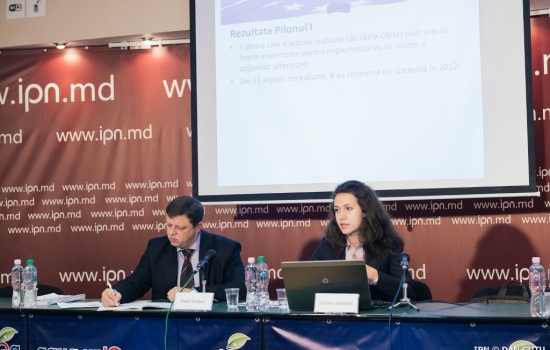
_article_1403011208June 17, 2014, as part of a roundtable, Promo-LEX Association released the report “Human Rights in Moldova: 2012-2013 Retrospective.” The report—now in its fifth edition—presents the human rights analysis for the Republic of Moldova, including Transnistria, as viewed by 12 experts.

According to the report, during the reporting period, Moldova had systemic issues with the right to liberty and security of person. Most of them relate to the arrest procedure, the detention of persons in psychiatric clinics, the compensation of material and moral damages caused by the violation of liberty and security, the provision of healthcare for detainees, etc.

The main issues with the access to justice, the right to a fair trial and the presumption of innocence, according to the experts, relate to judges’ independence and unbiasedness, motivations of court judgments and reasonable timeframes for case resolution and judgment enforcement.

Despite the adoption of the Law on the Social Inclusion of People with Disabilities, these people’s rights are regularly violated in many ways, such as by the inaccessibility of social infrastructure, jobs and adequate healthcare, and severe violations of the rights of people with disabilities in psychiatric clinics.

During the reporting period, the number of officially registered domestic violence cases increased and, although there are laws and regulations providing for the protection to victims of domestic violence, the enforcement of such laws and regulations raises concerns.

The situation of human rights in Transnistria is very bad. Despite positive commitments, the constitutional law enforcement authorities, lacking actual control in that region, are unable to arrest and punish the individuals responsible for human rights violations there. In fact, the constitutional authorities could not identify any effective means to protect human rights in that region. Given these circumstances, the worst violations are committed against the right to liberty and security, the right to life and the right not to be subjected to degrading treatment.

The report is structured in 14 chapters, each one addressing one of the following rights: the right to life and the right not to be subjected to degrading treatment; liberty and security of person and the rights of detainees; free access to justice, the right to a fair trial and the presumption of innocence; the right to own property; the right to information and transparency in decision-making; freedom of expression; freedom of thought, conscience and religion; freedom of assembly and association; the right to education; the right to work, social protection and healthcare; the right to elect and to be elected; the interdiction of discrimination; domestic violence; and the right to private and family life.

The electronic version of the report is available here.

The report is part of the project “Human Rights Protection and Monitoring in the Republic of Moldova, Including Transnistria” implemented by Promo-LEX Association with the support of Civil Rights Defenders and Sida.

For more information, please, contact: Carolina Bondarciuc, Press Officer: GSM 069637849, Tel./Fax (+373 22) 450024,  e-mail [email protected]


The Release of the Study on the Perception and Treatment of Injection Drug Users by Police Officers in the Republic of Moldova

_article_1402949222June 13, 2014, as part of a roundtable, Promo-LEX Association released the Study on the Perception and Treatment of Injection Drug Users by Police Officers in the Republic of Moldova, developed in cooperation with Ms. Ludmila Malcoci, Dr. habil. in Sociology, on the initiative of the Public Health Program of the Soros Foundation-Moldova.

The Study aimed at providing a thorough analysis of the Moldovan legislation on the use, production and proliferation of drugs, including injection drugs, and studying the police officers’ knowledge about, attitudes toward, and treatment of injection drug users both from the perspective of police officers and that of injection drug users themselves.

The Study was carried out from January through May 2014, and included 100 interviews with police officers from Chisinau and Balti and 7 focus groups—2 with 16 sector chiefs from police inspectorates of Chisinau and Balti and employees of Antidrug Directorate 4, Chisinau, and Bureau 4 of the North Division, Balti; 4 with 40 injection drug users from Chisinau and Balti (2 with women and 2 with men); and 1 with relevant experts. The Study results are valid only for Balti and Chisinau.

The Study revealed that, despite considerable changes in the Moldovan legislation on the penalties for drug users and the prevention of their discrimination in recent years, so far there is neither efficient enforcement mechanism in place nor a mechanism for monitoring and assessing the implementation of new measures. Given these circumstances, the discrimination of injection drug users by the police persists.

Thus, some drug users in the focus groups said that whenever a crime was committed in their block or sector, they were the first to be searched and inquired and sometimes even wrongly charged with those crimes or made by police to take on the responsibility for other crimes in that area.

Female drug users said that some of them were subjected to humiliating searches, for example in their breasts or vagina, in indecent circumstances, disregarding privacy. They also said that police officers threatened them with the deprivation of parental rights or forced to have sex with them.

On the other hand, more than two in three police officers consider that injection drug users are offenders rather than victims and associate them with criminals. 50% of police officers consider that injection drug users are infected with viral hepatitis B and C, HIV or sexually transmitted diseases; and 40% consider that most crimes in their towns are connected to drug users. One in three respondent police officers considers that most female drug users are commercial sex workers.

Given low awareness about HIV transmission routes and standard HIV safety precautions, 89% of police officers consider that dealing with injection drug users is dangerous or very dangerous. The perception of danger is nurtured by the fear of contracting HIV, viral hepatitis B and C or TB.

The research revealed a number of strong stereotypes police officers have about drug users. Thus, approximately 28% of police officers associate drug users with certain ethnics (18% think that drug use is specific mostly to Gypsies and 10% think that it is specific to Russians).

The representatives of NGOs, the Ministry of Home Affairs and the General Police Inspectorate attending the event welcomed the release of the Study, which is the first of its kind in the Republic of Moldova and presents valuable statistics, findings and recommendations.

The Study recommendations are addressed to several institutions: the Ministry of Home Affairs, the General Police Inspectorate, the Ministry of Labor, Social Protection and Family, the Ministry of Health, the Ministry of Education, and the Supreme Court of Justice. Thus, the Study will serve as a benchmark for the development of new policies and practices in this area and for streamlining those already in place.

The electronic version of the Study in Romanian is available here at the Web site of Promo-LEX Association. The electronic version in English is coming soon.

The Study on the Perception and Treatment of Injection Drug Users by Police Officers in the Republic of Moldova is part of the project “Initial Assessment of the Perception and Treatment of Injection Drug Users by Police Officers in the Republic of Moldova” implemented by Promo-LEX Association with the support of the Soros Foundation-Moldova.

For more information, please, contact:
Olga Manole, Human Rights Program Coordinator
Promo-LEX Association
Tel: (+373 22) 449626
Fax: (+373 22) 450024
[email protected]
www.promolex.md


The Council of Europe’s Committee of Ministers has urged Russia to halt violations of the right to education in the Transnistrian region of Moldova

In the period 4-6 June 2014, in Strasbourg, took place the 1201st meeting of the Committee of Ministers of the Council of Europe. The Committee of Ministers discussed the Decisions of the European Court which have not been executed by the defendant states.

The case Catan and others was discussed on June 5th 2014, following the requests from representatives of the 170 petitioners from Tighina (Bender), Grigoriopol and Râbnița.

Following the examination of the received materials, the Committee of Ministers has expressed its profound concern caused by the reports regarding continuous violation of the right to education in the Transnistrian region of the Republic of Moldova (through acts of intimidation and pressure which affect the functioning of schools with Latin script). At the same time, the Committee of Ministers reminded about the unconditional obligation of each member state, according to Article 46, paragraph 1 of the Convention, to execute the final decisions and has summoned the Russian authorities to take all possible measures to end the violation of the plaintiffs’ right to education and send to the Committee of Ministers:

– within a month, information about the way in which it intends to guarantee that schools with Latin script will continue to function in the 2014/2015 school year; and

– as soon as possible, but no later than September 1st 2014, a complete plan of action or a report on how it will implement the Court’s sentence.

Moreover, the delegates of the June 2014 Reunion of the Committee of Ministers insist that Russian authorities pay to the plaintiffs, without further delay, the compensations established by the European Court, have agreed to reexamine this case during the 1208th meeting (September 2014) (DH) and, in the absence of information from Russian authorities, have delegated the secretariat to prepare a draft interim resolution project to be distributed together with the draft agenda of the meeting.

In front of the European Court of Human Rights, the plaintiffs were represented by attorneys and lawyers of the Promo-LEX Association, who have made constant efforts towards updating the situation of the schools and informing the Committee of Ministers and other relevant actors important to the process of monitoring and enforcing the decision Catan and others. vs Russia and Moldova.

For more information, please contact: Alexandru Postica, Program Director at Promo-LEX Association, Lawyer. Tel: (22) 450024, GSM: 069104851, e-mail: [email protected]


Domestic violence in the Roma community from the Republic of Moldova / Study

_article_1401979750On the 5th of June 2014, during a round table, the Study „Evaluating the implementation of the provisions of Law nr.45-XVI regarding the prevention and combating of domestic violence among Roma minorities from Republic of Moldova” was presented. The Study was developed by Alunica Lepadatu within the Internship Program in the Field of Human Rights – 2014.

The goal of the research emerged from the timeliness of the problem and consisted of evaluating the implementation of the provisions of Law nr.45 regarding the prevention and fight against domestic violence among Roma from Moldova. The research includes recommendations for streamlining the implementation of the law regarding domestic violence in Roma communities.

The Study was conducted based on interviews with Roma victims of domestic violence, police officers, social workers and community mediators; as well as focus group discussions with Roma women and men.

The author considers that it is not possible to compare the ways in which domestic violence manifests itself in Roma and non-Roma families, or the frequency and the dynamics of these cases. The reason for not being able to make the comparison is the fact that the authorities fail to  segregate the data by ethnicity.

According to the findings of the Study, the subject of domestic violence is sensible for Roma women, because it is considered a taboo in Roma families; while poverty is one of the main causes of the phenomenon. Also, Roma women who are domestically abused do not seek help from the police because they lack trust in law enforcement bodies (resulting from previous experience of interacting with police officers) and because they are afraid of being treated with neglect or being deceived by policemen (cases of corruption).

Another problem identified by the Study is the misinformation among the Roma community about the attributions of the district officer, the social worker and the Town Hall in preventing and combating domestic violence.

The author of the Study has offered several recommendations, among which: the need to train police officers, social workers and Town Hall employees in the fields of non-discrimination and prevention and fight against domestic violence; informing and raising awareness of the Roma population from localities with compact Roma populations in the field of preventing and fighting against domestic violence; employing a paralegal in the communities with compact Roma populations or providing legal training to community mediators.

The Study was conducted within the Internship Program in the Field of Human Rights – 2014, implemented with the financial support of the Foundation for an Open Society.

The electronic version of the Study can be accessed here.

For more information, please contact: Lilia Potîng, jurist of Promo-LEX Association, Tel: (22) 450024, e-mail: [email protected]


ECtHR to Look Into Inhuman Detention Conditions in Transnistrian “Prisons”

The European Court for Human Rights communicated to the Governments of the Republic of Moldova and the Russian Federation the case of Vadim Pogorlețchi, a Russian citizen, detained illegally, in inhuman conditions, in the Hlinaia “prison” in the Transnistrian region.

Between 2000 and 2008, Mr. Pogorlețchi administered several social-political publications in the region, including: “Днестровский Курьер”,”Руский рубеж”,”Новый днестровский курьер”, and “Руский прорыв”. Most of the materials published in these papers were political commentary and criticized the regime in Tiraspol.

On 3 May 2010, Vadim Pogorlețchi was seized by representatives of the so-called customs service of the region at the “Pervomaisk” border crossing post. He was later transported and put in the basement of the “isolator for preventive detention of the militsia Department” of Tiraspol, where he was detained in inhuman conditions. In April 2012, he was sentenced to 7 years in jail, in a strict-regime prison.

The applicant filed a complant to the European Court claiming violation of his rights under Article 3 of the Convention, namely his extended illegal detention, anti-sanitary detention conditions, and absence of medical care during detention, which had irreversible negative effects on his health; Article 5 of the Convention, namely his arrest by persons who did not have the legal authority to do so, and his extensive detention in absence of legal grounds, decided by an illegal court; and Article 13 of the Convention with regard to the absence of effective national remedies for the violations claimed by the applicant under Articles 3 and 5 of the Convention.

Promo-LEX has regularly drawn attention to the illegality of detention in Transnistrian region, and to the inhuman and degrading conditions in the respective detention facilities. In November 2013, a Report was launched with the topic: “Torture and Ill Treatments in the Republic of Moldova, including its Transnistrian region: Assumed Problems and Eluded Responsibility”, conducted by an international mission of FIDH (International Federation for Human Rights), which contains several conclusions regarding the conditions of detention in Moldovan prisons, including in detention facilities of the Transnistrian region.

Lawyers and legal advisers from the Promo-LEX Association represent the applicant before the European Court for Human Rights.

For details contact: Alexandru Postica, Promo-LEX Program Director, lawyer, tel: (22) 450-024, GSM: 069-104-851, email: [email protected].


Launch of the Project: “Strengthening civil society organizations from Moldova, including the transnistrian region, to combat discrimination through advocacy actions”

_article_1401801972On 2 June 2014, Promo-LEX Association in partnership with The Equal Rights Trust from London launched, at a roundtable, the Project: “Strengthening civil society organizations from Moldova, including the transnistrian region, to combat discrimination through advocacy actions.

The main objective of the project is to contribute to the strengthening of the protection mechanisms against any form of discrimination in Moldova.

Ion Manole, the Executive Director of Promo-LEX, outlined the important role of the EU Delegation in combating discrimination and promoting equality in Moldova, including by supporting civil society in this area. “The project will have a comprehensive approach on monitoring all the patterns of discrimination in Moldova, including the implementation of Law no.121. At the same time, the project refers to the civil society overall and aims at strengthening its capacity in Moldova, including in the Transnistrian region, in the area of fighting discrimination and promoting equality,” added Ion Manole.

Equal Rights Trust representative Jim Fitzgerald said: “The Law on Ensuring Equality entered into force 18 months ago, and the experience of ERT in many states that have recently adopted such laws shows that it takes a lot of work once the law is enforced to have it function in practice, and civil society is an important actor in this context.”

Andrei Brighidin, a member of the Council for Preventing and Combating Discrimination and Ensuring Equality in Moldova, welcomed the launch of the project and noted: “The project is extremely important in view of the fact that, for the first time, I hope, we will start receiving complaints from the Transnistrian region.”

“We believe this project will strengthen the Moldovan Government efforts and lead to the expected results. I want to emphasize that it is important not only to adopt a law on equality and non-discrimination and to create a Council of Equality, it is also important to show that this instrument and the mechanism works in practice,” said Mindaugas Kacerauskis, Political Officer at the EU Delegation to Moldova.

The project was designed to address weaker points in the Moldovan legal framework, practices and policies on equality. The project will focus on both the shortcomings and inconsistencies of the Law on ensuring equality and the problems pertaining to the implementation of the legal framework in the field of equality.

The Project “Strengthening Civil Society in Moldova, including the Transnistrian region, in fighting discrimination through advocacy actions” is funded by the European Union.

For more details, contact: Olga Manole, Human Rights Program Coordinator, Promo-LEX Association, tel: (+373 22) 449-626, 450-024, email: [email protected].


Irrevocable SCJ Decision: the Ministry of Interior will pay damages for disclosure of personal data to the separatist regime

Vitalie Eriomenco’s family will receive damages of 192,000 lei from the Ministry of Interior for unlawful disclosure of his and his family’s personal data to illegal structures from Tiraspol.

The Supreme Court of Justice ruled as inadmissible the recourse of the Ministry of Interior and of Tretiacov Gheorghe. Thus the decision of the Court of Center district of Chisinau of 23 April 2014, stating a violation of the rights under Art.8 of the European Convention on Human Rights and Fundamental Freedoms and the Law on the protection of personal data.

Recall that Police Colonel Gheorghe Tretiacov ordered to provide personal data about six Eriomenco family members, including Vitalie Eriomenco, illegally deprived of freedom by the regime in Tiraspol, to an entity of the separatist regime in Tiraspol.

In this context, Promo-LEX welcomes the decision of the Supreme Court of Justice and calls on the constitutional authorities to respect the laws of the Republic of Moldova and to avoid similar situations of violating their citizens’ rights by providing information and personal data to illegal entities.

For more details, contact: Alexandru Postica, Program Director with Promo-LEX, lawyer, tel: (22) 450024, GSM: 069104851, email: [email protected].


Promo-LEX and AGER: Only 14% of Current JSRS Actions are Implemented

_article_1400057258On May 14, 2014, Promo-LEX and the Association for Efficient and Responsible Governance (AGER) held a press conference to launch Quarterly Monitoring Report no. 5 on the Implementation of Justice Sector Reform Strategy (monitoring period: 1 January to 31 March 2014).

The general conclusions of the report shows that the pace of implementation of the Justice Sector Reform Strategy remains quite slow. Thus, of 264 of actions due for completion by 31 March 2014, including those overdue, 157 were implemented, and 107 remain not implemented, which represents a percentage ratio of 59% to 41%. Experts ared particularly concerned with the fact that the few activities provided for the monitoring period were not implemented. Statistics on the mplementationof actions due in the reporting period show a completion rate of only 14%.

“We emphasize that, during the reporting period, two studies were presented that are fundamental to the reform of the judicial system, and namely the Study on the optimization of the map of courts location, and the Study on the need for specialization of judges. We hope that this will encourage relevant actors to move quicker on follow up actions,” said Olesea Stamate from AGER Association.

With regard to trial monitoring, 300 hearings were monitored in courts across the country. In this regard, 480 court user satisfaction questionnaires were completed. A positive indicator of growth is the number of audio-recorded hearings, which increased by 12% compared to the fourth quarter of 2013, and the increase by approximately 10% of the number of hearings held in courtrooms. “Among the deficiencies we note court facilities that were rated negatively by 20% of lawyers and court users,” said Alexandru Postica from Promo-LEX.

Recall that monitoring focuses on the observation of two main components: assessment of actions included in the Action Plan for implementation of the Justice Sector Reform Strategy, and trial monitoring. The report analyzed two categories of actions: actions due for completion in the first quarter of 2014, and overdue actions, which were to be completed by 31 December 2013.

The electronic version of the Report is available on www.promolex.md and www.monitor.md.

The report was prepared within the project “Monitoring Justice Sector Reform to Increase Government Accountability”, implemented by Promo-LEX and the Association for Efficient and Responsible Governance, with the financial support of the European Union. The project is co-financed by the East European Foundation, with funds provided by the Government of Sweden through the Swedish Agency for International Development and Cooperation (Sida) and the Ministry of Foreign Affairs of Denmark/DANIDA.

For more details, please contact Carolina Bondarciuc, Press Officer: GSM – 069637849,
Tel/Fax – (+373 22) 450024, email [email protected].


PUBLIC APPEAL Regarding the guarantee of rights for education in the transnistrian region of the Republic of Moldova

The campaign “Save Transnistrian Schools” was launched and will take place during May. The goal of the campaign is to show solidarity with the pupils, their parents and teachers, who are studying and working in the educational institutions with Romanian as teaching language, located in the transnistrian region of Moldova, but also to inform the larger public about the problems of the latter.

We appeal to all those who are not indifferent to the faith of the schools from the transnistrian region to pledge for the guarantee of the right of each person from the region to study in their mother tongue and in the institution they chose to. There is a risk that as of 1 September 2014, the eight institutions (in which 1650 pupils are still studying) will be shut down. All the details regarding the actions and events within the Campaign can be followed on www.promolex.md and on Facebook.

To support students, their parents and the teachers from eight schools with Romanian as teaching language in the Transnistrian region of Moldova, undersign the Public Appeal from below here.

PUBLIC APPEAL
Regarding the guarantee of rights for education in the transnistrian region of the Republic of Moldova

The right to education is a fundamental one, which has to ensure the development of the person as well as the respect for the wish of the parents to ensure that the education of their children is according to their own religious and philosophical convictions.

The educational program of the institutions under the control of the de facto administration from Tiraspol and the program of institutions under the jurisdiction of the constitutional authorities of Moldova differ, but the main difference remains to be the script used in the education process. The eight institutions that are under the jurisdiction of the central constitutional government use Latin script. Generally, these institutions, implicitly the teachers, pupils and their parents are in the role of hostages. Their situation worsens every time the de facto administration of the region wants to send a message or to exercise certain pressure over the constitutional authorities, or in the event they want to obtain something in the negotiation format of the conflict resolution.

The intimidations come under the form of: illegal detainment of teachers, confiscation of material goods and assets owned by the institutions, application of fines, organization of discussions with the parents of the pupils where the parents are attempted to be convinced to transfer the pupils to schools in Cyrillic, intimidation of pupils by the law enforcement forces, imposing higher rent prices and other actions that follow the goal of intimidation and, ultimately, shutting down these institutions.

We consider that the issue of intimidation of the schools from the region and that of respect for rights to education can be solved only through an active and prompt involvement of the public opinion and of the international community. Any person individually, or institution collectively, can take part in the monitoring process of the situation of the eight schools from the transnistrian region of Moldova, through knowing about this problem, and supporting the pupils and showing solidarity with these groups.

In case the de facto administration will further recourse to intimidation and prosecution of teachers, pupils and their parents, we solicit the application of sanctions against individuals and groups of persons that will be guilty of further infringing the rights of these categories of people.

In this context, we, the undersigned, solicit the Government of the Republic of Moldova, International Community, and the Government of the Russian Federation:

  1. Guarantee the right for education in Romanian language based on Latin script, according to the curricula of the Ministry of Education of Republic of Moldova, for all residents of the transnistrian region;
  2. Non-admission of closing down the schools with Romanian as teaching language, from the east of the Republic of Moldova;
  3. Identification and sanctioning of all persons, who infringe or contribute to infringing the fundamental rights of teachers, pupils and their parents;
  4. Limiting and/or refusing to accept any financial transactions from the banking institutions from the territory of the Republic of Moldova, including the transnistrian region, that are not accredited by the National Bank of Moldova;
  5. Execution by the Russian Federation of the Decision of the European Court for Human Rights of 19 October 2012 in the case Catan and others v. Moldova and Russia;
  6. According to the their citizenship, to impose interdiction of circulation in the European Community space or other states for the persons responsible for infringing human rights in the transnistrian region;
  7. Impose other necessary sanctions, political and financial, on the de facto administration from Tiraspol and persons and institutions that are supporting them, to discourage the infringement by the above of rights to education.


PUBLIC APPEAL to the President of the Republic of Moldova

The Promo-LEX Association calls the President of the Republic of Moldova, as the guarantor of the Constitution:

  • Not to promulgate Law of 11 April 2014 on amending and completing several laws (Fiscal Code – Arts.20, 35, 54’4, etc.; Law on the Customs Tariff – Art.4, 28, Annex; etc.);
  • To propose to the Parliament and Government to establish a special fund for the accumulation of resources necessary to compensate for losses and damages incurred by landowners and farmers in Dubasari. That fund is to accumulate the amounts paid by businesses located in Moldova that do not have tax relations to its budget for customs procedures and environmental pollution.

Dubasari land owners’ and farmers’ access to agricultural lands is periodically blocked, restricted or prevented by the de facto administration of the Transnistrian region of Moldova, and this agricultural year is practical compromised. The efforts of the constitutional authorities to ensure and guarantee property rights to thousands of farmers and their families have not seen positive results, and losses and damages incurred by the residents of the alleged security area are INVALUABLE.

In its plenary session on 11 April 2014, the Parliament of the Republic of Moldova passed in a second reading the Bill on amending and completing several laws (Fiscal Code – Arts.20, 35, 54’4, etc.; Law on the Customs Tariff – Art.4, 28, Annex; etc.) as demanded by Nina Ştanski, a representative of the de facto administration of the breakaway region to continue the political dialogue.

According to her statements ​​after the meeting on 14 April 2014, the illegal administration of Tiraspol welcomed the adoption of the required legal amendments, but remained unwilling to allow landowners full access to their land.

In this context, Promo-LEX believes that constitutional authorities urgently need to calculate and compensate for all losses and damages incurred by farmers and landowners.

While the de facto administration of the region continues to create obstacles for citizens and the development of communities in the security zone, Promo-LEX believes that the promulgation of amendments requested by the administration of the eastern region of Moldova becomes impossible. Promo-LEX suggests that the funds received from operators in the eastern regions of the country need to be redirected to a special fund to cover damages and losses incurred by the farmers and landowners in Dubasari (Dorotcaia, Cosnita, Cocieri, Pirita, Pohrebea, and Molovata Noua).

Also, Promo-LEX draws attention to the situation of Latin-script schools in the Transnistrian region of Moldova. Recent statements by representatives of the Tiraspol administration show that they insist on taxing these schools under the local “law” and on other abusive actions deliberately aimed at closing these schools.

NOTE: Promo-LEX Association represents and defends the interests and rights of a total of 1651 farmers and agricultural landowners from Dubasari in the case Sandu vs. Moldova and the Russian Federation at the European Court of Human Rights.

For more details, contact: Alexandru Postica, Program Director with Promo-LEX, lawyer, tel: (22) 450024, GSM: 069104851, email: [email protected].