Human Rights Violations In Transnistria To Be Examined in Two New Cases At The ECtHR

The European Court for Human Rights has notified the Governments of Moldova and the Russian Federation about the cases Beşleaga and Bevziuc (Application No. 29182/14) and Petis and Others (Application No. 6151/12).

In the first case, the applicants complained to the ECtHR under Article 3 of the European Convention on Human Rights, namely inhuman and degrading conditions of detention in the “isolation facility” No. 3 in Tiraspol and the “penitentiary institution” in the village of Hlinaia, under Article 5, on the illegality of their detention as ruled by so-called Transnistrian courts, and under Article 13 of the Convention, namely lack of effective remedies regarding their complaint under Article 5.

In the second case, the applicants argued violations under Article 5 of the Convention, with regard to the conditions of detention in “penitentiary” No. 1 in Tiraspol, and under Article 6 of the Convention, related to the right to a fair trial, noting that the so-called court in the Transnistrian region cannot be qualified as a court established by law, and thus the trial to which they were subjected was unfair as conducted in an illegal court.

Respondent Governments have until 28 and 27 January 2015 respectively to submit their comments on the cited cases.

See more details on the cases of Vitalii Beșleaga and Serghei Bevziuc see below.

More information about the case can be accessed on the website of the European Court for Human Rights.

For more details, contact: Alexandru Postica, Program Director of the Promo-LEX Association, Attorney at Law. tel: (22) 450-024, GSM: 069-104-851, email: [email protected].


Promo-LEX launched the second Report on Monitoring Parliamentary Elections 2014: Poor electoral legislation hamper the start of the campaign

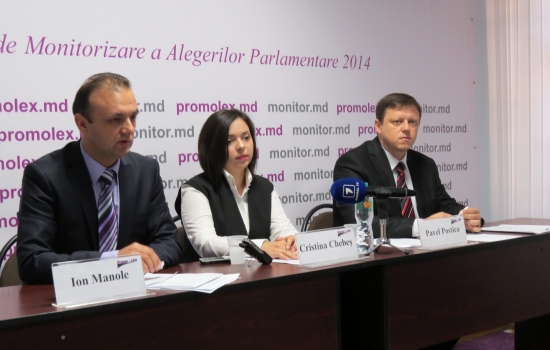
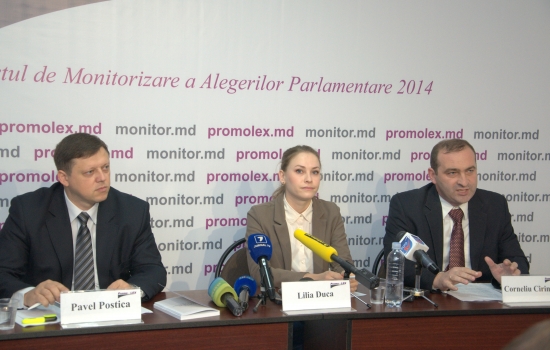
_article_1413453651On 16 October Promo-LEX Association launched the second Report on Monitoring Parliamentary Elections of 30 November 2014. The report covers electoral period from 24 September to 15 October and shows findings reported by observers.

Monitoring effort of Promo-LEX has found that the start of electoral campaign took place without major violations, having a quasi-unbiased record of electoral administration. During this period, Central Electoral Commission elaborated a number of regulations and instructions meant to improve the normative framework and has accredited national and international observers. Beginning with 10 October 2014, CEC registered 16 electoral contestants, and 7 persons picked up petitions for collecting signatures, required for electoral registration.

CEC established the amount of 55 mln. Lei as a ceiling of financial resources that may be transferred into the electoral fund. It is noteworthy to mention that this ceiling is considerably greater, more than two times, comparing to previous elections. For early elections from 28 November 2010 the ceiling amounted to 21 664 445 lei, whereas for new local elections from 5 June 2011 – almost 22 142 345 lei. Instead, for electoral contestants – independent candidates during 2014 campaign the ceiling was reduced with over 7%.

Though the opening of “Electoral funds” was not registered at CEC, Promo-LEX observers noticed numerous activities aiming at promoting the image of potential and actual electoral contestants (DPM, LDPM, PCRM, LP, PSRM, ChristianDemocratic Popular Party and the citizen Renato Usatîi). Thus, these incurred expenses for organizing electorally biased concerts, placing of electoral posters, polygraphic advertising, improving local infrastructure, construction of buildings and monuments.

Central Electoral Commission set up 37 electoral districts. However, there were not set up two electoral districts of Bender municipality and territorial-administrative unit of II level transnistrian region. Along these lines, we noticed that both central public administration and electoral administration had not initiated previous discussions regarding the improvement of participation of citizens from eastern districts of the Republic of Moldova in electoral process.

Likewise, during the reporting period first electoral incidents were registered, cases of administrative resource use, giving electoral gifts, and the involvement of regional and local media in support or against some electoral actors. Thus, in Rezina and Sângerei districts first cases of intimidation and pressure on voters were registered. Monitoring effort has also found the cases of giving gifts and other material goods by some political parties. According to Promo-LEX observers, at least 4 political parties (LP, LDPM, PSRM, DPM) have given gifts with electoral meaning in 9 districts of the country. At the same time, Promo-LEX observers have reported multiple electorally biased articles in local and regional media concerning DPM, LDPM, LP, PCRM, LRP and the citizen Renato Usatîi.

The Monitoring Effort of Parliamentary Elections of 30 November 2014 is conducted by Promo-LEX Association within the framework of the Monitoring Democratic Processes Program. The Monitoring Effort fits into activities undertaken by civil society under the aegis of the Civic Coalition for Free and Fair Elections.

The Monitoring Effort of Parliamentary Elections of 30 November 2014 benefits of technical assistance from the National Democratic Institute (NDI), and is funded by the United States Agency for International Development (USAID), National Endowment for Democracy (NED), Council of Europe and Stefan Batory Foundation from the resource offered by the Solidarity Fund through “Support for Democracy” Program of the Ministry of Foreign Affairs of Poland.

The opinions expressed in this report belong to the authors and do not necessarily reflect those of the donors.

For additional information, please contact:
Galina Sanduța, Press Officer Monitoring Effort Promo-LEX
Telephone: 069 95 82 89, E-mail: [email protected]


“Violence-Free Family – Violence-Free Society!

_article_1413381405The Promo-LEX Association, the Office of the Ombudsman and the Centre for Social Assistance and Protection of Victims of Human Trafficking come with a common message of the need and importance of preventing and combating domestic violence in the campaign “Violence-Free Family – Violence-Free Society!”.  You may watch the launching conference here.

“The aim of this campaign is to highlight once again the important role of tolerance and respect for one another, and how these principles can bring the family and society together,” says Ombudsman Tudor Lazar.

The Ombudsman also stressed that human diversity must not lead to discrimination and violence, and only through joint efforts, by acknowledging and acting against violence, we can help fight this phenomenon.

According to Lilia Potîng, lawyer of the Promo-LEX Association, “The urgency and immediacy of this issue is confirmed by statistics in this field – currently thousands of women in Moldova are subjected to violence. Thus, according to a national survey, every sixth woman in urban regions, and every seventh woman in rural areas was subjected to violence at least once in their lifetime.”

Another message to be transmitted in the course of the campaign is that there is a Law that protects the rights and interests of victims of domestic violence, under which victims can obtain protective orders, and that measures exist to punish the perpetrator in such cases,” adds Lilia Potîng.

For her part, Lilia Gorceac, a psychologist at the Center for Social Assistance and Protection of Victims of Human Trafficking, drew attention to the very serious issue of sexual violence to which children are subjected in the family. “This is a major problem, and these children, need psychological assistance because they remain scarred for live after passing through such inhumane experiences. What happens in the neighbor’s yard is very important both for social health and for the well being of every human being.”

The first meeting with a group of citizens as part of the Campaign was held today in Cojuşna, Straseni.

The Campaign will feature several meetings with citizens, where lawyers, people with notoriety and psychologists will address issues related to the impact of domestic violence on victims, children, families and society as a whole, prejudices and gender-based stereotypes that encourage domestic violence and legal provisions relevant to this topic.

The “Violence-Free Family – Violence-Free Society” campaign was initiated by the Office of the Ombudsperson, and Ombudsman Tudor Lazar, in partnership with Promo-LEX and the Center for Social Assistance and Protection of Victims of Human Trafficking. The campaign will be conducted between 15 October and 25 November 2014. The media Partner of the campaign is National Broadcasting Company Teleradio-Moldova.

For details, please contact: Carolina Bondarciuc, Promo-LEX Press Officer: GSM 069637849, Tel/Fax (+373 22) 450-024, e-mail [email protected].


The CoE Committee of Ministers called Russia to uphold the ECHR decision in the schools case

The Committee of Ministers of the Council of Europe met on 25 September 2014 to discuss the European Court decisions that have not been enforced by respondent Governments.

At the reunion, the Committee of Ministers expressed their deep concern with the fact that Russian authorities failed to present by 1 September 2014 any information on the enforcement of the ECtHR decision concerning Latin-script schools.

Recall that, in June, the Committee of Ministers urged the Russian Government to take all necessary measures to stop the violation of the applicants’ right to education, to inform the Committee of the way they plan to guarantee the fact that Latin-script schools will continue to function in the academic year 2014/2015, and to present, by 1 September 2014, a concrete plan of action or report on the enforcement of the Court’s decision.

Accordingly, the latest decision of the September Reunion delegation ruled to give Russia a new deadline, by 1 November 2014, to present all information about its actions to uphold the EctHR decision.

The European Court for Human Rights issued a decision in the case of Catan and others on 19 October 2012, stating that the Russian Federaton violated Article 2 Protocol 1 – the right to education. Applicants in the case are teachers, pupils and their parents from Tighina (Bender), Grigoriopol and Ribnita. Almost two years after the ECtHR pronounced its decision, The Russian Federation refuses to enforce it.

For details, contact: Alexandru Postica, Promo-LEX Program Director, lawyer. tel: (22) 450-024, GSM: 069-104-851, email: [email protected].


Russia could be held accountable for inhuman detention conditions in the Transnistrian region

The European Court of Human Rights recently notified the respondent Governments on the case Şcvarcenco v. Moldova and the Russian Federation (application no. 45464).

Dumitru Şcvarcenco, a Ukrainian citizen, detained in a “prison” in Tiraspol, complained to the High Court citing violations of his rights under Article 3 of the European Convention, inhuman and degrading conditions of detention, Article 5, illegal arrest by Transnistrian “authorities”, and Article 13, lack of effective remedy regarding his complaint under Article 5. More information on this case can be found on the ECtHR website here.

The Promo-LEX Association repeatedly drew attention to the poor detention conditions in the Transnistrian region. There are three institutions for execution of sentence under the control of the Tiraspol administration, and the number of persons held in preventive detention isolators remains unknown.

According to Human Rights Report 2012-2013, the high rate of persons in detention per 100,000 population compared with the capacity of detention facilities raises many concerns, which was also noted in previous reports of Promo-LEX. Analyzed statistical data show that 563 out of every 100,000 people in the region are in detention. For comparison, the ratio of detainees held in in prisons under the jurisdiction of the constitutional authorities is of 188 for every 100,000 people, while the EU average, as of 2013, is 129 people.

You can find more detailed descriptions of the conditions of detention in Transnistria in articles by Human Rights Without Frontiers International, written with the support of Promo-LEX, here.

For details contact: Alexandru Postica, Promo-LEX Program Director, lawyer. tel: (22) 450-024, GSM: 069-104-851, email: [email protected].


Farmers from Dubăsari: “If the authorities don’t react, we will lose our lands!”

_article_1411732017As a result of the unilateral actions of the Tiraspol administration, from March 2014, the access of farmers and enterprises from the villages: Doroțcaia, Pohrebea, Coșnița, Pârâta, Cocieri, Molovata Nouă and Roghi to the lands they own on the route Rîbnița-Tiraspol was limited.

According to a declaration of the Committee defending the rights of owners of land situated across the route Rîbnița-Tiraspol, they relied on the support of constitutional authorities in solving the situation which has arisen, but the authorities exhibited indifference and impotence in solving this issue. Thus, starting with the mentioned period, the enterprises and farmers incurred expenses of tens of millions of lei.

The constitutional authorities are aware of this situation, but unfortunately are not contributing to solving this issue. The government promised to grant compensations to the farmers who incurred expenses in the process of working the lands, but this promise has remained only on paper, says Petru Leșan, farmer from Coșnița village, Dubăsari rayon.

Sergiu Crijancovschi, landowner from Pohrebea village, Dubăsari rayon said: “We are afraid that those 300 hectares of farmland situated across the route, representing 50% of the land in the property of the village’s residents, will pass into the ownership of enterprises from the transnistrian region. In the spring we had a parcel of land of 75 hectares prepared for sowing, and some unknown people came and sowed the land prepared by us. When asked who gave them permission to work the land, they referred to the administration from Dubăsari.”

The residents of Vasilievca village are in a very complicated situation, which according to Gheorghe Colun, farmer, is completely isolated, and from 11 September 2014, the land has been worked by foreign people with the authorization of the separatist administration.

The situation is equally as difficult in Doroțcaia village, where Vera Simionov, representative of the local landowners, says 91% of the lands are across the route, and if previously they still had the possibility of crossing over and working the land more or less openly, now representatives of the militia and other structures came and told them openly that they are not allowed to go there and almost forcibly evicted them, confiscating the agricultural machinery, which was subsequently recovered after some fines were paid.

Previously, the farmers reported several issues, like: the appearance of ditches dug along the route Rîbnița-Tiraspol to prevent the access of agricultural machinery to the fields across the route, and the illegal working of the lands by the Tiraspol administration.

We would like to remind you that at the beginning of 2013, the ECHR has informed Moldova and the Russian Federation about eight requests, which include the complaints of 1651 landowners from Dubăsari rayon, as well as three commercial agriculture companies. Observations on this case have already been sent, and the ECHR will make a decision in the near future.

The Promo-LEX Association has stressed time and time again the importance of full realization of the positive obligations of constitutional authorities in the case of landowners from Dubăsari rayon, by identifying some viable solutions for the thousands of legal owners of the lands, to ensure the possibility of unhindered working of these lands and the respect for ownership rights, declared Alexandru Postica, Director of the Program for Human Rights, Promo-LEX Association.

Considering the given situation, representatives of the Committee defending the rights of owners of land situated across the route Rîbnița-Tiraspol declare that they reserve the right to block all unconstitutional customs houses on the Coșnița plateau until all requests of the farmers and enterprises who own land across the route Rîbnița-Tiraspol will be heard and fulfilled.

Requests towards the constitutional authorities:

(Excerpts from the minutes from the meeting of landowners on 24.09.2014)

  • Ensuring the access of farmers and enterprises to their properties located across the route Rîbnița-Tiraspol.
  • Urgent payment of the expenses incurred by the owners of the lands across the route Rîbnița-Tiraspol in the process of working the lands, in amount of 13428.900 thousand (thirteen million four hundred twenty-eight thousand nine hundred) lei in accordance with law Nr. 182 from 25.07.2014.
  • Compensating the missed profits for each hectare in amount of 2,500 lei.
  • Meeting with the Prime Minister of Republic of Moldova in order to discuss the problem of the lands across the route Rîbnița-Tiraspol.


At the same time, an ultimatum was set for fulfilling the requests until 1 October 2014.

For more details, contact:
Alexandru Postica, Director of the Program for Human Rights, Promo-LEX Association. Tel: (22) 450024, GSM: 069104851, [email protected]
Pentru Bondari, landowner, Pohrebea village, Dubăsari rayon, GSM:079767509.


Promo-LEX Launches its Monitoring Effort for the 2014 Parliamentary Elections

_article_1411649525On 25 September, the Promo-LEX Association announced the launching of its Monitoring Effort for the parliamentary elections on 30 November 2014, and released their first pre-electoral findings.

The first report covers the period between the parliamentary poll of 28 November 2010 and 24 September 2014, and presents information on the changes in the electoral legal framework, the key areas of the Promo-LEX monitoring analysis, and a summary of the latest findings of the observers.

Promo-LEX observers found the previous recommendations of domestic monitoring groups have been implemented partially and selectively. Only seven recommendations were fully implemented by the public authorities of the total of 21 recommendations put forward by Promo-LEX in its monitoring reports for the 28 November 2010 parliamentary election and 5 June 2011 local elections. The remaining 16 recommendations were not implemented and stay relevant.

For these elections, Promo-LEX aims to monitor the activities of electoral contestants, electoral administration and public authorities. 41 long term observers and 35 observation assistants will conduct election monitoring in all 36 constituencies between 15 September and 15 December 2014. On Election Day, Promo-LEX will deploy one short term observer to each polling station in Moldova.

The Monitoring Effort has found during the current reporting period that the potential electoral contestants undertook a number of activities with electoral connotations.

The purpose of election monitoring is to increase public confidence in the electoral process and help ensure free and fair elections in accordance with international standards and national legislation.

Promo-LEX is the only non-governmental organization registered as an observer for the 2014 parliamentary elections. Promo-LEX will monitor the entire electoral process and will release three monitoring reports prior to Election Day, a Quick Count report providing an alternative count of votes the next day after elections, a Campaign Finance Monitoring Report and a Final Report.

The electronic version of the Report here.

The Monitoring Effort of Parliamentary Elections of 30 November 2014 benefits of technical assistance from the National Democratic Institute (NDI), and is funded by the United States Agency for International Development (USAID), National Endowment for Democracy (NED), Council of Europe and Stefan Batory Foundation from the resource offered by the Solidarity Fund through “Support for Democracy” Program of the Ministry of Foreign Affairs of Poland. The opinions expressed in this report belong to the authors and do not necessarily reflect those of the funders.

For more information, please contact:

Galina Sanduța, Press Officer, Promo-LEX Association, GSM: 069 95 82 89, email: [email protected].


Justice Sector Reform Strategy Progress Conference Conclusions

_article_1411133406A conference on the topic „Progress in the implementation of the Justice Sector Reform Strategy after three years since its launch” was held on 18 September 2014. The conference was organized by the Promo-LEX Association and the Association for Efficient and Responsible Governance (AGER).

Representatives of civil society and government institutions, invited to the event, tried to jointly assess the progress of the justice sector reform.

36 national Promo-LEX observers throughout Moldova were involved in the monitoring effort on the implementation of the Justice Sector Reform Strategy, and our conclusions and recommendations were presented in six quarterly reports, which were based on a methodology specially developed for this purpose, mentioned Ion Manole, executive director of Promo-LEX. “While the findings of our reports were quite consistent, the authorities did not always agree with our figures and findings; however this is a democratic exercise to be further intensified. I think it is the duty of civil society and authorities to work together to have a fair, open and transparent justice”, added Ion Manole. You can find all the reports here.

According to Wicher Slagter, Head of Political and Economic Section of the EU Delegation in Moldova, “the justice reform is the mother of all reforms”, that is, other reforms cannot be implemented without a functioning justice system. While ​​some progress has been made, not all goals were achieved, and there are areas, such as prosecution reform, where additional efforts should be made, and the fight against corruption in the judiciary needs to intensify, Mr. Slagter added.

Erik Svanidze, team leader of the EU project “Support to the coordination of the justice reform in Moldova”, emphasized the contribution of Promo-LEX and AGER in the implementation of the justice sector reform, noting in particular the monitoring component of the overall coordination mechanism for the implementation of the reform, and thanked the organizations for their constructive criticism​​.

Referring to the progress in the implementation of the reform strategy, Olesea Stamate, AGER executive director, noted: “We expected progress to be more expedient. In the last report we presented, the number of implemented actions is 60%, while those not implemented is 40%, which is not a bad figure. However, more than these figures, we are interested in the level of implementation of actions that have been deemed implemented within this strategy. We will continue our monitoring effort until the completion of the strategy, and we will try to focus on assessing the effects of the reform.”

Cristina Tarna, deputy director of the National Anti-Corruption Center, noted that some progress in fighting corruption, though perhaps modest, has been achieved. She compared the state of completion of corruption before the launch of the reform and after its launch. “Approximately 80% of defendants admitted their guilt in court, which in 2010-2012 led to a conviction rate of 90%; however 30% of those convicted were drawn to administrative liability, and only the rest faced criminal charges. With regard to disqualification from corruption-prone positions, two out of three convicts returned to the positions held. Only 1.5% of the total number of persons convicted for corruption actually went to jail. For comparison, in the first half of 2014, the conviction rate remained at 90%, of which 2% faced administrative liability, in 55% of cases the defendants received criminal sanctions and were deprived of the right to hold office, and deprivation of liberty applied to as many as 17% of cases.”

The results of the implementation of the JSRS were presented during the event, including two studies on court map optimization and specialization of judges. Ion Guzun, LRCM legal adviser, said that while the action pertaining to court map optimization has not yet started, certain preparatory activities have already been carried out.

Discussing alternative dispute resolution mechanisms, the participants emphasized the need to increase public confidence in mediation services, which is what the Mediation Council has been actively working on.

A number of challenges remain in achieving a child-friendly justice system, and these include the lack of specialists for hearing child victims, absence of judges specialized in such cases, and lengthy examinations of these cases.

The prosecution reform remains the most important arrear of the JSRS. The extensive delay in the discussion of the concept of the reform and adoption of the respective law shows that there was no strong commitment to reforming this institution, concluded LRCM chairman, Vladislav Gribincea.

With regard to the judicial enforcement system reform, one of the issues highlighted by the chairman of Bailiffs Union was the independence of bailiffs, and the fact that the Ministry of Justice delayed the adoption of legislation to facilitate the work of the profession.

One of the goals of the monitoring effort conducted by Promo-LEX and AGER was the observation of the conduct of court hearings from a procedural point of view. After monitoring a total of 1,800 hearings, a positive trend has been noted with regard to the solemnity of trials. Another used testing mechanism was a court satisfaction survey. The analysis of 2,643 court users’ satisfaction surveys, which focused on elements of a fair trial, showed a positive dynamic in that respect.

The conference was the final event of the project “Monitoring the Justice Sector Reform for Increased Government Responsibility”, implemented by Promo-LEX and the Association for Efficient and Responsible Governance between 19 September 2012 and 18 September 2014. The project was implemented with the financial support from the European Union. The project was also financed by the East European Foundation from funds provided by the Government of Sweden through its Swedish International Development Cooperation (Sida), and the Danish Ministry of Foreign Affairs/DANIDA.

For more details, contact: Carolina Bondarciuc, Press Officer: GSM: (+373/0) 696-37-849, tel/tax: (+373 22) 450-024, email: [email protected]


They Have Their Land – But They Don’t Have Their Rights

Farmers from the Dubasari district urge the relevant Moldovan authorities to intervene and stop the actions of the representatives of the Tiraspol administration, which have been working the fields that are the private property of farmers from the left bank of Nistru.


On 17 September 2014, two model K-700 tractors with Transnistrian registration plates, belonging to companies from the Transnistrian region, started working the lands owned by SRL Victoria-Cocieri, a company from the village of Cocieri, district Dubasari.


Earlier, on 11 September 2014, another tractor, which also had Transnistrian registration plates, started tillage of land plots owned by other farmers from Cocieri village. The tractor worked the land under the protection of mobile militsia teams from the town of Dubasari.


Another farming company from Dorotcaia village was informed that their storage facilities, located on the other side of the Ribnita-Tiraspol road, had been seized. A farmer from the Molovata Noua village was threatened that his farming machines will be seized if they are seen in the fields. Most of the farmers cannot work their farmland because the Transnistrian militsia frequently patrol the access way to the fields. While negotiations are stalling, the Transnistrian secessionist administration abuses its position in this region.


For details contact: Alexandru Postica, Promo-LEX Program Director, lawyer, tel: (22) 450-024, GSM: 069-104-851, email: [email protected].


Promo-LEX: The Convention on Enforced Disappearance of Persons Must Be Ratified

30th of August marks the International Day of Forcibly Disappeared Persons, according to the United Nations’ calendar of events. On 21 December 2010, in its Resolution 65/209, the UN General Assembly expressed its profound concern with the rise of forced or involuntary disappearances of persons in different parts of the world, including arrests, detention, abductions, and harassment of witnesses or relatives of the disappeared persons. In the same Resolution, the Assembly encouraged states to adopt and ratify the International Convention for the Protection of Persons From Enforced Disappearance, adopted in New York on 20 December 2006.

The Convention provides a number of guarantees for victims of forced disappearances and their close relatives. It also established the obligation of States to condemn forced disappearance, ensure timely, thorough and unbiased investigations, take urgent action and measures to find those disappeared, identify those responsible, protect victims, witnesses and relatives against ill-treatments and intimidations, etc.

Moldova signed the Convention on 6 February 2007, but hasn’t ratified it to this day although the country has been confronting with similar problems. To date, family members of over 40 persons forcibly disappeared during the war on Nistru do not know the circumstances of their disappearance, those responsible for these disappearances have not been identified and punished for their deeds, the victims have not been rehabilitated, and the relatives continue to suffer from post-traumatic stress.

Valeriu Mițul, a former combatant during the war and chairman of the Association of War Veterans “Corjova 1992”, says that the actions of the separatists and Cossacks at the time were aimed at spreading terror among the locals. “Fifty six civilians – people who had nothing to do with the fighting during the war – disappeared in Corjova, and their bodies were later found in cellars, hidden in bags, thrown in the Nistru River. To date, 2 persons from the community remain disappeared, and their relatives live without news about their loved ones. They were known and respected for their activism and resistance to the separatist regime: professor Afanasie Coțofan, and Nicolae Zavtur. This is how [the local authorities] planted and maintain fear in people’s hearts”.

A mixed commission to investigate such cases, formed under the Joint Control Commission, functioned until recently. At this moment, the JCC does not do any work on that topic. The cases of disappeared persons examined by the JCC are not public. The public opinion is also unaware of any criminal proceedings started based on the materials of those cases.

According to Ion Manole, Executive Director of Promo-LEX, given the unresolved conflict on the territory of the Republic of Moldova and the presence of foreign troops on its land, contrary to the will of constitutional authorities, the ratification of this Convention, which could provide much needed guarantees to the victims of forced disappearances, is an imperative.

Promo-LEX Association