Report- “FROM WORDS TO DEEDS Addressing Discrimination and Inequality in Moldova”

Masa Rotunda 20 iunieOn 20 June 2016, Equal Rights Trust and Promo-LEX Association launched the Report FROM WORDS TO DEEDS Addressing Discrimination and Inequality in Moldova”. The full event can be watched here.

The purpose of this Report is to highlight and assess discrimination and inequality in the Republic of Moldova and to recommend steps aimed at combating discrimination and promoting equality. The Report explores long-recognised human rights problems, while also seeking to shed light upon certain patterns of discrimination.

Alexandru Postica, Director of the Human Rights Program of Promo-LEX Association stated: “The Report reflects the realities of the country in the area of discrimination and inequality. Unfortunately, this phenomenon is present in Moldova and affects a large number of the population: women, persons with disabilities, racial, ethnic, linguistic minorities, LGBT community, older persons, people living with HIV and TB, etc. There are numerous patterns of discrimination in Moldova, some of them are more obvious, others more hidden and less noticeable, but all of them have adverse effects on the quality of life of thousands of people.”

“We hope that through this effort we will bring something distinct and complementary compared to other similar publications and namely a comprehensive picture with regard to ensuring the right to equality and non-discrimination in Moldova.  The conclusions and recommendations of the Report are based on the analysis of lived experience of discrimination combined with exhaustive review of national legislation and policies, including in terms of international obligations”, Jim Fitzgerald, Head of Advocacy at Equal Rights Trust, said.

”This Report is especially important in terms of monitoring the implementation of anti-discrimination legislation. To achieve positive results in preventing and combating discrimination it is necessary to involve both public authorities and civil society, by conducting proactive activities: supporting the victims of discrimination, monitoring the implementation of public policies, conducting awareness-raising campaigns or joint trainings”, Olga Bulmaga, Head of Administrative Office of the Council on the Prevention and Elimination of Discrimination and Ensuring Equality, said.

One of the main conclusions of the Report concerns the discrepancy between the legislation in the area and the provisions against discrimination and reality in the Republic of Moldova, in particular the actions of the authorities to implement these legal provisions.

The Report contains a range of recommendations, including strengthening the international commitments on equality, constitutional and legislative reform in the area, enforcement of the legislation on ensuring equality and other laws aimed at prohibiting discrimination. In addition, the recommendations refer to the implementation of national policies and education on equality.

The electronic version of the Report is available here.

The event was organized under the Project “Strengthening civil society organizations from Moldova, including the Transnistrian region, to combat discrimination through advocacy actions”. The Project is implemented by the Equal Rights Trust and Promo-LEX Association and funded by the European Union.

For more details, please contact: Carolina Bondarciuc, Promo-LEX Press Officer: GSM 069637849, Tel/Fax (+373 22) 450024, e-mail: [email protected]


UN (Genève): Promo-LEX case in the focus of the United Nations Human Rights Council

The attack against Promo-LEX Association manifested by initiating criminal files against the members of the Association (see details here), by the security service (”kgb”), established by de facto regime from Tiraspol, as well as the interdiction to travel and to freely carry out activity of  promoting the human rights in the transnistrian region, has come to the attention of the  Special Rapporteurs of the United Nations Human Rights Council.

On 27th May 2016, the case of Promo-LEX Association was included in the Communications reports of special procedures of the UNO  (A/HRC/32/53) which shall be audited during the 32nd session of the United Nations Human Rights Council, to be held within  13 June – 1 July 2016, in Genève, Switzerland (see here). The session shall also deliberate on the Report of the United Nations High Commissioner for Human Rights (A/HRC/32/20) on the practical recommendations for the creation and maintenance of a safe and enabling environment for civil society, based on good practices and lessons learned  which referred to  Promo-LEX case as well (see here).

Therefore, on 7 Deceber 2015 The Special Report of the United Nations Organization on human rights defenders  acted on the complaint of Promo-LEX Association, jointly with other Special Rapporteurs addressing appeals [1] to the Government of the Republic of Moldova, UN Resident coordinators, UN General Secretary Representative (Dafina Gercheva) and to Tiraspol administration (Ignatiev Vitaly).

The rapporteurs expressed their concern regarding the criminal proceeding initiated by the security services from the transnistrian region against  Promo-LEX members, which pursuant to the rapporteurs greatly hamper exercising the right of freedom of expression and monitoring the violations of human rights in the region; also with regard to the “special investigation measures” applied during the alleged criminal investigation, which could lead to the infringement of the  right to privacy of the Association’s members.

In the referred appeals, the rapporteurs drafted clarification questions regarding the instance of intimidation of Promo-LEX Association and the members thereof, requesting the concerned parties to submit the information within 60 days.  Once submitted within the period requested by the rapporteurs, the replies of Tiraspol administration should have been published in the Communications report of special procedures as of 27 May 2016,  insofar this information could have been made public and presented during the 32nd session of the United Nations Human Rights Council. However, the reply of the Government of the Republic of  Moldova [2] was not published in the Communications report of special procedures as of 27 May 2016.

For further details, please contact Nicoleta Hriplivîi, Lawyer, Promo-LEX Association, GSM: 0692 79 133, e-mail: [email protected]


[1]The letters were addressed on 7 December 2015 jointly by the UN Special Rapporteur on the promotion and protection of the right to freedom of opinion and expression  (David Kaye); UN Special Rapporteur on the rights to freedom of peaceful assembly and of association(Maina Kiai); UN Special rapporteur on the situation of human rights defenders (Michel Forst).

[2] Notă: Acest raport se referă la toate apelurile și comunicările de urgență Raportorilor Speciali între 1 decembrie 2015 și 29 februarie 2016, cât și răspunsurile primite între 1 februarie și 30 aprilie în 2016.


APPEAL on lack of transparency in the adoption of amendments and completions to the Electoral Code referring to the election of the President of the Republic of Moldova

On 04th March 2016 the Constitutional Court adopted the Decision[1] which inter alia declared unconstitutional the Law No. 1227 of 21stSeptember 2000 amending the Electoral Code with revival of the repealed provision of the Title IV ”Presidential Elections in the Republic of Moldova”.

On 18th March 2016 the Parliament approved a decision that constituted[2] a working group responsible for drafting a bill on amending and supplementing the Electoral Code in accordance with the decision of the Constitutional Court no. 7 of 4th March 2016, in order to ensure the exercise of the Moldovan people the right to elect the President by universal, equal, direct, secret and free suffrage.

On 7th April 2016, in the Parliament, the working group created on 18th March 2016 registered the project [3] No.144 on amending and supplementing the Electoral Code no. 1381 of 21st November 1997. Essentially the bill comes to restore the Title IV ”Elections of the President of the Republic of Moldova” following the appropriate decision of the Constitutional Court and to adjust the rules restored to the current provisions of the Electoral Code.

On 14th April 2016 the Parliament voted at First Reading the bill no.144 of 7th April 2016. At that time in the legislative debates it was decided to send the text for expertise to the Venice Commission. During the meeting[4] of the Venice Commission from 10th to 11th June 2016, is to be adopted an advisory opinion on the text of the bill no.144 voted in First Reading by the Parliament.

The signatory organizations note that during drafting and adopting in First Reading of the said bill no debates or public consultations were organized. Similarly, the signatory organizations warn that public authorities, namely the Parliament, has the obligation to consult citizens, associations in the field, other interested parties on drafting legislative, administrative acts, which can have social impact on their livelihoods and human rights. From the point of view of the signatories, restoring the right of citizens to choose directly their President is vitiated by lack of transparency in the adoption of legislation by which this law will be achieved in practice.

Moreover, the signatory organizations note that the text of the bill no.144 is imperfect and will be supplemented by provisions clarifying and regulating the following topics:

  • Sources, financial thresholds and financing mechanism of the initiative groups for collection of signatures;
  • Legal prohibitions but also the responsibility of the candidate or the initiative group in case of admission of violations from legal or financial procedures;
  • Reporting mechanism of the initiative groups’ activity, including the segment of accumulation of financial resources and the way of spending them.
  • Responsibility of political parties in case of admission of financial misconduct by initiative groups created by them;
  • Clarifying the role and the place of the initiative group to collect signatures and its members in the electoral process;
  • Submission by or against the initiative group of appeals for actions or inactions taken.

The lack of regulations may clearly vitiate the process of electing the President and may constitute grounds for numerous political accusations between different actors and/or candidates. Worse, the lack of clear regulations may favour non-transparent funding of the campaign for collecting signatures and/or to use the campaign for collecting signatures as a disguised part of electoral campaigning.

In this context, signatory organizations ask the Leadership of Parliament and/or the working group that drafted the bill to hold a public discussion/debate of the project where the authors opinion, position and notification of the Venice Commission would be presented and where the position of civil society organizations, non-parliamentary political parties on the mentioned bill would be heard and listen. Moreover, the signatory organizations announce their willingness to facilitate the public debate of the mentioned bill by offering neutral space and logistical support needed to organize a public event in this regard.

Chisinau
June 9, 2016

Contact person: Pavel Postica, Program Director, Promo-LEX Association, GSM: 069165154,e-mail: [email protected]

Signatures:

  1. Promo-LEX Association
  2. East Europe Foundation
  3. IDIS Viitorul
  4. CALM
  5. IPRE
  6. Center for Independent Journalis
  7. Association of Independent Press
  8. Foundation for Development
  9. BPW Moldova
  10. “Terra-1530”
  11. CPD
  12. Coalition for Free and Fair Elections
  13. Association Bios
  14. Resource Centre DIALOG-Pro
  15. EcoContact
  16. “Acces-info”
  17. ARD “Habitat”
  18. ADEPT
  19. CRJM
  20. Transparency Moldova
  21. REC Moldova
  22. Union of Disabled People Organizations in Moldova
  23. Ecological Movement of Moldova
  24. Small Business Association (AMB)


APPEAL upon the priority treatment of the issues related to guaranteeing human rights in the Transnistrian region

Promo-LEX association welcomes the resumption of the activities of the Permanent Conference on Political Issues within the Negotiation Process towards a Transnistrian Settlement   (5+2 Negotiations)[1] and addresses the participants the following message:

Promo-LEX association is confident that the politica discussions and negociation process is the most efficient tool to identify solutions with respect to transnistrian settlement.

Promoting and protecting the human rights are fundamental components required for the development of a modern society based on dignity and respect for all human beings.   In this context, we also reiterate that the Transnistrian region faces a number of issues related to monitoring and protecting human rights,[2] in particular the lack of any efficient instruments to monitor and protect social, political, cultural and economic rights.

The conviction of Promo-LEX Association is based on the rules of international law, the principles regarding the obligation to promote and respect human dignity. Therewith, since human rights have been declared universal applicable legal rules[3], Promo-LEX reiterates its belief and repeatedly addresses to the participants of 5 plus 2 Negotiations to initiate a process of identifying ad hoc and temporary instruments to allow for both monitoring the situation regarding the human rights and fundamental freedoms and transparent, accurate and efficient protection thereof.    This process must include possibility of inviting and the participation of a wide circle of experts and relevant actors, also on behalf of local, national and international NGOs.

Promo-LEX Association requests the uniform application of the principles of legal liability   in order to make accountable the persons exercising control over a territory,  abusing or violating fundamental human rights. We point out in this respect that any administration, either de jure or de facto, shall be bound to comply with the international rights and fundamental freedoms and shall be accountable for the violation thereof.

Promo-LEX Association is acutely concerned at the lack of the consideration of these issues and the situation of the human rights in the Transnistrian region, the lack of any interest regarding the environment in which the civil society, human rights defenders develop and carry out their activity, as well at the freedom of media in the region.  With regard to these concerns, the Association has previously repeatedly approached constitutional authorities and relevant international authorities, recently having delivered reports to the UN Human Rights Council within the Universal Periodic Review, drafting recommendations related to different areas which require immediate consideration[4].

The Association considers it a priority to identify within the negotiations certain solutions for establishing legal and reliable mechanisms and instruments to guarantee monitoring, promotion and protection of human rights and fundamental freedoms in the Transnistrian region of the Republic of Moldova.

In this respect, with the resumption of the negotiations, Promo-LEX Association requests the Republic of Moldova, OSCE, Ukraine, Russian Federation, European Union and United States of America, (participants to 5 plus 2 Negotiations) to initiate as soon as possible procedures for the establishment of legal and reliable mechanisms for the inhabitants of the Transnistrian region.     These could serve as practical instruments for the population in the region to protect and defend their fundamental and constitutional rights.

Promo-LEX considers that human rights related aspects are core elements to positively and effectively facilitate the process of identifying solution for the peaceful and political   transnistrian settlement. By ignoring them, the negotiation process shall remain formal, inefficient and ineffective as it was from the very beginning.

Chișinău,
June 2, 2016

For further details please contact Alexandru POSTICA, Program Director,  Tel: (22) 450024, e-mail: [email protected]


Roma People were Denied Access to a Swimming Pool, the Council Found Discrimination

A group of Roma people were denied access to a swimming pool, in Drochia town, which was found by the Council on Prevention and Elimination of Discrimination and Ensuring Equality to be an act of discrimination.

In the summer of 2015, Ion Bucur, Romeo Bucur, Roman Cebotari and some other friends decided to go to a swimming pool. Being aware of the previous cases when Roma people were denied access to the swimming pool, allegedly because of lack of available places, Ion Bucur made beforehand a reservation by phone. In spite of this, when they arrived to the swimming pool the management did not allow them to enter the pool, pointing to a poster with the following text: “We reserve the right to choose our clients”. When asking for an explanation, they were informed by the management that Roma people make “mess and disorder” and that “you (the Roma) are all alike”. The petitioners claim that Roma people are discriminated systematically by representatives of the swimming pool.

In November 2015, the petitioners submitted a complaint to the Council on Prevention and Elimination of Discrimination and Ensuring Equality (CPEDEE), invoking ethnicity-based discrimination in the access to publicly available services.

On 9 February 2016, CPEDEE found ethnicity-based discrimination in the case of petitioners Ion Bucur, Romeo Bucur and Roman Cebotari, according to Article 1, 2 corroborated with Article 8(f) of Law No 121 on Equality.

Thus, according to the decision issued by the Equality Council, the Party complained against shall take all the necessary measures to avoid similar situations in the future and develop a set of clear and well defined rules on the access to the swimming pool, making sure that the potential clients are informed about them.

The Promo-LEX layer, Vadim Vieru, declared the following: “Roma people continue to be discriminated systematically, due to many preconceived ideas that still persist in the society. This is confirmed by the most recent opinion poll, carried out in 2015 by the Council for Equality in cooperation with the Office of the UN High Commissioner for Human Rights. As revealed by the opinion poll, the Roma are one of the most discriminated social groups, along with persons with disabilities, HIV/AIDS infected persons and LGBT persons. The Council Decision on the case of Bucur and others proves that they were discriminated on the basis of some preconceived ideas and stereotypes. These stereotypes must not be admitted in any form in the relations between business operators and their clients, regardless of the social category they belong to”.

Legal aid was provided by Promo-LEX Association under the “Strengthening civil society organizations from Moldova, including the Transnistrian region, to combat discrimination through advocacy actions” Project, implemented by The Equal Rights Trust and Promo-LEX Association, financed by the European Union and co-financed by Soros Foundation Moldova.

For more details, please contact: Carolina Bondarciuc, Promo-LEX Press Officer: GSM 069637849, Tel/Fax (+373 22) 450024, e-mail: [email protected]


Public Appeal of Civil Society Organizations on the Need to Ensure Transparency in the Verification of Holders of and Candidates to Public Positions

The signatory organizations express their concern about the secrecy of information on the candidates to public positions in accordance with Law No 271 of 18 December 2008 on the Verification of Candidates to Public Positions.

In 2014, after signing the Association Agreement, Moldova assumed the responsibility to carry out the necessary reforms in order to align Moldova to the European standards. Thus, according to the RM-EU 2014-2016 Action Plan, Section 16 (Title III) on Preventing and Combating Organized Crime, Corruption and other Unlawful Activities, civil servants’ integrity, combating corruption and implementing ethical and anti-corruption behavioral standards should have become one of the main pillars of the administrative system reform. In the absence of such reforms, the system is still affected by suspicious of corruption.

In this condition, the signatory organizations recall that, according to Law No 271 of 18 December 2008, all holders of and candidates to positions of “public dignity” or “management public positions” must be verified by the Intelligence and Security Service, to prevent and combat corruption within public authorities, to prevent the occupation of civil service positions by persons posing a threat to national security interests, to determine the degree of compliance by the holders and candidates with the employment requirements and compliance with the restrictions set by law, to prevent, detect and exclude the risk factors, to determine the authenticity of the information provided by holders and candidates to public functions in the documents submitted for their employment, to implement the measures provided by law, aimed at excluding the facts that may constitute a threat to the national security interests.

In this context, we mention that the ISS opinions are classified and therefore are not made public, being available only to a narrow circle of people who have access to state secrets. Thus, for example, when electing judges, only 3 of the 9 members of the SCM have access to the classified opinions of the ISS, namely: The SCJ Chairman, Prosecutor General and the Minister of Justice. Thus, the other 6 members vote for candidates, not having full information about them, especially the classified ISS opinion.

At the same time, in case of appointing the future membership of CEC, in accordance with Article 19 (3) of the Electoral Code, the verification results based on Law 271 must be published by the authority that confirms the Commission members, i.e. the Parliament. We note that on 11 April 2016, the Parliamentary Legal, Appointments and Immunities Committee reviewed the draft resolution on the appointment of CEC members and then approved the list of candidates. The information was made public only on 13 April 2016 and on the same day, a number of civil society organizations published an appeal, requesting the verification of the candidates’ compatibility with the criteria set by law. At the plenary session on 14 April 2016, the Parliament designated the candidates to the position of CEC member, initiating the verification process in accordance with Law No 271. According to Article 11 (1) of Law 271, ISS had to submit the opinion to Parliament within 30 days, the extension of the deadline is permitted if additional checks are needed. Until the date of issuing the call, confirmation of the future CEC members was not set as an item on the Parliament’s agenda, and it is unclear why the ISS opinions are not made public by the Parliament, and why the deadline for candidates verification was extended. However, despite the clear procedure, a repeated examination of draft No 153 of 11 April 2016 regarding the appointment of CEC members was included as an item on the Parliament’s agenda of 26 May 2016, even if they have already been appointed and a new draft confirming into positions should to be examined, which should be accompanied by the opinions of ISS and Legal, Appointments and Immunities Commission.

Thus, the signatory organizations draw attention of the members of the Moldovan Parliament and ISS to the need of making the process for selecting candidates into public positions more transparent, and of ensuring a uniform legal framework to prevent and combat corruption, including at the institutional level. Moreover, the signatory organizations, based on the practical application of Law No 271 with regards to candidates to the judicial system, have reasonable doubts that the ISS opinions on the candidates to the position of CEC member can be classified in violation of the legal provisions.

In conclusion, the signatory organizations require to:

  1. Publish the ISS opinions, drawn up in accordance with Law No 271 on the candidates to the position of CEC member, explaining the reasons behind the failure to submit the opinions within the 30 days’ period provided by law and the examination of separate drafts on the confirmation of future CEC members;
  2. For the uniform application of the law, publish the ISS opinions drawn up in accordance with Law No 271 on all candidates and persons appointed into position after 14 April 2015 (the date on which the amendments to Article 19 of the Electoral Code were published) which have to be verified by ISS under Law 271;
  3. In case of persons who fall under Law No 271, appointed into position after 14 April 2015 without ISS verification, initiate immediately their verification under the mentioned law;
  4. Initiate immediately the amendment of Law No 271 and other laws to ensure the mandatory publication of all ISS opinions on all categories of persons covered by this law.

For further information: Irina Corobcenco, Program Assistant, Promo-LEX Association, Tel: 069388065, e-mail:[email protected].

Signatory organizations:

  1. Promo-LEX Association
  2. IDIS Viitorul
  3. Congress of Local Authorities from Moldova (CLAM)
  4. East Europe Foundation
  5. DIALOG-Pro Resource Center
  6. Transparency International Moldova
  7. Legal Resources Centre from Moldova (LRCM)
  8. Institute for European Policies and Reforms (IEPR)
  9. National Environmental Center
  10. Partnership for Development Center (PDC)
  11. Institute for Public Policy (IPP)
  12. Center for Independent Journalism (CIJ)
  13. Civic Coalition for Free and Fair Elections
  14. Memoria Rehabilitation Center of Torture Victims,
  15. Women’s Association for Environment Protection and Sustainable Development (WAEPSD)
  16. Ecological Movement from Moldova
  17. Union of organisations of persons with disabilities from Moldova
  18. Terra-1530
  19. Foundation for Development (FAM)
  20. Transparency and Civic Development Association
  21. Alliance of Community Centers for Access to Information and Training
  22. National Youth Council of Moldova (CNTM)
  23. Electronic Press Association (APEL)
  24. Always Together Association
  25. BIOS
  26. Urban Development Institute
  27. CONTACT Center
  28. Small Business Association (SBA)
  29. Association Piligrim-Demo
  30. Professional and Business Women’s Association of Moldova
  31. The Association of Independent Press (API)
  32. ADEPT
  33. Anti-corruption Alliance of Moldova
  34. Moldovan Institute for Human Rights (IDOM)

For further information: Irina Corobcenco, Program Assistant, Promo-LEX, Tel: 069388065,
E-mail: [email protected]


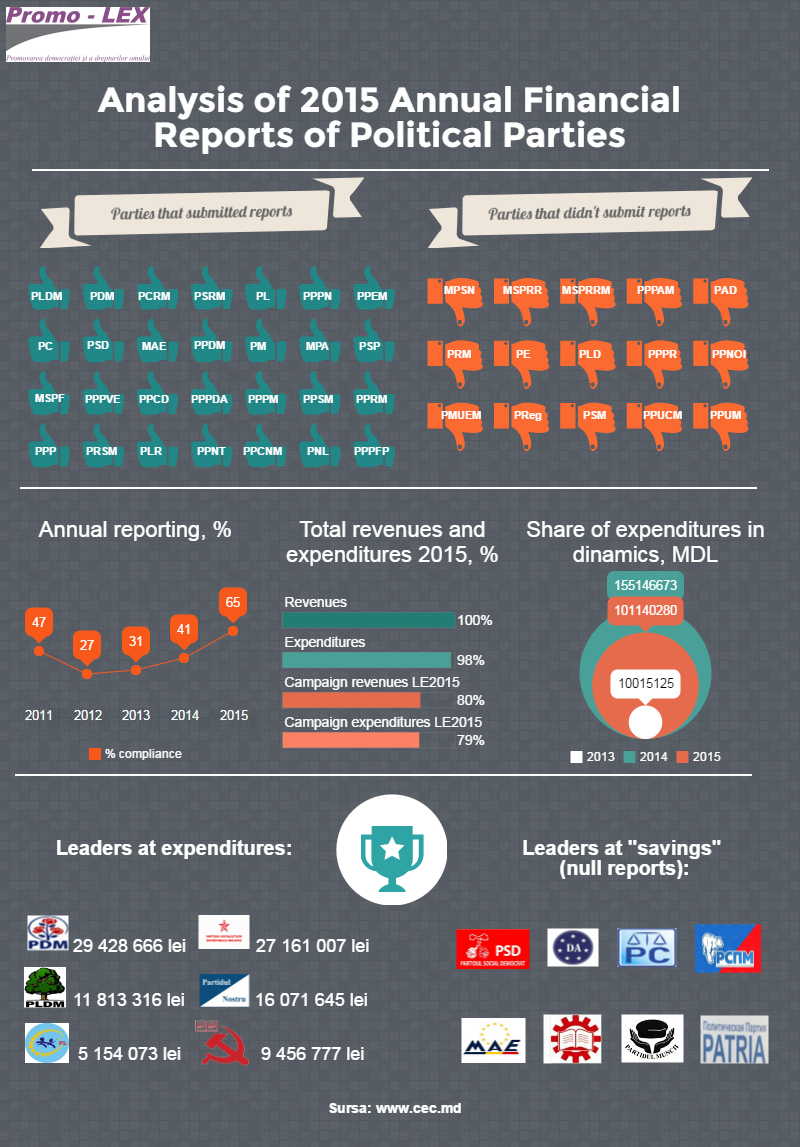
Analysis of 2015 Annual Financial Reports of Political Parties

rapoarte-financiare-2015-eng_block_1


Declaration of civil society organizations on the campaign aimed at discrediting representatives of the diplomatic corps in the Republic of Moldova

The representatives of civil society organizations express their deepest concern about the campaign led by some political interest groups and affiliated media institutions aimed at discrediting the representatives of the diplomatic corps that monitor the evolution of reforms in the Republic of Moldova.

We condemn the accusations made by these groups in saying that members of the diplomatic corps interfere in the justice act or that members of the diplomatic corps can only give general talks about the problem of corruption and cannot point at concrete illegalities and anti-democratic deviations.

We demand that these political interest groups stop their unfounded and inadmissible attacks.

As the Republic of Moldova started on the European path, the European Union launched a major campaign of financial, technical and expert assistance to support the reforms in our country. Therefore, we believe that the foreign donors have the right to present their opinion not only vis-à-vis the implementation of separate activities from action plans, but also about the results of these reforms or their absence.

One of the reasons for civil society organizations that monitor reforms in the country to share their opinions and expertise with international institutions, donors and development partners, is to influence decision makers in Moldova to consolidate the state of law and democracy based on a free market economy.  The critical opinions passed by the representatives of the diplomatic corps accredited in Moldova, especially of the partners that invest the money of their taxpayers in the development of the Republic of Moldova, present a useful and necessary for the Government and Moldovan citizens evaluation and the conclusions of the foreign diplomats need to be treated sincerely and honestly to correct the path of the reforms and initiate modifications in the areas that lag behind.


The Statement of civil society organizations on the procedure for nominating and selecting candidates for membership of the Central Election Commission

The civil society organizations state the delayed publishing, on the official web page of the Parliament,  of the list of the candidates for the membership of the Central Electoral Commission(CEC), appointed by the parliamentary majority and the opposition. In this context, the signatory organizations draw attention on the fact that the mandate of the members of CEC expired on 11 February 2016 and the Speaker of the Parliament initiated the selection of the new members on 18 March.

Unfortunately, the information on the candidates was published today, on 13 April 2016 and the Committee on Legal Affairs, Appointments and Immunities on the same day endorsed the list of the candidates. In our opinion, this is not a transparent process. The civil society and the general public did not have the opportunity to follow the process at issue and to analyze the compliance of the candidates with the requirements provided for in the Electoral Code and the Law NO. 199 as of 16.07.2010 „ on the status of the persons performing responsible state positions”.

Therewith, the civil society draws the attention on the lack of information regarding the candidate for the CEC membership to be appointed by the President.

The transparent contest –based selection, grounded on principles of meritocracy and political nonpartisanship of the CEC members, by the parliamentary majority and opposition shall be deemed an important step for enhancing the independency and the professionalism of the CEC members, and the institution itself. In this context, the signatory organizations are concerned about the refusal of the Parliament to support certain previously presented legislative initiatives aiming at ensuring a selection process based on clear principles of meritocracy and transparency of the candidates to CEC membership.

In the light of the above, the signatory organizations, even after the endorsement of the Committee on Legal Affairs, Appointments and Immunities, request the Parliament of the Republic of Moldova and the President of the country to organize public consultations in order to identify the candidates for CEC membership, in compliance with the following principles: clear procedures and requirements for selecting the candidates, sufficient time for the application of the potential candidates, clear requirements for the potential candidates, transparency in the selection process, consultations and the involvement of the civil society in the selection process and justification of the decision on selection.

The signatory organizations consider that the political influence on the CEC members’ selection process at this stage shall be reduced at maximum and totally excluded from the further CEC activity.

It this respect, we deem as inadmissible the recommendation of the Speaker of the Parliament, expressed publicly on 18 March 2016, regarding the opportunity to offer the position of the Chairperson of CEC to the parliamentary opposition.

We reiterate the point that pursuant the electoral legislation, the Chairperson of CEC shall be selected by the new members, and any interference, especially from the political environment, shall directly point at the fact that the future CEC members could be subsequently politically influences in the activity thereof. ,

The parties to this document request:

  1. The Parliament Republic Moldova – to ensure the transparency of the procedure of appointing the candidates for the CEC membership and to eliminate the political influence in the process of selecting the CEC Chairperson;
  2. The President of the Republic of Moldova – ensuring the transparency of the procedure of appointing the candidate for CEC membership on behalf of the President.

Contact person: Ion Manole, Facilitator of the National Platform of EaP CSF, Executive Director Promo-LEX Association, tel. 022450024, GSM: 069070800 , e-mail [email protected].


The Statement of civil society organizations on the procedure for nominating and selecting candidates for membership of the Central Election Commission

The civil society organizations state the delayed publishing, on the official web page of the Parliament,  of the list of the candidates for the membership of the Central Electoral Commission(CEC), appointed by the parliamentary majority and the opposition. In this context, the signatory organizations draw attention on the fact that the mandate of the members of CEC expired on 11 February 2016 and the Speaker of the Parliament initiated the selection of the new members on 18 March.

Unfortunately, the information on the candidates was published today, on 13 April 2016 and the Committee on Legal Affairs, Appointments and Immunities on the same day endorsed the list of the candidates. In our opinion, this is not a transparent process. The civil society and the general public did not have the opportunity to follow the process at issue and to analyze the compliance of the candidates with the requirements provided for in the Electoral Code and the Law NO. 199 as of 16.07.2010 „ on the status of the persons performing responsible state positions”.

Therewith, the civil society draws the attention on the lack of information regarding the candidate for the CEC membership to be appointed by the President.

The transparent contest –based selection, grounded on principles of meritocracy and political nonpartisanship of the CEC members, by the parliamentary majority and opposition shall be deemed an important step for enhancing the independency and the professionalism of the CEC members, and the institution itself. In this context, the signatory organizations are concerned about the refusal of the Parliament to support certain previously presented legislative initiatives aiming at ensuring a selection process based on clear principles of meritocracy and transparency of the candidates to CEC membership.

In the light of the above, the signatory organizations, even after the endorsement of the Committee on Legal Affairs, Appointments and Immunities, request the Parliament of the Republic of Moldova and the President of the country to organize public consultations in order to identify the candidates for CEC membership, in compliance with the following principles: clear procedures and requirements for selecting the candidates, sufficient time for the application of the potential candidates, clear requirements for the potential candidates, transparency in the selection process, consultations and the involvement of the civil society in the selection process and justification of the decision on selection.

The signatory organizations consider that the political influence on the CEC members’ selection process at this stage shall be reduced at maximum and totally excluded from the further CEC activity.

It this respect, we deem as inadmissible the recommendation of the Speaker of the Parliament, expressed publicly on 18 March 2016, regarding the opportunity to offer the position of the Chairperson of CEC to the parliamentary opposition.

We reiterate the point that pursuant the electoral legislation, the Chairperson of CEC shall be selected by the new members, and any interference, especially from the political environment, shall directly point at the fact that the future CEC members could be subsequently politically influences in the activity thereof. ,

The parties to this document request:

  1. The Parliament Republic Moldova – to ensure the transparency of the procedure of appointing the candidates for the CEC membership and to eliminate the political influence in the process of selecting the CEC Chairperson;
  2. The President of the Republic of Moldova – ensuring the transparency of the procedure of appointing the candidate for CEC membership on behalf of the President.

Contact person: Ion Manole, Facilitator of the National Platform of EaP CSF, Executive Director Promo-LEX Association, tel. 022450024, GSM: 069070800 , e-mail [email protected].