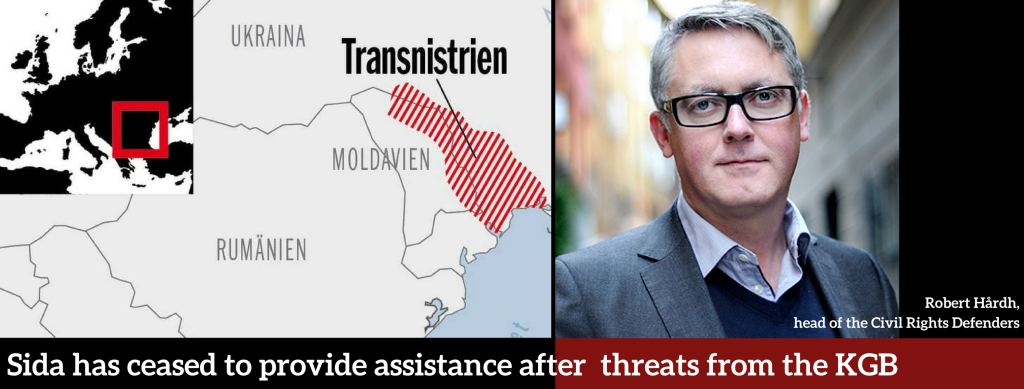
Sida has ceased to provide assistance after threats from the KGB

engSida a încetat să ofere asistență după amenințările parvenite din partea KGB (1)

article by Nils Resare
see the original version here

 The KGB security service threatened a Swedish official at Sida.
After this threat, the Swedish Agency for International Development has suspended its support provided to an NGO in Moldova.

 – It’s an outrageous and deeply unfortunate decision, says Robert Hårdh, head of the Civil Rights Defenders.

Through Civil Rights Defenders, Sida supports various human rights organizations in Moldova. One of them is Promo-LEX, which provides legal aid to people who have been subjected to torture in the prisons of the breakaway republic of Transnistria.

The aid stopped

But this aid, which had lasted for about ten years, was now stopped because it is assumed to make negotiations with Transnistria’s self-proclaimed regime more difficult.

– It’s an outrageous and deeply unfortunate decision. I’m afraid it will mean a stronger politicization of Swedish aid and undermine the human rights activity, says Robert Hårdh, heads of the Civil Rights Defenders. Transnistria, located between Moldova and Ukraine, is known for organized crime, arms smuggling and human trafficking. The country is not recognized by any nation but receives financial and military support from Russia.

Tries to extort money

Promo-LEX, working from Moldova, has so far helped 27 victims of torture from Transnistria to make their case to the European Court of Human Rights in Strasbourg. So far they have won all the cases that have been completed.

Some court cases are about victims of economic blackmail. The regime has tried to extort money or financial assets by torturing prisoners in jails and prisons.

Has spread threatening videos

The rulers of Transnistria are deeply bothered by the fact that these cases are dealt with in an international court. Last year, the secret police, the KGB, accused Promo-LEX of espionage and undermining of the security of Transnistria. In a press release KGB wrote that a preliminary investigation had been opened against the organization’s lawyers.

KGB is also suspected to have spread two threatening films about Promo-LEX and a number of journalists in social media. The films show how a number of named individuals get their email accounts hacked.

The films also send a warning to the organizations financing the work of Promo-LEX.

A Swedish national threatened

One of the e-mail accounts that are exposed in the films belongs to Månstråle Dahlström, Second Secretary at the Swedish Embassy in Moldova. Dahlström is responsible for Sweden’s support for human rights in the region and for the now discontinued support for Promo-LEX.

According to the head of Sweden’s aid in Moldova, Henrik Huitfeldt, the decision to stop aid has nothing to do with the threats. In contrast, according to the Swedish Embassy in Moldova, the activity of Promo-LEX complicates the talks on Transdniestria’s future that the security organization, the OSCE, is trying to lead.

Refuses to negotiate

The authorities in Transnistria have so far refused to join the negations as long as Promo-LEX work continues.

– Promo-LEX does a lot of good things, but they also do things that do not favor negotiations. Promo-LEX have pushed their cases hard. We do not believe that it is a viable strategy for improving the human rights situation in Transnistria for the long term, says Henrik Huitfeldt.

”Sida should have supported Promo-LEX”

Sida’s reasoning is challenged by both Civil Rights Defenders and Promo-LEX. They argue that the work with torture victims should not be sacrificed for the attempts to resume the negotiations on Transnistria. Sweden should not bow to the KGB’s claims.

– Promo-LEX is an independent human rights organization that does an excellent legal work. Sida should have supported Promo-LEX when they were attacked by the KGB rather than cutting aid, says Robert Hårdh.

A longer report by Blank Spot Project on the situation in Transnistrian region here! 

Sida responds to criticism: ”Absolutely wrong”

After this article had been published, Sida’s press secretary Inga-Lill Hagberg contacted  Aftonbladet. She believes that the title of the article is absolutely wrong – according to Sida, the aid was not stopped after the threats.

– We have not been subjected to any threats, either in Sweden or in Moldova. Nothing like that happened, says Inga-Lill Hagberg at Sida.

Nobody at Sida knew anything about the films before the reporter Nils Resare contacted the Agency for an opinion, says Inga-Lill Hagberg. Since January this year, Sida has indeed stopped paying out money to PromoLex.

– We said we should not support Promo-LEX, but no threat is behind the decision. We have other reasons. The situation in the breakaway region of Transnistria is very difficult. We try to help resolve the conflict with the Moldovan government and the de facto authorities in place. Promo-LEX hampers the dialogue and undermines the conflict resolution process in Transnistria, says Sida’s press secretary Inga-Lill Hagberg.


Promo-LEX found the use of administrative resources and a tendency to dodge reporting the actual expenditures incurred while collecting signatures

IMG_5229Promo-LEX Observation Mission of the Presidential Elections of 30 October 2016 states in its Second Monitoring Report cases of administrative resources use during the signature collection campaigns by the initiative groups, cases when signatures were collected by unauthorised people and stakeholders dodging to report the actual expenditures incurred for signature collection.

During the monitored period the registration of initiative groups, in charge of collecting signatures for candidates to the position of President, came to an end. The Central Electoral Commission registered 24 initiative groups that will have to collect signatures until 30 September 2016. Promo-LEX observers also found the intention of PCRM to boycott the Presidential Elections, keeping the right to assign members into the electoral bodies from their party.

The review of the legal framework on the Presidential elections reveals that the legislation is aligned to the international standards to a high extent, though the regulations on the Presidential elections are more recent, and there isn’t yet any practice of their sustainable implementation. In this context, we draw the attention that during the presidential elections, the students and pupils with the right to vote can vote only on the basis of their student/pupil cards, which is a usual practice for the Parliamentary elections. Thus, Promo-LEX recommends to regulate the participation of students/pupils the right to vote in the electoral process by applying uniform, non-discriminatory and sustainable provisions for all types of elections.

The observers note that during this period, CEC manifested a high level of activity, adopting the necessary documents to secure compliance with the timetable. However, Promo-LEX Observation Mission believes that on 3 September 2016, CEC could have worked in order to fulfill its duties, including receiving documents to register initiative groups, but not register candidates to the position of President, because in such a way it favoured indirectly the PDM candidate, Marian Lupu.

At the same time, to ensure transparency, Promo-LEX recommends to CEC to publish without delays on its website all requests and applications received from the potential election candidates. In the same train of thoughts, Promo-LEX requests to ensure continuous access to the information about the validity or invalidity of the signatures from the subscription lists established by operators, so that they could be subsequently compared with the CEC decisions on candidates registration.

Promo-LEX Mission welcomes the public information campaign, initiated by CEC for the Presidential elections of 30 October 2016, and the launching of two advertisement sports for voters both from the country and from abroad.

Monitoring of the signature collection by initiative groups revealed that signatures had been collected for 7 candidates to the position of the President of the Republic of Moldova in at least 110 settlements. In this context, isolated cases of signatures in the subscription lists by unauthorised persons were reported.

At the same time, Promo-LEX observers found cases that can be regarded as use of administrative resources during the collection of signatures for four candidates: Marian Lupu (PDM), Mihai Ghimpu (PL), Iurie Leanca (PPEM) and Igor Dodon (PSRM). With this in mind, note that the initiative group of candidate Marian Lupu collected signatures in 311 settlements run by PDM mayors, accounting for 75.12% of the 414 settlements were signatures were collected. In at least two cases, signatures were collected for Marian Lupu in public authorities and institutions (mayor’s offices, schools, kindergartens).

In addition, according to Promo-LEX observers, Valeriu Munteanu, Minister of Environment, used the administrative resources when he received and filed the subscription lists for candidate Mihai Ghimpu, during the working hours.

The observers also found to two cases when the subscription lists were filed during the working hours: to support the PPEM candidate, Mr Iurie Leanca, by the Deputy President of   Cantemir district, and to support the PSRM candidate, Igor Dodon, by two social workers.

Promo-LEX found that, during the monitored period, both political parties, and candidates that announced their intention to participate in the elections of 30 October, intensified their electoral activities. Thus, at least 27 activities of electoral nature were found in favour of 8 political parties/potential candidates (PSRM/Igor Dodon, PP PN, PDM/Marian Lupu, Valeriu Ghileţchi, PPEM/ Iurie Leancă, PPPDA/Andrei Năstase, PPPAS/Maia Sandu).

As for the financing, during the reporting period, 3 initiative groups that submitted subscription lists to CEC, reported lower expenditures in their financial statements than estimated by Promo-LEX, or reported zero expenditures. Thus, according to the estimations of the Observation Mission, these initiative groups failed to report in their global financial statements at least MDL 85,200 for different categories of expenditures (IG of PPEM – MDL 28,555, IG of PL – MDL 24,999,  PPPDA – MDL 31,646). Likewise, though the initiative group for the PDM candidate reported higher expenditures than estimated by EOM, nevertheless failed to include in the global financial statement the estimated expenditures of at least MDL 10599.60 for the remuneration of members of the initiative group and volunteers.

In this context, Promo-LEX reminds to election candidates that they are liable for contraventional, criminal and fiscal liability, and also risk to be eliminated from the electoral run, according to Article 38 (10) and Article 22 (2)(g) of the Electoral Code.

On the other hand, according to Promo-LEX observers, as part of the electoral activities, a number of political parties incurred during the reporting period, for outdoor advertising only, expenditures estimated, by EOM at a minimum of MDL 1,142,000 (PPPAS – MDL 10,000, PP PDA – MDL 2,000 lei, PL – MDL 179,840, PDM –  MDL 950,160).

Promo-LEX Observation Mission consists of 42 long-term observers who will monitor the electoral process in all constituencies of the Republic of Moldova during 31 August – 30 November 2016. On the election day, Promo-LEX will delegate a short-term observer in each polling station of the country. Promo-LEX EOM will also perform the parallel vote tabulation in all polling stations. The observers involved in the monitoring process sign the Code of Conduct of the Promo-LEX. Independent National Observer, assuming the commitment to act efficiently, in good faith and in a non-partisan manner. The activity of all observers is coordinated by a central team consisting of 37 persons.

The activity carried out by Promo-LEX EOM and the “Come to Vote” campaign is currently funded by by the United States Agency for International Development (USAID), the British Embassy in Chisinau, the National Endowment for Democracy and by the Council of Europe. The opinions presented in the public reports of Promo-LEX belong to authors and do not necessarily reflect the donors’ view.

For more details, please contact: Tatiana Pascovschi, Comunnication officer of the Promo-LEX Election Observation Mission: GSM 060804022, e-mail [email protected]


The blind spot of Europe

Untitled design

More and more people from the Republic of Moldova seek asylum in Germany, but the chances of being recognized are minimum. Why do the Moldovans leave their houses? A trip to a torn country.

article by Petra Sorge
see the original version here

În Grozești, Republic of Moldova, Valeriu Butnaru, the 60-year old locksmith is alone in his house and workshop. There are three land plots around the house.

The weeds grow, the shutters grind with every wind blow. Everyone has left: children, young people, and families.

They all jostle in Western Berlin in a reused industrial house. The lots in the shelter on Paulsternstraße are separated with curtains. Every twelfth comes from the Republic of Moldova. In the first half of the year, 1608 people came to Germany – twice as many as in the same period of last year. Even more people are asylum seekers – 1780 in total.

As compared to one million asylum seekers from Syria, Iraq and other countries, the figure does not seem to be very high. But the small country Moldova with 3.6 million inhabitants is facing a tendency: thousands of people are abandoning their country from the Eastern garden of the European Union.

BERLIN, PAULSTERNSTRASSE

This is true for Victor, blond, 32, Russian-speaker and his  colleague Natalia. They came with their families and are  worried about the decision on the asylum. Because, they have been constantly  rejected so far. The Federal Office for Migration and Refugees (Bamf) said NO 1040 times to the asylum seekers from the Republic of Moldova in January-July. Only two asylum seekers received positive answers. So, the share of positive answers is 0.1%. Victor was responsible for security in a foodstuff company. One day, one of his colleagues died in a work accident. Victor informed his manager and the police. Nothing happened. No investigation. No consequence. He chose to leave. Natalia is the victim of a huge bank scandal. She kept her money at the state company Banca de Economii, 5000 Euros in total. One year ago, this bank went bankrupt and her money vanished.

She was not offered any solution in Moldova, did not benefit from the state insurance of deposits. The former Prime Minister is accused of the theft of one billion dollars  from this bank and from other commercial banks. In October he was arrested. According to the corruption index developed by Transparency International, the Republic of Moldova is on the 103rd position out of 168. We must add a frozen conflict here: Moldova is divided in the Western part, where the Romanian language is spoken and people want to join the EU and the Eastern part where Russian is predominantly spoken: Transnistria, that declared itself an autonomous republic, acknowledged only by Russia.  The region is isolated from the international point of view. In 1992, there was a war between the two parts. After 1992, no violent actions have been recorded.    The citizens of the Republic of Moldova are allowed to   travel to the EU without visas since 2014. The Transnistrians want to join the Russian Federation. At the end of May, the US army sent soldiers to Moldova for a maneuver in response to Putin’s aggression in Eastern Ukraine. At the NATO Summit held in Warsaw in July, it was decided that it is appropriate to send more troops to Eastern Europe. At the shelter, Victor tells us that he did not run because of the policy of the Chancellor Angela Merkel. Natalia has relatives in Germany. In April they searched on the Internet, translated the information with Google Translate. They rented a van and told the driver: “Berlin, Turmstraße please”. It is the address of the initial reception of refugees. We made this trip on our own and continued the new wave of migration.

MOLDOVA, IN NISPORENI DISTRICT

In Grozești village, almost everyone lives on the money that is sent by relatives from abroad. This is true for Valeriu Butnaru, who has a son in Germany. The latter works in a car service, in Munich region. His second son lives with his wife and children in the neighborhood. Not all the houses are destroyed here. There are also noble houses with finished façade and a garden.

Butnaru has a dream: he wants to build a new workshop and launch, with his sons, a repair business with his own money, without credits and, especially, without politicians: “they are thieves”.

Butnaru pays taxes like all the local residents. But the money does not come back to the village, for the public infrastructure, for example: the street in front of his house is full of mud. The toilet is in the garden – a wooden box almost overthrown by the wind.

Until recently, he used to go out with the tractor three times a month to bring drinking water. In Nisporeni district, there are wells, but the water is polluted with toxic substances and heavy metals. Things are easier for Butnaru now since the end of July: a new system of drinking water with network has been built with Austrian and EU funds. Now, about 16,000 people have fresh drinking water in their taps.

“This refers, in essence, to treating the reason for the refuge, because life in the village becomes more tolerable and can enhance the economic activity”, says the Project Coordinator Gerhard Schaumberger from the Austrian Development Agency.

NISPORENI TOWN IN THE REPUBLIC OF MOLDOVA,
DISTRICT ADMINISTRATION

The water from the building of the Nisporeni district administration still smells like rotten eggs. It contains hydrogen sulphate, a colorless gas.

The President of the district Ion Artene has his office here. There are three small flags on his table – Nisporeni, Moldova, EU. He says that the district and the member communities have also participated in the water project. In addition, every owner had to pay 5000 lei (about 230 Euros) for connection.

Ion Artene speaks about economic development, “local business”. But where are the asphalted streets that businesses need urgently? Where is the sewerage system? The president of the district raises his shoulders: “I am in this position for only one year.” What about corruption? Artene says that there may be some problems with the “Police and justice”.

At the beginning of the year, most asylum seekers from the Republic of Moldova are from Nisporeni. Why? Ion says that there is no persecution and he has not heard of people who facilitate trafficking to Berlin. His assumption is: “They are looking for a better life in Germany.”

CHIȘINĂU, CAPITAL OF MOLDOVA,
STATE BUREAU FOR MIGRATION AND ASYLUM

Maybe we get some help from a state representative who is involved in this issue. Iulian Popov, Button-Down shirt, is the director of the Bureau for Asylum and is the person who takes the decision about the stay of foreign citizens in the Republic of Moldova. He has a world map in the office. He leaves his door open and all the employees do the same. There is no queue here anyway. First, Popov makes a tea, pours hot water in the cups until the water reaches the margins. He jumps, brings a napkin and removes the stain.

Popov has statistics: how many Moldovans sought asylum in other countries: 980 in 2014. Of them, 122 received positive reply. In line with the Geneva Convention, the asylum can be obtained by people who are discriminated because of race, religion, nationality or membership to a social group, as well as in case of political persecution.

Is there persecution in the Republic of Moldova? Popov says: “As a country of origin, we don’t have the right to speculate on the reasons of our citizens’ refuge.” But it is possible that not everyone knows what a refugee is: this creates misunderstanding.”

We see very quickly that Popov does not want to talk about the negative aspects of the existence in the country where he works as a civil servant.

CHIȘINĂU, CAPITAL OF MOLDOVA,
INTERNATIONAL ORGANIZATION FOR MIGRATION

Ghenadie Crețu is not bound by a civil servant’s behavior. He works for the International Organization of Migration (IOM), which is an inter-state organization that supports refugees and people returning to the country. He calls the recent emigration of Moldovans “economic migration”. “Many of those who were blocked in Europe, without a job and money seek asylum.”

Crețu does not see the Transnistrian conflict as a reason for seeking asylum: “There is no war there.”

Since the beginning of June – after two years of peace – the parties to the conflict talk to each other. The representatives of Moldova and Transnistria met in Berlin with the mediation of German diplomats. Germany took over the leadership of the Organization for Security and Co-operation in Europe (OSCE) this year; in July, Frank-Walter Steinmeier travelled to the region one more time.

The Minister of Foreign Affairs, member of the SPD announced small progresses: the mutual acknowledgement of the registration plates and of the graduation diplomas.

Steinmeier warned that, because of the NATO troops, there may be a war against Russia in Eastern Europe. Transnistria is important, because this is, in fact, a conflict between Moldova and Russia. President Putin sees Transnistria as a buffer zone to the European Union and NATO.

Many diplomats know that the successful negotiations in Transnistria will serve as an example to other frozen conflicts, such as Nagorno-Karabakh, Abkhazia or Eastern Ukraine. Beside Moldova and Transnistria, the EU and USA take part as observers in the so-called discussions in the 5+2 format. Russia and Ukraine have the role of mediators. The fact that these two rivals sit at the same table can be called a success, because the peace plans Minsk I and II are still not functioning for Ukraine.

Steinmeier formulated the goal of negotiations at the beginning of the year: sovereignty and territorial integrity for the Republic of Moldova, a special status for Transnistria. This is in theory. Basically, we are far from a viable solution.

Thus, Moldovans are not afraid only of Putin’s influence, but also of the fact that the Gagauz, a Turkish people settled down in the Southern part of the country will solicit more autonomy. At the end of July, Transnistria rejected the special status suggested by OSCE. The President of the Supreme Council refers to a referendum held in 2006, when the participants clearly expressed their wish that Transnistria be part of Russia.

The refugees do not have any role in this conflict.

CHIȘINĂU, CAPITAL OF MOLDOVA,
A SHELTER FOR THE ASYLUM SEEKERS

Currently, there is one refugee from Transnistria in the Republic of Moldova: Sergej Ilcenco. The journalist in a grey T-shirt, blue jeans and with a beard has lived for one year in a shelter of the UN Agency for Refugees. He shares the room with two persons and has three kittens in a carton box. There are only 14 residents in the whole shelter, including 4 Syrians – the flow of refugees of the last year brought them close to Moldova.

The case of Sergej Ilcenco is an important piece of evidence for the Republic of Moldova: the situation on the left bank of Nistru is serious. Almost dramatic.

This is what Ilcenco also felt. He stayed for two months in a Transnistrian prison, because he incited to a so-called “armed revolt against the legal and lawfully elected authority”. This is what a document of the KGB says – the Transnistrian secret service still keeps the name of the Soviet model. Ilcenco says that this statement was “completely fabricated”. He never wrote this text on the blog, as he was accused. His asthma and heart condition worsened while he was in the prison.

To the civil servant Iulian Popov, Ilcenco’s case shows that “it is likely that there is a risk of torture and deprivation of liberty in Transnistria”.

But are the facts seen the same in the self-declared Republic?

TRANSNISTRIA, CAPITAL TIRASPOL

In the Tiraspol capital, the soldiers’ monuments remind about the war with Moldova. The state coat of arms displayed on a number of boards, still contains the communist symbols: a red star, a hammer, a sickle and a crown with ears.

In a pizzeria we meet Ekaterina Lipovcenko, opponent of the regime. She looks nervously at the street. Her son, Alexandru, has been staying in a detention center in Tiraspol for one year. His cell, 24 square meters, is shared with eight people. At the end of March, the court found him guilty for extremist activities and he was imprisoned for three years and a half. Previously, he wrote on Facebook: “the order in Transnistria can be restored with the help of American soldiers”.

This internationally isolated regime is not afraid of anything, but an intervention from the outside. The head of the Government, Pavel Prokudin raised Steinmeier’s picture at the end of July and talked about a “clink of swords” at the borders of Transnistria.

Oleksandr Lipovcenko contested the KGB statement, started the hunger strike and got hepatitis. The guards beat him. “He barely could walk, lost weight and his body was covered with bruises”, the mother’s boy describes the condition he was in.

His mother, Ekaterina Lipovcenko, wrote letters to the Organization for Security and Co-operation in Europe. She was asking for help. She hasn’t received an answer so far. The OSCE wrote that the branch from the Republic of Moldova is responsible for certain incidents. But the correspondence must remain confidential.

CHIȘINĂU, CAPITAL OF MOLDOVA,
AT A NON-GOVERNMENTAL ORGANIZATION

Ion Manole is nervous. He is a legal expert, activist and director of the non-governmental organization Promo-Lex. He considers that Transnistria is a “black spot” in terms of Human rights and the OSCE “does not do anything to combat this for years”.

Manole collects information on cases of human rights violation. If the inhabitants of Transnistria want to seek asylum abroad, they will need his services. Later, he transmits documents: “only for those who are really persecuted”. There is a shelf in his office with many case files on it.

Ion Manole and his colleagues are not allowed to travel to Transnistria for one year to get information on their clients there; an investigation on them has been initiated there. The accusation has been made public by the KGB: Promo-Lex was discredited because it has never addressed in Moldova the subject of Ukrainian nationalists or the violation of human rights in the USA. On the other hand, its activity is said to be the “methodical, destructive and hostile” organization of activities against the Transnistrian Republic.

The Council of Europe is “concerned” and warned about the consequences at the end of June: the international actors

Human rights and the OSCE “does not do anything to combat this for years”.

Manole collects information on cases of human rights violation. If the inhabitants of Transnistria want to seek asylum abroad, they will need his services. Later, he transmits documents: “only for those who are really persecuted”. There is a shelf in his office with many case files on it.

Ion Manole and his colleagues are not allowed to travel to Transnistria for one year to get information on their clients there; an investigation on them has been initiated there. The accusation has been made public by the KGB: Promo-Lex was discredited because it has never addressed in Moldova the subject of Ukrainian nationalists or the violation of human rights in the USA. On the other hand, its activity is said to be the “methodical, destructive and hostile” organization of activities against the Transnistrian Republic.

The Council of Europe is “concerned” and warned about the consequences at the end of June: the international actors had to immediately create an “emergency mission” to Moldova. There was a clear requirement to the OSCE: the main mission to Moldova must also take into consideration the human rights, according to its mandate. But nothing happened so far.

Upon request, the OSCE mission to Moldova, the OSCE secretariat in Vienna, as well as the Federal Ministry for Foreign Affairs transmit the correspondence one to another. Finally, an OSCE representative declared in 2016, in written form: “The discussion about the individual violation of human rights is not part of the 5+2 agenda”. However, there is a group of experts on this subject.

How accurately the violations of human rights in Transnistria are recorded is demonstrated by another destiny the OSCE was informed about.

CHISINAU, CAPITAL OF MOLDOVA,
THE BUSINESSWOMAN ALA GHERMAN

This case ruins the life of Ala Gherman. The 53-year old woman sits in the center of her office, surrounded by files with documents and piles of papers on the floor. “Vitali, Vitali“, she shouts, as though these papers could bring him back. Thousands of pages with evidence that her brother Vitali Eriomenko is innocent. Evidence that nobody wants to take into consideration.

The 47-year old man had a food manufacturing company in Slobozia, a Transnistrian community. When the business became profitable, the problems started. He was accused of tax evasion. The fact that neither the auditors nor the Tax Department confirmed this was not important for the Transnistrian secret services or for the law enforcement authorities. On March 29, 2011, Eriomenko was handcuffed. The process was discussed 18 times. He was sent to jail for 12 years.

His wife and three children migrated, and the 400 employees were dismissed. An empire was destroyed. Eriomenko’s house was vandalized.

Ala Gherman opens a file on the computer. In spring, after five years, she secretly managed to take pictures of her brother’s house. The windows are broken, the cupboards are empty. A cut out teddy duck. Worms moving on the floor.

She shows a picture made in 2013. The radiography of Vitalie’s teeth. We see six holes. “He has no teeth anymore”. The woman’s brother has problems with the heart, stomach and intestines. “I would pay for the surgery”, says Gherman, who is a businesswoman and produces dry fruit in Chisinau, “but they don’t allow me”.

Ala Gherman wrote to OSCE, again and again. Her parents also addressed to the mission. They still have not received a reply.

OSCE claims that it has not found letters from the human rights activists. “The messages were looked for in the corresponding electronic file”, the spokesperson of the OSCE presidency in Germany stated.

BERLIN, FEDERAL MINISTRY FOR FOREIGN AFFAIRS

At the beginning of July, the Federal Ministry for Foreign Affairs invites to a conference: “OSCE as an agent”. In a panel, there is the German special representative who participates in the Transnistrian negotiations, Cord Meier-Klodt. In front of him, an illustrator draws small pictures on a whiteboard. A turtle, a snowman, a squirrel. It is the content of the conference that must not be seen outside. I cannot transmit authorized quotations from the conference nor the interview with the special representative.

Later, Ion Manole from Promo-Lex writes on Facebook: he had the impression that only in Moldova can it occur that OSCE blocks the news. “If Germany and OSCE had an adequate policy in Transnistria, there would be fewer refugees”.

The Swedish journalist Nils Resare tried to get an interview from OSCE, from the main mission with the headquarters in Chișinău. His subject: Transnistrian negotiations and the “situation of victims of torture”. At the end of June he received a reply: “we cannot talk to you about cases of torture, so, if you don’t mind, we will not touch upon this subject”.

So, is it better to hide the violation of human rights? Even the Federation Institution for Migration and Refugees talks openly about “tortures” in Transnistria.

OSCE has a problem. It is an entity one of the parties to the conflict is in: Russia. The Transnistrian negotiations “must be supported only by the 57 OSCE member states through consensus”, said the spokesperson of the OSCE presidency from Germany. The OSCE problem is also a problem of Steinmeier until the end of the year.

But nobody sees this: Steinmeier doesn’t want confrontations with Russia. When he has public meetings in Transnistria, he doesn’t talk about the violation of human rights. The Federal Ministry for Foreign Affairs highlights that Steinmeier, during his business trips, “always” addresses relevant subjects – “which includes the violation of human rights”.

BERLIN, PAULSTERNSTRASSE

July 21 is for Natalia at the shelter for refugees a day when all her hopes vanish. She received the rejection letter: her family and she will have to return to Moldova. Victor received the same decision one month ago.

Natalia doesn’t know what will happen. She has no money or job. She has no future.


Eurasian GNDEM Members Discuss Advancements in Parallel Vote Tabulations

From August 4-5, representatives from GNDEM members in Eurasia – the International Society for Fair Elections and Democracy (ISFED) in Georgia, Civil Network OPORA (OPORA) in Ukraine, Promo-LEX in Moldova, Center for Research, Transparency and Accountability(CRTA) in Serbia, and the Coalition for Democracy and Civil Society (Coalition) in Kyrgyzstan – gathered in Tbilisi, Georgia, along with the National Democratic Institute (NDI), for a regional workshop on advancements in Parallel Vote Tabulation (PVT). The workshop focused on three main topics: ensuring quality observers, data collection and analysis, and communicating findings. Given the regional focus, leaders and experts from the five citizen observer groups and NDI tailored their presentations and discussions to specific advancements and challenges that countries in the region have experienced over time. Each session was accompanied by a discussion, where members could share their country and electoral specific experiences, and ask questions to improve their future election observation programs.

The two day workshop began with a presentation on how the parallel vote tabulation (PVT) methodology has evolved over the last 30 years including the accompanying changes in technology. In addition, challenges specific to the implementation of PVTs in the Eurasia region were discussed. Typically the goal of the PVT is to deter and detect potential election day irregularities. Due to this, election monitoring organizations face enormous time pressure as they race to release their assessment and projections before the Election Commission announces the official results. This is in contrast to other regions where the goal is to confirm the results and to reduce the potential for violence. Participants also discussed the importance of recruiting quality observers and using pre- and post-training tests and the full-scale simulation to evaluate the observer’s understanding of their form and reporting method.

The second day focused on citizen observer groups’ communication plans and data management. One presentation highlighted a recent case in Serbia where CRTA had a livestream of their election monitoring activities which included video from their call center, a live view of the PVT database and each of the press conferences. They also discussed the challenges of explaining the technical details of PVTs in a way that the general public can easily understand. Development of sophisticated PVT databases was also a priority for many organizations. A leading expert who has developed PVT databases for several countries around the world discussed the difficulty in developing a universal database, as each country’s observation effort can be different.
Through this peer-to-peer workshop, participants were able to share best practices from recent elections, while others were able to look forward to using new methodologies and tools in upcoming electoral activities. The workshop allowed regional experts to collaborate and share experiences with one another, and fostered exchange and collaboration amongst organizations in Eurasia and Central and Eastern Europe. This type of exchange between regional peers not only increases the capacity of more nascent groups, but serves to further entrench norms and practices within the community of citizen observer groups working for electoral integrity in their countries. This model of peer-to-peer exchange can and should be replicated in other regions, with GNDEM members sharing their strengths, challenges and overall experiences with their regional colleagues, while also learning from other organizations and further strengthening election observation activities.

More at: www.gndem.org


The seizure of automobiles by the separatist administration of the Transnistrian region: a violation of the European Convention

On August 30th 2016, the European Court of Human Rights handed down a decision finding the Russian Federation liable for the infringement of the plaintiff’s right to property in the Casian case against the Republic of Moldova and the Russian Federation. This case is among the first in which the European Court has ruled on the legality of the actions of the separatist administration, which has confiscated and applied fines to cars with Moldovan license plates that pass through the Transnistrian region.

In February 2007, the car of plaintiff Petru Casian was confiscated by representatives of a so-called customs post installed by separatist forces at the entrance of the village of Lunga, on the grounds that he had violated the allowed length of his stay in the Transnistrian region. In order to recover his car, the plaintiff had to pay a “fine” of approximately 30 euros. Even so, the car was only returned at the end of March 2007. Although the applicant requested the support of the constitutional authorities, they failed to give him any help in solving the issue and made only general statements.

In his complaint to the High Court, the plaintiff argued that his right to property under Article 1 of Protocol 1 of the European Convention on Human Rights had been violated because his car was confiscated and because he was required to pay an illegal fine. The Court found with 6 votes against 1 that the plaintiff’s property rights were violated in this regard.  The Court ordered the payment of material and moral damages and legal costs amounting to €3530.

Petru Casian was represented by legal experts and attorneys from Promo-LEX. More details about this case can be found on the website of the European Court of Human Rights. During the examination of the Casian case, the Court decided to merge it with a similar case, the Turturica case (also against Moldova and Russia), and this decision applies to both cases.

For more details, contact: Carolina Bondarciuc, Promo-LEX Communication Officer: GSM 060280980, Tel./Fax (+373 22) 45-00-24, e-mail: [email protected]


Promo-LEX Will Monitor the Presidential Elections of 30 October 2016

IMG_5041The Promo-LEX Election Observation Mission started monitoring the electoral process and stated in its report that the electoral management bodies are investing efforts into the proper conduct of elections on 30 October 2016. The observers also mentioned the need to prepare the lists of voters and to verify political parties and election campaigns funding under conditions of greater transparency.

An analysis of the legal framework regarding the presidential elections of 30 October shows that the tools needed for this activity to be carried out are in place. However, there are some unsettled issues related to when the election campaigns are to begin and to the signature sheet terms and verification procedures. Promo-LEX EOM also found that the procedure to follow for the compiling of the list of initiative group’s members and of the signature sheet is cumbersome.

The political parties do not observe to the fullest extent the provisions regarding the funding of parties and election campaigns. It is necessary to penalize those political parties that did not submit their financial statements before the deadline or did not submit any at all or that submitted incomplete financial statements or financial statements that contained obvious mistakes, particularly if such violations were reported by observers or other actors involved in the electoral process.

Promo-LEX notes that in order for the voters to be able to vote, CEC made an online early registration platform available for citizens who are abroad. There were as many as 557 voters registered as of the date that the report was developed on.

Promo-LEX expresses its appreciation for the openness of CEC to update and publish the information from the State Register of Voters on 22 August 2016. However, given the large discrepancies in the number of people who have turned 18 years of age, provided by different state institutions (ÎS CRIS Registru, NBS and CEC), the public authorities need to ensure a higher transparency of the process of compiling and providing access to the voters lists for all electoral stakeholders.

The Ministry of Justice updated the list of political parties having the right to nominate a candidate for the presidential elections. There are 45 parties and social-and-political organizations on the list. Until 23 August 2016, the following candidates expressed their intention to run for the presidential elections of 30 October 2016: Igor Dodon (PSRM), Iurie Leanca (PPEM), Maia Sandu (PPPAS), Andrei Nastase (PPPDA), Valeriu Ghiletchi (independent candidate) and Oleg Brega (independent candidate). The PPPAS, PPPDA and PLDM leaders announced later their intention to forward one joint candidate. The leaders of 4 parties (PCRM, PDM, PL and PPPN) announced their intention to nominate their own candidate if no final decision is taken by the party management body with regards to its name.

Alongside the Election Observation Mission, Promo-LEX Association will also conduct the “Come to Vote” Campaign, the purpose of which is to engage the voters in the electoral process and to make sure that Moldovan citizens eligible to vote cast their votes knowingly and consciously. The Moldovan citizens eligible to vote, particularly the youth, will be the target group of the campaign. As part of the “Come to Vote” Campaign, as many as 10 public electoral debates will be held, two video-spots will be launched and awareness will be raised among citizens at local and national levels. Promo-LEX Association will also launch a Grant Contest for the NGOs from Moldova, meant to support 2-3 projects focusing on voter mobilization and on the promotion of informed and conscious voting.

The Report is available here.

Promo-LEX Observation Mission consists of 42 long-term observers who will monitor the electoral process in all constituencies of the Republic of Moldova during 31 August – 30 November 2016. On the election day, Promo-LEX will delegate a short-term observer in each polling station of the country. Promo-LEX EOM will also perform the parallel vote tabulation in all polling stations. The observers involved in the monitoring process sign the Code of Conduct of the Promo-LEX. Independent National Observer, assuming the commitment to act efficiently, in good faith and in a non-partisan manner. The activity of all observers is coordinated by a central team consisting of 37 persons.

The activity carried out by Promo-LEX EOM and the “Come to Vote” campaign is currently funded by by the United States Agency for International Development (USAID), the British Embassy in Chisinau, the National Endowment for Democracy and by the Council of Europe. The opinions presented in the public reports of Promo-LEX belong to authors and do not necessarily reflect the donors’ view.

For more details, please contact: Tatiana Pascovschi, Comunnication officer of the Promo-LEX Election Observation Mission: GSM 060804022, e-mail [email protected]


Declaration of the Civil Society regarding the Red lines of the Transnistrian Settlement

Chisinau, August 21st, 2016

Recognizing the importance of sustainable settlement of the Transnistrian conflict through dialogue and political negotiations;

Appreciating the efforts of the European Union, United States, Ukraine and the OSCE to find a lasting political solution to the Transnistrian conflict by respecting the sovereignty and territorial integrity of Moldova;

Supporting the confidence building measures among civil society, businesses and Moldovan citizens from the both sides of the Dniester River;

Welcoming the initiative of the German Presidency of the OSCE to resume political consultations in the “5 +2” format as well as to give an impetus to the sector working groups’ meetings between representatives of the central authorities of Moldova and the representatives of the de facto administration of the Transnistrian region of Moldova;

We also express our deep concern with the isolation of Moldova in the “5 +2” format by multiplying the pressure on its constitutional authorities to urge them to make unilateral concessions incompatible with the norms and principles of international law that could seriously harm future negotiations of
Transnistrian region status within Moldova. The result of these pressures can later serve as a precedent for other areas and frozen conflicts;

We appeal to the mediators and observers of the “5 +2” format to take into account the norms of international law in the resolution of this conflict that was escalated by the illegal foreign military presence on the territory of our country and to avoid supporting any settlements that are not in line with the principles of international and European experience of unity through diversity, respect for recognized borders of the nation states and which would only encourage separatism and territorial disintegration of Moldova;

We draw attention of the international partners that by compelling unilateral concessions from the part of Moldova, represented by the internationally recognized legitimate authorities, it will not contribute in any case to the lasting resolution of the Transnistrian conflict, rather it will ensure the conservation of the conflict. Moreover, by satisfying unjustified claims of the Transnistrian separatist administration that coincides fully with the interests of the Russian Federation to re-assert its geopolitical dominance over the ex-Soviet space, OSCE, EU and other international organizations put their prestige, resources and authority at the service of the Russian revisionist policy that presents security risks for the Eastern Partnership countries, as well as for the whole of Eastern Europe;

We call on the Moldovan authorities to not recognize statehood elements of secessionist Transnistrian region nor in or out the “5+2” format, regardless of charming promises and chancelleries from where those promises come. The main priority of the reintegration policy of Moldova must be the protection of civil and political rights of its citizens that live in the Transnistrian region, defusing conflict hotbeds and unconditional, total and full withdrawal of the foreign troops, their ammunition and combat equipment, intelligence services, as well as of all other hostile forces from its sovereign territory. The obligations of the Moldovan authorities are prescribed by the Constitution, the relevant legislation and international conventions to which Moldova is party. Any concessions that would exceed the limits of the territorial-administrative autonomy in the composition of Moldova should be dismissed or suspended immediately;

President of Moldova is the only institution that guarantees the sovereignty and independence of the state. That’s why Moldovan authorities must categorically reject any unilateral guarantees invoked, proposed or haggled in the process of the Transnistrian political settlement that have not been endorsed by the President and the Parliament of Moldova and that could serve only the interests of foreign actors as a pretext and instrument for intervention and capturing our state;

We insist on the principle of demilitarization of the Transnistrian region, the withdrawal of Russian troops and combat equipment is a key prerequisite for sustainable, comprehensive and definitive political settlement. Foreign military forces present on the territory of Moldova without the agreement of the constitutional authorities are illegal, and their presence is contrary to the Constitution and unilaterally declared neutrality of Moldova;

Moldova recognizes the priority application of international conventions on human rights and freedoms throughout its sovereign territory, including the Transnistrian region. That’s why everyone who has violated the rights and civil liberties of citizens or have committed crimes, either to the right or left bank of the Dniester River, must be held accountable without pretending any exception from the law, as well as any kind of guarantees. It is recommended that any projects to promote confidence building, to deliver humanitarian assistance to the population or to build infrastructure, launched with the support of the development partners of Moldova have to contain clauses of non-recognition of the legitimacy of decisions taken by the Transnistrian separatist authorities;

Any policy to promote confidence must be based on the priority of promoting human rights, freedoms and legal remedies to redress any human rights abuses. Respecting international conventions on human rights, civil and political freedoms to which Moldova is part, must prevail over all other secondary topics regularly raised by the leaders of the Tiraspol administration during the negotiation process;

We believe that the access to international markets opened to the Transnistrian business by the Moldovan authorities and EU must be conditioned on the respect of legislation and rule of law of Moldova. Moldovan authorities should make clear that this access is due to the Association Agreement negotiated, signed, ratified and implemented by the Moldovan constitutional authorities and not by Tiraspol agreements with various unauthorized representatives with such mandate from EU. Access to the EU market is a good guaranteed by/within the national legislation of Moldova and not outside it. All those who show disrespect and defy Moldovan law must be deprived of access to privileged trade and economic agreements;

Moldova must continue the democratic process of devolution and decentralization, while strengthening the power of the state, enhancing public order and punish abuses, illegalities, corruption and other criminal offenses. No region, city or village located on the territory of Moldova can arrogate powers/rights that the supreme law of the country did not recognize. In this context, the fundamental obligation of negotiators on behalf of Moldova is to affirm and strengthen the unity and indivisibility of the state rights and fundamental freedoms enshrined in the international and national laws;

Negotiation of any statute of territorial autonomy for Transnistria cannot question the sovereignty, independence, national unity and European integration policy of Moldova. Also negotiating the future state should be accompanied by wide public consultation and participation;

Finally, we appeal to the constitutional authorities to negotiate only with those representatives of the Transnistrian region who have not committed crimes, not persecuted Moldovan citizens and do not promote purposes contrary to the Constitution of Moldova.

This statement has been supported with signatures, including people of culture and science, diplomats, journalists and politicians.

The declaration remains open for signature supporters.

Signatories:

• Vasile Nedelciuc, Chairman of the Foreign Policy Association (APE)
• Ion Sturza, Chairman Fribourg Investments, Ex-Prime-Minister of Moldova, Member of APE
• Igor Munteanu, Executive Director, IDIS Viitorul
• Nicu Popescu, Member of APE
• Eugen Carpov, Deputy Prime-minister for Reintegration, Member of APE
• Victor Chirila, Executive Director APE
• Igor Boțan, Executive Director ADEPT
• Arcadie Barbăroșie, Executive Director IPP
• Nicolae Negru, Ziarul Național
• Ion Manole, Executive Director, Promo-Lex
• Petru Bogatu, Deputy Chairman, Union of Journalists of the Republic of Moldova
• Iurie Reniță, Ambassador of the Republic of Moldova to the Kingdom of Belgium and Chief of Mission of the Republic of Moldova to NATO
• Mihai Gribincea, Ambassador of the Republic of Moldova to Romania
• Leonid Litra, Senior Researcher, Institute of World Policy, Kiev
• Iurie Pîntea, Programs Director IPP
• Victoria Bucătaru, Programs Director APE
• Corneliu Ciurea, Political Analyst
• Pavel Postică, Promo-Lex
• Lilia Carasciuc, Transparency International – Moldova
• Petru Macovei, Association of Independent Press (API)
• Oazu Nantoi, Programs Director IPP
• Iulian Groza, Executive Director, Institute for European Policies and Reforms (IPRE)
• Lilia Snegureac, Resources Center DIALOG-Pro
• Adrian Lupușor, Executive Director, Expert-Grup
• Liliana Vițu-Eșanu, Member of APE
• Ion Guzun, Legal Resources Center from Moldova
• Anatol Țăranu, Executive Director, Politicon
• Viorel Soltan, Center For Health Policies and Studies (PAS)
• Cornelia Cozonac, Center for Journalistic Investigations
• Petru Botnaru, Executive Director, ONG “Terra-1530”
• Ludmila Popovici, Executive Director, Rehabilitation Centre for Torture Victims “Memoria”
• Valentin Ciubotaru, Executive Director, NGO BIOS
• Ioana Bobina, Women’s Association for the Environment Protection and Sustainable Development (AFPMDD)
• Vitali Covaliov, Chairman, Union of the organizations of invalids of the Republic of Moldova
• Valeriu Rusu, AO ADR “Habitat”
• Angela Chicu, Chairman, Association of Business and Professional Women from Moldova


Once a Hostage of the Transnistrian Militia, Now Waiting for the ECtHR Judgement

The European Court of Human Rights informed the defendant governments on the case of Elena DOBROVITCAIA (Case File 41660/10).

On 16 July 2010, Elena was “summoned” as witness by representatives of the militia. Later, when she appeared at the militia station, she was detained on the grounds that her mother, Zinaida Ciuhnenco, did not comply with a subpoena of the militia. Mrs. Ciuhnenco was targeted in a criminal file, but at that moment she was undergoing treatment in the cardiology department of a medical center in Chisinau. She was informed by telephone by a so-called investigator from Bender that her daughter would be detained until she returns to the Transnistrian region to serve a “criminal sentence”. For more details please click here.

Elena had been detained for three days in the basement of Bender militia station in inhuman conditions. Her release was conditioned on her mother’s return to the region. The graduation examination of a pre-university institution that Elena had to pass on 17 July was replaced by a traumatic experience of being kept hostage in a militia station.

“The domination of impunity in the Transnistrian region for serious violations of the fundamental rights and freedoms is one of the reasons that such cases of arbitrary deprivation of liberty occur. “Any administration, either de jure or de facto, shall be bound to observe the human rights and shall be made accountable for its actions”, Alexandru Zubco, Promo-LEX lawyer, declares.

*Conversation of Zinaida Ciuhnenco with the “investigator” from Bender, where she asks for the release of her daughter.

In her application to the European Court of Human Rights against the Republic of Moldova and the Russian Federation, Elena Dobrovitcaia  complained under Article 3 of the Convention (torture and inhuman and degrading treatment used during detention period). In addition, the applicant invoked the violation of all paragraphs of Article 5 (Right to liberty and security), Article 8 (Right to respect for private and family life) and Article 2 of the Protocol No 4 of the Convention (Freedom of movement).

The applicant is represented before the High Court by lawyers and attorneys of Promo-LEX Association.

For more details, please contact: Carolina Bondarciuc, Promo-LEX Press Officer: GSM 060280980, Tel/Fax (+373 22) 450024, e-mail[email protected]


ECtHR Communicated the Case of Police Officer Alexandru Ursu

Recently, the European Court of Human Rights communicated to the Government of the Republic of Moldova and the Government of the Russian Federation the case of Alexandru URSU (Case File No 25197/11).

Alexandru Ursu is a former district police officer and leutenant at Hagimus police station of Causeni DPS, who was detained since July 2009 – November 2012 in the prison of Hlinaia village, Transnistrian region. He was kidnapped on 21 July 2009 by the representatives of Tiraspol militia men and accused of forgery in documents and fraud when purchasing an immovable property on the left bank of the Nistru River.  In a period less than a year – from July 2009 to May 2010, he was indicted on five counts, took part to such called lawsuits, and on 19 May 2010 he was “sentenced” to 15 years of imprisonment by the Bender “Court of law”.

The case came into the sight of constitutional bodies only at the end of 2010, when, upon the relatives’ request, the Promo-LEX Association’s layers sent a notification to the Ministry of Internal Affair informing that a police representative was kidnapped and “sentenced”. For more details please click here.

“The arrest and detention of the police officer Ursu Alexandru must be qualified as an intimidating and persecuting action against the national police officers who work in the security area. Building of the criminal case and subsequent sentencing aimed at denigrating constitutional authorities that try to perform their duties in the security area. It is a clear evidence of the fact that nobody can feel safe in the Transnistrian region”, Alexandru Postica, Director of Human Rights Program, declared.

In his Application submitted to the European Court of Human Rights, Alexandru Ursu complained under Article 3 of the Convention (torture and inhuman and degrading treatment used during detention period). In addition, the Applicant invoked the violation of the Article 5(1) of ECHR (right to liberty and safety), Article 6(1) (right to a fair trail) and Article 13 of the Convention (right to an effective remedy).

The Applicant is represented before the High Court by lawyers and attorneys of Promo-LEX Association.

For more details, please contact: Carolina Bondarciuc, Promo-LEX Press Officer: GSM 060280980, Tel/Fax (+373 22) 450024, e-mail [email protected]


Council of Europe Is Concerned about the Situation of Human Rights Defenders in the Transnistrian Region

On 24 June 2016, the participants in the Conference of International Non-Government Organisations of the Council of Europe adopted a series of recommendations (CONF/PLE (2016)REC1) on human rights defenders’ protection in the Transnistrian region of the Republic of Moldova in the case of Promo-LEX Association.

Thus, according to the adopted document, the non-government organisations attending the conference showed their deep concerns about stigmatization, application of “special prosecution measures” and initiation of criminal proceedings against Promo-LEX Association human rights defenders.

At the same time, the participants in the conference expressed their concerns on the progress of the situation of human rights defenders and the lack of a legal and efficient framework that would establish clear guarantees for human rights observance and human rights defenders’ protection in the Transnistrian region.

The International Non-Government Organizations of the Council of Europe call upon Moldovan authorities to publicly condemn the threats against the human rights defenders initiated by the de facto administration of the region and to ensure effective and impartial investigation of the cases of reprisals against human rights defenders.

They also call upon Russian authorities to get actively involved and make use of their influence to determine the de facto administration of the region to stop exerting pressure on the human rights defenders.

In addition, they urge the international and inter-governmental organizations to initiate a urgent mission of monitoring the situation in the Transnistrian region.

We remind that during 21-24 June 2016 the Conference of International Non-Government Organisations of the Council of Europe took place in Strasbourg. During the event, the Human Rights Committee examined the situation of the human rights defenders in the Transnistrian region based on the case of Promo-LEX and its work in this area of the Republic of Moldova. The document can be viewed here.

According to Ion Manole, Executive Director of Promo-LEX Association: “Each administration, either de jure or de facto, shall be bound to observe the human rights and shall be made accountable for its actions. However, the de facto administration of the Transnistrian region continues to reject the dialogue on human rights and democracy, believing that these are political issues.

Thus, the impunity excels in this region and there are neither norms nor efficient legal remedies for protecting the human rights. The shortage of independent human rights defenders, impossibility to monitor the situation, to protect and promote the human rights in this region remain the main issues.

Last but not least, we are concerned about the lack of interest and consideration for the issue of human rights and human rights defenders in the Transnistrian region, for the working environment of the civil society, as well as for the situation of the freedom of the press”.

For more details, please contact: Carolina Bondarciuc, Promo-LEX Press Officer: GSM 060280980, Tel/Fax (+373 22) 450024, e-mail [email protected]