PUBLIC APPEAL the adoption of the law on the liberalisation of capital and financial incentive undermines anti-corruption efforts and discourages honest taxpayers and state servants

The civil society organisations draw the attention of the Parliament, the Government, the general public and Moldova’s development partners to the legislative initiatives no. 451 and no. 452 registered in the Parliament on 1 December 2016. These initiatives provide for “capital liberalization”, i.e. exemption from any liability of individuals and companies that have not declared their properties in return for their declaration by 15 April 2017 and subsequent payment of 2% from the value of undeclared property to the state budget. The above-mentioned initiatives also introduce a ban on sanctioning of the public servants for not having declared these properties.

Our reaction is determined by the sensitive and dual nature of the foregoing initiatives, insufficient approach to the subject and foremost by their impact on society. Besides the effects reflected in the informative notes, which are not grounded and do not foresee economic, administrative and fiscal impact, we express our strong concerns that such initiatives would lead to a total amnesty of those who have illegally acquired their property, especially of the state servants.

Fighting corruption is the first priority of Filip Government Program. In 2016, important laws have been adopted aimed at strengthening the fight against corruption. Development partners have heavily invested in justice sector reforms, preventing and combating corruption in Moldova and strengthening anti-corruption authorities. It would appear logical under such circumstances for the Government to be concerned with the efficient operation of the relevant authorities so as to hold accountable those state servants who have illegally acquired their properties.

If the legislatives initiatives no. 451 and no. 452 are adopted, it will be impossible to sanction the companies and the individuals, especially state servants, who have not declared or declared at reduced values their properties. On the other hand, these initiatives reduce to zero the efficiency of the legislative amendments known as “Integrity Package:, adopted by the Parliament a few months ago and reported by the authorities as a great success in fighting corruption. Moreover, it will allow corrupt officials to keep their public functions and will discourage honest taxpayers and state servants. Additionally, the draft laws do not contain a sufficient reasoning.

We point out that between 2007 and 2008, the Government granted a tax and capital amnesty, draining the state budget of 4 billion lei. In the period 2012-2016, through several theft and embezzlement schemes, many Government representatives became, either directly or through intermediaries, beneficiaries of such irregularities. Among them – the one billion dollars theft, the airport concession, the money laundering schemes through the banking system, acquisitions through affiliated companies, trading operationsthrough phantom companies in the energetic sector, property takeover through raider attacks etc. Since 2013 a law on indirect methods of taxation is in force, which has not been applied so far. This has not allowed investigating the undeclared income and properties, as well as has drained the state budget of considerable revenues.

The signatory organizations consider inadmissible the adoption of draft laws no. 451 and no. 452, as they legalise irregularities and undermine the efforts of fighting corruption and building rule of law in Moldova.

Signatories:

1. Asociaţia Micului Business;
2. Asociaţia pentru Democraţie Participativă “ADEPT”;
3. Asociația pentru Guvernare Eficientă și Responsabilă;
4. Asociația pentru Politică Externă;
5. Asociația Presei Independente;
6. BIOS;
7. Business Consulting Institute;
8. Centru de Investigații Jurnalistice;
9. Centrul de Analiză și Prevenire a Corupției;
10. Centrul de Asistență Juridică pentru Persoane cu Dezabilități;
11. Centrul de resurse DIALOG-Pro;
12. Centrul de Resurse Juridice din Moldova;
13. Centrul Național de Mediu;
14. Centrul pentru Politici și Analize în Sănătate;
15. Confederaţia Naţională a Patronatului din Republica Moldova;
16. Consiliul Național al Tineretului din Moldova;
17. Eco-TIRAS;
18. Expert-Grup;
19. Fundația Est-Europeană;
20. IDIS Viitorul;
21. Institutul de Dezvoltare Urbană;
22. Institutul de Instruire în Dezvoltare “MilleniuM”;
23. Institutul de Politici Publice;
24. Mișcarea Ecologistă din Moldova;
25. Portalul Platzforma.md
26. Promo-LEX;
27. Centrul de Reabilitare a Victimelor Torturii „Memoria;
28. Centrul Regional de Mediu Moldova;
29. TERA1530;
30. Transparency International – Moldova.

Contact person: Lilia Carasciuc, Executive Director, Transparency International Moldova, E-mail: [email protected], Tel.: (373-22) 203-484, 203-485


The exercise of the right to peaceful assembly versus the management of the organization of assemblies in 2016

IMG_4334The Promo-LEX Association issued a retrospective of the exercise of right to peaceful assembly in the Republic of Moldova in 2016. The study presents a short analysis of the most prominent assemblies that were organized in 2016, and focuses the ways in which the authorities ensured that assemblies ran smoothly. Although there is generally a positive trend in the protection of the right to assemble freely, there were a few cases in which participants in assemblies and police employees obviously overstepped their rights and obligations.

The study finds that 2016 was the year with the highest number of political events crucial for the evolution of the domestic democratic system. This evolution took place against a background of continuous pressure from groups of people protesting against several systemic issues. On the one hand these assemblies polarized society; on the other hand, they were the reason for certain actions by the authorities that brought to light long-hidden problems and realities.

The electronic version of the study can be found here.

This study was carried out by the Promo-LEX Association with the support of the East Europe Foundation, with grants from the Government of Sweden and the Ministry of Foreign Affairs of Denmark/DANIDA. The opinions expressed in Promo-LEX reports belong to the authors and do not necessarily reflect the views of the East Europe Foundation, the Swedish Government or the Ministry of Foreign Affairs of Denmark/DANIDA.


Promo-LEX: Mild penalties for perpetrators of domestic violence

For the past 16 days, several events have been organized in the Republic of Moldova in order to raise awareness about, prevent, and combat domestic violence. At its last Universal Periodic Review, Moldova was given 30 recommendations on preventing and combating domestic violence. Among them was a recommendation that Moldova ratify the Convention of the Council of Europe on preventing and combating violence against women and domestic violence.

Although we now have mechanisms to combat domestic violence, the Promo-LEX Association notes with concern that courts continue to apply excessively mild punishments to abusers. Thus, there is a discrepancy between the sentences received by perpetrators and the seriousness of the acts they have committed. Promo-LEX lawyers believe that symbolic punishments can actually encourage further domestic violence.

In this context, the Buiucani Court delivered a judgement yesterday (December 9th) sentencing an abuser to a suspended sentence of 5 years, even though he was charged with four offenses: illegal deprivation of liberty (article 166 of the Criminal Code), domestic violence against a spouse or minor daughter (article 201/1, paragraph 2 of the Criminal Code), hooliganism (article 287 of the Criminal Code) and non-execution of a court decision (article 320 of the Criminal Code). The defendant has repeatedly abused a woman and minor since 2014, especially after the victim decided to leave their shared residence and filed a request to investigate the defendant.

The prosecutor requested a sentence of 7 years of imprisonment for the abuser, and the injured party and her lawyer requested the maximum penalties for each charge. Nevertheless, the court ended the trial for 2 of the charges using the Law on Amnesty and handed down a conditional sentence of 5 years of suspended imprisonment for the other 2 charges. Finally, the court decided to apply the provisions of Article 90 of the Criminal Code, arguing that the defendant has shown good behavior and can be reformed.

Given the perpetrator caused his former partner and the minor to suffer greatly for three years, the punishment was excessively mild compared to the acts committed, says Dumitru Sliusarenco, a Promo-LEX lawyer. He also observed that courts apply lenient punishments (without time in prison) in the majority of domestic violence cases, even though judges apply much harsher penalties for other, similarly severe crimes. The Promo-LEX lawyer concluded that almost nothing stops the offender from committing new acts of violence and endangering the life and security of the victim after such a sentence.

In conclusion, the Promo-LEX Association draws the authorities’ attention to the decisive role of the courts in preventing domestic violence. Applying light punishments to abusers discourages victims of abuse from turning to the legal system for help. Since superior courts have previously applied more severe punishments in cases of domestic violence, and given the seriousness of the problem, we believe that inferior courts should standardize judicial practice in this area.


Detainees continue to report poor detention conditions to the ECtHR

The European Court for Human Rights has communicated the Jereghi (Case nr. 11040/16), Lupoi (Case nr. 17744/16), and Cîrlig (Case nr. 26827/15) cases to the Government of the Republic of Moldova. The complaints are filed under articles 3 (prohibition of torture) and 13 (the right to an effective remedy) of the Convention, and refer to poor detention conditions and bad healthcare in penitentiaries.

In their applications to the European Court of Human Rights, the applicants described: small, narrow, cold, poorly ventilated or unventilated detention spaces; overcrowded cells; poor lighting; limited access to toilets; lack of access to medical services; lack of food for several days or insufficiently caloric food; limitations on access to water; exposure to infections; and other problems.

The issue of poor detention conditions in the penitentiary system of the Republic of Moldova was discussed in the fall of 2016 at the United Nations Universal Periodic Review, where the Republic of Moldova received and accepted 12 recommendations regarding the right to not be submitted to torture and inhuman or degrading treatment. The improvement of detention conditions and medical care in penitentiaries was one of the main recommendations of the United Nations.

The Promo-LEX Association calls on the Government of Moldova to quickly implement the Action Plan (presented to the Committee of Ministers of the Council of Europe on October 21st, 2013) on enforcing the decisions in the Becciev, Ciorap and Paladi (DH-DD(2013)1168) group of cases by urgently changing legislation concerning the penitentiary system and detention conditions, allocating more funding for the penitentiary system, improving existing remand detention practices in order to reduce the number of people in custody, creating effective ways to appeal poor detention conditions, and accelerating the construction of the new Chișinău prison.

Given that the communicated cases refer to violations that occurred in Penitentiary Number 13, the Promo-LEX Association calls on the Government to prioritize the following: taking the necessary measures in order to reduce the population of this penitentiary, including by transferring prisoners from Penitentiary Number 13 to other penitentiaries; creating effective compensatory remedies for poor detention conditions and lack of access to health care; and allocating additional financial resources for detainees’ healthcare.

The applicants are represented at the High Court by attorneys from the Promo-LEX Association.  More details can be found here.

For more details, contact: Carolina Bondarciuc, Promo-LEX Press Officer: GSM 060280980, Tel./Fax (+373 22) 45-00-24, e-mail: [email protected]


Promo-LEX presents the conclusions of its observation mission on the financing of the 2016 Presidential Campaign and a comparative assessment of different legal frameworks in the fight against political corruption in the Eastern Partnership countries

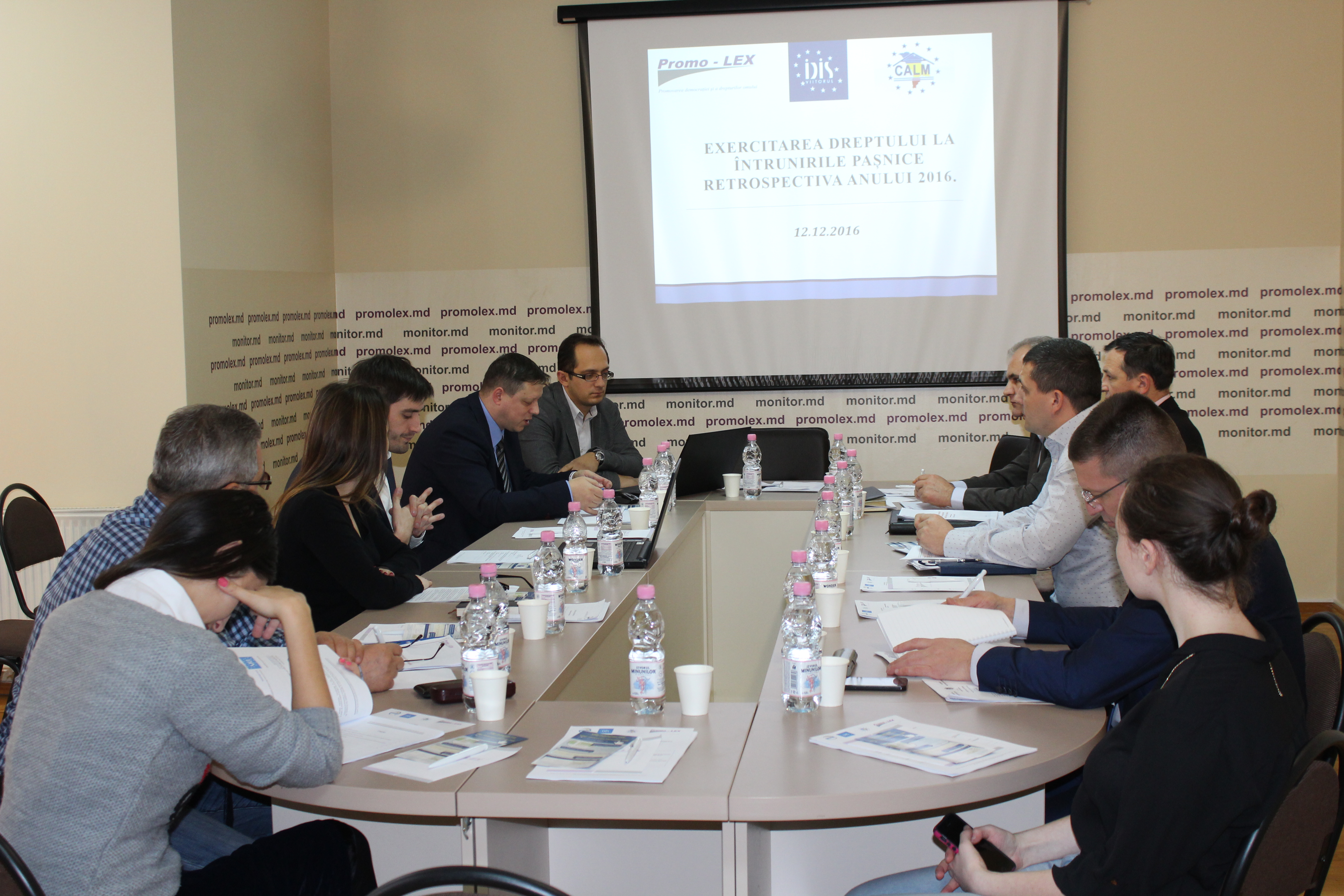
IMG_3725On 28 November 2016, the Promo-LEX Association conducted a workshop on the financing of political parties and election campaigns in Eastern Partnership countries and specifically on campaign finance practices in Moldova’s Presidential Election. The report reveals that 11 election candidates did not submit a complete accounting of their expenditures during the election campaign. The study covers the period from 25 August to 13 November 2016.

The Promo-LEX Mission’s analysis of the finances of initiative groups and electoral candidates during the election period shows that MDL 1 160 427 were collected in accounts marked “Intended for Initiative Groups” and MDL 59 426 475 in “Electoral Fund” accounts. The majority of the contributions collected by the initiative groups came from legal entities (46.58%), followed by individual contributions (41.49%) and in-kind donations (4.66%). On the other hand, election candidates received the majority of their contributions from individuals; 2 895 people transferred MDL 52 408 936 to campaign funds, followed by MDL 7 008 200 from legal entities and in-kind donations totaling MDL 837 765. The total amount reported by election candidates was MDL 59 426 475.

In addition, Promo-LEX has estimated that a total of at least MDL 7 627 223 was not reflected in the financial statements of 11 candidates. Most of the unreported expenditures are payroll expenses for campaign staff, compensation for volunteers/observers, outdoor and mobile advertising, promotions and – last but not least – maintenance costs for campaign offices.  According to the observers’ estimates, Igor Dodon, Marian Lupu and Dumitru Ciubașenco are among the candidates whose financial statements omitted the largest amounts of money. Estimates of the expenditures of these electoral stakeholders reach more than one million lei each. In addition, the Observation Mission estimates that a total of MDL 2 239 310 was spent by 5 political parties for electoral purposes – expenses that should be included in those parties’ semi-annual financial statements (semester II, 2016).

The closest any initiative group came to reaching the funding ceilings set by the CEC was 82.77%, raised by the initiative group supporting Dumitru Ciubașenco (PPPN), followed by the initiative group supporting EC Marian Lupu (PDM), which raised 36.86% of the maximum (he later withdrew from the electoral race). The initiative groups supporting Mihai Ghimpu (PL), I.C. Vasile Tarlev, I.C. Maia Laguta, Vitalina Pavlicencon (PNL), Ana Gutu, I.C. Geta Savitcaia, I.C. Ion Dron and 1 EC (I.C. Maia Laguta) declared no expenditures during this period.

The observers note that 94% of the reported expenses were designated for advertising (including promotional materials), 2% for public events, 2% for transport, 1% for compensation of volunteers/observers and 1% for other expenses. No electoral candidates reported payroll expenses or expenses related to public opinion polling. Only three electoral candidates reported expenses for volunteer compensation, consulting and additional maintenance expenses (including telecommunications). Like the electoral candidates, the initiative groups focused their attention on advertising (including promotional materials), spending 75% of reported expenses on advertising, 17% on transport, 4% on additional maintenance expenses and 4% on other expenses.

In addition, the Promo-LEX Mission found that electoral authorities were less active during the 2016 presidential election, given that they independently supervise and oversee  the financing of political parties and election campaigns. Legislation currently in force provides for gradual sanctions when laws on political party and election campaign financing are violated.  The CEC also the ability to inform the relevant bodies about any violations punishable under administrative or criminal law, or related to violations of tax law. Regarding this mechanism, Promo-LEX did not record any cases of sanctions being imposed or relevant bodies being informed  with a view toward imposing sanctions.

In conclusion, the Promo-LEX Mission observed several irregularities that were not properly accounted for in the financial reporting of both initiative groups and election candidates, with a view toward imposing proper sanctions or filing appeals. The comparative assessment of campaign financing was based on the financial statements submitted by initiative groups and election candidates to the CEC, analyzed in connection with the observers’ findings.

The comparative analysis of the ability of legal frameworks to fight political corruption in Eastern Partnership countries focuses on 4 areas of comparison. These areas are: the regulatory body for political party and election campaign financing; revenue and expenses in political party and election campaign finances; reporting requirements for political party and election campaign financing; and sanctions for violations in political party and election campaign financing. The analysis notes Georgias positive experience with elections, which serves as an example for the rest of the countries in the region and demonstrates that the Republic of Moldova needs to make progress in campaign finance transparency.

Click here to find the study on Political Parties and Election Campaign Finance in the Eastern Partnership Countries. The findings and recommendations of the Promo-LEX Observation Mission can be found here.

The workshopPolitical parties and election campaign finance in the Eastern Partnership countries. Campaign finance practices in the Presidential Election of the Republic of Moldova” was organized under the projects “Strengthening civil society organizations in the fight against political corruption in the Eastern Partnership countries” and Civic monitoring of political financing and support for the uniform application of the judicial code in Moldova“, with the financial support of the Civil Society Forum of the Eastern Partnership Countries, the Ministry of Foreign Affairs of the Czech Republic, the European Union, the National Endowment for Democracy and the Embassy of Great Britain in Chisinau. Responsibility for the opinions expressed belongs to the Promo-LEX Association and does not necessarily reflect the positions of partner organizations and donors.

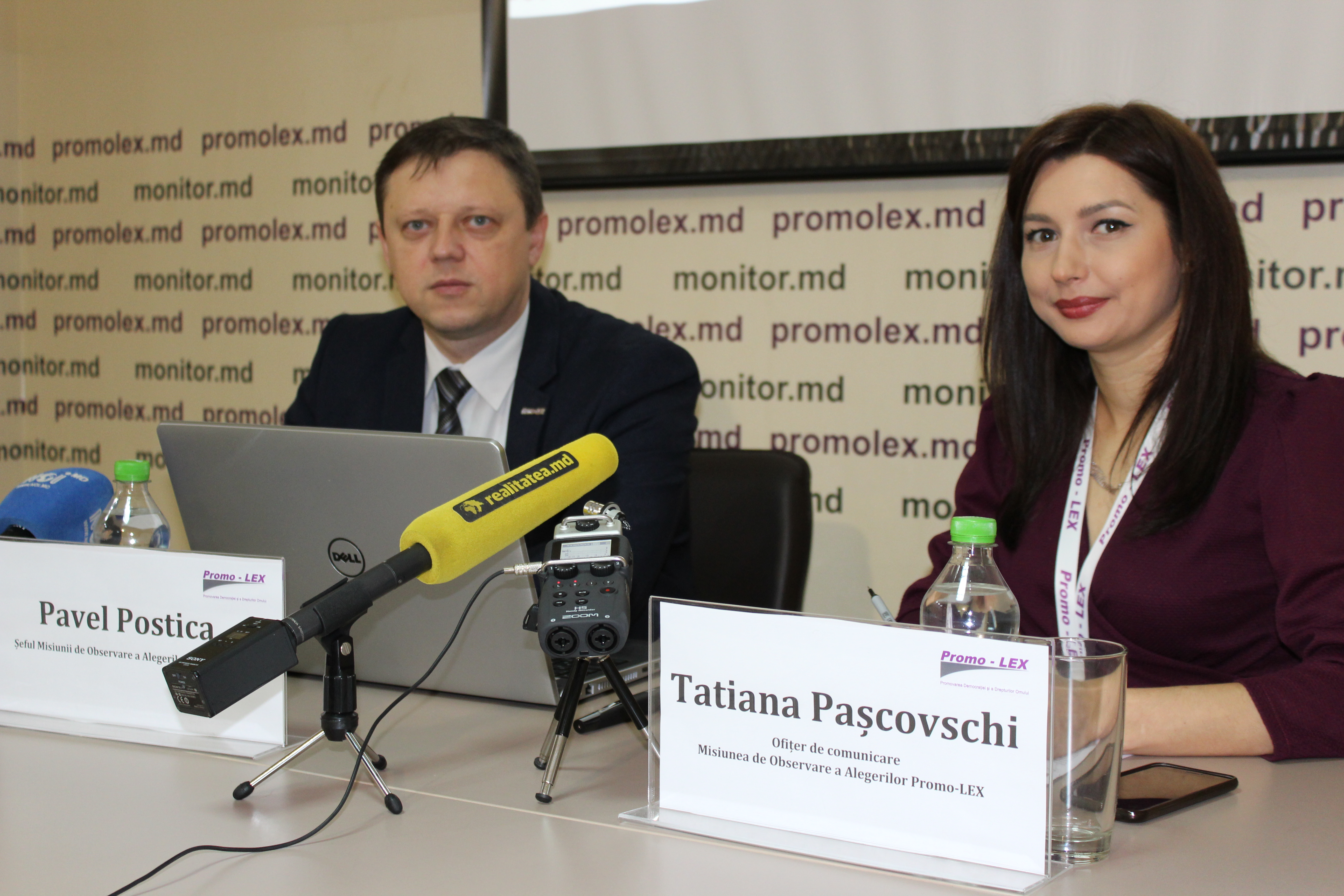
For more details, please contact: Tatiana Pascovschi, Communication Officer of Promo-LEX: GSM 060804022, e-mail: [email protected]


The state recognizes that Victoria Pruteanu is a victim of domestic violence

Today (November 22, 2016) the judges of the Chișinău Court of Appeals returned a verdict in the case of Victoria Pruteanu, a victim of domestic violence from Străseni who supports 4 minors. The magistrates denied the prosecution’s appeal and partially granted the appeal of Victoria Pruteanu’s lawyers regarding sentencing. The appeals court upheld the sentence of the Strășeni court (which had sentenced Victoria to three years and eight months in prison), but the sentence will be suspended until her children are 8 years old. The time Victoria has already served under house arrest – more than 2 years – will count toward the sentence, meaning she will only serve one year and six months. The Promo-LEX lawyer Vadim Vieru, who represented Victoria Pruteanu at the appeals court, declared that he will appeal the decision of the Court of Appeals to the Supreme Court of Justice and that he will insist Victoria Pruteanu be acquitted.

In addition, the Promo-LEX legal expert Lilia Potâng said that decision of the Chișinău Court of Appeals has several positive aspects, including an interlocutory statement from the Chișinău Court of Appeals relating to local social workers and police officers and the lack of protection for victims of domestic violence.

The Promo-LEX Association has assisted with the case of Victoria Pruteanu since June 2015, as it is a representative case for the Republic of Moldova and reveals gaps in the system for defending victims of domestic violence. We have found that state institutions have increased the pace of reform and implemented legislation to protect victims since civil society and the mass media have begun paying attention to and getting involved in cases of domestic violence. Therefore, the Promo-LEX Association would like to thank everyone who has been involved in the Victoria Pruteanu case, as well as in other cases of domestic violence.

We repeat that Victoria Pruteanu was subjected to domestic violence by her husband throughout her years of marriage. Although she sought help from the authorities, Victoria was not protected from her abuser. A protection order was issued in August 2014, but the order was not carried out and Victoria remained in danger. Her aggressive husband violated the order repeatedly, but the authorities failed to give Victoria any real protection. The authorities knew that acts of violence were committed against her and her children, but the police punished her abusive husband only lightly. On the evening of December 14, 2014, Victoria defended herself against a renewed attack by her aggressive husband. During the confrontation that followed, her husband died. Victoria Pruteanu supports 4 children and is part of a socially vulnerable family.

Other details about this case are available here.

Images and statements from the hearing can be seen here.

For more details, contact: Tatiana Pașcovschi, Press Officer at the Promo-LEX Association: GSM 060804022, e-mail: [email protected].


For the First Time in the Republic of Moldova, Incapacitated Persons Will Have Free Access to Justice

eb648fff-acd9-473a-bbca-3b497e19764dIn April 2016, Promo-LEX Association submitted a request to cancel the exception of unconstitutionality in order to check the constitutionality of Articles 57(2), 58(21), 170(1)(c), 267(b) and (a), 306(1) and 308(2) of the Code of Civil Procedure of the Republic of Moldova. On 17 November 2016, the Constitutional Court ruled that the provisions excessively limiting the rights of persons with disabilities were unconstitutional.

The decision on excessively limiting of the rights of persons with disabilities consists of 2 parts: the first part refers to the right to access to justice, and the second part refers to the civil and legal capacity and establishment of guardianship. Until recently, any person suffering from a mental disability, even a minor one, could easily be declared incapacitated in a procedure that used to be rather perfunctory, and be totally deprived of the opportunity to exercise his/her rights. The person declared incapacitated could not appeal the decision declaring him/her incapacitated, and as a result, a guardian was assigned to take all the decisions on his/her behalf.

Promo-LEX lawyer, Dumitru Sliusarenco affirms that the Court decision is one of the most important decisions of 2016 and this positive result was achieved after many years of joint efforts of Promo-LEX Association, Office of the Ombudsperson and several Non-Government Organisations. The lawyer also stated that regulatory provisions declared unconstitutional, although de jure they are meant to ensure an effective balance between protection and access to justice for the incapacitated persons, de facto they represent the biggest barrier, impeding these persons from exercising their right of access to justice.

The notification submitted by Promo-LEX Association to the Constitutional Court invoked several articles referring to two major aspects relating to incapacitated persons. First aspect – possibility of incapacitated persons to submit requests to courts of law, including to appeal court decisions and judgements. Second aspect – possibility of incapacitated persons to participate directly in lawsuits or to hire a lawyer. Thus, an entire category of people, who were until now totally isolated from the society, will have the possibility to claim and defend their rights in courts of law.

We want to remind you that about 250 persons from the Republic of Moldova are declared incapacitated and deprived from their fundamental rights, according to 2015 data provided by the Ministry of Health. Most persons deprived of their legal capacity are placed in health care facilities or in specialised residential institutions, without having the possibility to decide whether to be placed or to leave these institutions on their own, in most cases they are isolated for their entire life. At the same time, limiting the disabled persons’ access to justice may lead to the following: loss of house or other goods, impossibility to participate in divorce proceedings or to initiate these actions, impossibility to submit criminal complaints and to benefit from efficient investigation, impossibility to participate in inheritance proceedings, etc. In 2015, 3267 persons from Moldova were deprived of legal capacity.

Legal aid was provided by Promo-LEX Association under the “Strengthening civil society organizations from Moldova, including the Transnistrian region, to combat discrimination through advocacy actions” Project, implemented by The Equal Rights Trust and Promo-LEX Association, financed by the European Union and co-financed by Soros Foundation Moldova.

For more details, contact: Tatiana Pascovschi, Communication Officer of Promo-LEX: GSM 060804022, e-mail: [email protected].


Promo-LEX: There continue to be reports of the organized transport of voters at more than 32 polling stations, there is a growing number of cases of photographing of ballots and ballots are running out in many polling stations abroad

Time: 19.30

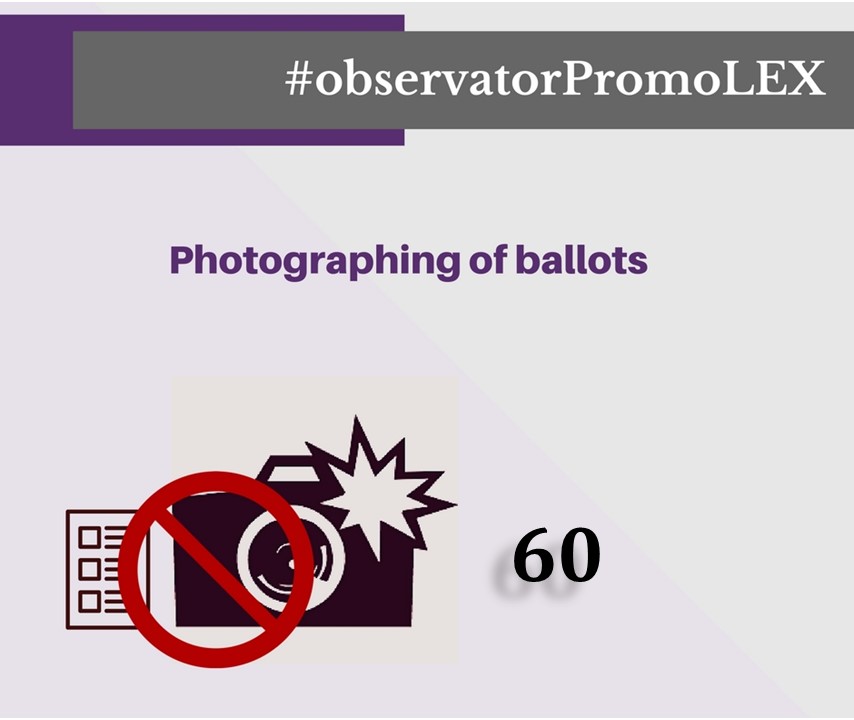
IMG_3470The Promo-LEX Observation Mission for the Presidential Elections continues to receive reports of multiple cases of organized transport of voters at more than 32 polling stations. In addition, there is a growing trend of photographing ballots—60 cases. Promo-LEX observers outside the country also report that there are many polling stations abroad that have run out of ballots.

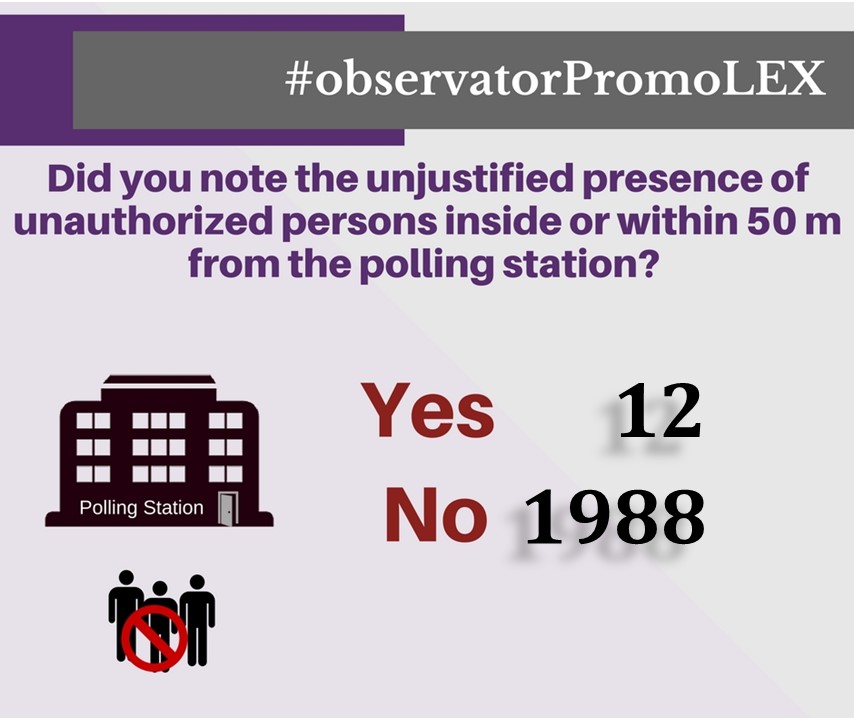
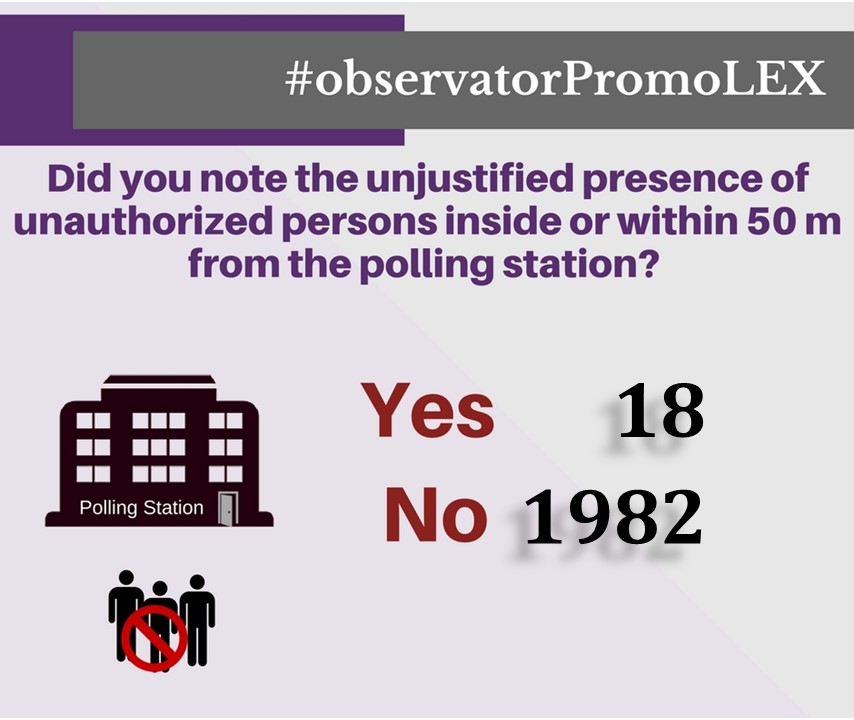
The unjustified presence of unauthorized people on the premises or within 50 meters of polling stations – 12 cases. Some examples follow:

  • PS 57 Chișinău. A group of 4 people spent approximately 20 minutes in front of the PS and recorded the voters who came to the PS.
  • PS 9 Ungheni. A PSEB member observed a person who recorded video of what was happening in the polling station through a window
  • PS 33 Cahul. The mayor, once he had voted, remained in the PS and talked with PSEB members. An observer notified PSEB members and the mayor left the PS.
  • PS 34 Chișinău. A man stayed in the PS for about 30 minutes. He left after police intervened.

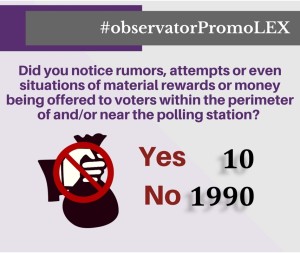
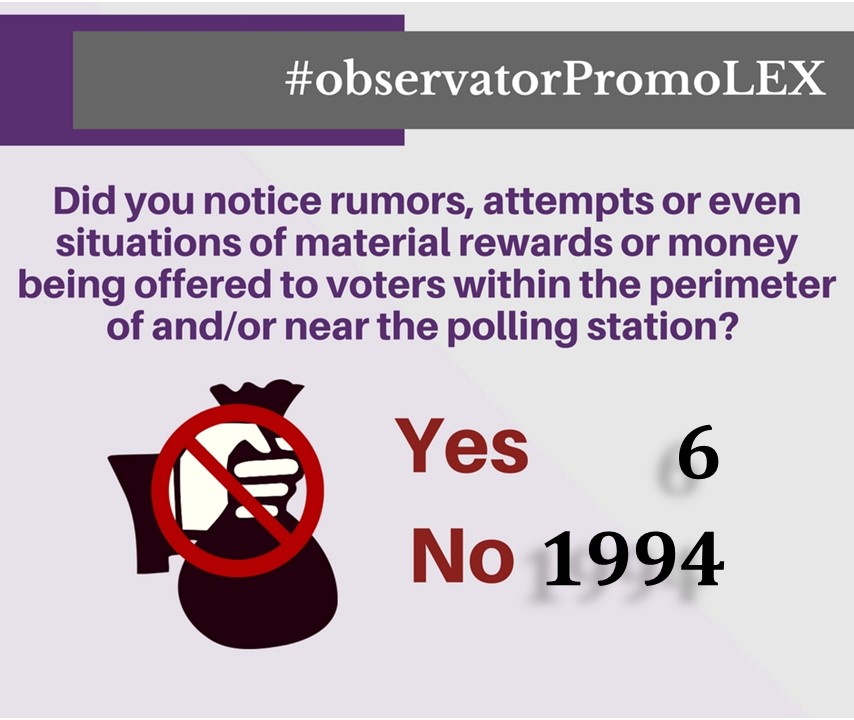
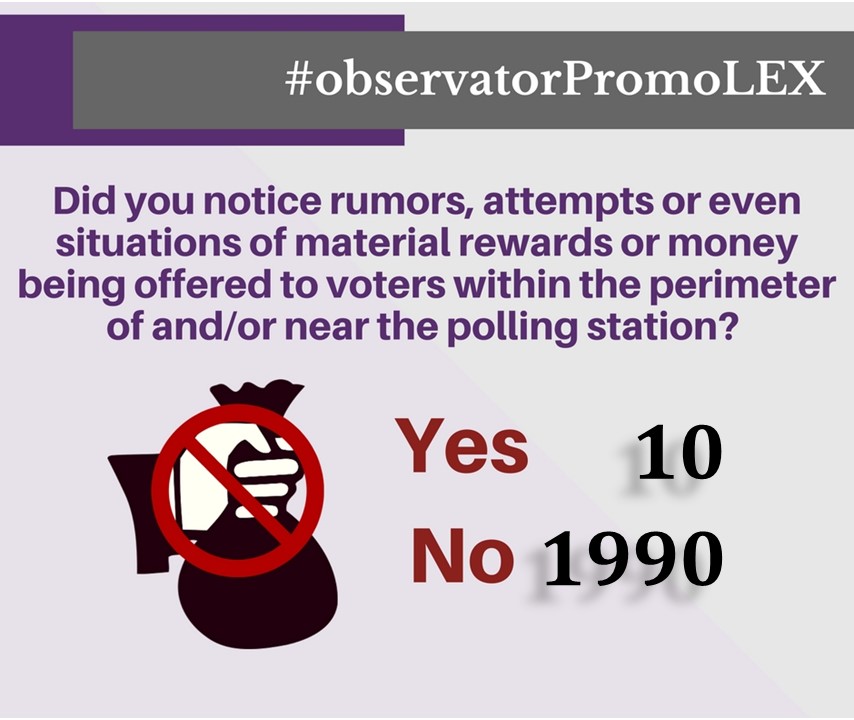
Rumors, attempts and even incidents of material or monetary compensation being offered to voters within the perimeter and/ or on the premises of polling stations with the purpose of influencing voters – 6 cases. Some examples follow:

  • PS 58 Florești. Voters who had come in minibuses from the other side of the Nistru to vote stopped on the way back on the other side of the river, where they were compensated for having voted.
  • PS 49 ATUG. Within 100 m of the PS, voters were served wine after having voted.
  • PS 308 Chișinău. A voter declared that he was compensated 100 lei for having voted for a particular candidate.
  • PS 7 Dubăsari. Within the perimeter of the polling station, two people–presumably representatives of an electoral candidate—conversed with voters for about three hours; there were rumors about the buying of votes.
  • PS 10 Chișinău. A woman offered monetary compensation on behalf of a candidate more than 100 meters from the PS. After having taken money, voters signed a list.

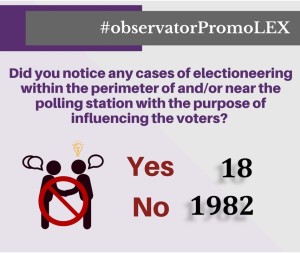
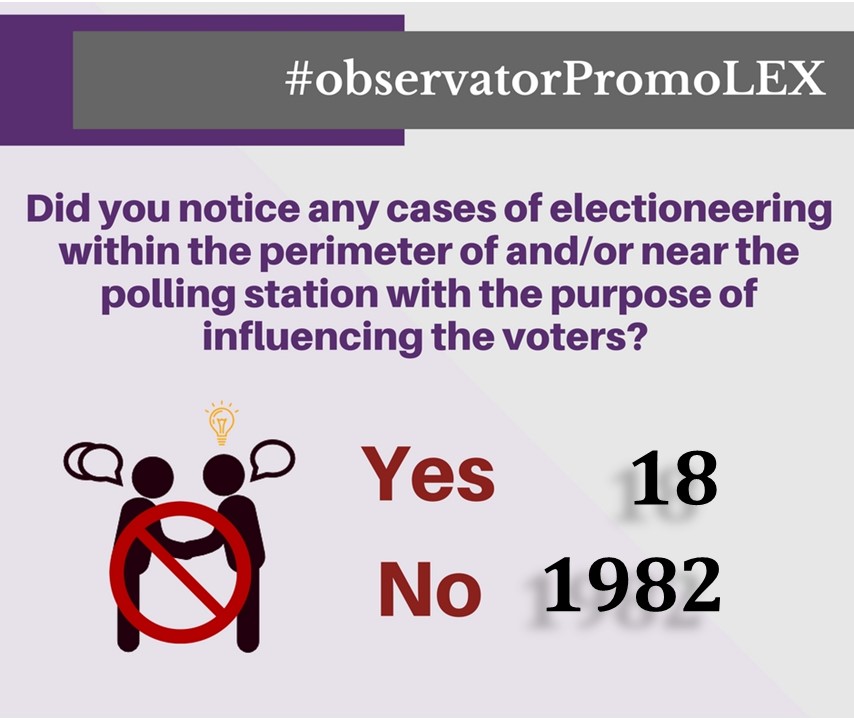
Electoral campaigning or black PR within the perimeter and/ or on the premises of polling stations with the purpose of influencing voters—8 cases.

  • PS 38, 42 Leova. Voters showed who they had voted for and campaigned for a candidate.
  • PS 20 Șoldănești. Three people were close to a polling station. One of them was a member of a political party, and the other two were voters. The member of the political party told voters who to vote for.
  • PS 38 Orhei. A candidate’s observer was wearing a sign on his chest. The PSEB president objected, and he took the sign off his chest.
  • PS 7 Ungheni. At the door of the PS a voter hung a ribbon with the distinct color of an electoral candidate. The PSEB candidate called a police officer to take the ribbon down.
  • PS 278 Chișinău. The mayor, after having voted, told people as he left the PS not to promote „homosexual pride”.
  • PS 4 Briceni. Two people displayed the symbols of a political party outside the polling station.
  • PS 7 Cimișlia. A PSEB member, after having taken the ballot of a voter, said who the voter had voted for.

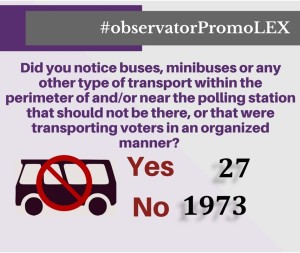
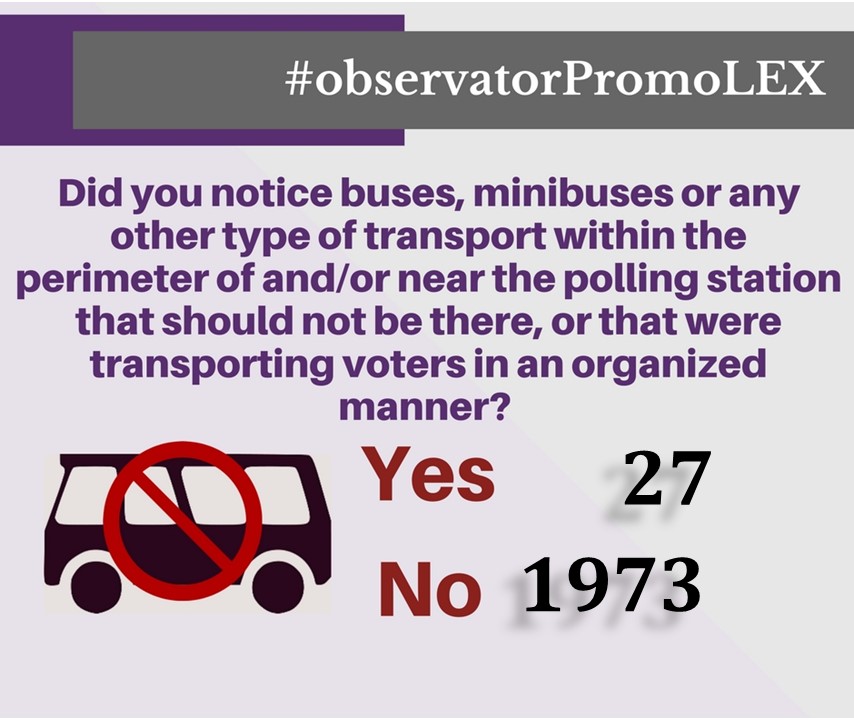
The organized transport of voters was reported in 32 PS.

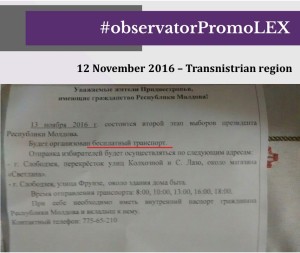
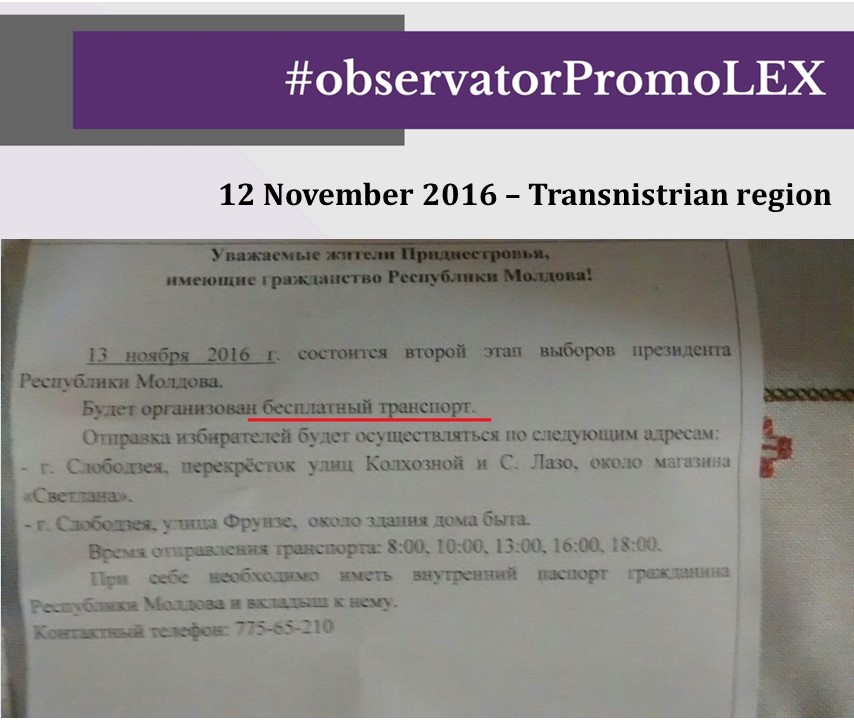
  • PS 24 Ștefan Vodă. The organized transport of voters by about 30 minibuses; they were presumably brought by representatives of an electoral candidate. During the course of the day about 1000 citizens—who were presumably from the Transnistrian region—were brought to vote
  • PS 53 ATUG. The organized transport of voters in two minibuses.
  • PS 50 ATUG. Observers stated that, between 3:00 pm and 3:40 pm, four vehicles brought voters
  • PS 58 Florești. Three minibuses brought voters back and forth across the Nistru.
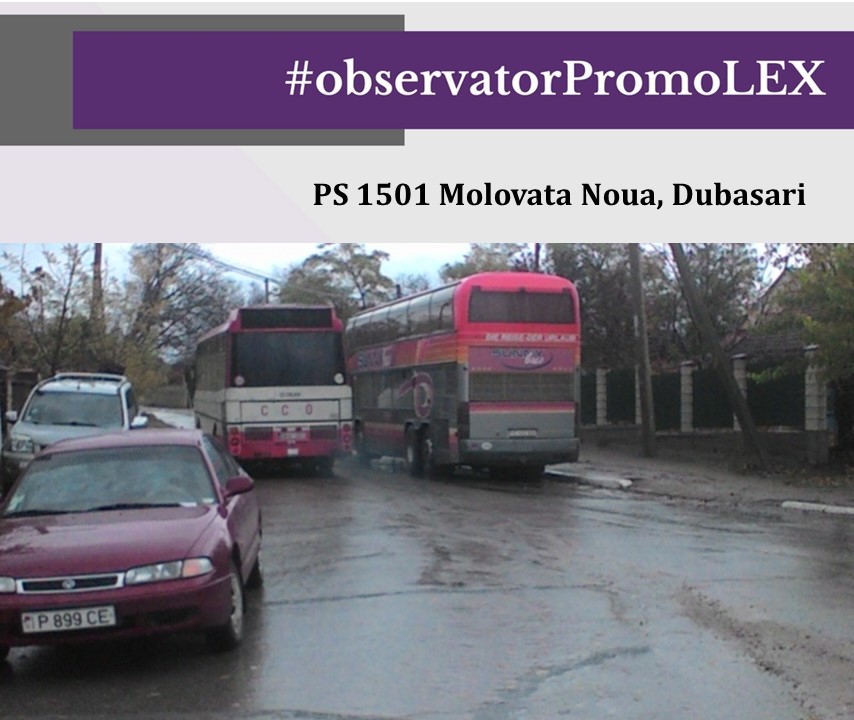
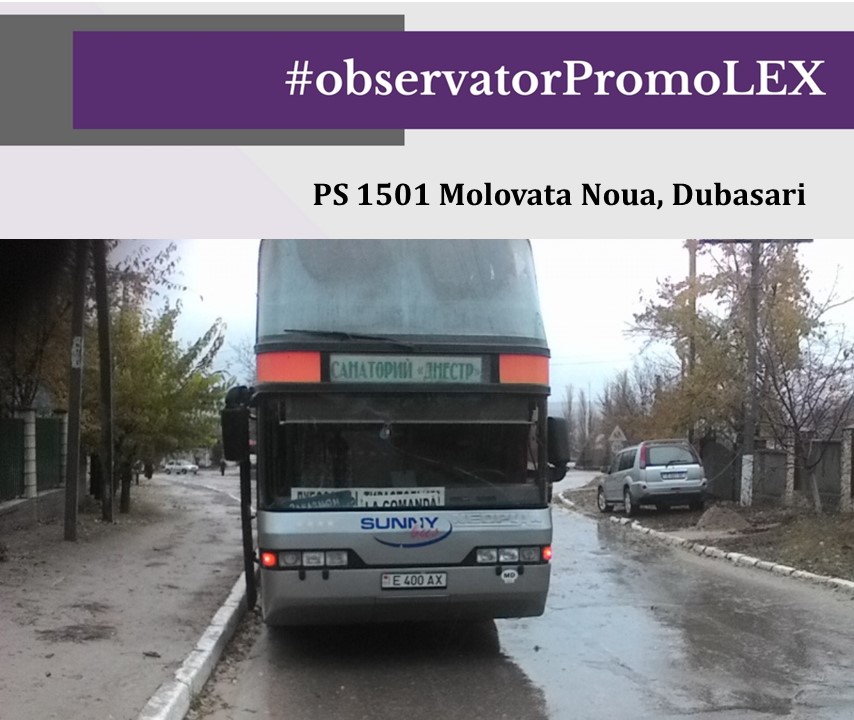
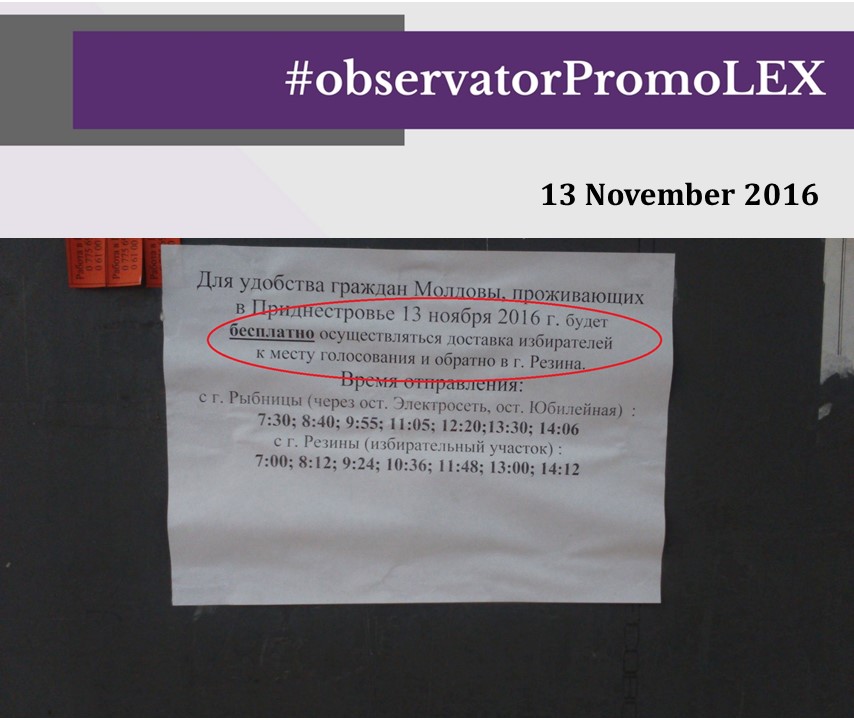
  • PS 42 Rezina. A bus with license plates from the Transnistrian region transported 50 voters. A total of about 100 vehicles (including multiple trips) were reported at PS 42 Rezina during the hours of observation, each of which brought more than 7-8 people.
  • UATSN – Three minibuses and four buses transported voters in an organized fashion.
  • In Varnița three cars with license plates from the Transnistrian region circulated.
  • PS 32 Căușeni. A car transported voters.
  • PS 22 Căușeni. An entrepreneur organized a few voters with a minibus (2 times). In addition, a minibus transported voters and representatives of a certain electoral candidate (about 20 people).
  • PS 26 Căușeni, an automobile identical to that at PS 32 transported voters.
  • PS 271 Chișinău. A supporter of a certain political party brought people in his own car.
  • PS 41 Anenii Noi. A minibus transported 10 people to the PS. About 25 voters were transported with a minibus in an organized way from PS 41 to PS 24 Amenii Noi.
  • PS 19 Anenii Noi. About 4-6 people were brought to vote.
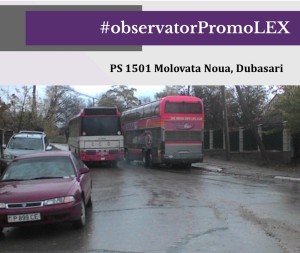
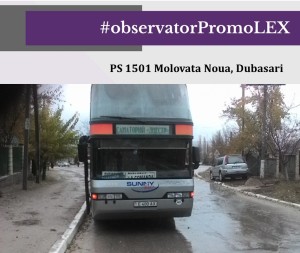
  • PS 3 Dubăsari. Voters were transported with buses and 3 minibuses by supporters of a political party, and about 13-15 people were also transported in a car.
  • PS 5 Dubăsari. A minibus with license plates from the Transnistrian region brought about 15 people.
  • PS 42 Rezina. Minibuses regularly brought voters from the Transnistrian region – 8 vehicles with 15-20 people in each
  • PS 14 Soroca. Ninety-three people were brought to the PS from the psycho-neurologic hospital in Bădiceni. The vice-president of the PSEB helped them to vote, indicating with his finger where to apply the „Voted” stamp on the ballot.
  • PS 52 ATUG. Transport for 10 voters was organized in two trips with an automobile.
  • PS 29 Briceni. While travelling with a mobile ballot box, members of PSEB entrusted the mobile ballot box to an electoral candidate’s observers. The observer was alone with the ballot box for several minutes.
  • PS 41 Anenii Noi. Twenty-four minibuses were observed in the organized transport of voters; about 15 people were in each.
  • From PS 41 Anenii Noi. A minibus transported about 25 voters to PS 24 Anenii Noi two times.
  • PS 24 Anenii Noi. 2 minibuses brought about 20 people.
  • PS 42 Anenii Noi. Organized transport with minibuses, about 12 people were taken from Slobozia.
  • PS 26 Căușeni. 6 automobiles brought about 30 people.
  • PS 32 Căușeni. A minibus from Gâsca transported about 10-15 people.
  • PS 10 Dubăsari. A bus transported 50 people to the polling station.
  • PS 33 Ocnița. A bus brought many voters during the course of the day.
  • PS 5 Edineț. 12 people were brought in an organized fashion in a minibus to the PS, they entered and left together from the PS.
  • PS 53 ATUG. An automobile made two trips to the PS to transport voters.
  • PS 42 ATUG. A minibus transported voters two times. In the first case it brought 4 people and in the second case ten people.
  • PS 320, Saint Petersburg, Russia.
  • PS 391 Iași, Romania.
  • PS 394 Brașov, Romania.

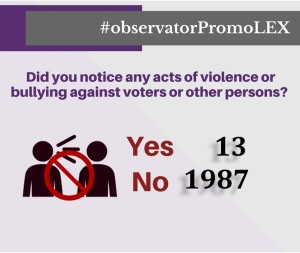
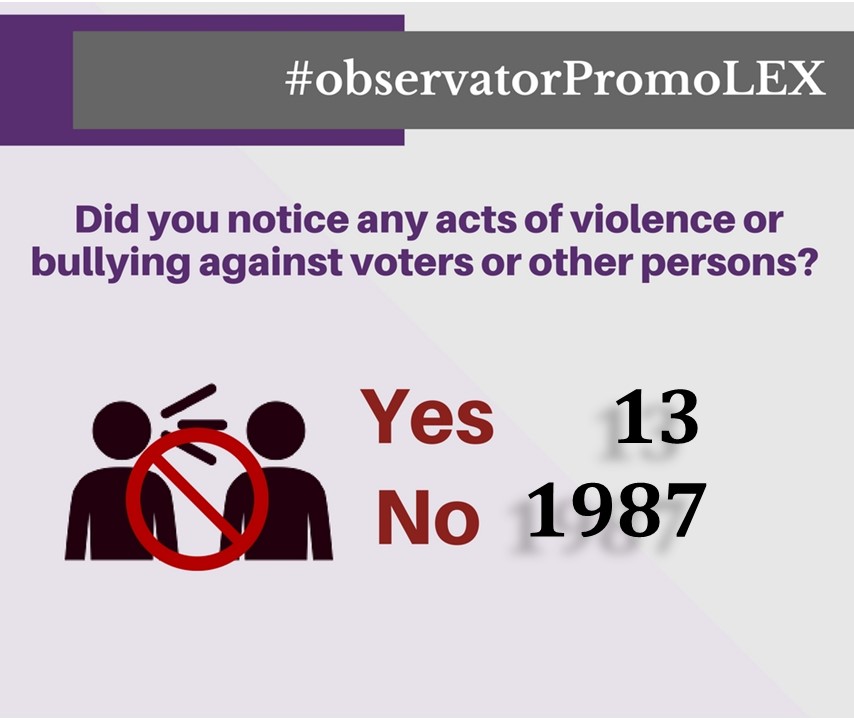
Acts of violence or intimidation towards voters or other people – 6 cases. Some examples follow:

  • PS 38 Bălți. A woman became indignant because the secretary of the PSEB spoke to her in Russian and demanded that he speak to her in Romanian. Although the secretary tried to help the voter, she raised her voice and caused a disturbance in the polling station. The police were called. Finally, the woman helped her father vote and left.
  • PS 200 Chișinău. Representatives of a certain candidate intimidated the president of the PSEB so that he would allow a student to vote.
  • PS 138 Chișinău. A voter provoked a conflict because he was not permitted to access the information of another voter in the main list.
  • PS 18 Bălți. A voter insulted an operator of SAIS Elections. A woman came with a damaged ballot, got angry at the operator and used obscenity. Eventually the police were called.

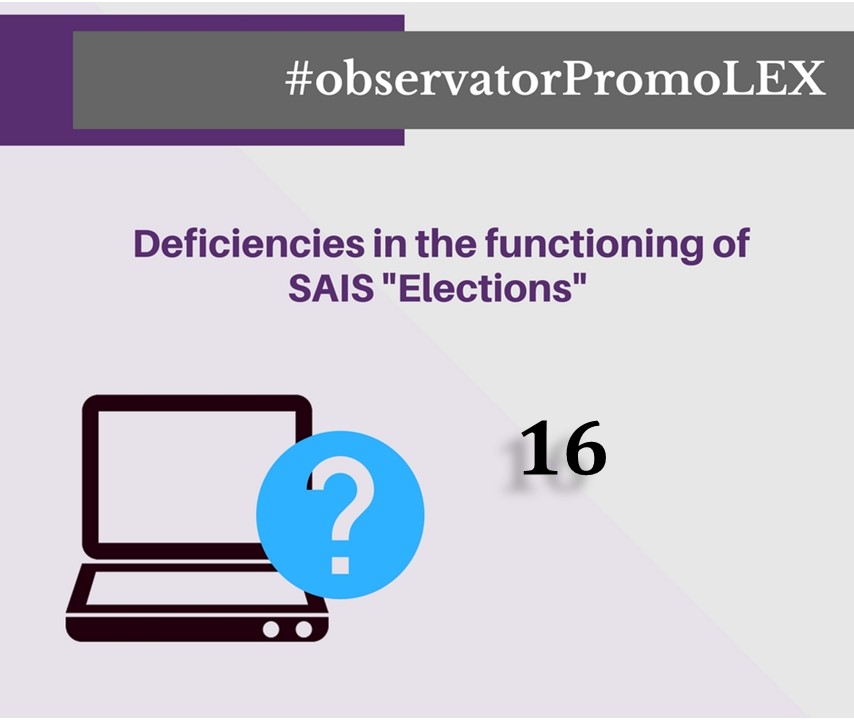
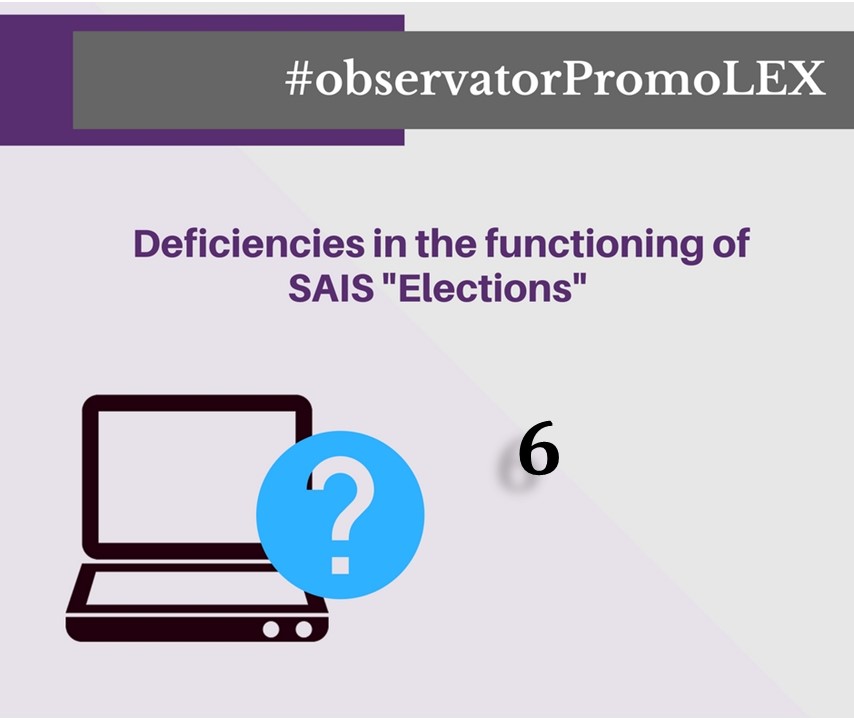
Problems with SAIS Elections (the suspension of functions; situations in which SAIS Elections indicates that a voter has voted but the voter maintains that he/ she has not voted) – 22 cases. Some examples follow:

  • PS 390 Bucharest, Romania. Problems with SAIS Elections—the system stopped working for 10 minutes (1:25-1:33 pm), during which time 20 people voted without being verified by the system. Their personal identification numbers were written on A4 sheets and were later used to verify the voters once the system was back in service. The system did not show that any of the voters had voted before.
  • PS 16 Bălți. There was a lack of internet between 2:20 and 2:50 pm. PSEB members tried to using personal modems without results. As a result, lines formed.
  • PS 5 Călărași. There was no electricity from 9:40 until now (1:30 pm). The problem remains unresolved; 137 people were registered on paper lists.
  • PS 350 Paris, France. A voter was not able to exercise his right to vote because SAIS Elections showed that the voter had already voted in France, even though he did not have a stamp in his passport. He was not allowed to vote again, and he left without voting.
  • PS 394 Brașov. A voter was not found in SAIS Elections.
  • PS 42 Rezina. The PSEB president asked the ECC to send a third operator. The president of the ECC appealed to the CEC and was refused. The Promo-LEX observer still observed three operators working at the PS. The PSEB president said that he had obtained the permission of the ECC. Finally it was established that the CEC had allowed the ECC to send one more operator and commission member to help the PSEB.
  • PS 24 Criuleni. Because of a lack of electricity, SAIS Elections did not work for 30 minutes.
  • PS 29 ATUG. For about two hours (between 4:00 pm and 6:00 pm) there was no electricity. Business was not interrupted. Candles and cell phones were used.
  • PS 47 Florești. The operators of SAIS Elections left the polling station for 15 minutes.
  • PS 200 Chișinău. A student came at 5:00 pm to vote, but SAIS Elections showed that he had already voted in Ocnița at 4:00 pm.
  • PS 349, Villeneuve-Saint-George, France. At 4:40 pm a voter was not able to vote, because the system showed that she had already voted in Anenii Noi.
  • PS 47, Calărași. While being checked by SAIS Elections, it was discovered that a voter had already voted at a PS in Chișinău, although he maintained that he had not voted. No „Voted” stamp was on his identity card; PSEB members are trying to determine the problem with the system.

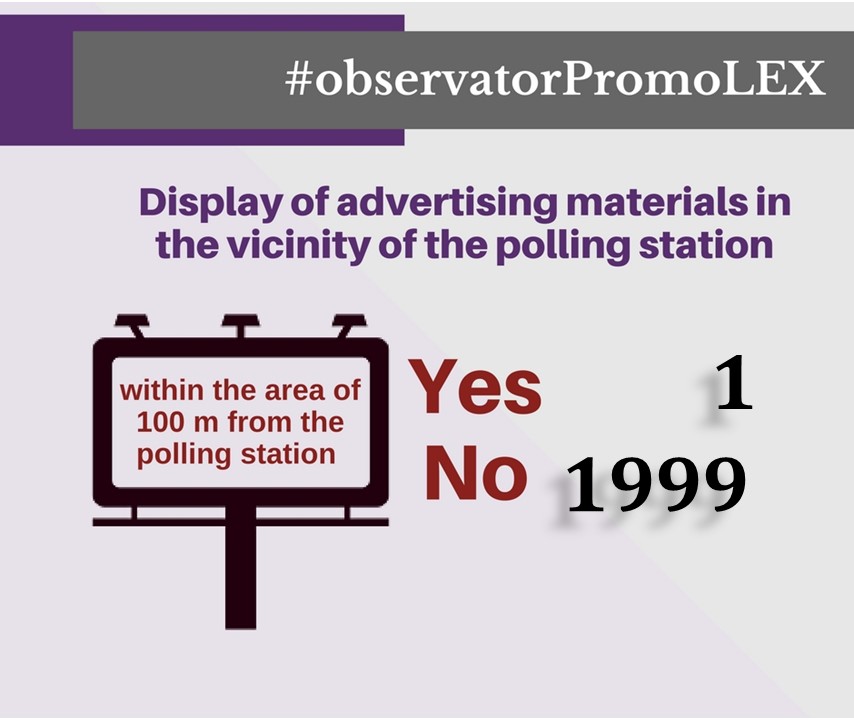
The presence of publicity materials, advertisements and electoral billboards within the perimeter of polling stations (within 100 meters of the polling station) – 1 case at PS 152 Chișinău.

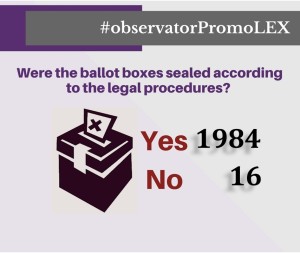
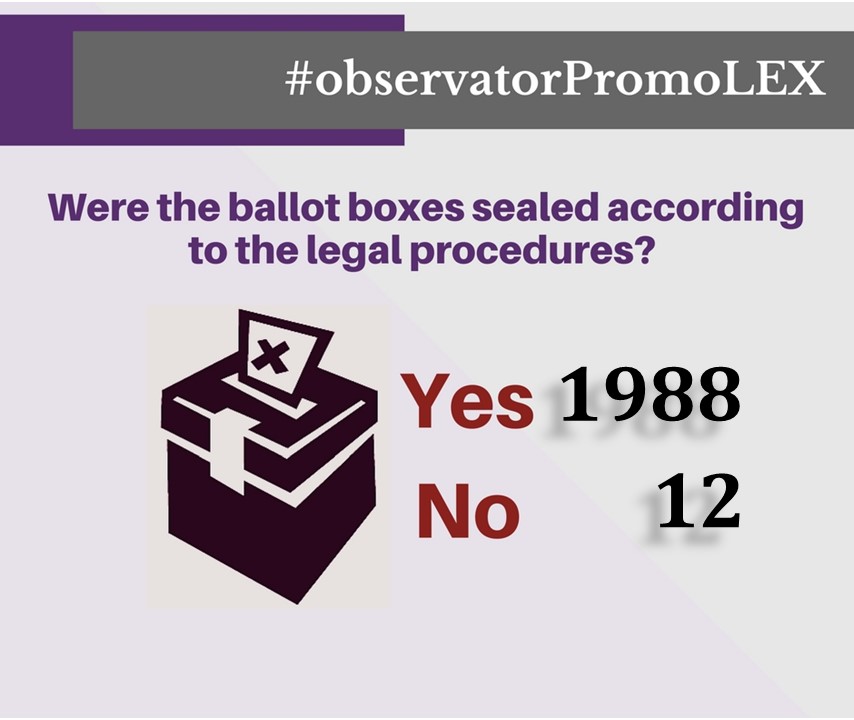
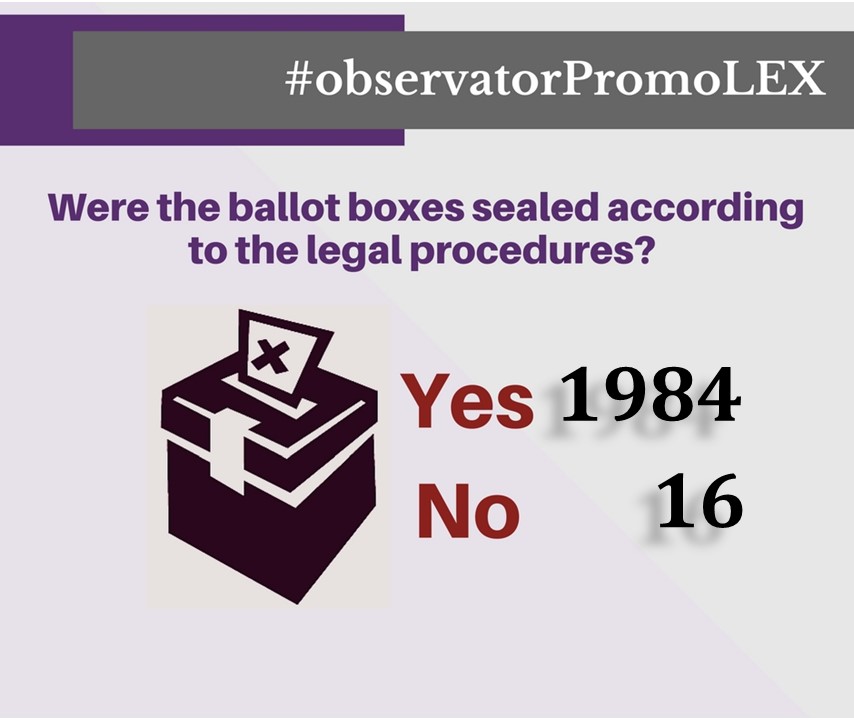
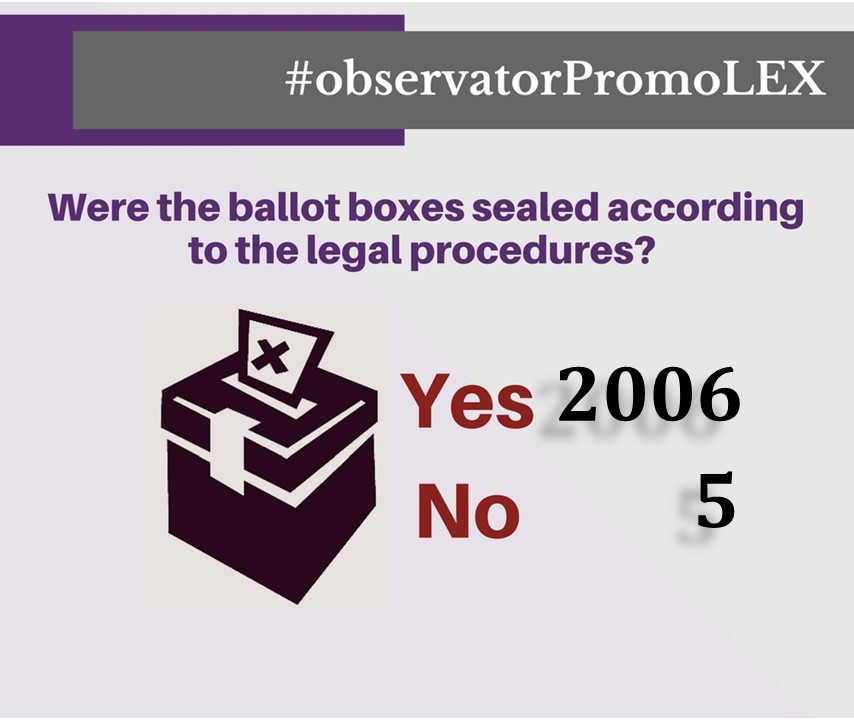
Ballot boxes were not sealed according to the legal procedures. Tearing/ damage or absence of seals on ballot boxes – 12 cases, for example at PS 391 Iași, Romania.

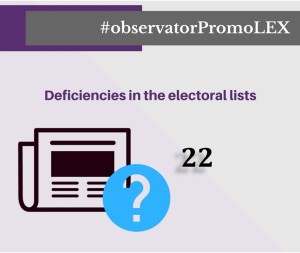
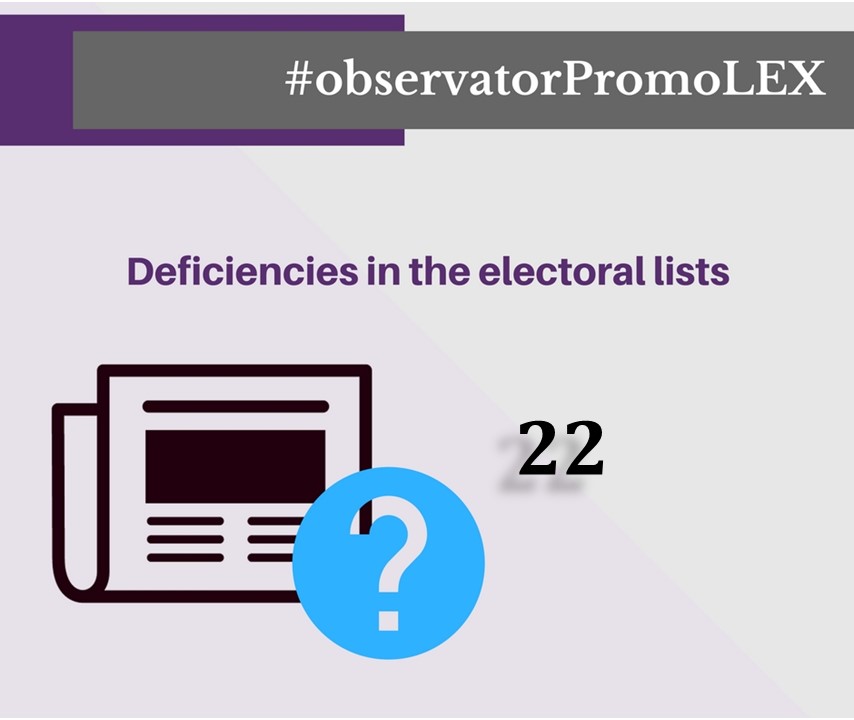
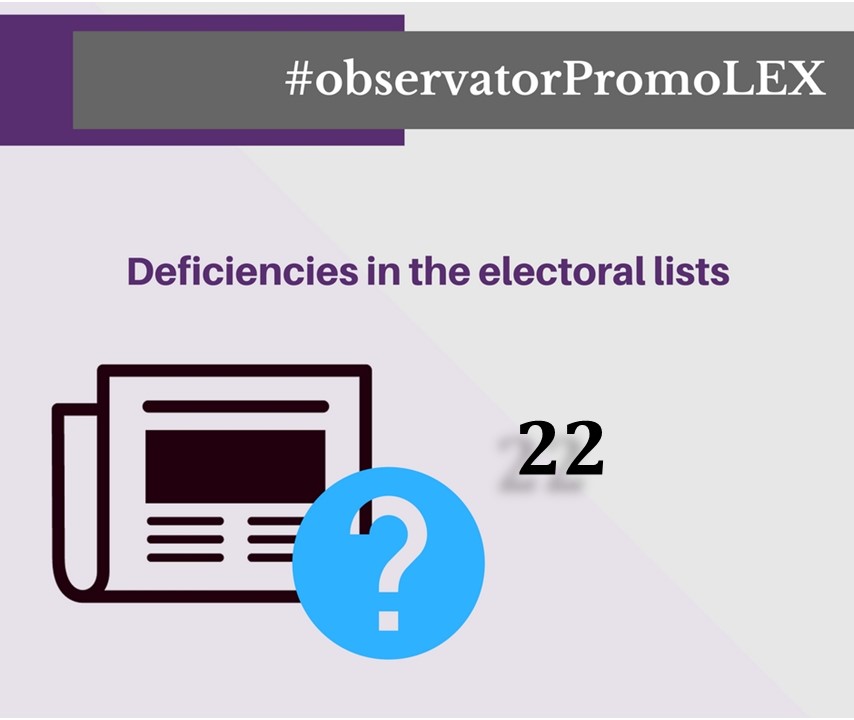
Problems with the electoral lists (discrepancies in addresses; deceased voters; signatures under the names of other people) – 11 cases

  • PS 114, 180, 200 Chișinău. In each polling station one voter identified dead relatives in the electoral lists.
  • PS 222 Chișinău. A voter found unknown people registered under his home address.
  • PS 59 Sângerei. A voter was not registered on the main lists.
  • PS 21 Bălți. A deceased person was included on the main electoral lists. A man asked the president of the PSEB why his wife, who was deceased, was still included on the list. The PSEB suggested speaking to the city hall, because the PSEB does not make the lists.
  • PS 44 Bălți. A voter came to vote, but he was not registered in the electoral lists (although his wife was) – he was registered at another address and another polling station. The man refused to go to the other polling station. The PSEB made a copy of his identification card, wrote his name on the supplementary lists, and allowed him to vote.
  • PS 20 Chișinău. Strangers were registered under the addresses of four voters.
  • PS 135 Chișinău. Strangers were registered under the addresses of four voters.
  • PS 23 Bălți. A voter found that that another person had signed in his place at approximately 5:00 pm. He signed on the line above. The PSEB discussed among themselves and allowed him to sign above. No written complaint was submitted.
  • PS 5 Rezina. PSEB members went with the mobile ballot box to a nursing home without having received requests from voters. The voters were not included on the supplementary lists. The director of the nursing home simply made a list of people on Election Day at 5:32 pm.

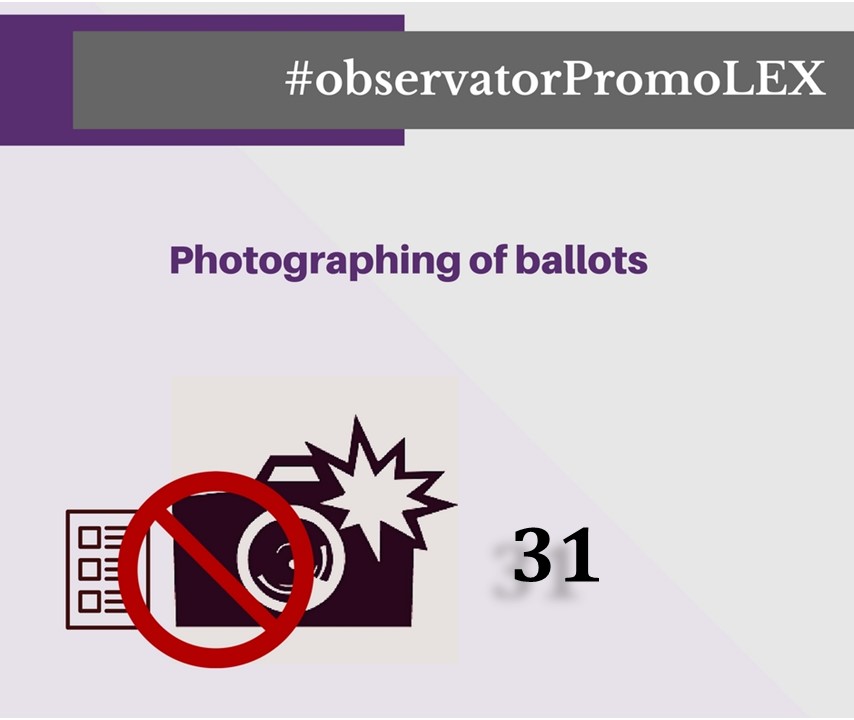
The photographing of ballots – 43 cases in: PS 50 Bălți; PS 52 Florești; PS 27 Briceni; PS 7 Ialoveni; PS 38 Nisporeni; PS 3, PS 6 Orhei; PS 25, 33, 94, 103, 105, 143, 147, 180, 182, 230, 232, 248, 257, 263, 267, 309, 131, 299, 12, 13, 20, 105, 142, 155, 120, 126, 135, 143, 180, 203, 210, 248 Chișinău; PS 2 Ungheni; PS 2 Bălți; PS 350 Montreuill, France; PS 394 Brașov, Romania.

Problems with the electricity – 11 cases. Some examples follow: PS 75 Ungheni; PS 30 Cimișlia; PS 26 Criuleni; PS 43 Ungheni; PS 29 Sângerei; PS 40, 45 Cimișlia; PS 10, 48, 49 Fălești; PS 59 Soroca.

Problematic situations relating to voting with identity documents – 5 cases.

  • PS 221 Chișinău. A voter voted without having the stamp applied to the additional page of his identity document.
  • PS 31 Briceni. In the majority of cases the stamp „Elections 13.11.2016 Round II” was not applied to identity documents. The PSEB president argued that he could not require voters to put the stamp on their identification cards. The voters explained that they did not want to have the stamp because they wanted cross the border between the Republic of Moldova and Ukraine.
  • PS 124 Chișinău. A voter residing in Leova was allowed to vote based on his own testimony.
  • PS 31 Briceni. A voter voted without having the stamp „Elections 13.11.2016” applied to the additional page of his identity document. The voter refused the application of the stamp.
  • PS 41 Cahul. A voter cast his ballot without the additional page of his identity document.

Ballots have run out at the following polling stations:

  • PS 336 Stratford, Great Britain. The ballots ran out in the PS at 3:15 pm. Citizens signed a petition.
  • PS 41 Varnița. At 6:40 pm there were no more ballots.
  • There are a tense situations regarding the number of ballots at PS 355 Bologna, Italy, PS 335 Great Britain (voters want to sign petitions, complaints)
  • PS 359 Mestre, Italy. Voters were encouraged to go vote at the PS in Treviso, Italy.
  • PS 389 Bucharest, Romania. There are no more ballots.

Other violations recorded by observers:

  • PS 10 Cimișlia. The room in which the PS is located is large, not heated, and very poorly illuminated.
  • PS 33 Leova. There is a growing number of applicants to vote in the place of residence (from 44 in the first round to 57 in the second round)
  • PS 1 Cimișlia. A voter asked if it was possible to vote outside the PS; he did not present his identification or other evidence that was a person with special needs. The PSEB president brought the electoral lists, a ballot, and the stamp „Elections 13.11.2016” to the voter’s car.
  • PS 25 Chișinău. A voter found that, on the main lists, there was a signature from the first round next to the name of a cousin who was living in Germany. The man submitted a complaint.
  • PS 278 Chișinău. On November 12, 2016, 15 people changed their residence to this precinct.

e-dai II _ 3eng ultimul (2) e-dai II _ 3eng ultimul (3) e-dai II _ 3eng ultimul (4) e-dai II _ 3eng ultimul (5) e-dai II _ 3eng ultimul (6) e-dai II _ 3eng ultimul (7) e-dai II _ 3eng ultimul (8) e-dai II _ 3eng ultimul (9) e-dai II _ 3eng ultimul (10) e-dai II _ 3eng ultimul (11) e-dai II _ 3eng ultimul (12) e-dai II _ 3eng ultimul (13) e-dai II _ 3eng ultimul (14) e-dai II _ 3eng ultimul (15)

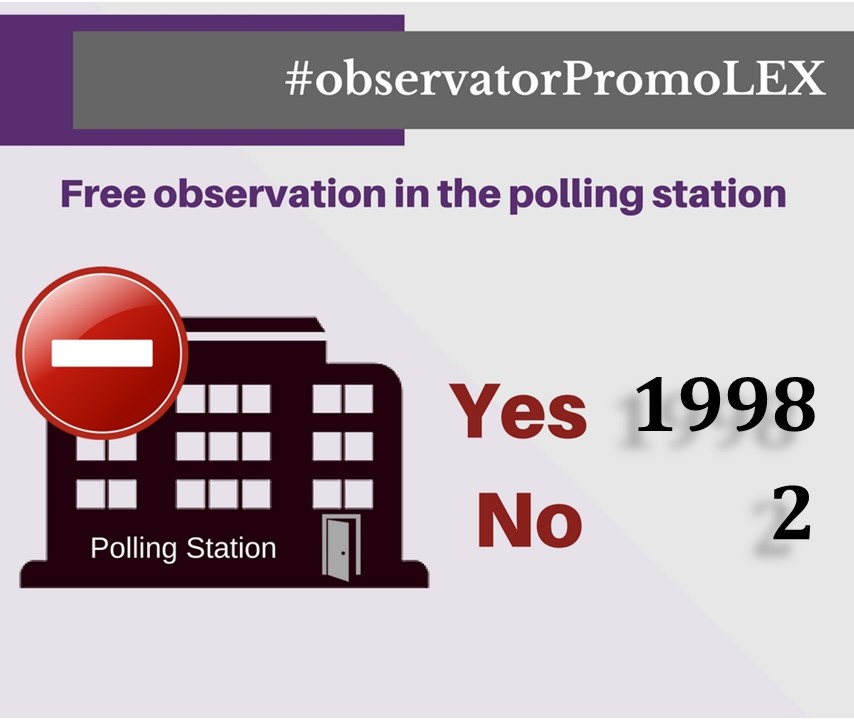
The Promo-LEX Observation Mission consists of 42 long-term observers who monitor the electoral process in all constituencies of the Republic of Moldova during 31 August – 30 November 2016. On Election Day, Promo-LEX sent a short-term observer to each polling station in the country, involving a total of 1981 observers. The Mission monitors the electoral process in 36 polling stations open abroad. The observers involved in the monitoring process signed the Code of Conduct of the Promo-LEX Independent National Observer, committing to act promptly, in good faith and in a non-partisan manner. The Promo-LEX EOM will also perform a Parallel Vote Tabulation in all polling stations. The activity of all observers is coordinated by a central team consisting of 37 persons.

The activity carried out by Promo-LEX EOM and the “Come to Vote” campaign is currently funded by the United States Agency for International Development (USAID), the British Embassy in Chisinau, the National Endowment for Democracy and the Council of Europe. The opinions presented in the public reports of Promo-LEX belong to the authors and do not necessarily reflect the donors’ view.

For more details, contact: Tatiana Pascovschi, Communication Officer of Promo-Lex Election Observation Mission: GSM 060804022, e-mail: [email protected]


Promo-LEX: Observers have reported over 150 cases of organized transport of voters and lines of voters at at least 10 polling stations outside the country

Time: 14.30

IMG_3452

The Promo-LEX Observation Mission for the Presidential Elections states with concern that at least 164 cases of organized transport of voters, a growing number of acts of violence and voter intimidation, cases of the unjustified presence of unauthorized people inside or in the vicinity of polling stations, and lines of voters at polling stations abroad have been reported before 2:00 pm.

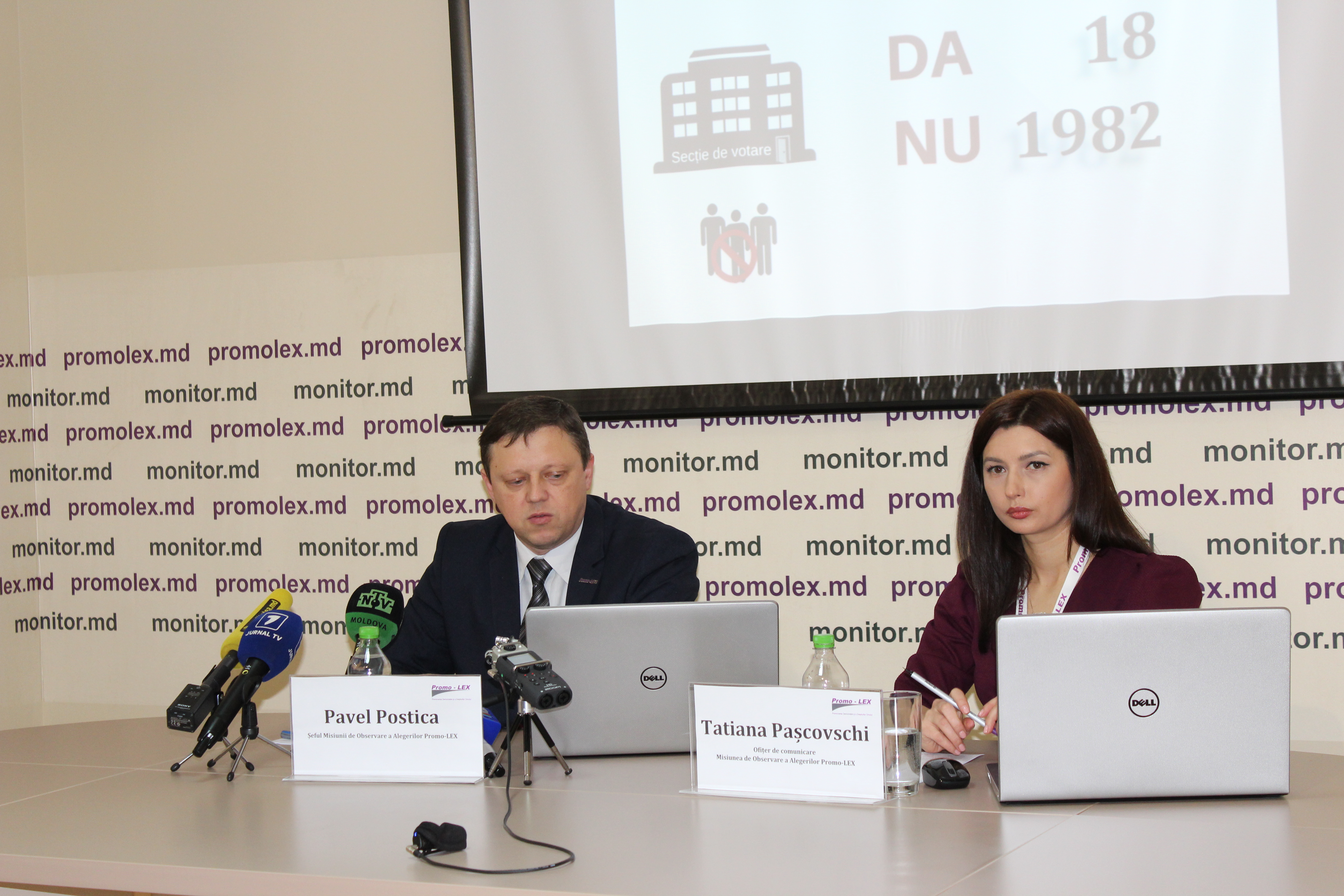
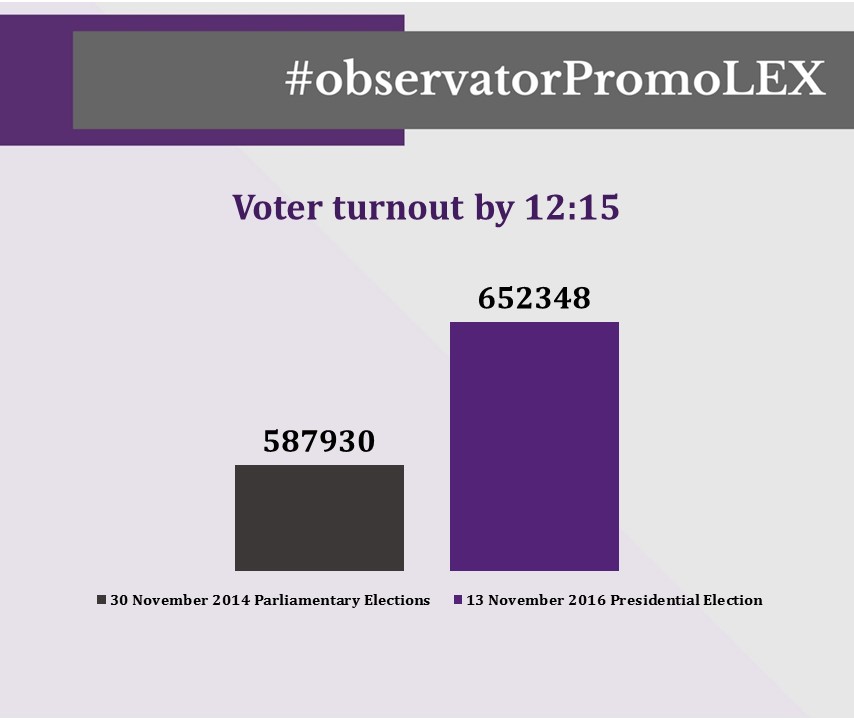
Promo-LEX states that, up to 12:45 pm, the voter turnout is much bigger than the turnout on November 30, 2014. By 12:45 pm in 2014, 587,930 people had already voted; today, 652,348 people have voted.

According to reports from Promo-LEX observers, the following incidents were reported before 2:00 pm:

The organized transport of voters – at least 164 vehicles.

  • PS 41 Anenii Noi. Cases of transporting voters with 12 vehicles (at least 210 people) were reported.
  • PS 10 Dubăsari. Cases of transporting voters with 6 vehicles (at least 210 people) were reported, with the representative of a candidate directing traffic.
  • PS 1 Dubăsari. A case (45 voters) has been reported from the city of Dubăsari.
  • PS 2 Dubăsari. Cases of voter transport with 3 vehicles (at least 100 voters) have been reported.
  • PS 3 Criuleni. A minibus has transported about 24 voters two times.
  • PS 225 Chișinău. Five private cars have transported 17 people to the PS.
  • PS 22 Căușeni. A minibus has transported voters.
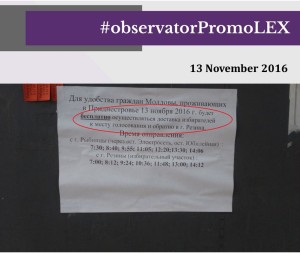
  • A Promo-LEX mobile team has reported that lines of minibuses and buses are headed from Camenca and Râbnița to vote. About 17 vehicles have been reported transporting voters (more than 250 people).
  • From the Territorial Administrative Unit of Transnistria – at least 8 vehicles.
  • PS 18 ATUG. Three vehicles.
  • PS 4 ATUG. 4 elderly voters were transported to the polling station by a car. The driver of the car waited at the polling station to take the voters home.
  • PS 58 Florești. People were transported by 3 minibuses. One of the minibuses made at least 3 trips. Each vehicle took an average of 20 people.
  • PS 42 Rezina. At least 60 vehicles. Every 10-15 minutes about 7-8 minibuses came. At 11:20 am the Promo-LEX observer reported at least 50-60 vehicles with a minimum of 8 people in each.
  • PS 43 Edineț. At least 8 voters came to vote with a minibus from the neighboring village. They tried to hire a driver to drive them to vote because they came from the neighboring village.
  • PS 2 Ungheni. A minibus transported about 10 people.
  • PS 44 ATUG. Transport was organized and directed by a candidate’s representative, who had a consultative vote on the PSEB.
  • PS 1 Dubăsari. Voters who were transported by buses stated that they had been encouraged to vote by local administrators.
  • PS 39 Strășeni. A minibus, arranged by a representative of a candidate, transported approximately 7 people.
  • PS 45 ATUG. Transport was organized by a mayor using public money.
  • PS 32 Căușeni. There were 24 vehicles with license plates from the Transnistrian region.
  • There is a coordinated flow of vehicles coming from Tiraspor, Slobozia, and Bender.
  • PS 24 Căușeni. The organized transport of voters with cars.
  • PS 41 Anenii Noi. Three vehicles brought about 60 people.
  • PS 225 Chișinău. Some automobiles transported about 25 voters from the Transnistrian region starting at 11:00 am.
  • PS 10 Dubăsari. 5 vans transported voters.
  • SV 5 Dubăsari. A minibus with license plates from the Transnistrian region brought about 15 people.

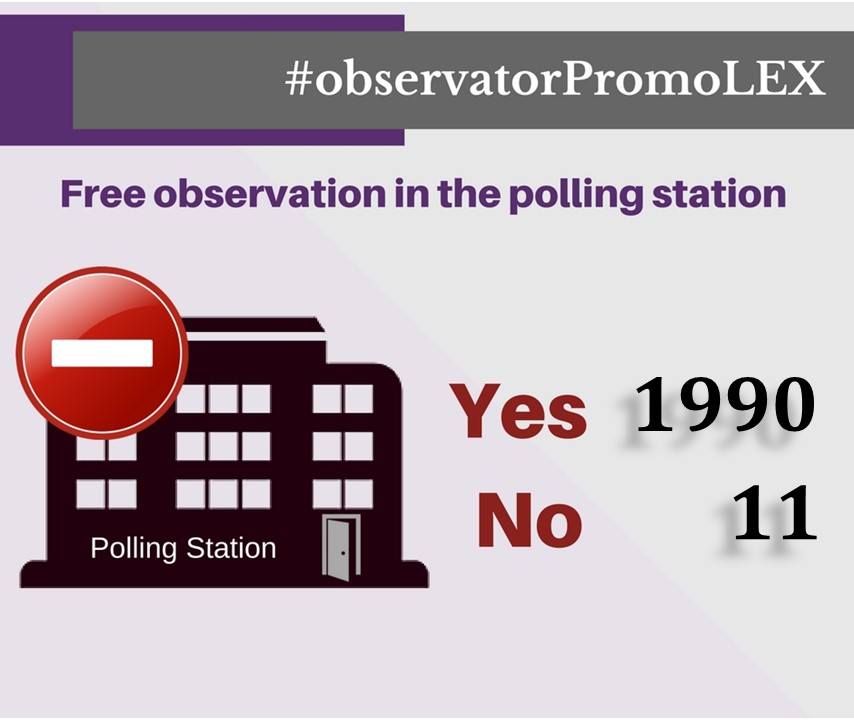
Restricted access or the obstruction of the free observation process in the polling station – 11 cases. Some examples follow:

  • PS 1, 237 Chișinău. Promo-LEX observers were prevented from freely observing the polling station.
  • PS 6 Criuleni. The PS is very small, about 20 m2. Half of the building is damaged. There was not enough space for the observer.

Ballot boxes were not sealed according to the legal procedures. Tearing/ damage or absence of seals on ballot boxes – 16 cases. Some examples follow:

  • PS 25 Florești. The mobile ballot box is not sealed in accordance with regulations.

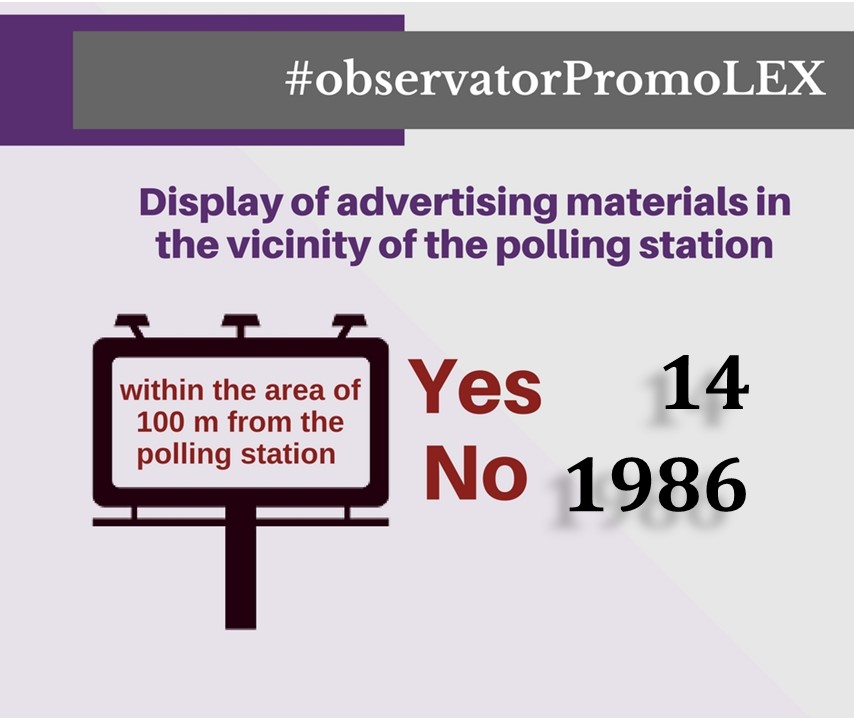
The presence of publicity materials, advertisements, and electoral billboards within the perimeter of polling stations (within 100 meters of the local precinct) – 14 cases. Some examples follow: PS 128, 278 Chișinău; PS 23 Căușeni.

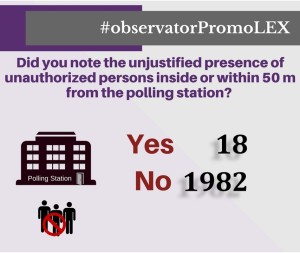
The unjustified presence of unauthorized people on the premises or within 50 meters of the polling station – 18 cases. Some examples follow:

  • PS 2 Edineț. At the entrance of the PS there were 3 people discussing how to vote. Members of the PSEB asked them to leave the area of the polling station, so they moved 30 m away and continued the discussion.
  • PS 10 Șoldănești. At a distance of just over 100 meters an MP and the car of another MP were observed.
  • PS 180 Chișinău. A person introduced himself as a parliamentary official and asked to check the security of the PS. The request was refused.
  • PS 278 Chișinău. A supporter of a candidate stood next to the ballot box and argued with a member of the PSEB.
  • PS 67 ATUG. The mayor stood within the perimeter of the PS and monitored the turnout.

Rumors, attempts, and even cases of material or monetary compensation being offered to voters within the perimeter / in the vicinity of polling stations with the purpose of influencing voters – 10 cases. Some examples follow:

  • PS 22 ATUG. A car—from which voters were served wine—was parked in front of the PS.
  • PS 58 Florești. The Promo-LEX observer reported that voters received 200 lei if they showed the „Voted” stamp on their ID cards.
  • PS 27 Bălți. A voter tried to photograph his ballot. After he was stopped, he told one of the PSEB members that he needed the photograph in order to be compensated.
  • PS 82 Chișinău. A candidate’s observer had a list of voters. Some voters told him to include them in this list; he went outside with some voters, while others were entered into this list.

Electioneering or black PR within the perimeter and/ or on the premises of a polling station with the purpose of influencing voters – 10 cases.

  • PS 25 Hâncești. A voter publicly announced who he voted for. The president of the PSEB gave him a warning.
  • PS 23 Căușeni. In front of the PS a citizen campaigned for a candidate.
  • PS 163 Chișinău. A candidate’s observer campaigned inside the PS. At the entrance of the PS, the observer said to the citizens, „I believe I know who you need to vote for” before saying, „Let me give you a few cigarettes.”
  • PS 265 Chișinău. A citizen gave out a candidate’s calendars in front of the PS.
  • PS 95 Chișinău. A voter approached another voter in the voting booth and talked with him.
  • PS 8 Călărași. A 30-year-old man campaigned for a candidate in the neighborhood of a PS. The Promo-LEX observer tried to take photos to document the case, but the people left.
  • PS 58 Orhei. A candidate’s observer campaigned, and the PSEB President gave him a warning.
  • SV 7 Dubăsari. Within 100 m of a PS there was a grocery store in which about 6-7 people campaigned for a candidate.

Acts of violence or intimidation of voters or other people – 13 cases. Some examples follow:

  • PS 69 Orhei. At 8:55 am, the mayor punched an observer of one of the candidates in the face with his fist and tore off his clothes. The reason for the incident was that the observer had photographed a minibus transporting people to the PS. The minibus was parked 15 m from the PS. The mayor ran off from the scene.
  • PS 43 Hâncești. An observer approached the PS in order to vote and he approached a member of the PSEB. There was a dispute between them. The observer did not present his accreditation, which he had in his pocket. A report was filed explaining the incident and the police were called.
  • PS 119 Chișinău. A voter intimidated a member of the PSEB because he was not in the main voting lists of the PS. The voter sold his apartment and was therefore on the main list of another PS.
  • PS 136 Chișinău. A voter intimidated a member of the PSEB because he was not on the main list of that PS. The incident was resolved with the help of the police.
  • PS 180 Chișinău. A conflict was reported when two voters wanted to vote in the same voting booth and PSEB members disallowed it.
  • PS 247 Chișinău. A member of a political party intimidated PSEB members and photographed the Promo-LEX observer, then posting the photograph on Facebook.
  • PS 95 Chișinău. Two voters were photographed by an observer while they were both voting in the same voting booth.
  • PS 67 ATUG. The mayor was inside the PS and intimidated the voters, shouting that they should vote for a particular candidate.
  • PS 247 Chișinău. A voter intimidated a member of the PSEB because the PSEB member asked him to be quiet.
  • PS 23 Chișinău. The Promo-LEX observer was intimidated by PSEB members because he had told them that some voters had voted without being entered in SAIS Elections.

Problems in the functioning of SAIS Elections (the suspension of function; situations in which SIAS Elections indicates that a voter has voted, but the voter maintains that he/ she has not voted) – 8 cases. Some examples follow: PS 50 Florești; PS 24 Criuleni; PS 180, 231, 237, 60 Chișinău; PS 59 Sângerei; PS 60 Chișinău; PS 24 Căușeni.

Problems in the electoral lists (discrepancies in addresses; deceased voters; signatures under the names of other people) – 14 cases. Some examples follow: PS 5 Fălești, PS 34 Bălți; PS 25 Chișinău, PS 87 Chișinău, PS 296, 38, 77,120, 85, 123, 223, 119, 90 Chișinău; PS 2 Florești.

The photographing of ballots – 31 cases. Some examples follow: PS 37 Ialoveni; PS 38 Nisporeni, PS 1 Leova; PS 66 Orhei; PS 302, PS 299, PS 33, PS 120, PS 232, PS 302, PS 111, PS 115, PS 119, PS 123, PS 126, PS 148 Chișinău; PS 2 Edineț; PS 7 Ialoveni; PS 38 Nisporeni; PS 7 Dubăsari.

Problems with the electricity – 6 cases. Some examples follow: PS 5 Călărași, PS 28 Sângerei, PS 39, 24 Căușeni, PS 13 Ștefan Vodă, PS 1 Edineț.

Lines/ Queues at PS in other countries – at least 10 cases. Some examples follow:

  • PS 318,319 Moscow, Russia
  • PS 355 Bologna, Italy
  • PS 325 Dublin, Ireland
  • PS 330 Bucharest, Romania
  • PS 3 Paris, France
  • PS 336 London, England
  • PS 359 Mestre, Italy
  • PS 375 Verona, Italy
  • PS 366 Parma, Italy

Voting with unfolded ballots / disregard for the secrecy of the vote – 5 cases. Some examples follow:

  • PS 18 ATUG. Voters were encouraged by PSEB members to not fold their ballots. Their choice could therefore be seen, even inside the ballot box.
  • PS 4 Leova. The PSEB members administering voting inside the prison allowed voters to not fold their ballots.
  • PS 25 Florești. Voters did not fold their ballots and their choice was visible through the ballot box. A Promo-LEX observer brought this to the attention of the PSEB members, who stated that it was not obligatory to fold ballots.
  • PS 394 Brașov. The secrecy of the vote was violated by two TV channels, Brasov TV and Digi 24 TV, which filmed the placement of ballots in the ballot box even though the voter’s choice was visible.
  • PS 10 Basarabeasca. A voter showed his ballot to a member of the PSEB after the „Voted” stamp had been applied.

Activism and campaigning by an NGO with accredited observers

Observers campaigned for a particular candidate within the perimeter of polling stations: PS 71 Chișinău, PS 41 Ialoveni, PS 16 Florești.

Instances of voting with expired or incomplete identity cards – 10 cases.

Some examples follow: PS 8 Criuleni; PS 24 Hâncești; PS 101, 297, 181, 221, 115 Chișinău; PS 26, 40 Bălți; PS 4 Căușeni.

Other incidents reported by Promo-LEX observers:

  • PS 15 Șoldănești. The „Voted” stamps were not in the voting booths but on the table of the PSEB members. The stamps were given to voters and the voter had to bring them back. This was justified by the fear that the seals might be stolen.
  • PS 22 Căușeni. Representatives of an election candidate directed the voting process in the PS (they checked the voters at the PSEB tables, directed them to voting booths, and coordinated the voting).
  • PS 22 Cimișlia. 6 requests to vote at home were accepted without medical certificates.
  • PS 191 Chișinău. A voter placed his ballot in the mobile ballot box. The president of the PSEB took the ballot out of the mobile ballot box and placed it in the stationary ballot box.
  • PS 116 Chișinău. One voter left his ballot inside the voting booth. The ballot was placed in the stationary ballot box by the president of the PSEB..

E-day II eng ameaza (1) E-day II eng ameaza (2) E-day II eng ameaza (3) E-day II eng ameaza (4) E-day II eng ameaza (5) E-day II eng ameaza (6) E-day II eng ameaza (7) E-day II eng ameaza (8) E-day II eng ameaza (9) E-day II eng ameaza (10) E-day II eng ameaza (11) E-day II eng ameaza (12) E-day II eng ameaza (13) E-day II eng ameaza (14) E-day II eng ameaza (15) E-day II eng ameaza (16) E-day II eng ameaza (17) E-day II eng ameaza (18)

The Promo-LEX Observation Mission consists of 42 long-term observers who monitor the electoral process in all constituencies of the Republic of Moldova during 31 August – 30 November 2016. On Election Day, Promo-LEX sent a short-term observer to each polling station in the country, involving a total of 1981 observers. The Mission monitors the electoral process in 36 polling stations open abroad. The observers involved in the monitoring process signed the Code of Conduct of the Promo-LEX Independent National Observer, committing to act promptly, in good faith and in a non-partisan manner. The Promo-LEX EOM will also perform a Parallel Vote Tabulation in all polling stations. The activity of all observers is coordinated by a central team consisting of 37 persons.

The activity carried out by Promo-LEX EOM and the “Come to Vote” campaign is currently funded by the United States Agency for International Development (USAID), the British Embassy in Chisinau, the National Endowment for Democracy and the Council of Europe. The opinions presented in the public reports of Promo-LEX belong to the authors and do not necessarily reflect the donors’ view.

For more details, contact: Tatiana Pascovschi, Communication Officer of Promo-Lex Election Observation Mission: GSM 060804022, e-mail: [email protected]


Promo-LEX: During the first hours of Election Day there was a high number of requests to vote at a place of residence, the presence of electoral posters within the vicinity of polling stations and the organized transport of voters

Time: 9.30 am

IMG_3437

The Promo-LEX Observation Mission of the Presidential Elections finds that at the opening of polling stations in the country there was a high number of requests to vote at home, the presence of electoral posters within the vicinity of polling stations, the organized transport of voters and a lack of electricity.

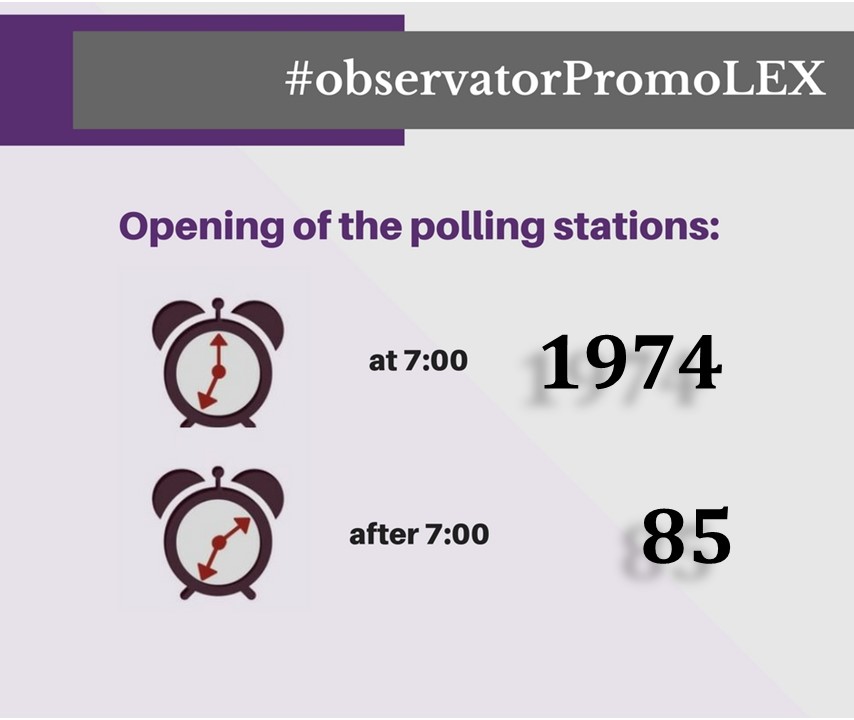
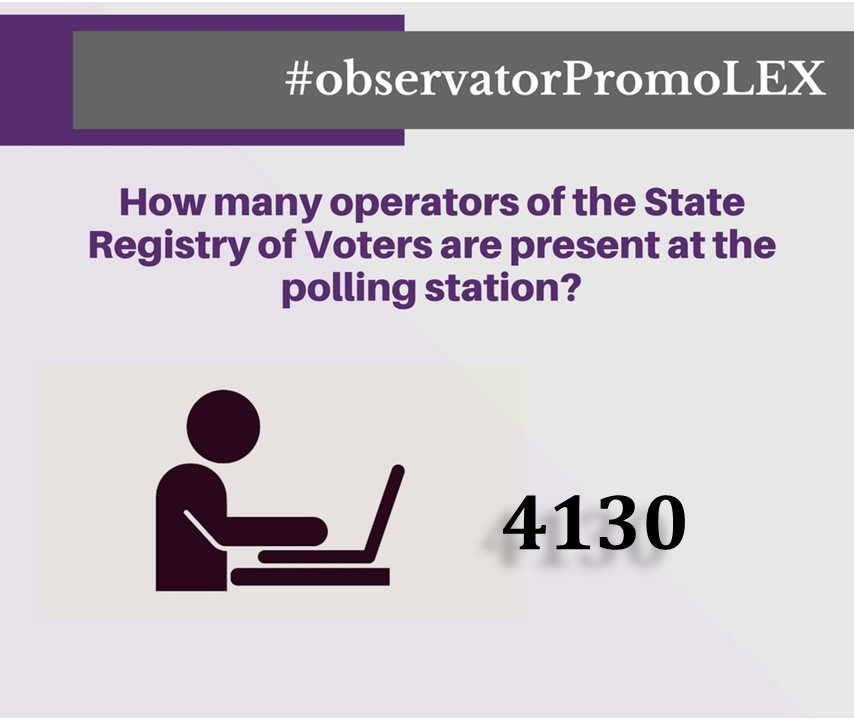
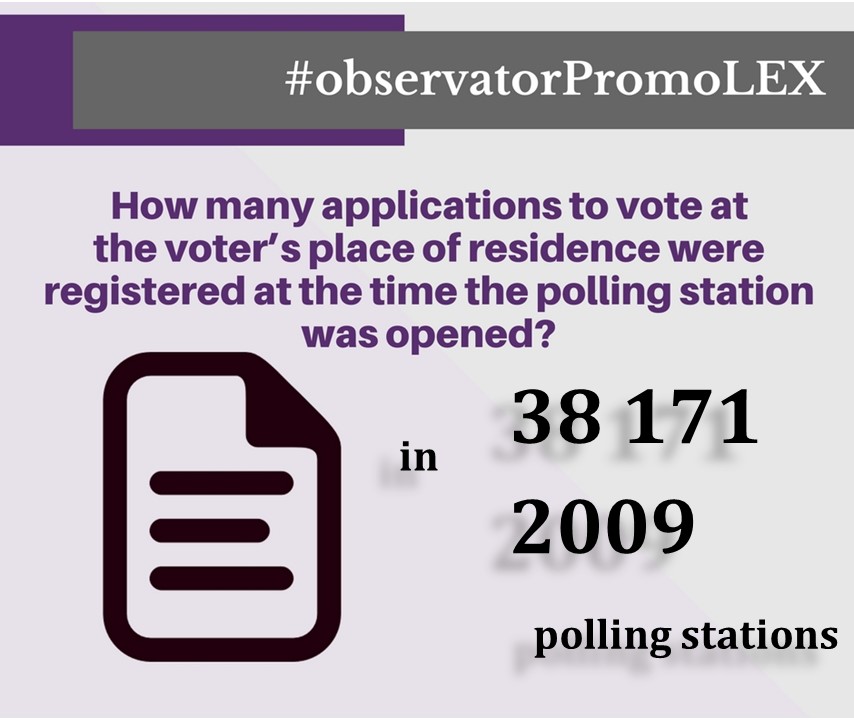
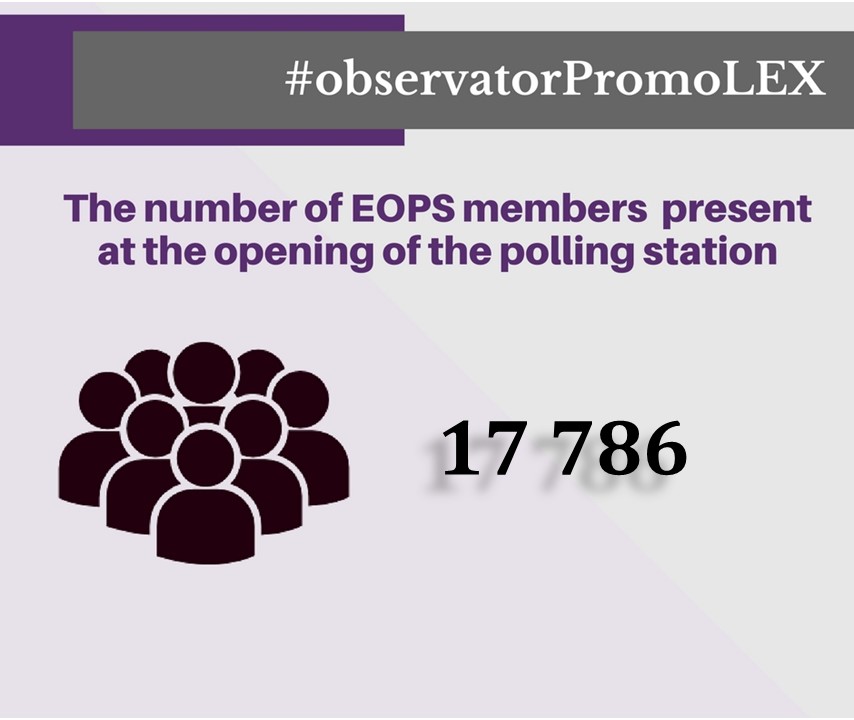
Promo-LEX observers reported that 1074 monitored polling stations were open at 7:00 am and 85 polling stations were opened with a delay of less than 15 minutes. In the polling stations there were 17,786 members of PSEB and 4130 operators of the State Registry of Voters present. The observers also reported 38,171 registered requests to vote at a place of residence at 2009 monitored polling stations.

According to the information received from Promo-LEX observers, as of 9:15 am the following incidents were recorded:

Restricted access or the prevention of the free observation process at polling stations – 5 cases. Here are several examples:

  • PS 14, Basarabeasca. Between 6:30 and 6:50 access for the Promo-LEX observer was restricted on the grounds that accreditation from the first round was not valid. After the intervention of the long-term observer in Basarabeasca, the incident was resolved.
  • PS 154, Chisinau. The PSEB president did not allow free observation in the PS for all observers, and also limited the use of mobile phones.

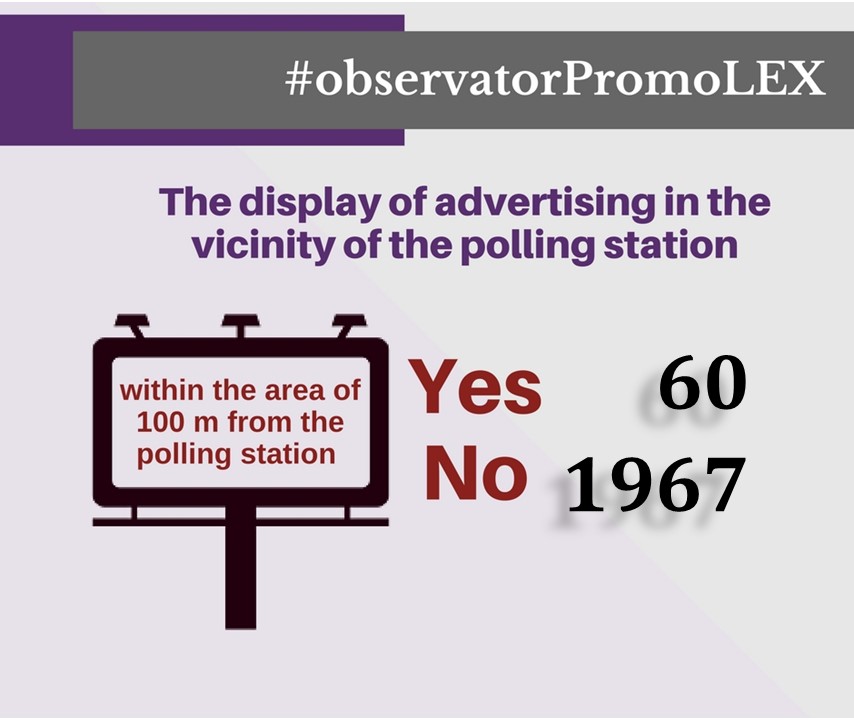
The presence of publicity materials, advertisements and electoral billboards within the perimeter of polling stations (within 100 meters of the polling station)– 60 cases. Here are several examples: PS 4, 3 Calarasi, PS 6 Ungheni, PS 128, 198 Chisinau, PS 22 Causeni, PS 10, 13 Ialoveni, PS 5 Floresti.

Ballot boxes were not sealed according to the legal procedures. Tearing/damage or absence of seals on ballot boxes — 7 cases. The cases were reported at: PS 9, 34 Balti, PS 25, 7 Cimislia, PS 265, 287 Chisinau, PS 287, 71 Chisinau.

The unjustified presence of unauthorized persons inside or within 50 m of the polling station – 4 cases.

  • PS 2, Edinet. A candidate’s observer did not have accreditation. The PSEB president asked that person to come back to the polling station with accreditation.
  • PS 143, Chisinau. A candidate’s observer did not have an ID card or an observer’s pass; nevertheless the PSEB president allowed him to continue monitoring.
  • PS 3, Cahul. Two unauthorized people spent several minutes in the PS, and the PSEB president asked them to leave the polling station. The incident was settled after the intervention of a police officer.
  • PS 16 Florești. A civil servant from the mayor’s office— a supporter of a candidate—came to the polling station and started to give orders. He was accompanied by 5 observers accredited by a nongovernmental association from Chisinau, who subsequently remained in the polling station.

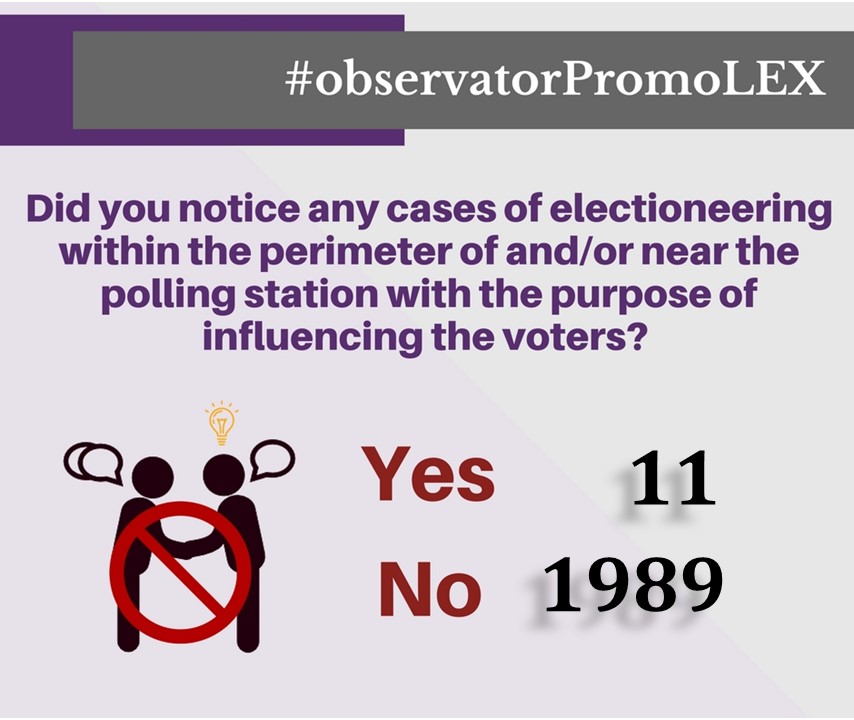
Electioneering or black PR within the perimeter of and/or near polling stations with the purpose of influencing the voters – 3 cases. Such cases were recorded in the following stations: PS 27 Taraclia, PS 20 and PS 215 Chisinau.

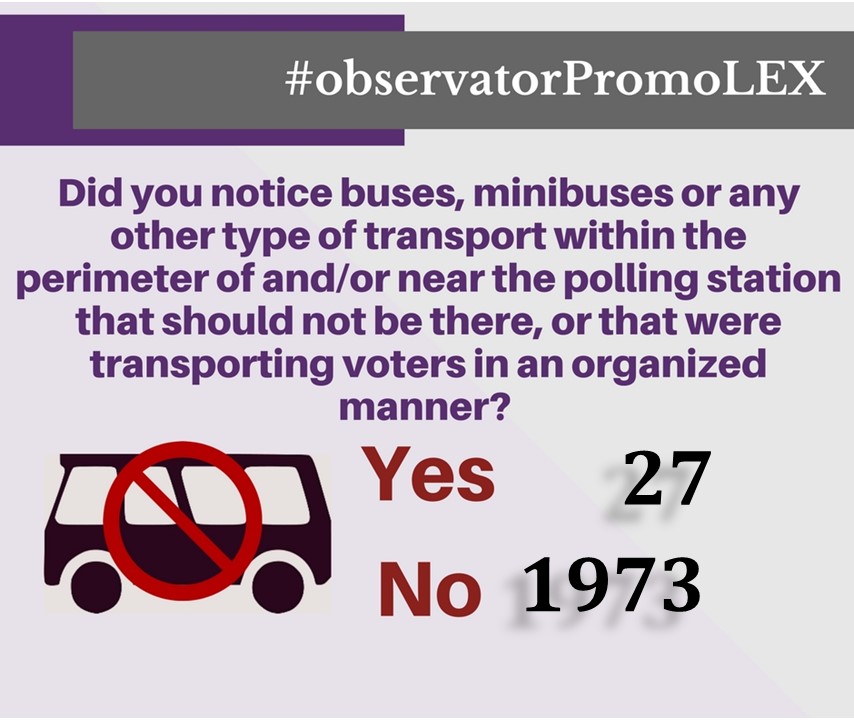
Organized transport of voters – 4 cases.

  • PS 41 Anenii Noi. 2 cases of voter transport were reported: in the first case, 12 visually-impaired voters were brought by a van; in the second case, 10-12 voters were transported by another van.
  • PS 42 Rezina. 5 vans were observed transporting about 15 people to the polling station. The Promo-LEX observer reported that these people were citizens of the Transnistrian region.
  • PS 41 Anenii Noi. A van with license plates from the Transnistrian region transported 10-15 visually-impaired people to the polling station.

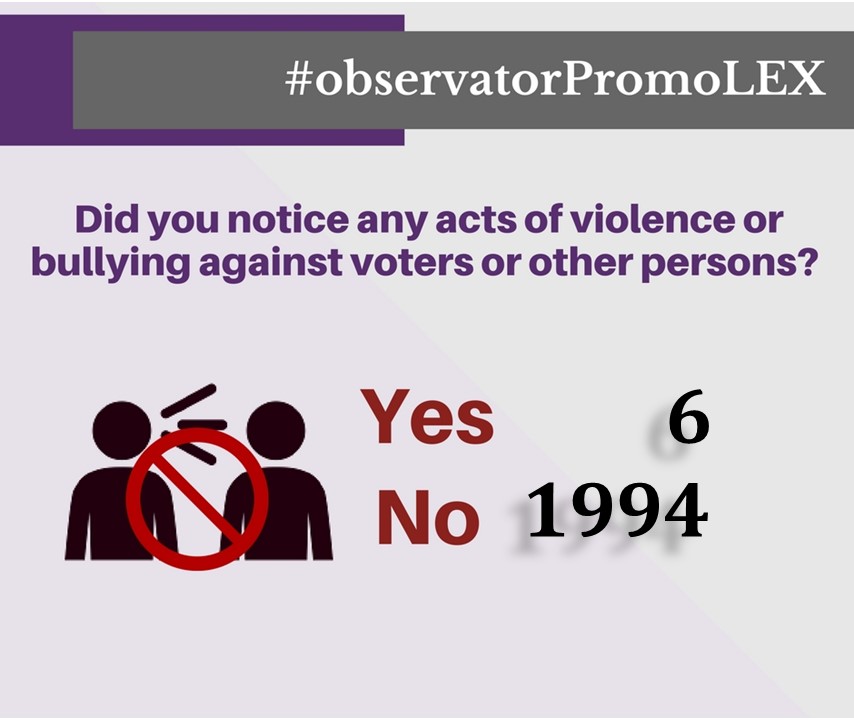
Acts of violence or intimidation against voters or other people — 1 case.

PS 257 Chisinau. An election candidate’s observer filmed the lists of voters without the consent of the PSEB president. When the PSEB president intervened, the observer reacted aggressively toward the PSEB president and secretary. The observer eventually stopped filming after speaking on the phone.

Problems in the operation of SAIS Elections (the suspension of functions; situations in which SAIS Elections indicates that a voter has voted, but the voter claims he/she has not) – 6 cases.

  • PS 21 Taraclia. Due to the lack of electricity, SAIS Elections did not work for 10 minutes.
  • PS 3, Rezina. A computer did not work for about 17 minutes. The voters were recorded on a sheet of paper.
  • PS 22, Cimislia. At 7:10 am there was no electricity in the PS.
  • PS 216, Chisinau. A different number of voters was registered in SAIS Elections than in the electoral lists. In SAIS Elections there were 2522 voters and in the electoral lists there were 2445 voters, but the number of ballot papers issued was 2534.
  • PS 29, Balti. SAIS Elections is operating, but with interruptions.
  • PS 24 Criuleni. The observer reported a large difference between the number of voters in SAIS Elections (1262) and number of voters on the main electoral lists (1254).

Problems with the electoral lists (discrepancies in addresses; deceased voters; signatures under the names of other people) – 2 cases.

  • PS 24 Criuleni. The Promo-LEX observer reported that 8 voters were not included on the main electoral lists, even though they were present in SAIS Elections.
  • PS 3, Calarasi. Deceased people were found on the electoral lists.

The photographing of ballots – 3 cases. These were recorded at PS 3 Calarasi. PS 144, 198 Chisinau.

Lack of electricity – 22 cases. These cases were recorded at the opening of polling stations: PS 20, 21, 22 Taraclia; PS 2 Basarabeasca; PS 6, 15, 16, 17, 26 Soldandesti; PS 39 Causeni; PS 1 Glodeni; PS 19, 20, 36, 38, 40, 41, 42 Soldandesti; PS 12, 17, 18, 20 Stefan Voda.

Other incidents reported by Promo-LEX observers:

  • PS 30, Rezina. On 12 November 2016 the PSEB president withdrew from the EOPS, as he was a local council member. His duties were taken over by the deputy president.
  • PS 13 Soldandesti. The PS number is not displayed at the entrance to the polling station.
  • In Dubasari, on the 11th and 12th of November all social workers from local districts were sent to visit the elderly in order to collect requests to vote at home. The Promo-LEX observer was informed that the social workers had encouraged the elderly to vote for a certain candidate. On the day of the second round of the elections, 351 requests to vote at home were recorded with the ECC in Dubasari. For comparison, in the first round there were 67 such requests.
  • At the ECC in Criuleni, 502 requests to vote at home were filed for the first round, and 780 for the second round.
  • PS 115, Chisinau. At 8:20 am, the PSEB president found 500 Euros in a voting booth. The police were called to document the case.


e day I eng dimineata (2) e day I eng dimineata (3) e day I eng dimineata (4) e day I eng dimineata (5) e day I eng dimineata (6) e day I eng dimineata (7) e day I eng dimineata (8) e day I eng dimineata (9) e day I eng dimineata (10)

Promo-LEX Observation Mission consists of 42 long-term observers who monitor the electoral process in all constituencies of the Republic of Moldova during 31 August – 30 November 2016. On the election day, Promo-LEX sent a short-term observer to each polling station in the country, involving a total of 1981 observers. The Mission monitors the electoral process in 36 polling stations open abroad. The observers involved in the monitoring process signed the Code of Conduct of the Promo-LEX Independent National Observer, committing to act efficiently, in good faith and in a non-partisan manner. The Promo-LEX EOM will also perform a Parallel Vote Tabulation in all polling stations. The activity of all observers is coordinated by a central team consisting of 37 persons.

The activity carried out by Promo-LEX EOM and the “Come to Vote” campaign is currently funded by the United States Agency for International Development (USAID), the British Embassy in Chisinau, the National Endowment for Democracy and the Council of Europe. The opinions presented in the public reports of Promo-LEX belong to the authors and do not necessarily reflect the donors’ view.

For more details, contact: Tatiana Pascovschi, Communication Officer of Promo-Lex Election Observation Mission: GSM 060804022, e-mail: [email protected]