Legal opinion on the Regulation of the Superior Council of Magistrates on access to court premises

On 2 February 2017, a public hearing organized by the Superior Council of Magistrates for debate on the modification of the Regulation on Access to Court Premises took place.  We note that the Regulation was adopted at the end of September of the previous year and was published in the Official Monitor on 21 October 2016. Its provisions impose restrictions on access for common citizens to court premises and hearings.

Promo-LEX believes that some provisions, which require the presentation of identity documents for citizens to access court premises—in effect conditioning access for journalists as well—to be unjust.

In the course of the meeting the Promo-LEX Association’s representative and other participants formulated many proposals for modifying the Regulation, which we believe should be implemented by members of the Working Group. Details about all the changes proposed by Promo-LEX can be found here.

In addition, Promo-LEX recommends that, in the future, when developing normative acts, the Superior Council of Magistrates respect the provisions of Law nr. 239 on Transparency in the Decision Process, the principles established in art. 5 of that Law, and art. 10 of the European Convention on Human Rights.


DOC. Legal opinion on the Regulation of the Superior Council of Magistrates on access to court premises.


The National Social Insurance Office must immediately cease the practice of illegally suspending social payments to citizens who live in the security zone and benefit from unrecognized payments from the Transnistrian region

In 2015, the National Social Insurance Office (NSIO) issued a decision suspending social payments to some citizens residing in the city of Tighina and other communities in the security zone. The reason given by the NSIO was that those people (citizens of the Republic of Moldova) already benefitted from social payments from unrecognized sources in the Transnistrian region. In some cases, the NSIO decided to retain 20% of the monthly pension amount until the due date for the money that the beneficiaries supposedly received from representatives of the de facto administration of east of the country.

There is a reasonable suspicion that, in the course of these activities, the NSIO illegally transmitted information—including the personal data of beneficiaries—to the de facto administration without the authorization to do so. Based on existing material, an exchange of personal data took place between the NSIO and the Center for Social Insurance and Protection in the city of Tighina, which is controlled by the de facto Tiraspol administration.

This issue was referred to the Promo-LEX Association by people who believed that their rights had been violated. Promo-LEX lawyers challenged the decision issued by the NSIO and its local office to cease and retain social payments. The decision was appealed in court.

The NSIO’s decisions on the cessation of pension payments and the retention of some beneficiaries’ pensions were declared illegal and annulled by decisions of the Center District Court on 14 April 2016 and 1 February 2017.

Promo-LEX lawyer Vadim Vieru argued that, in these types of situations, people have been illegally deprived of their social payments without legal grounds. In these types of situations, beneficiaries are not able to procure the most basic, necessary goods and services because of a lack of financial resources.

In conclusion, the Promo-LEX Association draws attention to the fact that, in its decisions related to violations of human rights in the eastern region of the Republic of Moldova in the cases Ilaşcu and Others v. Moldova and Russia [GC], (No. 48787/99, ECHR 2004-VII) and Catan and Others v. Moldova and Russia [GC] (nos. 43370/04,8252/05 and 18454/06, §§ 102-123, 19 October 2012), the European Court of Human Rights found that the Republic of Moldova has a positive obligation to protect the rights of citizens who live in the Transnistrian region. The obligation to pay social benefits to those residents of the left bank of the Nistru who contribute to the national budget for social assistance should not be conditioned on whether or not they receive payments from unrecognized sources.

For more details, please contact: Carolina Bondarciuc, Promo-LEX Press Officer: GSM 060280980, Tel./Fax (+373 22) 45-00-24, e-mail: [email protected]


The Republic of Moldova at the ECtHR in 2016. Progress or a step backwards?

As part of its efforts to inform society about the activity of the European Court of Human Rights (ECtHR), the Center for Legal Resources in Moldova analyzed the activity of the ECtHR in the year 2016. The analysis was conducted using the ECtHR’s Annual Report for 2016 and by studying ECtHR jurisprudence in Moldovan cases.

The principle conclusions of the year were:

  • In 2016, the ECtHR registered 839 applications admitted against Moldova, or 17% fewer than in 2015. It appears that this decrease was caused, in general, by a reduction in the popularity of the ECtHR, after the ECtHR sent back 8,500 Moldovan applications without explanation in 2011-2016. This fact had a discouraging effect on lawyers;
  • Despite the decrease in 2016, the number of applications submitted to the ECtHR against Moldova is very large in proportion to the country’s population. In this respect, in 2016 Moldova occupied 7th place out of some 47 countries member to the Council of Europe. Moldovans applied to the ECtHR 4 times more frequently than the European average in 2016;
  • On 31 December 2016, 1,283 Moldovan applications were still waiting to be examined. Of these, 93.4% have a high change of success. This number is larger than the total number of applications in which Moldova has been found guilty during the last 20 years;
  • Before 31 December 2016, the ECtHR had handed down 339 decisions on Moldovan cases, including 23 in 2016. In this respect, Moldova is far ahead of Germany, Spain, and Holland, countries that became party to the European Convention on Human Rights (ECHR) long before Moldova and that have much larger populations than Moldova;
  • The ECtHR found that the Republic of Moldova had not violated the ECHR in only 1.9% of cases;
  • The most frequent type of violation found by the ECtHR in Moldovan cases was the non-execution of judicial decisions (previous rulings); inadequate investigations of maltreatment and deaths; detention in poor conditions; the irregular annulment of irrevocable judicial decisions; and maltreatment or the use of excessive force by representatives of the state;
  • On the basis of all the rulings and decisions pronounced before 31 December 2016, the Republic of Moldova is required to pay more than EUR 16,200,000 (EUR 236,807 in 2016 alone). This amount is larger than the entire budget for the court system for 2016.

The CLRM has previously completed similar analyses for the years 2010, 2011, 2012, 2013, 2014 and 2015, and a summary of the data on the activity of the European Court of Human Rights in 2016 is available here.

Statistical data and conclusions about this year were presented at a press conference by Vladislav GRIBINCEA, the president of the CLRM and Alexandru POSTICA, director of the Promo-LEX program.

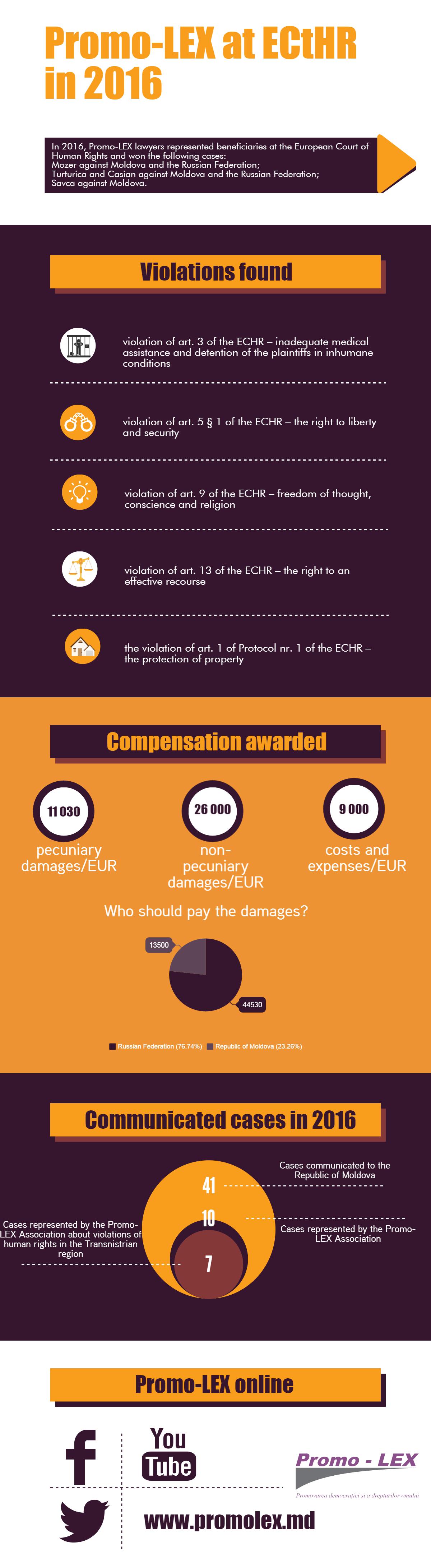
In addition, here is an infographic with information about the cases handled by Promo-LEX lawyers at the European Court of Human Rights in 2016.

eng-promo-lex-c_19890646_7249a321a7a7f4539afc20f1d0ea852bc8551fc9


The conclusion of Promo-LEX’s Final Report on monitoring the presidential election: The election was competitive, partially free and was fairly well organized


5e397160-2dcc-4748-8338-22d49e52333ePromo-LEX discussed the key findings of the Final Report of the Election Observation Mission for the presidential election in the Republic of Moldova on 30 October 2016 at a round table entitled X-Ray and Assessment of the Direct Presidential Election in the Republic of Moldova. Post-Election Conclusions. The event brought together the main stakeholders involved in the presidential election that took place in the autumn of 2016.

At the beginning of the event, Ion Manole, the Executive Director of Promo-LEX, announced that the goal of the exercise was to understand what elements of the election campaign were good or bad; what the role of political parties was; what the role of civil society was; which aspects were positive; and what actions should be taken to ensure a higher level of information and awareness, and, ultimately, informed votes by citizens. Ion Manole also conveyed that local and regional stakeholders would be involved, through Promo-LEX’s regional offices, in discussions and activities developed by civil society in the period between elections, so that they are not active only during election campaigns.

Alina Russu, the President of the CEC (who was present at the debate) highlighted the importance of civil society in monitoring electoral stakeholders, saying that civil society is one of the key actors that influences the content of public debates about both internal and external politics in a country, and that the CEC was no exception to that. In addition, the monitoring of elections serves to raise the integrity of and public confidence in the electoral process. She noted that civil society influences the current activity of the CEC and certainly affects the decisions that are made, and that the problems in electoral and related legislation and in electoral procedures that were described in the Final Report of the Promo-LEX Observation Mission would be thoroughly examined.

The journalist Vasile Botnaru declared that it is of great value to realize how we have acted in the precise moment after the president has been elected by direct vote, because such a moment is important and instructive for society. Vasile Botnaru said that if we draw a parallel between vaccination, which is the deliberate introduction of a small dose that mobilizes an organism’s defenses, and what is happening now between the presidency, the legislature, and the executive, than we see that we are in the stage of that process when a weak organism has received a dose of “scarlet fever” vaccine and is looking for antibodies. To conclude, he mentioned that if the organism knows how to overcome this stage, we will probably be able to say that we are on the right path to democracy.

In his general initial findings, Igor Bucataru, the Head of the Analysis Team of the Promo-LEX Observation Mission, stated that we had a competitive general election; 12 candidates, who represented the entire range of political opinions in Moldova, were registered. Igor Bucataru also mentioned that, in the opinion of Promo-LEX, the election was partially free in two senses of the word: the casting of votes and the ability to form an opinion on the progress of the election. The Head of the Promo-LEX Analysis Team mentioned restrictions on the freedom of voters abroad in casting their ballots and limits on the ability of voters to form their own opinions because of black PR and the manipulation of public opinion during the election campaign, as well as vote buying and the use of administrative resources, all of which were phenomena that damaged the concept of free elections.

The results of the financial monitoring of election candidates during the election campaign were presented by Cornelia Călin, a financial analyst at Promo-LEX. She spoke about the implementation of the most recent election campaigns, which proved that the lack of legal provisions and rigorous mechanisms regulating election campaign financing can vitiate election processes. Cornelia Călin also pointed out that the non-transparent use of resources in election campaigns continues to generate inequality, unfairness, electoral corruption, abuse of administrative resources, and tax evasion. On the other hand, she noted that monitoring of the use of funds in recent election campaigns has managed to draw the attention of key stakeholders, including election candidates, political parties, and the Central Electoral Commission, to the need to regulate and improve the legal framework.

The recommendations from the Final Report of the Observation Mission were presented by Pavel Postica, Head of the Promo-LEX Observation Mission. They can be found in the report published on the Promo-LEX website.

An electronic version of the Report is available in Romanian, English and Russian here.

The Observation Mission for the Presidential Election in the Republic of Moldova on 30 October 2016 is funded by the United States Agency for International Development (USAID), the British Embassy in Chisinau, the National Endowment for Democracy, and the Council of Europe. The opinions expressed in the public reports of Promo-LEX belong to the authors and do not necessarily reflect the donors’ views.

For more details, contact: Tatiana Pascovschi, Communication Officer for the Promo-LEX Election Observation Mission: GSM 060804022, e-mail: [email protected]


The Promo-LEX Association expresses concern about pressure on investigative journalist Mariana Rață

On 22 December 2016, journalist Mariana Rață published an article on the nomination of the former police commissioner of Chișinău as head of a department at S.A. Moldtelecom.[1] That article cited Ziarul de gardă[2] on the functions previously held by Vladimir Botnari, making reference to his daughter’s wealth without naming her.

After the publication of the article, V. Botnari submitted a complaint to the Office of the Prosecutor in Chișinău invoking the right to privacy and requesting that a criminal case be opened under art. 177 (2) of the Criminal Code (Violation of the Right to Privacy) against those responsible for accessing and publishing personal data about V. Botnari and his family members. [3]

According to art. 2 of Law no. 64/2010 on freedom of expression, the phrase “information about a person’s family and private life” is interpreted as any information (including images) about a person’s family life, life at home (…) etc. This law specifies that the media is supposed to inform the public about issues of public interest and to carry out (…) journalistic investigations of interest to the public. Journalists have the right to obtain and disseminate information, and can also request that any public institution verify the facts or circumstances referred to in certain materials.

Applying the provisions of Law no. 133/2011 on the protection of personal data to the article published by Mariana Rață, we find that the journalist’s actions adhere to legal regulations, since the information was used for journalistic purposes and the information about Mr. V. Botnari and the situation in which he was involved was of interest to the public.

Article 10 (2) of Law no. 64 establishes that information about the private and family life of a public person or of a person who occupies a public function can be disclosed if it is in the public interest. Furthermore, if public figures or those who occupy public functions draw attention to certain aspects of their lives, the mass media has the right to examine those aspects.

In addition, art. 32 of the Constitution of the Republic of Moldova guarantees freedom of speech for every citizen, as well as the freedom to express oneself in public with words, images and any other possible means. In exercising this right, the mass media must respect a series of principles related to the right to obtain and disseminate information: to report the truth; to verify information before publishing; to reject any attempt to distort facts, events, or their interpretation; to respect legislation regulating the activity of the media; etc.

On the other hand, the state is obligated to create the necessary conditions for establishing and developing a free and impartial media, and is also obligated to not intervene in its activity; the censorship of the media is prohibited.

In addition, Law no. 243/1994 on the press provides for sanctions in cases in which coercive measures are used against journalists with the intent of causing the dissemination or non-dissemination of information.

The Promo-LEX Association is an organization that supports human rights and freedom of expression as the foundation for the defense of democratic principles. We therefore express our concern about the pressure that the mass media has recently been subjected to and we appeal to law enforcement bodies to make all efforts through criminal investigations to prevent interference with and intimidation of journalists in their activities.

In addition, we respectfully ask that law enforcement bodies approach these types of cases with the greatest care, taking into account both national legislation on freedom of expression, freedom of the press, and the protection of journalists, as well as the European Convention on Human Rights and the jurisprudence related to it.

The Promo-LEX Association 


Appeal on ensuring the right to education in the Transnistrian region of the Republic of Moldova

The Promo-LEX Association, as the Association representing some 170 plaintiffs in the case Catan and Others v. Moldova and Russia (applications no. 43370/04, 8252/05 and 18454/06) requests that the President of the Republic of Moldova, Mr. Igor Dodon, contribute to protecting the right to education in the Transnistrian region.

We believe that this problem can and should be addressed in the course of the discussions that the President will have during his first official visit to Moscow on 16.01.2017.

We note the Decision of the High Chamber of the ECtHR on 19.10.2017 recognized the violation of 170 plaintiffs’ right to education, and the party found responsible for this infraction was the state the Russian Federation.

We emphasize some particularly important aspects of the European Court’s findings that have yet to be fulfilled relating to implementing and guaranteeing the rights of all residents of the Transnistrian region of the Republic of Moldova in equal measure.

The Court found that the 2002 evictions of the “Evrica” Lyceum on Gagarin St., city of Râbniţa; of the “Alexandru cel Bun” Lyceum from its school building on Kosmodemianskaia St., city of Bender; and of the “Ştefan cel Mare” Lyceum in the city of Grigoriopol were unjust.

In addition, the Court ordered the payment of 1 million 70 thousand Euros in non-material damages to the 170 victims and to cover the costs of representation in the Court. That decision should have been implemented before 19.01.2013.

The European Court also found that the local legislation (“RMN”) contains discriminatory provisions incompatible with the guarantee of the right to education for all residents of that region of the Republic of Moldova. The unjust provisions restrict the use of the Latin script for working and teaching in Romanian in that area (art. 6 of the “Law on the Use of Languages”, art. 12 of the “Constitution of the RMN”, art. 200/3 of the “Contraventional Administrative Code of the RMN”, the decision from 18.08.1994 on the prohibition of the use of the Latin script in educational institutions).

Unfortunately, for the past 3 years, the authorities of the Russian Federation (the Government Agency and the Ministry of Justice of the Russian Federation) have ignored requests to implement the Court’s decision by representatives and by the plaintiffs, and the rights of people who wish to study using the Educational Program (Curriculum) of the Ministry of Education in Chișinău continue to be violated.

We remain firmly convinced that the implementation of the ECtHR decision in favor of the 170 citizens of the Republic of Moldova would contribute to respect for the right to education and human rights more generally in the Transnistrian region.

We make an appeal to the President of the Republic of Moldova to address the problem of human rights in the Transnistrian region in his discussions with his Russian counterpart and to request that the Decision of the European Court from 19 October 2012 be implemented, in order to contribute to the defense of human rights and the constitutional interests of the citizens of the Republic of Moldova in the Transnistrian region.

For more details, please contact: Alexandru POSTICA, Program Director, GSM:0691 04 851,  Tel: (22) 450024, e-mail: [email protected]

The Promo-LEX Association
Human Rights Program


APPEAL of the Promo-LEX Association on the necessity for reports on the financial management of political parties in the second half of 2016 to be presented and examined by 15 January 2017

The Promo-LEX Association makes an appeal to political parties and selected public authorities to ensure transparency and to present reports (and that the CEC receive the reports) about the financial management of political parties in the second half of 2016 by the date established by law, 15 January 2017.

In conformance with Art. 29 (1) of Law No. 294 from December 21 2007 on Political Parties and para. 65 of the Regulation on Financing the Activities of Political Parties, approved by Decision no. 4401 of the Central Electoral Commission (CEC) on December 23 2015, political parties have the obligation to present semi-annual and annual reports on their financial management to the CEC. Political parties that benefit from grants of public money are obligated to present their reports to the Court of Accounts as well.

We draw attention to the fact that the Law cited above sets the deadline for presenting the semi-annual reports as the 15th of the last month in the reporting period. We find the law problematic in this regard because the deadline for reporting should be outside the reporting period, as it is for annual reports. Accordingly, just as annual reporting takes place by March 31, semi-annual reporting should be completed by July 15 and January 15 respectively.

In addition, the Promo-LEX Association requests that the CEC review the contents of the Regulation on Financing the Activities of Political Parties. Regarding para. 65 of the Regulation in particular, we specify that the date for semi-annual reporting was set according to the logic explained above, but only the date July 15 was included in the legislation; a date for the second semi-annual report was omitted. This change should be made in the regulation on reporting for both semi-annual periods.

According to what has been stated, the Promo-LEX Association calls the attention of political parties to the importance of conforming to the law described above and of submitting the reports for the second semester of 2016 before January 15 2017. Among other cases, we mention that in the recent election campaign the Central Electoral Commission warned two political parties that they had made transfers from their party accounts to the Electoral Fund of their candidates, thereby reducing the transparency of the campaign. In addition, by possibly delaying the presentation of financial reports for more than 2.5 months, the CEC contributes to the fact that absolutely all political parties can avoid transparency for the named period.

According to the relevant legal provisions, the reports will be checked and analyzed by the CEC. During the course of this verification, the Commission has the right to ask political parties, as well as public and private institutions, for necessary information within the limits of its jurisdiction. Political parties and other selected institutions are obligated to present the requested information within two weeks. By request and as a function of the nature of the information requested, this period can be extended by the CEC, but still, in general, it cannot exceed a month.

The information contained in the annual reports of political parties about the revenue accumulated and expenditures made, including the identity of the donor and the sums donated, in addition to the concluding information (conclusions) of the reports (opinions) of an independent audit must be placed on the webpage of the CEC within 48 hours of the reports being received and accepted, as well as on the webpages belonging to the political parties, if they exist.

Political parties that have violated regulatory provisions on financial management are punishable by contraventional responses according to the Contraventional Code (article 481), that is:

  • The non-submission by a political party of reports about its financial management in the period and format established by the CEC, including the presentation of incomplete data in the report, is punishable by a fine from 300 to 500 conventional units applied to persons in positions of responsibility.
  • Infringements of reporting requirements or the use of the property of political parties, including the failure to report the identification data of donors, is punishable with a fine of 100 to 300 conventional units applied to persons in positions of responsibility.

According to article 315 of the Law on Political Parties, statements on the violation of provisions relating to the financing and financial management of political parties can be submitted by any person with the right to vote or by a legal entity in the Republic of Moldova, including by authorities or public institutions, within a period of 30 calendar days from the moment when the violation becomes known.

In the opinion of the Promo-LEX Association, the contents of article 31 of the Law on Political Parties explained above, corroborated by the provisions of article 22 (1) (q) of the Electoral Code, obligate the CEC to take action on its own in cases of violation of the legislation on the subject of financial reporting by political parties.

The statement must contain the personal data and contact information of the author of the statement, a description of the situation that may have constituted a violation, proof of the violation, and the signature of the person that submitted it.

In particular, the Promo-LEX Association emphasizes that political parties, as non-commercial organizations that do not receive cash profits in the course of their economic operations (selling goods, doing work, providing services), must keep accounting records including receipts even when cash registers are not used, according to points 6 and 17 of the Regulation on the Use of Cash Registers (CCR), approved by Decision no. 474 of the Government on 28.04.1998. Therefore, the collection of membership and subscription fees from members requires the issuance either of a formal receipt or of a statement acknowledging the money received.

The Promo-LEX Association


Promo-LEX presents the preliminary conclusions of its report evaluating legal practices in cases involving Groups at a High Risk of Infection

^5BF7C28074A466817F66F45616D92399FFEFD9C65C032E7C4E^pimgpsh_fullsize_distrDuring a workshop on December 26, 2016, the Promo-LEX Association presented the preliminary conclusions of a report evaluating legal practices in cases that involve GHRI. The report was based on an in-depth analysis of legal practices in 2015, including an examination of the misdemeanors in articles 85-87 of the Misdemeanor Code and the crimes in article 217 of the Penal Code.

The analysis demonstrated many gaps in existing legal practices and current regulations. Some of the most important conclusions were: a) problematic regulatory provisions regarding quantifying narcotic substances using the categories large and small, which leads to the penal criminalization of the possession and consumption of narcotic substances, even in small quantities; b) the minimal quality of legal assistance; c) assigning the majority of the responsibility to drug consumers and less to combating trafficking; d) relatively mild sanctions after massive admissions of guilt; e) the lack of rehabilitation and treatment measures; etc.

The event was organized in partnership with the KAP (Key Affected Population) Committee, with the participation of representatives of member organizations of the Committee to Provide Services to GHRI (Groups at a High Risk of Infection) and IDU (Injectable Drug Users) and a group of lawyers. The lawyers have benefited from training under the project “Promoting Respect for the Rights of Groups at a High Risk of Infection in the RM,” implemented by the Promo-LEX Association with the support of the Public Health Program of the Soros Foundation Moldova.

To this end, after the presentation of the preliminary results of the Report, the attendees of the workshop identified the need for KAP member organizations to provide qualified legal assistance to GHRI and IDU, and potential ways for networks of lawyers trained in defending the rights of GHRI and IDU to collaborate with nongovernmental organizations that specialize in providing relevant services.

The most frequent situations involving the infringement of the rights of IDU and GHRI were discussed, including: denial of quality medical treatment, the refusal of treatment, discrimination, illegal detention and arrest, detention in poor conditions, detention without access to qualified medical assistance, etc.


OPINION of the Signatory Organisations on Draft Law No 439 from 24.11.2016

To Mrs. Raisa Apolschii
President of the Parliamentary Committee
Legal Committee on Appointments and Immunities

In Bill Number 439, MP Vladimir Țurcan proposes amending Article 291 of the Electoral Code, which regulates the establishment and functioning of polling stations abroad. According to the current wording of the article, the number of polling stations abroad is determined by the number of people registered beforehand and the results of previous elections. In the new wording of the article, the authorities are obliged to open polling stations abroad in proportion to the number of citizens present in each country according to data from the MFAEI.

The signatory organisations do not support this initiative for several reasons. The MFAEI’s official data, which come from host governments through diplomatic missions and consular offices[1], cannot serve as a legal basis for establishing the number of polling stations abroad for the following reasons:

  • the method used to collect the data is not transparent;
  • the final data consist of information submitted by the authorities of other countries, and the accuracy of this information cannot be verified by relevant institutions of the Republic of Moldova;
  • different countries have different rules and deadlines for the temporary registration of aliens. Therefore, information provided by foreign governments on the number of Moldovan citizens in other countries will be distorted;
  • using data generated by other countries as the only criterion for opening polling stations abroad is a voluntary limitation of state sovereignty and allows the indirect interference of other countries in the electoral process.
  • we can not exclude the possibility that not all countries will be willing to provide information about the number of Moldovan citizens residing in their borders;
  • it is not a neutral criterion; on the contrary, it is politicised. The data are collected by the MFAEI, that is, by the Government of the Republic of Moldova, which represents the political will of the parliamentary majority. The political opposition does not participate in decision-making under this system;
  • data provided by MFAEI are often irrelevant in establishing of numbers of polling stations and voters, because these data do not reflect the actual number of citizens in each country (for example):
Country Number of Moldovan citizens, according to MFAEI Number of voters, parliamentary election 2014 Number of voters, presidential election 2016, first round Number of voters, presidential election 2016, second round
Belgium 1,364 1,163 1,419 2,995
Belarus 3,481 107 71 116
Ireland 728 1,467 2,079 3,000


Even if the legislative initiative is not successful, Article 291 of the Electoral Code should be amended to eliminate situations in which citizens from abroad cannot exercise their right to vote. In the opinion of the signatory organisations, paragraph (3) of Article 291 should be changed in the following way:

”(3) In addition to the polling stations provided for in para. (2), a number of polling stations in other districts shall also be opened with the consent of the relevant authorities of those countries. Polling stations  abroad shall be established by the Central Electoral Commission based on the number of voters who participated in the previous election, statistical data from the State Registry of Population on the number of Moldovan citizens who have permanent residency abroad, and preliminary registration of citizens abroad. During the organization and conduct of elections abroad, the Central Electoral Commission shall cooperate with the Government of the Republic of Moldova, the Ministry of Foreign Affairs and European Integration, and the diplomatic missions and consular offices in the relevant countries.”

Two now elements are included in this revision.

First, we propose a new concept of shared responsibility among the state institutions involved in the organisation and conduct of elections. Thus, the Association proposes flipping the direction of decision-making between the Government/MFAEI and the CEC regarding the establishment of polling stations abroad. The proportional representation of all political forces in the Commission should ensure an unbiased, transparent and less-politicised process for determining the number of polling stations to open abroad, the distribution of these polling stations between countries, and the number of ballots distributed to these polling stations. In their turn, the Government and the MFAEI should have an executive role in this process and ensure the full execution of CEC decisions, of course in strict compliance with the criteria provided by the Electoral Code. In addition, both the Government and the MFAEI should make necessary information available so that the CEC can provide for election processes abroad.

Secondly, we believe that the following three criteria should serve as a legal basis for determining the number and distribution of polling stations:

  • the number of voters who participated in the previous election;
  • statistical data from the State Registry of Population on the number of Moldovan citizens with permanent residency abroad;
  • preliminary registration by citizens abroad;

Referencing statistical data from the State Registry of Population on Moldovan citizens with permanent residency abroad is a new element[2]. We believe that it is absolutely necessary to consider the right of citizens who have changed their official place of residence to vote. In our opinion, it is necessary to include these citizens of the Republic of Moldova in the main electoral lists of polling stations abroad.

We believe that these criteria correspond to fundamental elements of the integrity of electoral procedures like: relevance, impartiality and transparency.

In addition to our opinion on Article 291 of the Electoral Code of the Republic of Moldova, the signatory organisations have several proposals.

Following the increase in the number of voters abroad during the last election, and in light of the potential growth of the diaspora vote because of the ongoing process of emigration, we propose that extraterritorial polling stations become a separate constituency. It is necessary to establish an Electoral Constituency Council in charge of conducting voting abroad. In this respect, the provisions of Article 27 of the Electoral Code should be changed.

The signatory organisations, in light of the upcoming presidential and parliamentary elections, consider it necessary to ensure that citizens of the Republic of Moldova abroad have the ability to sign signature sheets in support of designated candidates. Creating a separate constituency for voters abroad would be a first step in this respect. A second step would be to eliminate the need for local public authorities to authenticate signature sheets in national elections. For instance, the most common reason signatures were annulled by the Central Electoral Commission during the verification of signature sheets was that many signatures belonged to people who did not reside in the corresponding district (8,652 cases). At the same time, we warn that there is no list in which LPA leaders note signature sheets with errors. Given the circumstances, we conclude that the procedure was irrelevant, especially in national elections.

We believe it is absolutely necessary to increase the number of ballots that can be delivered to polling stations abroad. The limited number of 3,000 ballots currently provided for in the Electoral Code does not seem to reflect the maximum processing capabilities of a polling station. For instance, the ballots at one of the polling stations in London in 2016 ran out at about 2:00 pm, 7 hours after the opening of the polling station and 7 hours before its closing. This confirms that a well-organised polling station can reasonably process up to 6,000 ballot papers.  We propose replacing the number “3000” in the Article 49(3) of the Electoral Code with the number “6000”.

In addition, we ask that public and electoral authorities decide on and present the possibilities and opportunities for electronic voting before the next national election, as is stipulated in the CEC’s Strategic Plan for 2016-2019. We think that such alternative ways to exercise the right to vote will increase the availability of voting procedures for Moldovan citizens who are abroad or who cannot travel to a polling station on Election Day.

The signatory organizations, as stakeholders, under Article 11(2) and (21) of the Law on Transparency in Decision-Making and in accordance with the statutory provisions, propose to initiate public consultations and stand ready to participate and to present recommendations on the bill concerned.

We hereby request to be informed about the results of the review of the demands and recommendations expressed.

Signatory organizations:

  1. Promo-LEX Association;
  2. Legal Resources Centre from Moldova (LRCM);
  3. “ADEPT” Association for Participatory Democracy
  4. Center for Analysis and Evaluation of Reforms (CAER)
  5. AO “Terra – 1530”
  6. AO “Always Together”


[1]http://socialistii.md/igor-dodon-cere-deschiderea-a-159-sectii-de-votare-in-rusia/
[2]http://www.registru.md/date-statistice/referitor-la-cetatenii-rm-plecati-peste-hotare-la-loc-permanent-de-trai


Promo-LEX presents two studies monitoring the implementation of justice reform: on the implementation of the reform plan for the justice sector, 2011-2016; and on reforms in the legal profession in 2016

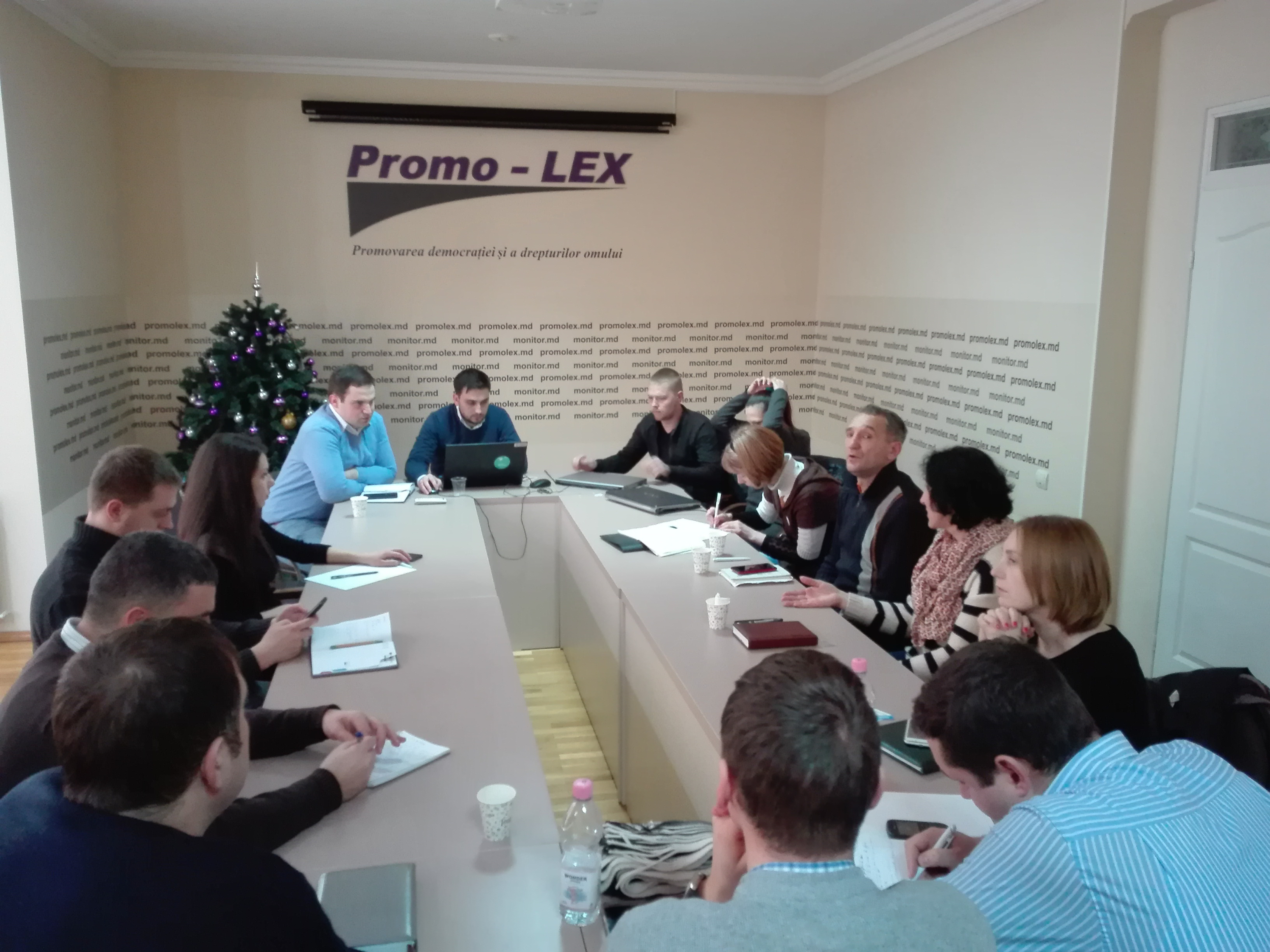
The Promo-LEX Association presented two reports based on its monitoring of reforms in justice: the monitoring report “Implementation of the Reform Plan for the Justice Sector 2011-2016” and the monitoring report “Progress in reforming the legal profession in the context of justice reform”.

The report “Implementation of the Reform Plan for the Justice Sector, 2011-2016” focused on monitoring the implementation of the fourth pillar of the Action Plan for Strategic Reform in the Justice Sector, 2011-2016. To this end, the webpages of institutions involved in the SRSJ, the sessions of Working Group Number IV, and information available in the mass media were monitored for the transparency of actions related to the Reform Plan.

According to the 2015 Annual Report on the implementation of the fourth pillar, from a total of 56 steps there were 26 completed steps, 9 outstanding steps, 3 obsolete steps and 18 steps in the process of completion (in 2016).

The monitoring report “Progress in reforming the legal profession in the context of justice reform” (draft version) focused on observing the progress of reforms in the legal profession in the context of the policies formulated by the Union of Attorneys (Plan of the Union of Attorneys, Communication Policy) and the justice reform, given the stages of the Action Plan for Strategic Reform in the Justice Sector. To this end, the web pages of institutions involved in the SRSJ, the Union of Attorneys’ website, and online networks of attorneys were monitored, and lawyers from the Council of the Union of Attorneys and from Commissions of the Union, lawyers at working groups, and information from the mass media were consulted.

The report identifies the specific conditions, legal provisions and mechanisms formulated during the last year by members of the legal profession, in coordination with the Reform Plan for the Justice Sector. The study is based on the analysis of the relevant legal provisions, relevant actions taken by the Union of Attorneys, structures within the Union and other organizations, discussions with focus groups, and the use of other available information.

These studies were carried out by the Promo-LEX Association with the support of the East Europe Foundation, with grants from the Government of Sweden and the Ministry of Foreign Affairs of Denmark/DANIDA. The opinions expressed in Promo-LEX reports belong to the authors and do not necessarily reflect the views of the East Europe Foundation, the Swedish Government, or the Ministry of Foreign Affairs of Denmark/DANIDA.