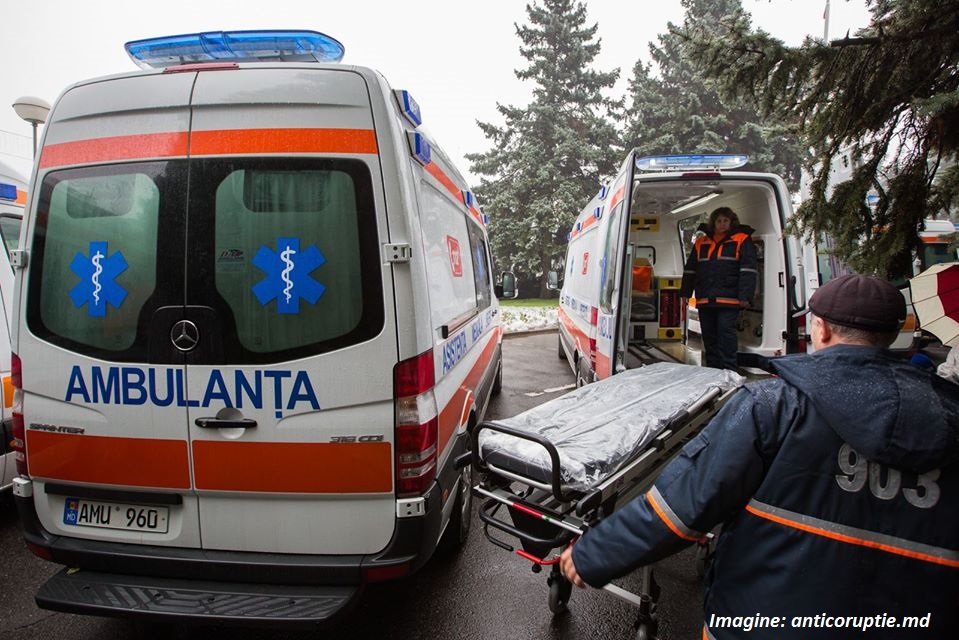
Promo-LEX Association: the acquisition of rapid response vehicles by the General Inspectorate of Police, without the implementation of other measures included in the Police Development Strategy, could contribute insignificantly to the reduction of the intervention time

Promo-LEX Association is presenting the Opinion regarding the acquisition of rapid response vehicles by the General Inspectorate of Police during the state of emergency declared across the country.

Given the fact that the GIP’s procurement notice of the acquisition of 54 field operations vehicles for rapid intervention teams was published during the state of emergency, it raised numerous questions, criticism and discontent among different actors in society, including citizens.

In this context, both the Minister of Internal Affairs and the Prime Minister of the Republic of Moldova stated that it is about the capitalization of some financial means, within the projects financed by the European Union. Likewise, GIP clarified in a press release posted on social networks that the procurement thereof is financed by the European Union (EU) funds, under the 2016-2020 Police Development Strategy, and not from the state budget.

However, there is no requirement from the EU’ side on procuring any new vehicles, this being only the decision of the Moldovan authorities. We emphasize that the subsequent allocation of financial resources from the Budget Support, after their disbursement by the European partners, is at the discretion of the authorities.

Thus, through this OPINION, the Promo-LEX Association considers necessary to emphasize that the procurement of vehicles is a planned measure, which has actually taken place in previous years. Promo-LEX considers that the procurement thereof, without implementing any other measures included in the Strategy, could to some extent contribute, but not yet sufficiently to reducing the intervention time at national level up to 15 minutes.

Promo-LEX believes that under the conditions of the state of emergency, while using certain information not reflecting reality, but also under the substantial arrears in the fulfillment of the commitments undertaken, the appropriateness of these procurements can be subject to serious criticism, including from partners but also from citizens.

That is why, in view of ensuring the transparency of the procurements made, but also for enhancing the achievement of the objectives set under the 2016 – 2020 Police Development Strategy and Budget Support Programme for Police Reform, the Promo-LEX Association recommends, in addition to the procurement procedures, ensuring the following measures:

  • publishing the information on the provision of rapid response teams with the equipment needed (albeit with vehicles), as well as the information on their short-and long-term needs;
  • supplementing the number of rapid response teams to citizens’ calls, according to territorial needs;
  • conducting trainings on the way of response for both persons involved in taking emergency calls (dispatchers) and response teams, including on the use of special equipment and means;
  • preparing and approving all the documents required for the operationalization of the National Inspectorate of Public Security and decentralization of patrol and rapid response structures under the Police Development Strategy. Implementing the measures taken after the end of the state of emergency;
  • providing true information to the public on the sources, methods and limits of procurement of the equipment, tools, etc., but also on the procedures for disbursement of financial means by development partners.

The full Opinion can be accessed here.

This OPINION has been drafted by the Promo-LEX Association within the “Civic Monitoring of Police Reform in the Republic of Moldova” project implemented with the financial support of the European Union. The opinions expressed herein belong to the Promo-LEX Association and do not necessarily reflect the position of the European Union.

For more details, please contact:
Inga Stegarescu, Press Officer of the Promo-LEX Association
GSM: 069 26 96 84;
E-mail: [email protected]


PUBLIC CALL for ensuring transparency and inclusiveness in the process of adoption of the draft law on nonprofit organizations

Attn.: The Parliament of the Republic of Moldova
Commission for Legal Matters, Appointments, and Immunities

Sent via email
30 April 2020

PUBLIC CALL
for ensuring transparency and inclusiveness in the process of adoption of the draft law on nonprofit organizations


Civil society organizations welcome Parliament’s intention to resume the consultation on the draft law on nonprofit organizations and to refine it and call on the legislator to pass the draft law, to ensure a genuine transparency in decision-making, and to involve all relevant civil society organizations in the consultation process prior to finalizing the draft.

On 15 April 2020, the Commission for Legal Matters, Appointments, and Immunities of the Parliament of the Republic of Moldova directed the letter CJ-04 No. 62 to several civil society organization, requesting their opinion that would help to refine Draft Law No. 109 of 3 April 2018 (Law on Nonprofit Organizations). The draft law had passed its first reading almost two years ago, on 3 May 2018.

The draft law transposes the best practice and standards concerning freedom of association recommended by the Venice Commission and the OSCE/ODIHR. It simplifies the registration of nonprofits and removes the rigid internal organization structure imposed on them by current laws. The draft law limits the possibilities for exerting pressure on nonprofits and excludes unjustified limitations on the foundation of nonprofits by persons from certain categories. As for political activities, the draft law completely prohibits nonprofits from supporting election candidates and sets clear limits on the relationship between nonprofits and political parties. The draft law also establishes the legal framework concerning the government financing or support for nonprofits—a field that has been insufficiently regulated by current laws. It does not require the repeated registration of nonprofits and does not restrict foreign funding for them. Civil society contributed to the development of the draft law, after which the Ministry of Justice has put it out once again for public consultation that was improved after it. The draft law received endorsements from relevant international organizations.

The signatory organizations welcome Parliament’s intention to resume the consultation on Draft Law No. 109 and to refine it, which they interpret as a response to the 3 March 2020 public call signed by more than 20 civil society organizations. On that occasion, the signatory organizations called on Parliament to pass the draft law in the final reading, to bar any amendments that could impede nonprofits’ work, and to consult with civil society organizations about any proposed amendment to the draft law in a transparent and inclusive way.

With a view to refining the draft law—especially amid the COVID-19 pandemic conditions which impose physical distancing and hinder participation in decision making — the signatory organizations call on the Parliament:

  • To publish the latest version of Draft Law No. 109 on the Parliament’s webpage dedicated to it in real time as it comes in for discussion by the Commission on Legal Matters, Appointments, and Immunities;
  • To publish potential amendments to Draft Law 109 and all submitted and registered opinions, comments, or objections received before this public call;
  • To constantly update the Parliament’s webpage dedicated to the draft law by adding all opinions, comments, or objections that will come in during the finalization of the draft law within 24 hours from their receipt at the longest;
  • To consult about any proposed amendment to the draft law in a transparent and inclusive way with the civil society organizations that have relevant expertise and field of work and have already participated in the development of this law until present, including via the Advisory Platform of Civil Society Representatives at the Parliament of the Republic of Moldova and the National Platform of the Eastern Partnership Civil Society Forum;
  • To ensure the live-streaming of the meeting at which the Commission for Legal Matters, Appointments, and Immunities will discuss the draft law and to facilitate the participation of civil society organizations, especially of all members of the working group that have contributed to the development of the draft law. They can also participate via electronic means of communication (Skype, Zoom, or other tools);
  • To pass the draft law on nonprofits in the final reading without delay, without admitting any amendments that can hinder the work of nonprofits, especially those that limit freedom of expression or the nonprofits’ possibility to advocate for public policies or to access foreign This will also contribute to the fulfillment of the general conditions upon which the Republic of Moldova can unlock the second installment of the European Union’s microfinance assistance.

The public call in English is available HERE.

Signatory organizations:

  1. Legal Resources Centre of Moldova (LRCM)
  2. East Europe Foundation
  3. Contact Center
  4. Soros Foundation – Moldova
  5. Independent Journalism Center (CJI)
  6. Independent Press Association (API)
  7. Terra-1530 Association
  8. Association for Efficient and Responsible Governance (AGER)
  9. AO AVE Copiii
  10. The Center “Partnership for Development”
  11. Promo-LEX Association
  12. The Community MD
  13. Institute for European Policies and Reforms (IPRE)
  14. IDIS Viitorul
  15. Center for Organizational Training and Consultancy (CICO)
  16. Public Association Eco-Răzeni
  17. Institute for Public Policy (IPP)
  18. Public Association BIOS
  19. INFONET Alliance
  20. Development Foundation
  21. Association for the Rehabilitation of People with Disabilities from Moldova (ARIM)
  22. Center for Training and Educational Development (CIDE)
  23. The Union of Moldovan Organizations for People with Disabilities (UOIRM)
  24. The International Association of the Keepers of the Nistru Eco-Tiras
  25. Public Association Caroma Nord
  26. European Institute for Political Studies in Moldova
  27. LDA Moldova
  28. EcoContact
  29. Association for Participatory Democracy ADEPT
  30. Rehabilitation Center for Victims of Torture Memoria
  31. National Youth Council of Moldova
  32. Expert-Grup
  33. AO Certitudine
  34. AO Centrul Internațional „La Strada”
  35. Association for Foreign Policy (APE)
  36. Automobile Club of Moldova
  37. INVENTO
  38. MilleniuM Training and Development Institute
  39. CPR Moldova
  40. Amnesty International Moldova
  41. The Alliance of Active NGOs in the Field of Child and Family Social Protection (APSCF)
  42. Public Association Eco Sor


A New Strategy to Stop the Abuses of Tiraspol Officials

Promo-LEX Association decided to change the paradigm in order to determine the Chisinau authorities to find new ways of addressing transnistrian officials’ abuses against human rights.

To prevent such illegalities by the so-called prosecutors, judges and politicians on the left bank of Nistru River, the Association’s lawyers opt for individual liability, based on a list of persons involved in unlawful acts drawn up following the ECHR decisions.

In March 2020, Promo-LEX association drew up a list of persons liable  for the transgressions committed on the left side of the Nistru River, in order to determine Chisinau authorities to take action against the flagrant infringements of human rights. It is already the third such annual report submitted by Promo-LEX Association.

The list is based on the ECHR decisions issued in 2019 with regards to the various violations committed by the separatist regime of Tiraspol by the action of its officials from law enforcement agencies and the so-called judiciary operating on the other bank of the Nistru river.

According to experts, the notion of ‘human rights’ is perceived abstractly on the left bank of the Nistru River, where the separatist authorities have developed an abusive pseudo-legal justice system over the past three decades.

‘It is known that human rights are violated in transnistrean region. Many of those who are mistreating people out there, under the guise of negotiations and the pretext that sins are forgotten as time goes by, are living very well, and then retire and buy businesses and real estate. They move to other countries, etc.’ says Alexandru Postica, Director of the Association’s Human Rights Program.

For many years already, human rights organisations from Moldova have been warning of the serious cases of Moldovans losing their health, wealth and dignity because of abuses that seem like from another century.

Chisinau authorities say they can do nothing when it comes to holding accountable someone from the left bank for abuses against Moldovan citizens.

Torture, ill-treatment and abusive takeover of ownership of real estate or businesses – all these were applied by police and court systems controlled by Tiraspol regime, right under the eyes of Chisinau authorities, which see these abuses committed on the both banks.

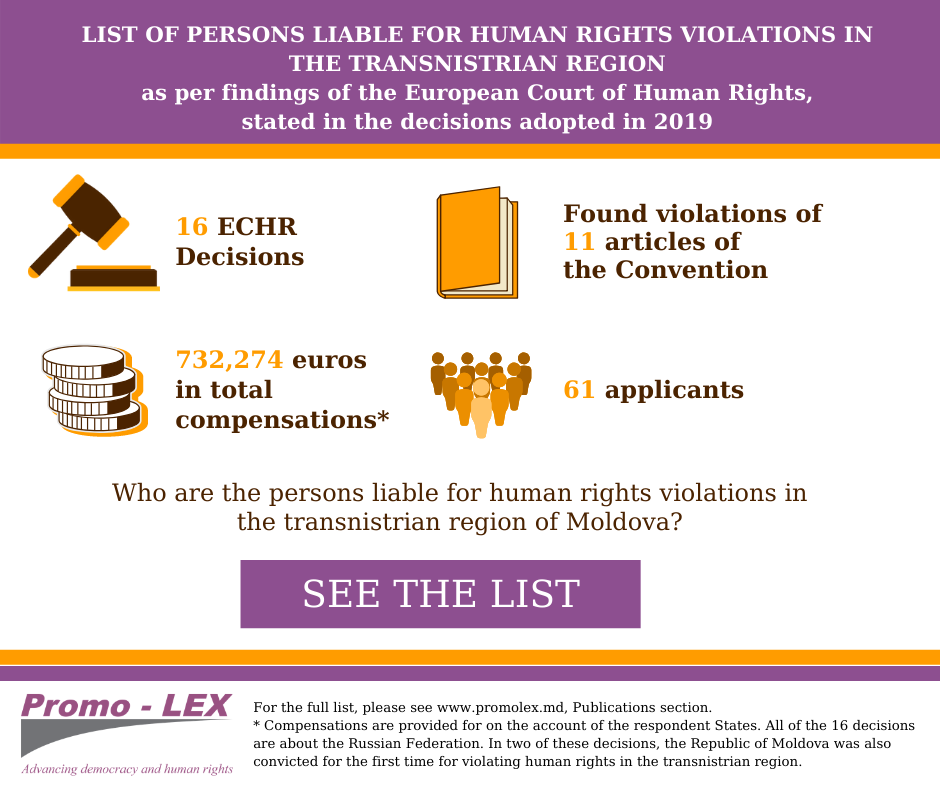
The above mentioned list includes 16 ECHR decisions from 2019, at least 11 violations of the European Convention of Human Rights’ provisions. The Republic of Moldova acceded to this document back in September 1997.
According to the Constitution of the Republic of Moldova, the international treaties, to which the state is a party, prevail over the national human rights law. Nonetheless, the reality in this field is different.

‘This document aims to analyse the situation. We tried to be as equidistant as possible and to work with reliable documents. In this case we refer to several ECHR decisions and violation of particular rights for particular periods’, the lawyer added.

In 2019 only, ECHR ruled in favour of at least 61 applicants. They are all Moldovan citizens who suffered from the injustice of Tiraspol authorities.

Both the Republic of Moldova and, for the most part, Russia, were obliged to pay compensations of EUR 732.274. The Russian Federation was condemned by Strasbourg Court for supporting the unconstitutional regime of Tiraspol, but it has never paid any of the compensations awarded by ECHR judges.

Cases Won at ECHR

The cases won last year by Moldovan citizens at ECHR have one common feature — the abuses committed by Tiraspol system and its officials.

The Strasbourg judges decided on the Babchin vs. Republic of Moldova and Russia case that the applicant had been detained for five years and one month in inhuman and degrading conditions in four places of detention in transnistrian region.
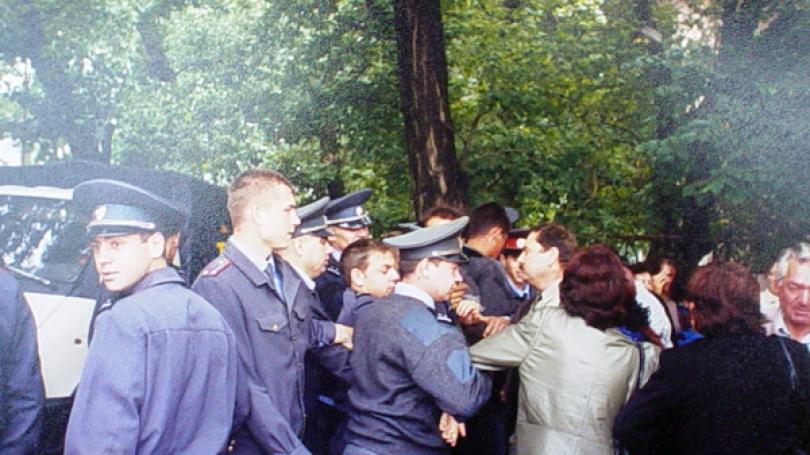
Militia during a protest on the left bank of the Nistru River. Photo: CIJM

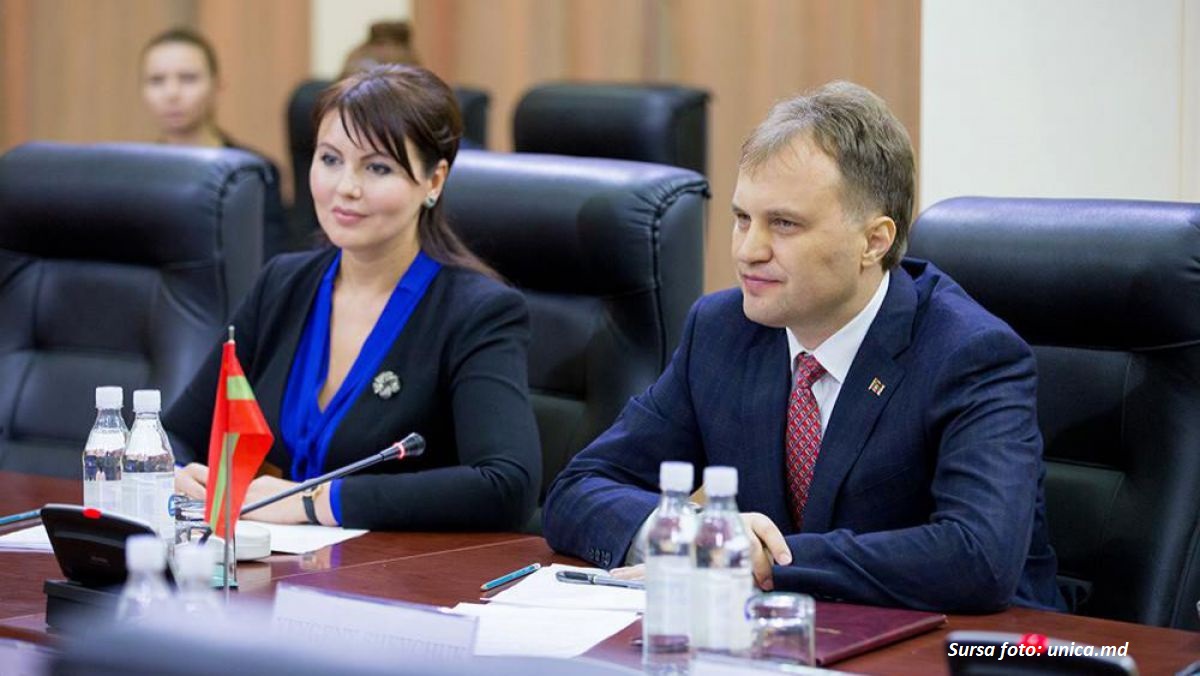
ECHR found guilty of abuses at least nine persons from Tiraspol administration, including the former separatist leader Evgheni Sevciuk.

In the case of Iovcev and others, the Russian Federation was also condemned to pay compensations of EUR 131.000 for intimidating and persecuting teachers, pupils and parents from 5 Latin-script schools in the region. At least 19 people were allegedly involved in these transgressions, including prosecutors, investigators, judges and leaders Evgheni Sevciuk and his wife Nina Stanski.

Besides, in the case of Grama and Dirul, ECHR established that several officials from Transnistrean region violated the right to protection of property, guaranteed by Article 1 of the Convention. The judges declared the seizure of applicants’ personal cars as illegal because it was not provided by the national law of the Republic of Moldova.

Executors of the Abusive Transnistrean System

Promo-LEX disclosed the names of several judges, militiamen, prosecutors and custom officials in the list.

Some of them are Nikolaeva I.I – judge in the Tiraspol Court; Ustinov V.A., Marciuc L.M., Savitkoi A.V – judges in the Supreme Court of Tiraspol; Krizhanovskii Alexei – investigator in the militia of Tiraspol and Tverdohleb Boris – prosecutor of Tiraspol; Teresenko Andrei V. – Head of the pre-trial detention center of Tiraspol militia (IVS Tiraspol); as well as the former leader Evgheni Sevciuk.

Nonetheless, Sevciuk and Stanski, were not prosecuted, ‘they have no criminal convictions and are not wanted in the Republic of Moldova’.

Moreover, they were accommodated by the authorities of the Republic of Moldova in the center of Chisinau for several months in the summer of 2017, and then were let to travel freely to the Russian Federation, together with their families, after losing power in favour of Vadim Krasnoselsky, the current separatist leader.
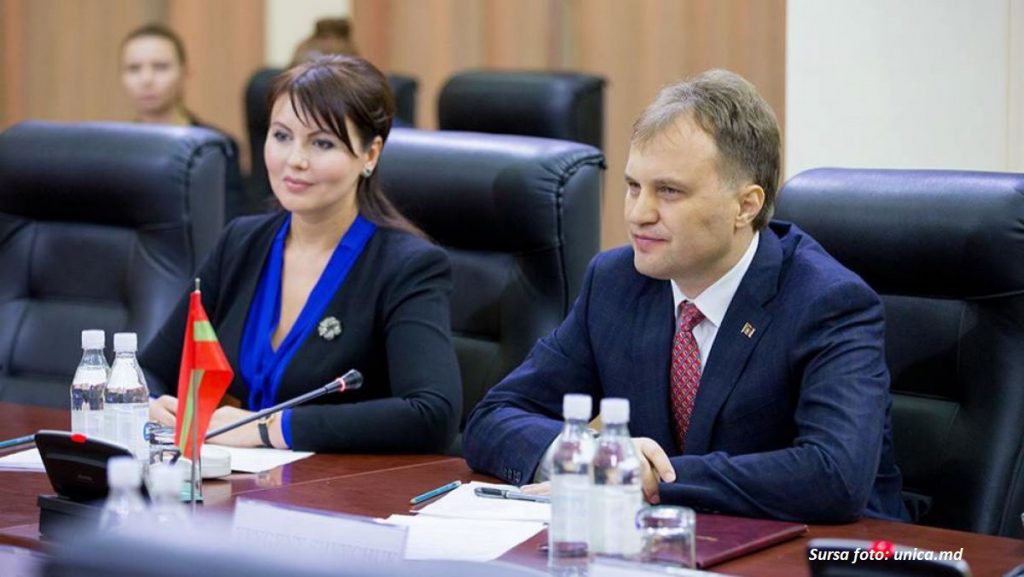
Former separatist leader of Tiraspol, Evgheni Șevciuk, and the so-called former head of transnistrean diplomacy Nina Ștanski. Photo: unica.md

In 2017, the later was declared wanted by the Prosecutor’s Office of Criuleni for ‘impeding the exercise of electoral rights or the activity of the electoral bodies’. Eventually, in 2014, the Prosecutor’s Office of Bender municipality closed the criminal case on the basis of the Article 275, section 4 – ‘expired limitation period’. In 2016, the Chisinau authorities stopped the prosecution of Krasnoselski.

The list published by Promo-LEX contains over 130 officials of the separatist regime, who committed human rights abuses.

Tens of Moldovan citizens were detained in inhuman conditions in pre-trial detention centers of the militia of Tiraspol, Rabnita, Dubasari, Slobozia or Tighina, Penitentiary No 1 Hlinaia (Grigoriopol), penitentiaries No 2 and No 3 of Tiraspol, etc.

‘In different periods, transnistrean officials in the fields of justice, militia, prosecutor’s office and executive bodies signed documents that served as pretext for limiting human rights. We are hence talking about complicity in committing crimes’, said Alexandru Postica.

ECHR judges decided that the 61 applicants were illegally convicted in 2019, because transnistrian courts of law cannot be qualified as ‘tribunals established by law’.

Cases brought to ECHR are various. These include illegal seizure of material goods, lack of health care in detention, physical ill-treatment and illegal detention, lack of right of defense in court and lack of access to a fair trial, or inhuman and degrading conditions of detention in the transnistrian detention facilities where the applicants were kept in custody.

A Need to Change the Approach
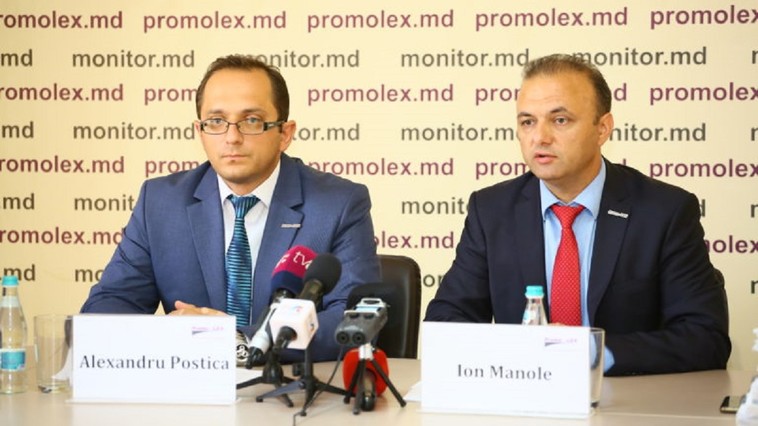
Promo-LEX lawyers, Alexandru Postica (left) and Ion Manole (right) during a press conference.

Though Promo-LEX Association has been warning for years, it decided to change the paradigm in order to determine Chisinau authorities to find new solutions for these situations that affect Moldovans citizens.

‘We are talking about individual accountability of people committing unlawful acts. If we continue with the same approach of focusing on all problems at once, we won’t have any progress for other 20-30 years. We want another approach – individual accountability. We submit to the Moldovan authorities, which claim they cannot solve individually the problems of citizens in Transnistria, a list of people involved in certain unlawful acts, including money laundering, torture, murder, etc. Moreover, we provide the Court’s findings that highlight these unlawful acts’, said the lawyer.

USA and other European countries, like Germany, the Netherlands, allow to hold liable persons who commit acts of torture, human rights violation, regardless of whether these unlawful acts were committed on their territory or not.

‘For instance, the acts of torture committed by a militiaman from the left bank of the Nistru River can be convicted in the Netherlands or Germany, if the offender is on the territory of that country or is somehow connected with its justice system. This principle was used to hold accountable the Donbas terrorists. Our activity aims to address this requirement’, the lawyer added.

According to Promo-LEX data, some of the militiamen, judges, former leaders – presidents – from transnistrian region ‘are now living well in European countries like Germany, the Netherlands, Spain, Ukraine with a wealth gained on the other’s pain’.

Despite public appeals and requests, the General Prosecutor’s Office does not react.

‘The General Prosecutor’s Office must investigate if these cases have criminal components. Depending on case, the Office has to find out to which jurisdiction (territory) the respective citizens belong and to send this official request further. The General Prosecutor’s Office has the obligation to express its opinion about this list’, said the lawyer Alexandru Postica.

According to him, all of the notifications made by the association ‘are taken note of’.

‘The truth is that criminal cases were opened for each case of illegal detention that we are managing. If we are talking about the violation of Article 5 of the Convention [the right to freedom and safety], all files were merged in a single procedure and were suspended until offenders are identified’, he added.

Despite the requests of the Center for Investigative Journalism of Moldova, the Prosecutor’s Office said nothing about the actions taken by Moldovan prosecutors with regards to cases of human rights violations in the Republic of Moldova.

Moreover, the transnistrean police was involved in several kidnappings on the constitutional territory of the Republic of Moldova during the last years.

On 27 July 2018, the former Minister of Internal Affairs from Tiraspol, Ghenadi Kuzmiciov was allegedly kidnapped near Chisinau by the law enforcement bodies from the transnistrian region. The operation was allegedly performed with the help of constitutional law enforcement bodies of the Republic of Moldova.

According to Kuzmiciov’s wife and Promo-LEX lawyers, Moldovan patrol inspectors stopped the car near Chisinau, under the pretext of exceeding the speed limit. Immediately after the documents were checked, four individuals dressed as civilians got out of a silver SUV, took him from the Moldovan police officers and forced him into their car. After that they drove in an unknown direction.

On the other hand, for such cases to be reviewed, the lawyer of ‘Apriori’ Association from Tiraspol, Stepan Popovschi, suggested to set up a common court that would function according to ECHR principles.

‘A Human Rights Court was established in Bosnia and Herzegovina, which is great. But we are abandoned by the Republic of Moldova to survive on this territory’, he said.

Stepan Popovschi’s proposal was rejected by Vasile Sova, the former Minister for Reintegration, the current Presidential Advisor, on the grounds that ‘it smells like Kosovo’.

‘Tiraspol authorities are not obliged to comply with these decisions [of the ECHR]. The Tiraspol regime it is not a signatory of the European Convention. It is an issue related to Russia and Moldova […] I think there is no one in Moldova who wants to solve this problem from a legal perspective. Unfortunately, the interests of Chisinau authorities and of the great power [Russia] match’, he concluded.

What Does the State Say?

The Reintegration Policies Bureau under the Government’s Office reported to have a limited set of tools it can use to intervene in the transnistrian region and settle the cases of human rights violations.

‘Chisinau authorities have a range of tools of diplomatic, political and legal influence on people on the left bank of the Nistru River who violate human rights. The constitutional authorities use all these tools whenever needed. The human rights dimension in Transnistrian Region is hence addressed on several communication platforms’, informed us the Reintegration Bureau.
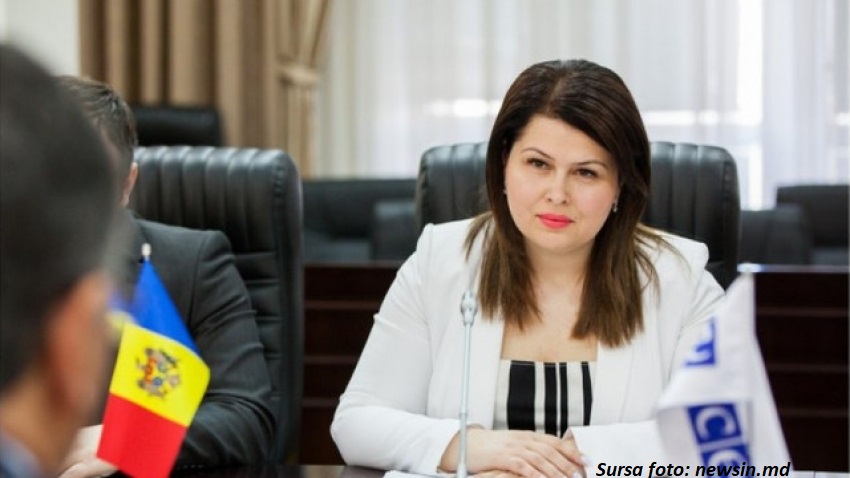
Cristina Lesnic, Head of Reintegration Policies Bureau. Photo: newsin.md

These include 1+1 and 5+2 negotiations, Joint Control Commission for the situation in the Security Area (JCC), reporting cases of human rights violations in region to the Council of Europe Commissioner for Human Rights, UN Special Representative, Ombudsperson of Chisinau.

‘Additionally, the observance of human rights on the left bank of Nistru River is reflected in the reports of European Committee for the Prevention of Torture and Inhuman or Degrading Treatment or Punishment (CPT) of the Council of Europe and reports of Thomas Hammerberg, the United Nations Senior Expert on Human Rights’, the officials said.

Besides, every year the European Union adopts decisions on keeping a number of persons from the so-called transnistrian administration on the sanctions list.

‘Note that ECHR decisions on cases from the transnistrian region usually absolve the Republic of Moldova from guilt, because the country makes positive efforts in a territory where it does not exercise effective control. There is also the Parliamentary platform, as well as NGO’s notifications that can trigger public authorities to take measures’, states the Reintegration Policies Bureau’s response.

The article is developed under the ‘Strengthening the Observance of Human Rights in the Transnistrian Region’ Project, implemented by Promo-LEX Association with the financial support of the National Endowment for Democracy. 


The Decree of Krasnoselski Left Six Districts of the Republic of Moldova Without Doctors

Various district hospitals and family doctors centres from Soldanesti, Rezina, Floresti, Dubasari, Criuleni and Causeni districts were left without doctors due to the state of emergency declared by the leader from Tiraspol on 17 March. Almost 100 doctors and health workers notified the Bureau for Reintegration Policies from Chisinau that they were not able to go to work because of Tiraspol’s interdiction. At the same time, the employees of the Metallurgical Plant from Ribnita, who live in Rezina, commute unhindered.

In the middle of pandemic, doctors from the Transnistrian region are the only category forced to observe the 14-day quarantine regime if they go to work in the health facilities located on the territory controlled by the constitutional authorities from Chisinau. Nonetheless, the constitutional authorities allowed the secessionist regime from the left bank of Nistru River to make laboratory tests in Chisinau, as they are not technically endowed to do it themselves.

According to the heads of health facilities who were contacted by the reporters of the Center for Investigative Journalism from Moldova, Tirapol argued that doctors are a category that is vulnerable to contracting the virus, and their free movement on both banks of Nistru River would increase the danger of contamination for the population on the left bank of Nistru River.

Rezina-Rabnita. Rezina District Hospital has 17 employees from Rabnita, ‘almost all them full time specialist’, says the head of the facility, Nina Postu. They have not been able to come to work for about a month, since 17 March, due to the state of emergency declared by Tiraspol. Those 17 doctors were entitled with paid leaves.

‘I tried to solve this issue via the Bureau for Reintegration Policies. They are allowed to come to this side, but they have to stay here. We need a doctor to really stay here, but the rest of them have small children, sick parents and they cannot stay’, told us the head of the health facility.

Nina Postu also said that because of some doctors not being able to come to work, those who are left are really struggling. Most of them are are at work all the time. The facility has only one infectious diseases physician who is responsible of the ward where three Covid-19 patients were admitted. At the same time, the so-called Transnistrian border guards allow the employees of the Metallurgical Plant of Rabnita and of two cement factories to commute unhindered.

Asked to comment on this situation, the Bureau for Reintegration Policies used a ‘diplomatic’ language: ‘We received various requests from different business entities asking to allow the free circulation during the state of emergency, on both banks of Nistru River.’

‘We believe that limiting the free movement is an abuse and we confirm that certain topics on the agenda of negotiations cannot be excluded due to the check of their sustainability level’.

Rabnita-Soldanesti. Soldanesti District Hospital has 14 doctors, a doctor’s assistant ad a nurse who live in Rabnita. Most of them are employed on the basis of concurrent employment and they took paid leave. The head of the hospital, Veaceslav Palii couldn’t tell the reporters if the leave applications of his staff from the left bank of Nistru River were determined by the state of emergency declared by the separatist administration from Tiraspol or by their own will.

‘At present, two doctors are willing to work until the quarantine ends. The doctor from the intensive care unit is from the left bank of Nistru River and will not leave to see her family until the quarantine ends. Soldanesti District Council provided her with a place to live and food’, said the doctor. Currently, there is one confirmed case of COVID-19 on the territory of Soldandesti district, but the patient is hospitalised at Chisinau Psychiatric Hospital and there is one suspected case.

Camenca-Sanatauca. Liuba Covali, aged 46, lives in Camenca, the region on the left bank of the Nistru River, and she is the head of Sanatauca Health Centre, Floresti. On the morning of 17 March, when she passed the border passing point she was announced by the so-called border guards of the unrecognised authorities from Tiraspol that if she was planning to return home, she would have to observe the 14-day quarantine regime.

She decided to stay in Sanatauca because she couldn’t leave the facility she was the manager of in times of pandemic. ‘I couldn’t have stayed home in such conditions’, explains the women her decision.

Sanatauca Health Centre covers three villages – Sanatauca, Napadova and Japca. Once she got to work, she notified immediately the Bureau for Reintegration Policies of the Republic of Moldova.

Cocieri-Dubasari. Raisa Spinovschi, Mayor of Cocieri, told reporters that two family doctors from her village live in Dubasari, the Transnistrian region.

‘After the set up of the military posts on the territory of our village, these two doctors cannot come to work because according to the Transnistrian police, they are in the risk category and could contribute to the outspread of the coronavirus in the Transnistrian region’, said the Mayor. There are three family doctors in Cocieri village. Now, however, there’s only one doctor in this health centre.

‘Doctors from Dubasari consult the patients and monitor those who came back from abroad by phone. For more serious cases, there is only one family doctor for about 5,000 inhabitants. She is over 60 years old and she tries hard to consult everyone, she works overtime a lot’, told us Raisa Spinovschi.

Besides Cocieri Family Doctors Centre, an emergency health care centre operates in the village and it has three employees and a dentist from Dubasari who cannot come to work. However, the situation remains unstable. On 15 April, several doctors who work in Criuleni

Dubasari–Criuleni. According to the Executive Director of Promo-LEX Association, Ion Manole, the doctors from Dubasari who work in Criuleni stayed initially in quarantine for 14 days and tried to go back to work, but they were forced again to stay in quarantine.

‘During four days they were able to go to work in Criuleni on the basis of a list agreed by Chisinau with Tiraspol.’ Today [15 April] they were prohibited to go to work from Dubasari to Criuleni and were placed again in quarantine. ‘When they asked to be allowed to leave the separatist region and said they would stay in Criuleni until the epidemic ends, they were accused of not being patriots of the Transnistrian motherland. True patriots should serve their motherland in such times’, added Ion Manole.

Bender-Anenii Noi. Two employees of Anenii Noi District Hospital live on the left bank of Nistru River. ‘One of them was provided accommodation and food, while the second one is employed on the basis of concurrent employment and took paid leave because of not being able to come to work, told us the Deputy Head of the hospital, Alexandru Nastas.

Also, one employee of Anenii Noi Health Centre, who lives on the left bank of Nistru River, will be provided accommodation. Three out of six family doctors from Varnita Health Centre from the same district live in Bender. They were not able to go to work due to the state of emergency declared by the secessionist regime from Tiraspol.

Bender-Causeni. One employee of Causeni District Hospital, an infectious diseases physician, lives in Bender and needs a permit in order to be able to commute between Bender and Causeni. ‘We filed a request with the Bureau for Reintegration Policies. At present, this physician is in Causeni and was provided accommodation’, told us Viorel Ceban, the Deputy Head of Causeni District Hospital.

Three employees of Causeni Family Doctors Centre live in Bender and two of them – a doctor and a nurse – cannot go to work. One of them, who is the family doctor in Carnateni village, is at work. ‘With or without these doctors, we have many communities without family doctors at all’, told us the senior nurse, Diana Carlig.

About 100 Health Workers Were Prohibited From Going to Work on the Right Bank

The Bureau for Reintegration Policies informed us that it was notified by the local public authorities and by the Ministry of Labor, Health and Social protection about 95 individuals who couldn’t go to work because of the quarantine regime imposed by the Transnistrian authorities. Chisinau authorities assume that the actual number could be bigger.

At the same time, the reporters were informed that the Bureau for Reintegration Policies does not have accurate data about the number of employees of health facilities in the security area who live with their families in the eastern districts of the Republic of Moldova.

Asked to speak about the measures taken to unblock the movement of doctors, the Bureau for Reintegration Policies informed us that they filed a direct request with the Transnistrian authorities to facilitate the movement of health workers in the Security Area.

Emergency Solution: ‘Forced’ Accommodation on the Right Bank of Nistru River

After the refusal of the Transnistrian authorities, the Bureau for Reintegration Policies notified the participants in the ‘5+2’ format and the Council of Europe Commissioner for Human Rights, Dunja Mijatovici, to get involved and unblock the situation. Finally, it was decided to provide the health workers who work in the Security Area, but live on the left bank of Nistru River with temporary accommodation in the communities where they work.

The costs for accommodation and other administrative arrangements for health workers/doctors are covered with the support from the European Union under the Confidence Building Measures Program on both banks of Nistru River, implemented by UNDP Moldova.

The representatives of the hospitals contacted by the reporters said that the doctors form the left bank of Nistru River, who decided to continue to work during the state of emergency, were already provided accommodation and everything they need by the local authorities. The accommodation of doctors in the communities where they work is done on voluntary basis, and so far, 14 doctors from seven districts were among the beneficiaries.

‘This is a temporary solution meant to ensure the access of citizens to health services. We didn’t give up the efforts to ensure the free circulation of the population and, first of all, of health workers throughout the Republic of Moldova’, stated the Deputy Prime Minister, Cristina Lesnic.

Note that these measures apply only to doctors and health workers who decided to stay on the territory that is under the jurisdiction of Chisinau.

Arrested for Doing Their Job

Remember that two workers from Molovata Noua who work as ambulance drivers at Dubasari District Hospital, were detained on 3 April and were condemned to 15 days in custody by the unrecognised authorities from Tiraspol. Following the multiple interventions of Chisinau authorities, on 9 April, those two workers were released.

Promo-LEX Association made this case public and as a result, Tiraspol took a step back in terms of applying these measures. ‘While all over the civilised world the health workers are appreciated, helped and honoured for their efforts, in the Transnistrian region of the Republic of Moldova the doctors are harassed, intimidated and sentenced because they want to continue to work during the epidemic’, was stated in a release of the Association.

Moreover, Promo-LEX flagged up that beginning 17 March, when the Parliament passed the decision in this regard in Chisinau, the Tiraspol administration resumed restricted the exercise of human rights.

The lawyers of the Association believe that the measures Tiraspol took are unreasonable and that even the epidemiological crisis cannot justify them. ‘Artificial and unjustified obstacles to the work of health professionals during an epidemiological crisis is an act of defiance of the efforts meant to prevent the spread of the virus and fight the epidemic’, added the lawyers of Promo-LEX in their release.

Since the pandemic started, Tiraspol blocked the circulation of various categories of individuals – farmers, police officers, employees of the penitentiary system, etc. The police officers and the employees of the penitentiaries Nos 8 and 12 from Bender were allowed to go to work on the basis of some lists previously agreed with Tiraspol.

The problem of farmers from Dubasari district was solved using the same method. Starting with 28 March, they were allowed to access their lands located east of the national road Rabnita-Tiraspol on the basis of the lists agreed with the unrecognised authorities from the left bank of Nistru River.

The article was developed under the ‘Strengthening the Observance of Human Rights in the Transnistrian Region’ Project, implemented by Promo-LEX Association with the financial support of the National Endowment for Democracy. 


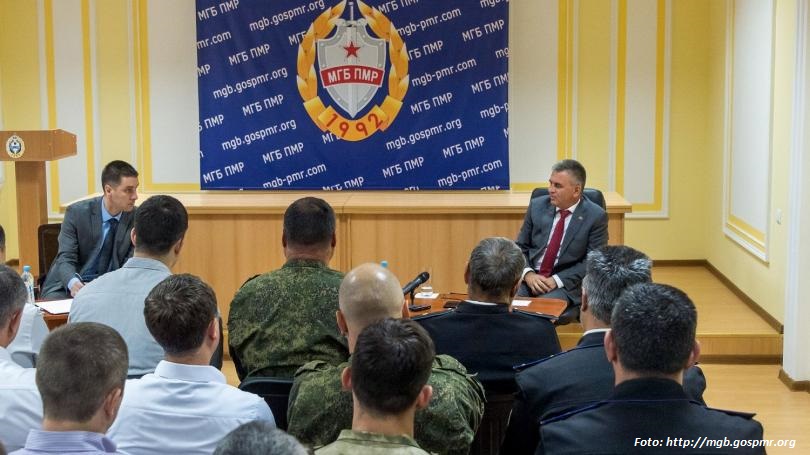
Transnistrian KGB vs. Civil Society. Who is next after Promo-LEX, Apriori and Larisa Kalik cases?

The non-governmental organizations became a threat for the group of people controlling economically, administratively and politicly 11% of the Moldovan territory. In 2015 the secessionist Tiraspol regime banned Promo-LEX Association access in the Transnistrian region. It has been five years since the local KGB filled in criminal charges for Promo-LEX representatives, and we wanted to find out more about the environment in which the non-governmental organizations in the Transnistrian region of the Republic of Moldova carry out their activities.

The “Apriori” information and legal assistance center in Tiraspol has become a last fortress of the civil society on the left bank of the Dniester. Apriori is the only organization in the region to which the provisions of the Law on “non-commercial” organizations of Russian inspiration have been applied.

The “Apriori” activity, like that of Promo-LEX, is under the local KGB’s thick magnifying glass. The two organizations have become the targets of the secret service, as they are encouraging, informing and defending the inhabitants of the region whenever their rights are violated.

The case of Apriori

Larisa Kalik, a 22years-old journalist from Tiraspol, was forced to leave Moldova after launching in December 2019 the volume “Year of Youth” about the experience of young people in the alleged “Transnistrian army”.

“Initially, in December [KGB employees] called my mother. They visited my former school requesting a testimonial of mine from the principal” the young woman retells me casually the communication with the local KGB employee. One month later, in January, she was wanted on the phone by a man who appeared as an officer of the same dreaded security service.

Larisa Kalik, author of the volume “Year of Youth”. Photo: Facebook.com

“I asked him his name and the military rank. He said he can only give me such details during a meeting. Within a week, he called me again and I told him I was not in Tiraspol. “ The young woman has hired a lawyer who informed her about “what could happen to her.” She was not eager to talk about such details, hoping she would not get to them. In Transnistria, the KGB can start criminal prosecution in the case of criminal charges for separatism, extremism, etc. Therefore, the persons pursued by this service have the right to defense, which can only be provided by a lawyer.

Larisa’s case is likely to be a lesson for her colleagues and for human rights activists in Transnistria. Her colleagues only told me that she was “taken out of Transnistria”, either to protect her or to show that they had nothing in common with her.

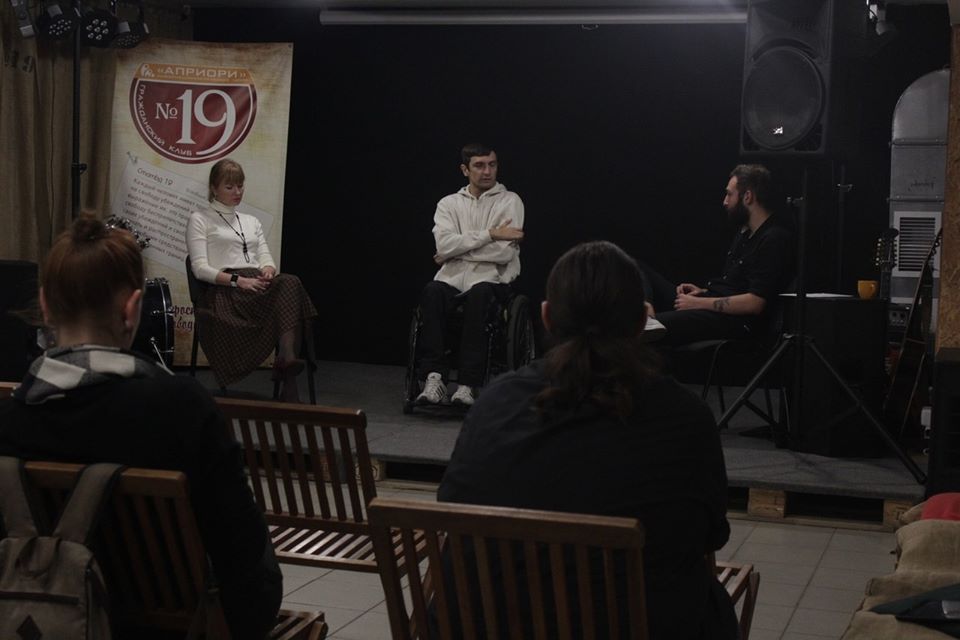
By publishing the testimonies of the 12 young people, the journalist wanted people to speak and reflect about the “Transnistrian army”. The discussions were organized within the “Club 19”, a forum of the non-governmental organization “Apriori” in the capital of the region. “A lot of people gathered in Tiraspol. We had held discussions in Dubăsari and Râbnița within the same “Club 19”. Most of the participants agreed on the reported issues, but of course there were disputes as well. “

The Promo-LEX Association from Chisinau compares the military service in the Transnistrian region with “illegal deprivation of liberty, manifested by detention in the paramilitary units in the eastern part of the Republic of Moldova”. The evasion from this “military service” is sanctioned with a fine of about $ 600 or up to two years in prison. The “Club 19” forum first appeared within Apriori, Tiraspol, with the support of the Czech organization “People in need”. Later on, it was expanded geographically to Dubăsari and Râbnița.

“Club 19”, a forum of the “Apriori” Center in Tiraspol. Photo: Facebook.com

“There is no subordination and mutual obligation between these structures. The representatives of the platforms collaborate in organizing public discussions “, said the director of the organization, Evgheni Dunaev. The forum was named after Article 19 of the Universal Declaration of Human Rights: “Everyone has the right to freedom of opinion and expression. This right includes the freedom to hold opinions without interference from outside, as well as the freedom to seek, receive and disseminate information and ideas through any means and regardless of state borders. “

The interest of the KGB people for the members of the organization once the public activists and journalists diversified their activity, as they “touched” “forbidden” issues and topics. “Six years ago, the KGB recruited a first-year student from the University of Tiraspol to infiltrate into our organization. The young man was actively involved in our discussions, and we hired him as a journalist “,Evgeni Dunaev reports.

“The boy hesitated and, one day the invited him to a university office and scared him. They had told him that if he did not want to collaborate with them, he would not pass the exams and thus he would get into the army, and there the things would not be good. His mission was to spy on our colleagues and report. He had to find out the password of our email. They started to pressure him, scare him with tormenting sounds and, finally, the boy gave up … He told us about his mission. “

Apriori is the only non-governmental organization in Transnistria to which the Law on Non-Commercial Organizations was applied – a law of Russian inspiration, adopted in 2018, providing for the closure of the organizations supported from outside, which hold public discussions. On the left bank of the Dniester the recently adopted Moldovan Law on 2% is not applied, and there are no internal donors for non-governmental organizations. In November 2018, the Transnistrian prosecutor’s office conducted the first verifications at the “Apriori” Center and established that it “is doing politics” through its activities.

“According to the same law, after a half a year, the prosecutors were to carry out other checks and file other charges, which did not happen. In order to close the organization, there is still a need for control,“ Apriori lawyer Stepan Popovski noted.

However, Evgheni Dunaev emphasized that Apriori continues to advocate for human rights and to provide voluntary legal assistance to people having problems with the regime. “The risk of eventual early closure of the organization increases once with its possibility to receive grants from outside. “ The secessionist authorities had also banned any relations of Apriori with other human rights non-governmental organizations.

The case of the Promo-LEX Association

The Promo-Lex Association from Chisinau has been officially banned in Transnistria as of 2015. The so-called State Security Committee has opened a “criminal investigation against Promo-LEX for the alleged” actions aimed at interrupting the 5 + 2 negotiation process “and for” subversive actions against the Transnistrian statehood “

“The charges are not clear and have not been notified to us. We tried to apply local rules and procedures but we failed to defend our rights and interests. The Tiraspol regime sought to keep us away from this region “,the program director of the Association, Alexandru Postica claims.

Tiraspol separatist regime has started to follow Promo-LEX activity and create obstacles for us since 2007. The members of the association realized that it is more efficient to contribute to building and strengthening of the nongovernmental sector in Transnistria. “Where there is no independent press, no open access for diplomats, journalists, lawyers in this area, only authentic local organizations would be able to deal with such a large number of human rights violations,” notes Postica.

Based on these beliefs, in 2006-2008 Promo-LEX organized the Forum of Transnistrian NGOs. “In addition, for five years [2006-2011] we organized numerous information and training activities, including funding for local organizations.

We have been providing legal assistance to the local people in the local courts, in the national and international ones “, evokes Ion Manole, the executive director of Promo-LEX.

In parallel, the local KGB launched a derogatory campaign against the association, resorting to threats against the organization’s partners and beneficiaries. “In 2007 the security service in the region summoned all the forum participants in a room. The military people told them that if they continue to participate in our activities, they may have problems. “

Consequently, Manole added, the non-governmental organizations that remained in Transnistria were forced to give up the human rights activities and the promotion of the democratic values. They were forced to choose activities “peculiar to the NGOs” such as humanitarian, social, ecological and to cooperate with the regime. “Each organization in the region has been appointed a local KGB agent as a curator, regularly visiting the organization and discussing with the people involved.”

Manole revealed that the donors accepted this condition. The most them refused to support human rights activities, accepting the game of the Tiraspol administration. “As a consequence, the inhabitants were left without a defense shield in an isolated region, where the human rights are neither known nor promoted and, moreover, they cannot be defended.”

A discussion platform for identifying solutions

The lawyer of the Apriori Association, Stepan Popovschi, says that Chisinau authorities’ actions are not far enough to provide an effective mechanism for the defense of human rights in Transnistria.

“The amendments to the Law of Justice on the right of the applicants from Transnistria to apply to the courts of the Republic of Moldova is a half measure. To what laws should the complainant from the left bank of the Dniester refer when addressing a court in the Republic of Moldova? “, the lawyer wonders.

Alexandru Postică, director of human rights programs at the Promo-LEX Association

“He is obliged to refer to Moldovan laws, but the Government from Chisinau does not ensure their functioning on the Transnistrian territory.” Therefore, the authorities from Chisinau ignore the fact that the citizens on both sides of the Dniester are in fact in different situations. The same approach to the legal defense is discriminatory for the people from the eastern districts of the Republic of Moldova.

The attitude of the Moldovan Government towards ensuring human rights in Transnistria is contrary to the ECHR’s position, namely “the obligation to disregard the deeds of the entities in fact is far from absolute”.

Where about half a million people do not have legal means of defense, the lawyer Popovski insists on the idea of establishing a court with special prerogatives, in Chisinau, which would work according to the principle of the European Court of Human Rights.

Ion Manole, in this turn, advocates for a platform “in which the authorities, experts and those concerned would seek solutions”: “The Promo-LEX tendency to refer the files to the ECHR, he added, is explained by the hope that the increasing number of cases examined and decisions will make the constitutional authorities, civil society and international partners understand the complexity of the problems faced by the inhabitants of this region. “

“My highest expectations in this case, underlined Manole, were related to the efficient involvement of the OSCE Mission in Moldova. The OSCE could have played an active and decisive role in this process. Unfortunately, neither the constitutional authorities nor the relevant actors are disturbed by the issues reported by the inhabitants of the region. Impunity in Transnistria remains comfortable at home and feels great.”

The article is developed within the project “Promoting Human Rights in Transnistria”, implemented by the Promo-LEX Association with the financial support provided by the National Endowment for Democracy.


Promo-LEX: Emergency measures must be clear, predictable and void of confusions

The Promo-LEX Association, presented today, 10.04.2020, a Written Opinion in response to the Request of the Constitutional Court of 27 March this year, regarding the petition lodged with the Court by a group of MPs (Petition no. 47a) to check the constitutionality of certain provisions of the Parliament’s Decision no. 55 of 17 March 2020 on the declaration of the state of emergency, as well as of some new legal provisions included in the Law no. 12/2004 on the regime of the state of emergency, siege and war, which, in the opinion of the authors of the aforementioned petition, imply “practically granting to all central authorities unlimited powers not provided by law”.

Promo-LEX stresses that the conditions for the functioning and powers of public authorities are subject to change in the event of a state of emergency, but the measures applied therein must be proportionate to the aim pursued and must not be arbitrary. For this reason, and in order to protect the citizens of the Republic of Moldova against any arbitrary situation, the only possible and strongly needed solution especially in the field covered by Law 212/2004 is to include an exhaustive list of measures that can be applied when a state of emergency is being declared.

Following on from that, the Promo-LEX Association does not challenge the opportunity for making certain amendments to the legislation relating to the exceptional situation, but cannot accept the establishment of a vague regulatory framework, which could endanger the observance of human rights.

Based on the analysis made as well as taking into account the Promo-LEX experience, the Association believes that the wordings used by the legislator in the text of the law (and challenged by the authors of the petition): “enforcement of other required measures” and “exercise other required tasks”, do not offer the subject of law an express guarantee on the respect of his rights and freedoms. Moreover, they deny everyone the opportunity to know their responsibilities in a state of emergency imposed by the abstract powers vested in the authorities. As a result, from the point of view of Promo-LEX, they run counter to the general constitutional provisions on fundamental human rights and freedoms.

Promo-LEX believes that in exceptional situations, it is rather proposed that the legislature should supplement the legislative framework, depending on social phenomena, with new express provisions, intended to regulate the phenomena related to the restriction of a certain right.

Moreover, Promo-LEX draws attention to the fact that the Parliament was not entitled to approve the amendments made to the law on the day of the emergency period, while the President was not entitled to promulgate the amendments thereof with immediate effect from 17 March 2020.

The full Opinion can be accessed below:

For more information, please contact:
Inga Stegarescu, Promo-LEX Association Press Officer
GSM: 069 26 96 84;
E-mail: [email protected]


PUBLIC APPEAL for the release of ambulance drivers Cebotari Anatolii and Carpov Alexei from the detention by the secessionist administration of Dubasari town

On April 3, 2020, in the morning Cebotari Anatolii and Carpov Alexei, residents of Molovata Noua village of Dubasari rayon, while being in Dubasari town (security zone under the control of the secessionist bodies) were detained by militia representatives from Dubasari town. Both Cebotari Anatolii and Carpov Alexei are working as ambulance drivers in the central hospital of Dubasari rayon, in the Emergency Unit. They were entering the day shift, activity which they have been practicing for 36 years (A. Cebotari) and for more than 5 years (A. Carpov).

As reported by the relatives and witnesses, it would result that Dubasari town militia deprived them of liberty after carrying out their activity for several days at a time. According to some sources, on the same day, a “judge” of “Dubasari Court” found the inmates guilty of committing an administrative contravention and set a 15-day administrative detention sentence for each of them with their detention in Dubasari detention facility. (the information is updated).

The friends and relatives sent some food and clothes for the prisoners who tried to do their job. There is no information on guaranteeing their rights of defense, as well as on their health status.

We recall that on 2 July, 2019, the European Court of Human Rights ruled in the case of Beșleaga v. Republic of Moldova and Russia (no. 48108/07). The court found the violation of art. 3, 5, 6, 10 and 13 of the Convention for the Protection of Human Rights and Fundamental Freedoms, alleging that the person had been detained against the law, under degrading conditions, for 15 days based on a “Judgment of the Dubasari Court”. It was emphasized that the courts in the so-called “transnistrian moldovan republic ” were not establish by law and that the complained governments did not establish any effective national remedy to defend the rights violated by the “tmr” structures.

Promo-LEX Association has been repeatedly emphasizing that all the necessary and characteristic measures for the State of Emergency during an epidemiological crisis must be effectively coordinated in order to avoid unjustified obstacles, which in turn jeopardize efforts to prevent the spread of the virus and, in particular, for the treatment of patients. This difficult time in fact represents a test of the true intentions of the participants in the negotiations on the Transnistrian dispute settlement. Permanent communication and effective coordination between the relevant subjects on both sides of the Dniester is required in the context of joint and effective efforts to prevent and combat Coronavirus, as well as in cases of serious human rights violations.

As of 17.03.2020, when the state of emergency was established in the Transnistrian region, Tiraspol administration has continued to restrict the human rights. We regret to note that these measures cannot be considered as reasonable and justified even during times of epidemiological crisis. It is inadmissible to block the movement for doctors and pharmacists (numerous cases reported over the last week) and now the arrest and detention of ambulance drivers. Artificial and unjustified obstacles to the activity of medical staff during times of epidemiological crisis represent a gesture of defying efforts to prevent the spread of the virus and to fight the epidemic.

While in the civilized world, medical professionals are appreciated, helped and honored for their efforts, in the Transnistrian region of the Republic of Moldova they are harassed, intimidated and condemned for wanting to continue their work during the epidemic.

WE URGE:

  1. The Prime Minister and the President of the Republic of Moldova, to take prompt action for the immediate and unconditional release from illegal detention of Cebotari Anatolii and Carpov Alexei;
  2. The General Prosecutor’s Office to investigate the situation described above from the perspective of the Criminal Code provisions, if appropriate to start a criminal case;
  3. Convening of the Unified Commission of Emergency Control to request the immediate withdrawal of the posts from Cocieri, installed unjustifiably after March 17, 2020;
  4. Diplomatic missions to monitor the situation.

For more information contact: Ion Manole, Executive Director, Promo-LEX Association: GSM 069070800,  e-mail: [email protected]


APEL PUBLIC cu privire la necesitatea sporirii nivelului de protecție a lucrătorilor medicali în contextul stării de urgență și a pandemiei COVID-19 în Republica Moldova


Asociația Promo-LEX își exprimă îngrijorarea profundă cu privire la:

  • numărul mare și în creștere continuă a cazurilor de lucrători medicali diagnosticați cu COVID-19,
  • condițiile de lucru a personalului medical, dotarea cu echipamente speciale de protecție individuală atât în spitalele strategice COVID-19, cât și în spitalele și centrele medicale din orașele și satele Republicii Moldova,
  • lipsa unei informații actualizate zilnic privind numărul de personal medical (grupă de risc sporit) aflați sub monitorizarea medicului de familie și confirmați ca fiind infectați, dar și numărul de persoane testate din această grupă de risc.

Subliniem că, în contextul declarării la 11 martie 2020 de către Organizația Mondială a Sănătății a pandemiei de COVID-19, precum și a decretării la 17 martie 2020 a stării de urgență de către Parlamentul Republicii Moldova, Comisia Națională Extraordinară de Sănătate Publică (CNESP) reprezintă singura autoritate care emite dispoziții în vederea punerii în aplicare la nivel național a măsurilor de gestionare a epidemiei de COVID-19.

Recunoașterea publică de către Prim Ministrul, Ion Chicu, președintele CNESP a faptului că sistemul medical nu a reprezentat o prioritate în ultimii ani, dar și a faptului că lucrătorii medicali nu sunt protejați 100% în această perioadă, impune ca autoritățile publice centrale să întreprindă neîntârziat toate măsurile necesare pentru asigurarea condițiilor sigure de activitate a personalului medical,dar și asigurarea condițiilor rezonabile de protecție a sănătății și a vieții.

Asociația Promo-LEX reamintește că, în conformitate cu Legea privind exercitarea profesiunii de medic[1], Art. 14, alin. (b), statul este obligat să asigure condiții pentru ca lucrătorul medical “să își desfășoare activitatea profesională cu respectarea regulilor şi tehnologiilor de acordare a asistenţei medicale. Iar Legea privind supravegherea de stat a sănătății publice[2], iar Art. 30, alin. (7) „obligă persoanele juridice să asigure evaluarea riscurilor la locul de muncă şi să implementeze măsuri de protecţie a sănătăţii angajaților”.

În condițiile în care personalul medical este grupul profesional cel mai expus riscului de a face o formă mai gravă a bolii, peste 16% dintre cazurile de COVID-19 confirmate[3] fiind lucrători medicali, Asociația Promo-LEX consideră că asigurarea condițiilor rezonabile de protecție individuală, de comun cu testarea în mod prioritar și periodic a acestora trebuie să constituie o prioritate pentru autorități, și urmează să fie aplicată într-un timp cât mai scurt posibil.

Credem că, protejarea lucrătorilor medicali înseamnă de fapt salvarea noastră, a cetățenilor. Emigrarea masivă a acestora în ultima perioadă ne obligă să recunoaștem că ei sunt de neînlocuit și nu putem conta în acest sens pe nici un ajutor extern. Republica Moldova are nevoie de lucrători medicali, iar ei trebuie să se simtă în siguranță în această perioadă pentru a-și îndeplini misiunea nobilă, dar și periculoasă pe care o au.

De asemenea, considerăm că CNESP trebuie să întreprindă toate măsurile necesare pentru achiziția testelor și testarea într-un număr cât mai mare a populației Republicii Moldova, cu un accent sporit pe alte grupe profesionale de risc (polițiști, farmaciști, asistenți sociali, reprezentanți ai administrației publice locale etc), dar și a populației din focarele unde sunt concentrate cele mai numeroase cazuri. În acest sens, ținem să atragem atenția asupra recomandării făcute de directorul Organizației Mondiale a Sănătății, Tedros Adhanom Ghebreyesus: ”Cel mai bun mod de a preveni infecțiile și a salva vieți este să rupeți lanțul transmiterilor. Avem un mesaj simplu pentru toate țările: testați, testați, testați!”[4].

Totodată, atragem atenția că, trezește suspiciuni și neîncredere discrepanța dintre numărul testelor declarate de autorități drept disponibile (achiziționate sau donate de parteneri naționali și internaționali) și numărul de teste zilnic efectiv procesate. În acest sens, considerăm că informarea continuă și onestă a publicului va spori încrederea societății atât în autoritățile publice, cât și acțiunile întreprinse de acestea.

Pornind de la cele expuse mai sus, Asociația Promo-LEX solicită cu insistență autorităților:

  1. Să testeze personalul medical, precum și să instituie un mecanism de testare periodică pentru aceștia.
  2. Să izoleze personalul medical care prezintă simptome ale îmbolnăvirii cu COVID-19, iar colegii din echipa de lucrători medicali care au intrat în contact cu aceștia să fie testați imediat și plasați în carantină.
  3. Să asigure cu echipament necesar, adecvat situației epidemiologice (măști N95, FFP2; mănuși; ochelari; viziere; halate sau costume de protecție) toate instituțiile medicale din țară, indiferent dacă sunt sau nu spitale COVID-19, dacă au înregistrat sau nu cazuri de COVID-19.
  4. Să se ia măsuri posibile și rezonabile de debirocratizare a accesului pacienților cronici la medicamente, fiind astfel redus riscului de infectare a lucrătorilor medicali dar și bolnavilor cronici.
  5. Să asigure informarea regulată și continuă a publicului cu privire la numărul de personal medical (grupă de risc sporit) aflați sub monitorizarea medicului de familie și după caz confirmați ca fiind infectați cu COVID-19.
  6. Să asigure informarea regulată și continuă a publicului cu privire la numărul de personal medical (grupă de risc sporit) testați ca măsură de prevenție.

Cu respect și apreciere,

Asociația Promo-LEX

Centrul de Reabilitare a Victimelor Torturii „Memoria”

Centrul de Resurse Juridice din Moldova

Ambasada Drepturilor Omului

Institutul pentru Drepturile Omului din Moldova

Cabinetul Avocatului Natalia Moloșag

Asociația Obștească „Inițiativa Pozitivă”


Apelul este deschis pentru subsemnare! E-mail: [email protected]


—————————————————————————————————————————————————————

[1]http://lex.justice.md/index.php?action=view&view=doc&lang=1&id=313062&fbclid=IwAR0sNrUmTGVq7FY8XC4tmqT_b5jFViuopDIxMhkQbHGu1Z0Shmbs3U9nbDQ

[2] https://www.legis.md/cautare/getResults?doc_id=106570&lang=ro

[3] Potrivit declarației din data de 2.04 2020, a prim-ministrului Ion Chicu: https://www.facebook.com/watch/?v=231769824611120

[4] https://www.who.int/dg/speeches/detail/who-director-general-s-opening-remarks-at-the-media-briefing-on-covid-19—16-march-202


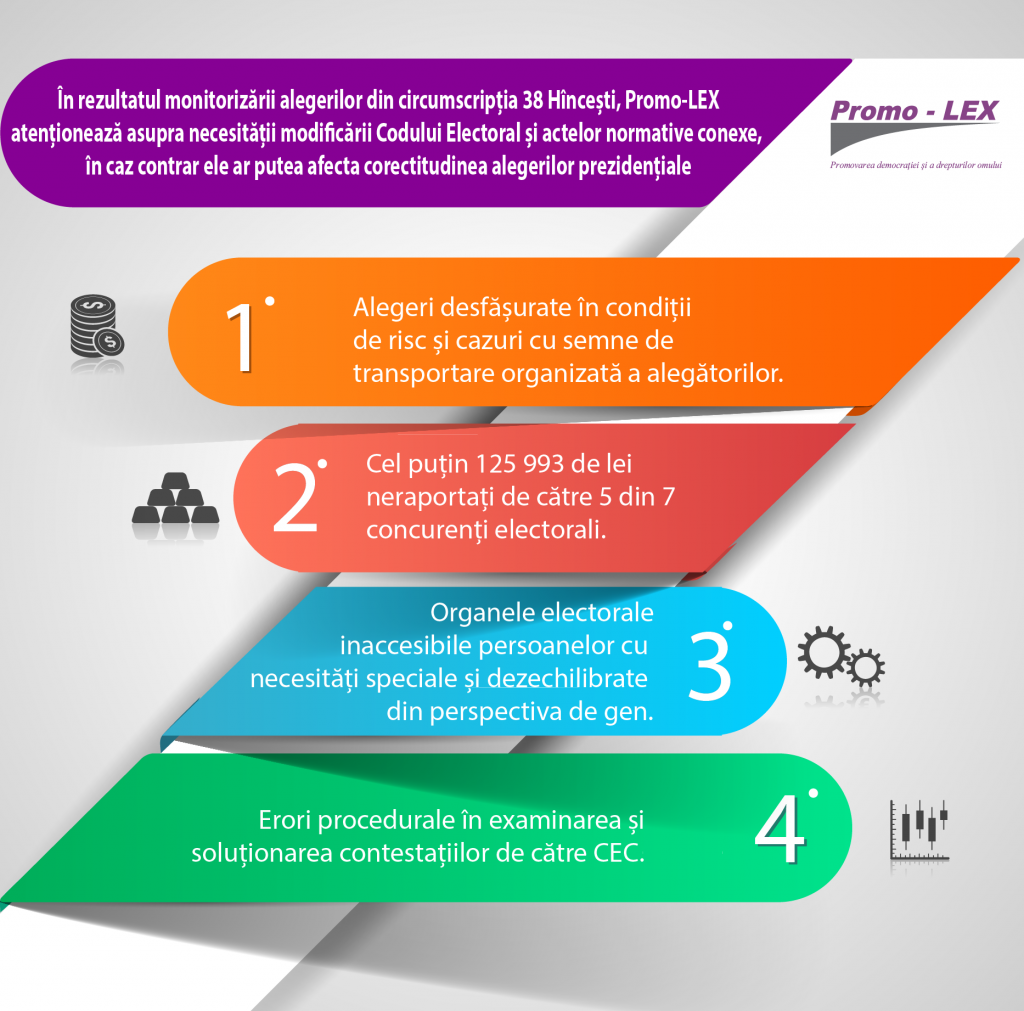
Following the monitoring of the elections in the single-member constituency no. 38 from Hincesti, Promo-LEX draws attention to the need to amend both the Electoral Code and related legal acts, otherwise the latter may affect the integrity of the presidential elections

The Final Report of the Observation Mission (OM) for the New Parliamentary Elections in the single-member constituency (SMC) no. 38 from Hincesti, published today on the official website of the Promo-LEX Association (www.promolex.md), contains the facts, conclusions and recommendations established by the Election Observation Mission.

Taking into account the approaching presidential elections, the OM draws the attention to the necessity of correcting the legislative gaps, the Electoral Code and related legal acts, among which are: clear regulation of cases that can be qualified as indirect campaign financing of some candidates by parties that are not registered as electoral competitors, but carry out pre-election campaigning, excluding the requirement that the subscription list should contain only signatures of supporters residing in a single settlement, etc.

Elections held under risky conditions and with signs of organized transportation of voters
The New Parliamentary Elections of 15 March 2020 in the SMC no. 38 from Hincesti were held in conditions of imminent epidemic threats that put both participants and voters at risk. According to the Promo-LEX OM, Parliament is the only authority that had the right to postpone the elections. In the current legislative environment, the postponement of elections could only be applied by declaring a state of emergency, which was in fact declared immediately after the elections.

On the Election Day, the Observation Mission reduced the number of observers involved by delegating only one mobile team, which operated in a limited observation mode, monitoring electoral processes at 11 polling stations. Also, on the Election Day, observers found three cases of organized transportation of voters.

At least 125,993 lei not reflected in reports of 5 out of 7 electoral competitors

During the monitored period, the electoral competitors carried out at least 176 promotional activities, the most frequent being the distribution ones and those related to the placement of electoral displays – 45%, followed by meetings with voters – 30%. Per competitors, most campaign activities were organized by the PPS – 34%, the PSRM – 29% and the PAS – 20%.

According to the reports submitted by all the electoral competitors with the CEC, the main share of the declared expenses falls on: advertising and promotional materials – 78%, meetings and events – 15%, salaries for the electoral staff – 3%; use of transport – 3%; others – 1%.

The Promo–LEX finds that five out of seven electoral competitors failed to report all the expenses incurred by them in the election campaign: the PSRM (91 015 lei), the IC Cobzac Grigore (16 978 lei), the PDM (10 409 lei), the UNIREA Bloc (6 122 lei),  the PPS (1 469 lei). The total amount estimated as unreported is at least 125 993 lei.

Gender-biased and inaccessible to people with special needs electoral bodies

According to Promo-LEX observers, the gender composition of the PEB was an imbalanced one. Hence 85 % of them were women, the proportion being also maintained at the management level of the PEB.

Availability of lower level electoral bodies to people with locomotor disabilities and/or special needs is still far from being great: CECEU no. 38 is inaccessible, while PEBs’ premises are not available at a proportion of 75%.

Procedural errors in the consideration and resolution of complaints by the CEC

During the monitored period one complaint was submitted to the CECEU and one request and one complaint to the CEC. As regards the subject matter of the request, the CEC requested the court to cancel the registration of a candidate even though there was no express request on the part of the signatory. The CEC’s request was satisfied by the court.

The Mission states a more active role of CEC in handling complaints and requests, compared to the practice of previous elections. At the same time, we draw attention to the fact that the effective processing of complaints and requests must be in strict compliance with substantive and procedural rules. Also, the CEC’s attitude and approach should apply equally to all electoral competitors.

We note that the number of voters in the basic voters’ lists for the new parliamentary elections of 15 March 2020 in the SMC no. 38, decreased by 169 citizens with the right to vote, compared to the parliamentary elections of 24 February 2019.

The full report can be accessed here.

The Observation Mission for the New Parliamentary Elections of 15 March 2020 was carried out by the Promo-LEX Association with the financial support of the US Agency for International Development (USAID) through the „Democracy, Transparency and Responsibility” Program.

For more details, please contact:
Inga Stegarescu, Press Officer of the Promo-LEX Association
GSM: 069 26 96 84;
E-mail: [email protected]