PUBLIC STATEMENT Parliament’s refusal to appoint Viorica PUICA to the Supreme Court of Justice contravenes the law and undermines the efforts to build an independent and professional judiciary in the Republic of Moldova

18 March 2021

On 12 March 2021, nine months after the nomination by the Superior Council of Magistracy (SCM), the parliamentary majority rejected the appointment of Viorica PUICA as judge at the Supreme Court of Justice (SCJ). Ms. PUICA was rejected without a hearing before the MPs and without any concrete reason. This rejection contravenes the law and undermines the efforts to build an independent and professional justice in the Republic of Moldova. We call on the SCM to put forward Ms. Puica’s candidacy for judgeship at the SCJ in Parliament repeatedly.

On 9 June 2020, the SCM nominated Judge Viorica PUICA for promotion to the SCJ. Judge Puica won the contest for this position where she competed with other five candidates. The SCM’s decision to promote her was based on the results of the professional performance review, the review of her previous professional experience, and the candidates’ performance at the interview before the SCM. Ms. PUICA’s nomination was supported by the majority of the SCM members. None of the SCM members had a dissenting opinion against her nomination.

On 15 July 2020, the Parliamentary Committee for Legal Matters, Appointments, and Immunities (the Legal Committee) rejected the appointment of Judge PUICA to the SCJ with a majority of votes of the MPs from the Party of Socialists of the Republic of Moldova (PSRM). The report of the Legal Committee failed to provide any reasoning and only mentioned lack of the necessary number of votes from Committee members. The Committee members had not held a hearing of the judge despite it being a customary practice for the Legal Committee so far and had not discussed her professional qualifications. The discussion of Viorica PUICA’s nomination in a plenary session of Parliament was scheduled for 16 and 20 July 2020, but this subject was excluded from the agenda on both occasions. On 22 July 2020, 15 civil society organizations issued a public call requesting Parliament not to breach the law and to vote for the appointment of Ms. Puica as Supreme Court justice as soon as possible.

On 12 March 2021 (nine months after the approval of the report of the Legal Committee), the parliamentary majority PSRM-Pentru Moldova (the Șor Party) voted against the appointment of Ms. PUICA as Supreme Court judge. The examination of Viorica PUICA’s nomination at the 12 March 2021 plenary session of Parliament (timestamp: 8:43:24) was limited to the reading of the draft decision and report of the Legal Committee. Once again, Parliament did not invite the judge for a hearing.

Parliament’s agenda for 12 March 2021 included the appointment of Tamara CHIȘCA-DONEVA (Civil Chamber) and Nadejda TOMA (Criminal Chamber) as vice chief justices of the SCJ and Ghenadie PLĂMĂDEALĂ, Nicolae ȘOVA, Anatolie MINCIUNĂ, Oxana ROBU, and Viorica PUICA as Supreme Court judges. Previously, they all had had hearings before the Legal Committee, except Ms. Puica. The parliamentary majority voted to appoint Tamara CHIȘCA-DONEVA. This appointment raised multiple questions among parliamentary opposition as she had participated in the judicial panel that had tried the Gemenii Case, which had resulted in the Republic of Moldova having to pay over EUR 3,600,000 in damages. Parliament also voted to appoint Nadejda TOMA. The parliamentary majority rejected the appointment of Nicolae ȘOVA and Anatolie MINCIUNĂ, citing the Legal Committee’s negative reports on them. Without citing any reasons, MPs did not discuss the appointment of Oxana ROBU and Ghenadie PLĂMĂDEALĂ as Supreme Court judges, although according to the Plenum agenda, this subject was to be discussed before the one about the appointment of Ms. PUICA. The selective approach to voting on the nominees for appointment to the SCJ raises big questions, all the more so that the SCJ has been unable to convene the plenum for more than one year due to lack of quorum. Currently, the SCJ has only 22 siting judges out of 33 judge positions required by the law.

According to Article 9 of the Law on the SCJ, Parliament may refuse to appoint Supreme Court judges only if it identifies irrefutable evidence of candidates’ incompatibility or the violation of the law or violations in the statutory procedures for their appointment and promotion. The Legal Committee’s report on Ms. PUICA did not cite any of these reasons. During the plenary session, MPs who voted for the rejection of Ms. PUICA’s candidacy did not offer any explanation to support their refusal. And yet such explanations were provided for other candidates.

Judge Viorica PUICA enjoys an impeccable reputation in the judiciary and is known as a person of undeniable integrity and thorough professionalism. In 2007, the SCM designated Ms. Puica as the best judge of Moldova. In 2018, at the latest ordinary professional performance review, the judge’s performance was appraised as “excellent.” The nomination of Judge Viorica PUICA for the SCJ was backed by the Association of Judges of Moldova, the Association of Judges Vocea Justiției, and the judges of the Chișinău District Court (Centru Office).

The rejection of this candidate sends out an alarming signal to honest judges from the Republic of Moldova and further undermines confidence in a genuine political will for reforming the judiciary. Moreover, the unjustified refusal to promote a judge constitutes a breach in the judicial independence. This process, once again, confirms the need for amending the Constitution of the Republic of Moldova to revoke Parliament’s powers to appoint Supreme Court judges. The Venice Commission welcomed this initiative, but unfortunately, Parliament failed to pass this amendment twice.

The signatories condemn Parliament’s refusal to promote Judge Viorica PUICA to the SCJ. Parliament’s refusal contravenes the law, discourages honest judges, and strikes at the very heart of the efforts to build an independent and professional judiciary in the Republic of Moldova, constituting gross interference in the independence of the judiciary.

The signatories call on the SCM to nominate Ms. PUICA repeatedly as judge at the SCJ. We also call on the Parliament to amend the Constitution, by excluding at the earliest opportunity the Parliament from the process of appointing judges, to increase judges’ independence.

Signatory organizations:

  1. Promo-LEX Association
  2. Legal Resources Centre from Moldova (LRCM)
  3. Institute for Public Policies (IPP)
  4. MD Community
  5. IDIS Viitorul
  6. Acces-Info Center
  7. RCTV Memoria
  8. Institute for European Policies and Reforms (IPRE)
  9. Foreign Policy Association (APE)
  10. AGER – Association for Efficient and Responsible Governance
  11. Amnesty International Moldova (AIM)
  12. Soros Foundation Moldova
  13. CPR Moldova
  14. Association for Participatory Democracy (ADEPT)
  15. The Centre for Analysis and Prevention of Corruption (CAPC)


Public Statement in English is available here

Declarația publică în limba română este disponibilă aici


Ассоциация Promo-LEX предлагает решения по запрету методов неправомерного влияния на результаты выборов

The policy document „ Use of administrative resources in electoral campaigns in the Republic of Moldova: lack of an explicit regulation and structure of the phenomenon” can be accessed here.

The policy document „Lack of a clear mechanism for de-registration of electoral contenders in presidential elections pursuant to Article 75(5) of the Electoral Code” can be accessed here.


Promo-LEX Continues the Management Reform Process

Dear friends,

Promo-LEX Association continues the management and administrative reform. This time, we would like to announce some changes in the management team of the Monitoring Democratic Processes Program. The success of Promo-LEX hinges on its human resources, including on the recognition of the team’s merits and capacities. We believe that changes in the management team must be implemented periodically, so as to ensure the continuous development of the Program.

Since 2009, Pavel Postica has successfully led the Monitoring Democratic Processes Program team and thanks to his managerial and analytical skills, he managed to create and guide a team of experts that monitored 20 national Moldovan elections so far.

Starting with 1 April 2021, the leadership of Monitoring Democratic Activities Program will be taken over by Nicolae Panfil, who has successfully coordinated and supervised the Program activities for 8 years. Gaining the appreciation of our colleagues and partners through his efforts and perseverance, Nicolae Panfil will continue to present a clear view of the further development of the program and the team.  Pavel Postica will remain part of the Promo-LEX team and will further contribute to delivering quality products and services within the organisation.

The entire Promo-LEX team wishes both colleagues health and new achievements.


The Promo-LEX Association presents solutions and recommendations on current issues in the electoral field

The policy document „ Signature collection in the context of the pandemic in support of candidates in elections or for initiating referenda: solutions and alternative mechanisms” can be accessed here.

The policy document „Establishment of Polling Stations for the Voters From the Left Bank of Nistru River” can be accessed here.


Belarus: Unprecedented crackdown on human rights defenders, civil society activists and independent journalists must be stopped

Statement by the Civic Solidarity Platform

17 February 2021

Following a renewed wave of persecution of the Belarusian human rights defenders, civil society activists and independent journalists, members of the Civic Solidarity Platform (CSP) strongly condemn actions of the Belarusian authorities and urge them to stop the harassment and show genuine respect towards the rights of those who seek to protect the rights of their fellow citizens and not to criminalize their legitimate human rights work.

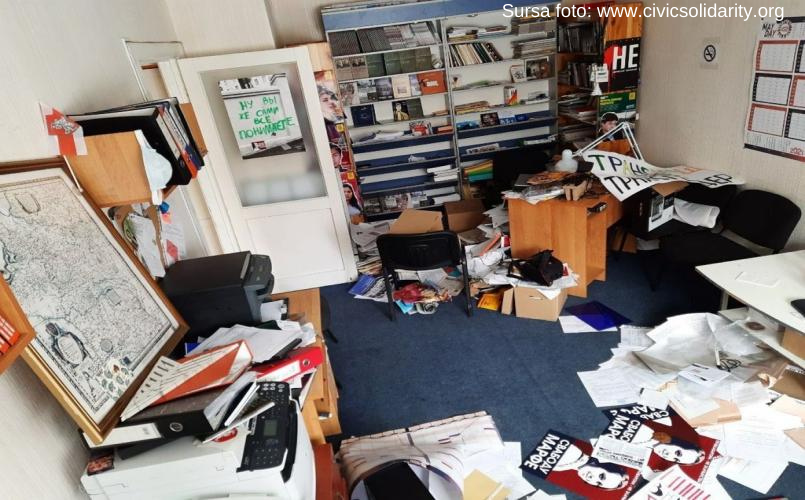
On 16 February 2021, over 40 human rights activists and journalists have seen their offices and houses being searched as a part of a concerted crackdown against the civil society of Belarus. The police raided the central office of the Belarusian Association of Journalists and the two Minsk offices of the Human Rights Center Viasna, as well as Viasna’s office in Mahilioŭ. The central office of the independent Belarusian Radio and Electronic Industry Workers’ Union REP was also searched.

The raid affected the private apartments of numerous human rights defenders, including BAJ leaders Andrei Bastunets, Barys Haretski and Aleh Aheyeu, as well as the organisation’s legal adviser Kristina Richter, Viasna Chairperson Ales Bialiatsky, and Viasna members Andrei Paluda, Pavel Sapelka and Dzmitry Salauyou and several Viasna activists in other cities. Several dozen human rights defenders and journalists and their relatives were targeted in Mahilioŭ, Brest, Viciebsk, Homieĺ, Mazyr, Rečyca, Baranavičy and other cities. The apartment of the coordinator of the BySol initiative Andrej Stryzhak and the apartment of his parents were also searched. Although most of the activists were released without charges, equipment, cash, bank cards and personal belongings of human rights defenders and journalists have been confiscated by the authorities. A few activists remain in detention.

According to the official statement of the Investigative Committee of the Republic of Belarus, the searches are supposedly linked to a criminal case opened under Article 342 of the Criminal Code of the Republic of Belarus (“organisation and preparation of actions that grossly violate the public order, or active participation in them”) and the likely charges will include “funding of the protests”. The current wave of detentions and raids of offices and apartments was preceded by recent arrests of media manager Andrei Aliaksandrau, member of Viasna human rights defender Leanid Sudalenka and their colleagues, toughening of criminal charges against the coordinator of Viasna’s volunteer programme Marfa Rabkova, and a smear campaign in the state-controlled media, picturing human rights NGOs as “terrorists”. All these actions by the authorities are clearly aimed at punishing human rights defenders and independent journalists for their peaceful and legitimate work, intimidating them, and paralysing their activities. The magnitude of the attack on civil society and independent media in Belarus is unprecedented throughout all of the OSCE region.

CSP members express their solidarity with all the colleagues in Belarus, including member organisations of the CSP – Human Rights Centre “Viasna” and the Belarusian Association of Journalists – and demand that the authorities of Belarus reverse this negative trend and bring their policies and practices in compliance with their OSCE commitments and their obligations as a party to the International Covenant on Civil and Political Rights. The authorities must immediately cease the attack against Belarusian human rights defenders, journalists, civic activists and their organisations. The charges against them must be dropped, detained activists must be released, and confiscated equipment must be returned to the respective owners. Belarusian authorities must guarantee the rights of human rights defenders, civic activists and journalists and not criminalize their legitimate work.

CSP members call on international organisations and institutions, including the OSCE, the EU, the UN and its member and participating States to immediately and publicly condemn the unprecedented persecution of Belarusian human rights defenders, civic activists and journalists, as well as to take relevant and effective steps that underline the unacceptability of the Belarusian government’s repressive policies. The international community has earlier recognised the important work of “Viasna” and the Belarusian Association of Journalists with prestigious awards. Now it is the time to protect them and other Belarusian human rights defenders and journalists from brutal repression by the government. The massive scale of persecution requires a swift, coordinated, and multilateral response.


List of organisations supporting the statement:

  1. Helsinki Citizens’ Assembly Vanadzor, Armenia
  2. Human Rights Monitoring Institute, Lithuania
  3. Center for Participation and Development, Georgia
  4. ARTICLE 19, United Kingdom
  5. International Partnership for Human Rights (IPHR), Belgium
  6. Legal Policy Research Centre, Kazakhstan
  7. DRA Berlin, Germany
  8. Bulgarian Helsinki Committee, Bulgaria
  9. The Barys Zvozskau Belarusian Human Rights House, Belarus/Lithuania
  10. KRF Public Alternative, Ukraine
  11. The International Rehabilitation Council for Torture Victims (IRCTO), International NGO
  12. The Swedish OSCE-network, Sweden
  13. Public Association “Dignity”, Kazakhstan
  14. Human Rights Group “Citizen.Army.Law”, Russia
  15. Human Rights House Zagreb, Croatia
  16. Swiss Helsinki Committee, Switzerland
  17. Public Verdict Foundation, Russia
  18. Centre for the Development of Democracy and Human Rights, Russia
  19. Norwegian Helsinki Committee, Norway
  20. Social Action Centre NGO, Ukraine
  21. Netherlands Helsinki Committee, Netherlands
  22. Truth Hounds, Ukraine
  23. Macedonian Helsinki Committee, Republic of North Macedonia
  24. Association UMDPL, Ukraine
  25. The Human Rights Center (HRC), Georgia
  26. The Georgian Centre for Psychosocial and Medical Rehabilitation of Torture Victims – GCRT, Georgia
  27. Human Rights in Mental Health – Federation Global Initiative on Psychiatry, Netherlands
  28. The Hungarian Helsinki Committee, Hungary
  29. Helsinki Foundation for Human Rights, Poland
  30. Human Rights Center ZMINA, Ukraine
  31. World Organisation against Torture (OMCT), Belgium/Switzerland
  32. Committee against Torture, Russia
  33. Human Rights House Foundation, international NGO (head office in Norway)
  34. People in Need, Czech Republic
  35. Human Rights Club, Azerbaijan
  36. Freedom Files, Poland
  37. Women of the Don, Russia
  38. Freedom Now, USA
  39. Women’s International League for Peace and Freedom (WILPF), Germany
  40. Index on Censorship, United Kingdom
  41. Center for Civil Liberties, Ukraine
  42. Crude Accountability, USA
  43. Moscow Helsinki Group, Russia
  44. Libereco Partnership for Human Rights, Germany/Switzerland
  45. Kazakhstan International Bureau for Human Rights and the Rule of Law, Kazakhstan
  46. Promo LEX, Moldova
  47. Bir Duino Kyrgyzstan, Kyrgyzstan


UN Human Rights Council should strongly denounce widespread and on-going actions by Russia to attack independent civil society, severely limit civic space, and silence dissenting voices

We, the undersigned human rights organisations, call on the United Nations Human Rights Council to respond robustly to the recent crackdown by the Russian authorities on independent civil society and dissenting voices in the country. Russian authorities are systematically using the tools of the state to arbitrarily deprive citizens of liberty and curtail the exercise of the freedoms of expression, peaceful assembly, and association. The alarming trends the international community has observed in Russia for more than a decade have been drastically increasing since the end of 2020 and require urgent international action.

At the beginning of 2021, Russia took a seat on the UN Human Rights Council. As a member of the international body charged with the promotion and protection of human rights around the globe, Russia’s active efforts to attack human rights domestically is particularly cynical. Members of the Council must use the 46th Session – Russia’s first session under its current membership – to strongly denounce these actions to use the tools of the state to attack independent civil society, severely limit civic space and silence dissenting voices.

Most recently, hundreds of thousands of Russian citizens have taken to the streets in protest of attacks on human rights and dissenting opinion, according to independent monitors. Protests erupted on 23 January following the arrest and detention of opposition leader Alexey Navalny. Information collected by the monitoring organisation OVD-Info reported more than 4,000 protesters arrested on that day alone. International and local media showed footage of riot police brutally attacking peaceful protesters, including the elderly, women, and children. A week later, on 31 January, people in Russia repeated their calls for human rights and political plurality with hundreds of thousands participating in actions across the vast country. Once again, the authorities responded with violence and arrested more than 7,500 according to OVD-Info. Finally, following the sentencing of Navalny on 2 February, Russians once again took to the streets in protest and faced excessive violence from riot police who detained a further 1,400 people. This brings the total number of arrests since late January to more than 12,000.

While international attention has been understandably focused on the arrest of opposition figure Alexey Navalny on 17 January 2021, this action must be considered in light of recent legislation which, according to local Russian human rights organisations, will lead to “a significant increase in total government control over Russian society and a growth in persecution of dissent”[1]. It is imperative that the Council take immediate action at the 46th Council session to condemn these actions and call on the Russian state to adhere to its international human rights obligations.

In 2012, Russia approved a novel “Foreign Agents” Law. This law required any organisation receiving minimal amounts of funding from private or public foreign entities and engaging in “political activities” to register as a “foreign agent”. For registering organisations, the law established reporting requirements as well as the requirement to identify as foreign agents on any publications. The law defined political activity unusually broadly and vaguely which allowed authorities to label any human rights or advocacy activities as political. The following year, Russia’s then-ombudsman challenged the law in Russian Constitutional Court but the case was dismissed. Two years later, the Russian parliament amended the law to allow the Justice Ministry to register organisations as foreign agents without their consent. In late 2019, legislation on mass media was amended to target media, individual journalists and bloggers as foreign agents.

At the end of 2020, the Russian government introduced and passed four pieces of legislation capping their decade-long attack on civic space, independent civil society, and dissenting opinion. Among other things, these pieces of legislation:

  • Further expand the list of actors who can be designated “foreign agents” to include unregistered NGOs and individuals regardless of nationality and require founders, members, participants, and employees of such organisations to mark accordingly their affiliation on any materials they publish and any official communications with the authorities; and, requires the media to identify them as foreign agents in any information published about, or citing, so-called foreign agents (Federal Law No. 481-FZ)
  • Restrict ability to organize rallies, demonstrations, marches, and pickets, including new measures restricting how such activities are financed and links those restrictions to foreign agents designations (Federal Law No. 541-FZ)
  • Introduce a five year jail sentence for libel (libel was criminalized in 2012) (Federal Law No. 538-FC)
  • Criminalize acts of individuals who can be designated as individual foreign agents according to recent legislative amendments and introduce a five year jail sentence (Federal Law No. 525-FZ)

Unfortunately, Russian authorities’ work to systematically pre-emptively limit the ability of the Russian people to exercise their human rights has not stopped. Currently, the State Duma is considering a number of bills to continue these dangerous and alarming trends. Once approved, these pieces of legislation will:

  • Require so-called foreign agent NGOs to pre-notify the Ministry of Justice about planned activities and gives the Ministry of Justice the authority to ban any activities preemptively but does not specify the grounds by which the Ministry of Justice may take such action. In the case of non-compliance, the Ministry of Justice will have the authority to ask a court to liquidate the non-compliant organisation (https://sozd.duma.gov.ru/bill/1052523-7).
  • Expand government ability to regulate public awareness raising activities and sharply restricts the freedom of expression (https://sozd.duma.gov.ru/bill/1057895-7).
  • Introduce penalties for non-compliance with these other pieces of legislation and imposes these penalties on organisations and their officers, and individuals.

We urge the members of the Human Rights Council to take immediate action to protect and promote human rights and strongly condemn the actions of the Russian authorities. Attacks by Council member states on independent civil society, civic space, and dissenting voices must not go unaddressed. The Council must act.


[1]https://www.mhg.ru/sites/default/files/inline/files/urgent_appeal_to_the_coe_on_new_repressive_laws_in_russia_24_january_2021.pdf


Final Report on the 2020 Presidential Elections: electoral incidents found by observers Promo-LEX should guide authorities towards a better electoral process

Election contenders avoiding reporting all campaign expenditures, record number of hate speeches and incitement to discrimination, use of administrative resources, bribing voters, high rate of complaints not accepted by CEC and courts… These are only several conclusions presented by Promo-LEX Association at the post-election Conference ‘Promo-LEX Mission’s Conclusions and Recommendations on 2020 Presidential Election”

At the same time, we appreciate the efforts made by CEC to conduct the election efficiently amidst the pandemic, as well as the appropriate cooperation with MFAEI on the establishment of PSs abroad in line with the legally established criteria.

However, we regret the instances when observers’ access to the main lists of voters was restricted. In addition, the observation process during the election day was affected by isolated cases of observer intimidation by the Police and electoral officials.

Legal drawbacks identified during the Presidential election

Promo-LEX Observation Mission regrets the faulty public consultation process, which resulted in a lost opportunity to make amendments at the beginning of the electoral period that would respond, even if partially, to Constitutional Court’s addresses issued as early as in 2016.

Besides the repetitive legal issues, Promo-LEX underscores certain new legal drawbacks identified during these elections: contradictory provisions in the Electoral Code and the Administrative Code on reviewing and settling electoral complaints; neglecting the need to adjust the Electoral Code provisions to the pandemic conditions; faulty definition of the notion of election contender in presidential elections.

More active contenders and hundreds of electoral incidents

The number of campaign activities did not diminish during the pandemic, with election contenders displaying a high activism, particularly online. At the same, some activities of electoral nature were conducted before the legal time period started.

According to Promo-LEX OM, the election campaigns are still affected by the use of administrative resources, with 114 cases reported. Most cases refer to the involvement of public sector employees in the election campaign during their working hours (54%) and election contenders taking credit for works/services performed at the expense of public funds (29%). Observers also identified at least 9 cases that can be regarded as electoral gifts.

Other identified violations include: use of images of religious cults in the election campaign (14 cases); promotion using the image of foreign officials and state symbols (17 cases); non-compliance with public health rules established by the extraordinary public health commissions (65 cases); use of electoral advertising in violation of legal provisions (57 cases); intimidation and use of violence in the electioneering process (12 cases).

Low transparency of expenditures made and reported during the election campaign

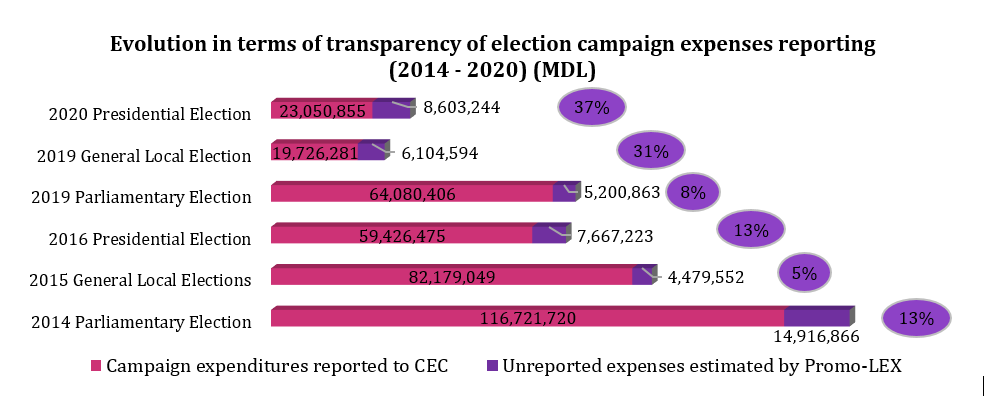
Promo-LEX OM finds that the current elections were characterized by a lower transparency of expenditures made and reported during the election campaign compared to the previous elections. Thus, for the 2020 Presidential Election, an estimated 39% of total expenditures reported to CEC failed to be reported, with a share of 13% the 2016 Presidential Election.

As estimated by Promo-LEX, the eight election contenders did not report to CEC at least MDL 9,099,163 for the activities conducted, which is by MDL 3 million than in the 2019 election.  According to the estimations, Igor Dodon (IC) allegedly did not report at least MDL 5,057,965 (56%), Violeta Ivanov (PPS) – MDL 2,063,354 (23%), Maia Sandu (PAS) – MDL 1,163,142 (13%), Andrei Nastase (PPPDA) – MDL 394,805 (4%), Tudor Deliu (PLDM) – MDL 156,387 (2%), Renato Usatii (PN) – MDL 117,806 (1%), Octavian Ticu (PUN) – MDL 113,449 (1%) and Dorin Chirtoaca (BE Unirea) – MDL 32,256.

Promo-LEX warns about the total failure to report any expenditures for delegation of electioneerers, stressing that no election contender had submitted declarations of volunteering to the control body, as they had declared plenty of times to journalists.

Election day affected by organised transportation of voters, flaws in lists of voters and cases of cash rewards offered to voters.

The 2020 Presidential Election was characterised by a high civic activism of voters, who showed up to vote even amidst the pandemic in greater numbers than for the 2016 election. The people who voted in the polling stations abroad stood out in particular. Unfortunately, not all of them had the opportunity to exercise their right to vote due to the huge queues at the polling stations and the insufficient number of ballot papers in some polling stations. In this context, Promo-LEX Association urges repeatedly authorities and politicians to consider introducing alternative voting measures and/or extending the voting period.

During the two rounds, Promo-LEX observers reported 980 incidents (499 in the first round, 481 in the second) – a slight decrease compared to the 2016 Presidential Election (1053) and 2019 Parliamentary Election (1118 incidents). We must, however, underline that the number of observers at the latter two elections was higher than during the 2020 election.

We also draw the attention to cases/rumours of awards given to voters (36) and instances of organised voter transportation (87), flagged in particular at the PSs set up for voters from the transnistrian region.

In terms of quantity, the most frequently reported incidents involve taking a picture of the ballot papers and other violations of secrecy of vote (167), non-compliance with COVID-19 protection measures (110) and deficiencies in the operation of ‘Elections’ SAIS (96).

Limited accessibility of lower level electoral bodies

Promo-LEX appreciates the efforts made by CEC to conduct efficiently the election amidst the pandemic. At the same time, compliance with the work schedule was poorer in the case of PEBs, so that 27% of the PEBs visited by Promo-LEX observers were closed during office hours. As well, not all lower-level electoral bodies complied with the pandemic-related requirements.

Accessibility for people with reduced mobility remains a problem for DEC (56%) and PEB (73%) offices.

High rate of complaints not accepted by CEC and courts

Complaints review remains a problem for the electoral process in the Republic of Moldova. Promo-LEX OM, thus, draws the attention on the high rate of inadmissibility of complaints (75%), which seriously affects the society’s trust in these procedures, the equal opportunities for contenders and the right to effective remedy.

The complaints mainly relate to: illegal electioneering, election campaign financing and the use of administrative resources.

Election affected by discriminatory messages and other forms of intolerance

This election stood out due to the record number of cases (420) of hate speech and incitement to discrimination. As for ways of manifesting hate, sexist prejudices, gender stereotypes in the society and prejudices against persons with disabilities have the highest incidence.

Also, during the election campaign, the hate speech and incitement to discrimination took the form of irony, threats, incitement to violence, etc. and fueled different social fears that promoted intolerance in the public space.

The Observation Mission for the Elections of the President of the Republic of Moldova on 1(15) November 2020 is conducted by Promo-LEX Association with the financial support of the United States Agency for International Development (USAID) via the ‘Democracy, Transparency and Accountability’ Program, the Good Governance Department of Soros Foundation-Moldova under ‘Monitoring the Presidential Elections of 1 November 2020’ Project, and the Council of Europe under ‘Support for civic observation of 2020 Presidential Election in polling stations abroad’. ‘Hate speech’ component is supported by Justice and Human Rights Department of Soros Foundation-Moldova under ‘Consolidation of a platform for the development of activism and education in the area of human rights in Moldova – stage IV’ Project.  

Find the full report here.

If there are any discrepancies between the text in Romanian and its translation, the provisions formulated in Romanian shall prevail. 

For more information, please contact:
Inga Stegarescu, Press Officer of Promo-LEX Association
GSM: 069 26 96 84;
E-mail: [email protected].


Promo-LEX Association has a number of announcements to make, which are equally important for the organisation and the human rights community

Dear Friends,

As February begins, Promo-LEX Association has a number of announcements to make, which are equally important for the organisation and the human rights community.

Promo-LEX Association undergoes the first implementation stage of an extensive managerial and administrative reform, as a result of which certain changes were already made and others will gradually be put in practice.

During its first 18 years of work, Promo-LEX Association made history by protecting and fighting for human rights in the Republic of Moldova, including the transnistrian region, which was an ‘epoch’ of multiple achievements and remarkable success.

Alexandru Postica, attorney at law, first Director of the Human Rights Program, had a special role in and contributed significantly to the development of Promo-LEX Association. As of 1 February 2021 he does not hold this position any more.  Nonetheless Alexandru Postica will stay with and be part of the Promo-LEX team as a manager responsible for research and litigation. Moreover, he will be the first advisor of the Executive Director, with the right to represent the Program and the Association at national and international level.

Thus as of 1 February 2021 the Human Rights Program Director position will be held by Vadim Vieru, attorney at law, who successfully joined the Promo-LEX team in 2010, being still a student at that time. Vadim Vieru is a dedicated and dynamic person, whose professional development has been ascending, who has proven competence at work and obtained recognition and appreciation among colleagues and partners.

We are confident that during his first term in the capacity of Human Rights Program Director, Vadim Vieru, attorney at law, will strengthen, represent and lead professionally the team, which will keep achieving remarkable results.

The entire Promo-LEX team wishes both its colleagues the best of luck, health and strength.


Statement | Position of the Civic Coalition for Free and Fair Elections on the presidential elections 2020

The Civic Coalition for Free and Fair Elections considers the presidential elections of 1 and 15 November 2020 to be partially correct and partially free. The assessment is based on respect of the principles for free and fair elections set out in international treaties and conventions on civil and political rights and in the Code of Good Practice in Electoral Matters of the Venice Commission, on the Coalition’s findings before the elections on 1 November 2020, as well as on the observation of the two-week election campaign for the second round and the observation of the two election days:

Impossibility of several voters to exercise their right to vote

In both rounds, several voters were unable to exercise their voting right at some polling stations opened abroad. On November 1, this was due to limited capacity of the polling stations to serve a large number of voters, despite the extension of the voting program. After the first round of elections, the Central Electoral Commission (CEC) and the Ministry of Foreign Affairs and European Integration worked to remove the organizational shortcomings of the first round by identifying more spacious locations for some polling stations, increasing the number of technical staff and equipment. However, even in the second round of voting, many citizens were unable to vote after some polling stations ran out the ballot papers before voting end time.

Election campaign marked by negative speech, fakes and hate speech

Numerous cases of hate speech, incitement to discrimination and sexist messages by candidates, politicians, opinion leaders, journalists and citizens were observed during the campaign. The negative speech gained momentum after the first round, primarily against the candidate Maia Sandu, being accompanied by dissemination of false and defamatory messages and materials.

High number of electoral incidents on election day

On E-day, Promo-LEX observers reported a high number of cases regarding the violation of voting secrecy, non-compliance with the sanitary-epidemiological requirements, but also the organized transportation of voters. Most cases of organized transportation took place in polling stations set up for voters residing in Transnistrian region. In addition, observers also reported credible cases in which Transnistrian voters acknowledged that they had been rewarded for exercising their voting right.

Cases of obstructing observation and intimidation of observers

The Promo-LEX election observation mission reported attempts to intimidate its observers immediately after the first round, when they were called, apparently by the police, and asked to provide detailed information on some reported incidents. The observation mission describes these situations as selective justice and organized attempts to intimidate national observers before runoff election. Isolated incidents of intimidation of observers by police and election officials also took place in the second round of voting. In both rounds, cases of obstructing the observation activity were reported.

The misuse of administrative resources in election campaign

Promo-LEX observers have identified many cases of misuse of administrative resources. Most of them concerned the assumption of merits for the work done on public money and the involvement of civil servants in electioneering during business hours or on vacation leaves requested during election campaign. In most cases, administrative resources were used to support independent candidate Igor Dodon. There were many documented cases when representatives of PSRM, the party that did not nominate its candidate for the presidential election, participated in Igor Dodon’s electoral campaign.

Unresolved election litigations and complaints

Most election litigations, some of them being obvious violation of electoral law, remained unresolved, and complaints filed with courts were not examined on the merits, being delayed or declared inadmissible. Parliament’s failure to bring the provisions of the Election Code concerning the filing, examination, and resolving of election complaints in line with the provisions of the Administrative Code resulted in the limitation of election candidates’ right to challenge the actions of their competitors and practically deprived of the right to an effective remedy.

Election campaign financing remains less transparent

No initiative group or electoral candidate reported expenses for the work of signature collectors, agitators, and volunteers, but neither declared these services as material donations. According to Promo-LEX estimates, all non-registered and registered candidates have not reported over 6 mln. Lei (300 000 Euro) election campaign expenses.

Unbalanced media coverage of election campaign, without informing the public of voting procedures

With a few exceptions, TV and online media have acted partisan in the election campaign, presented candidates in an unbalanced way, also promoting a strong gender imbalance, and failed to provide the public with complete information about the electoral process and voting procedures. Only two TV stations out of the ten that CALC monitored presented all presidential candidates in a relatively balanced and neutral way. Three TV stations were very partisan in favour of one candidate and the rest had a slightly disbalanced editorial policy, favouring some election candidates. The Audiovisual Council, the broadcasting regulatory authority, failed to act adequately and promptly to ensure fair and equidistant coverage of candidates by all broadcasters. In contract with the first round, when the CA verbally warned the broadcasters that violated the law, in the second round it imposed fines on most of monitored TV stations, regardless of the violations’ seriousness. Although the public television station Moldova 1 had covered in a balance way the election campaign, it changed the rules of the debates before the second round, in favor of the candidate Igor Dodon.

Most of 12 online news websites monitored by CALC openly expressed their election preferences through biased editorial behaviour and unbalanced presentation of electoral contestants. Throughout the election campaign, but especially before the second round, several PSRM affiliated web portals carried out a concerted campaign to discredit, label and place in a negative context the PAS candidate Maia Sandu, distributing false and denigrating news, biased opinions with verbal assaults, insinuations, sexist titles and wording, hate speech and discrimination. At the same time, the independent candidate, supported by PSRM, Igor Dodon, was massively promoted and placed mainly in a positive context. Most online media sources have neglected the rules of journalistic deontology, publishing insufficiently documented material, without a clear distinction between facts and opinions and without offering the right of reply.

Smear campaign against non-governmental organisations

The election campaign was marred by an unprecedented attack on non-governmental organizations, sought to discredit, using fakes and defamatory accusations against the whole civil society, of which the main target was organizations involved in monitoring the electoral process, the defence of human rights, justice reform, the fight against corruption, freedom of the press, the social and medical field, etc. The denigration campaign launched by a deputy of the Party of Socialists of the Republic of Moldova and taken over by the PSRM affiliated media, continued throughout the election campaign.

Discrimination against people with disabilities

People with disabilities have faced barriers to physical and information accessibility. Over 70% of polling stations are not accessible for people with locomotor disabilities, and only fewer than 1% are accessible. Most election candidates failed to develop and distribute materials in formats that were accessible for people with disabilities, except one candidate who published her platform in Braille. The people with mental and psycho-social disabilities from residential institutions, which imposed a quarantine on their residents due to the epidemiological situation and restricted their contact even with family members, had no access to any election-related information.

The legal framework governing elections contains loopholes and problematic provisions

The electoral legal framework applied in these elections has not been improved in line with the referrals of the Constitutional Court issued in 2016 and those provided by national election observation missions, the OSCE/ODIHR, and the Venice Commission. Many problematic provisions concerning the sanctioning of the organized transportation of voters, hate speech, incitement to discrimination, the involvement of religious groups in election campaign, and the application of mechanism for solving complaints and litigations concerning the administration of elections remained unresolved. This led to the maintenance of these types of electoral incidents, and in some cases to an increase of their number at the 2020 presidential elections.

The election campaign was carried out ignoring the COVID-19 prevention measures

The CEC has taken constant steps to ensure the safe conduct of election campaign and the voting process, by purchasing safety masks, gloves, and disinfectants for election officials. However, many election management bodies ignored the requirements concerning protection measures in a pandemic context, as did many election candidates and their election staffs during campaign activities. By disconsidering anti-COVID-19 measures imposed by the National Extraordinary Commission for Public Health against COVID-19, election candidates showed lack of consciousness and disrespect toward voters, promoted defiant behaviours toward the measures taken by authorities to prevent the COVID-19 infection, and created additional risks of spreading the infection among the population.

Differentiated participation of young people in voting

Young people living abroad registered an absolute record of turnout at the polls, compared to the low turnout of young people in the country. This is due to the unfavourable legal framework for exercising their voting right within the country, namely voting requirements at the place of residence, but also to the superficial approach by candidates of the needs of young people, who are often involved in campaigns as volunteers, including young people under 18.


_______________________________________________________________________________________________________________________________________________

www.alegeliber.mdThe Civic Coalition for Free and Fair Elections is a permanent voluntary entity formed of 34 nongovernmental organizations from the Republic of Moldova to contribute to the development of democracy in the Republic of Moldova by promoting and holding free and fair elections in accordance with the standards of ODIHR (OSCE), the Council of Europe, and its specialized affiliated institutions.


Promo-LEX Observation Mission presents the findings for the second round of election and the preliminary results on the basis of data collected in 608 polling stations from the sample

Promo-LEX Observation Mission presents the number of incidents on the second-round election day, reported by static observers from the sample of 608 polling stations, and the number of incidents extrapolated nationally. The main findings with regards to opening and closing the polling stations (PSs), the voting process and incidents reported by observers on the election day are presented, as well as an analysis of the outcomes of vote tabulation done by Promo-LEX OM.

A number of 251 incidents were reported after processing all of the reports received from short-term observers (STOs), appointed in the 608 polling stations from the sample.  On the other hand, the estimated number of incidents extrapolated nationally (on the basis of the sample of 608 PSs) is 734, by 489 incidents more compared to the estimates for the first round of election.

It is important to highlight the voters’ civic activism, who showed up to vote even amidst the pandemic in greater numbers than for the 2016 election.  Especially the people who voted in the polling stations abroad stood out. Unfortunately, the civil activism of Diaspora voters was tarnished by the insufficient number of ballot papers in some polling stations.  Though 5000 ballot papers were allocated to each polling station, at least 6 of them ran out of ballot papers before voting end time. In this context, Promo-LEX Association urges authorities and politicians to introduce alternative voting measures.

During the election day, the voting process was organised efficiently in the monitored polling stations. At the same time, Election SAIS was occasionally out of order. The electoral process in the transnistrian region was characterised especially by suspicious of vote buying and organised transportation of voters. The vote secrecy was impacted significantly by the high incidence of people taking pictures of their ballot papers. The observation was affected by isolated cases of Promo-LEX observers intimidation by the Police and electoral officials. Overall, votes were counted in a quick and calm manner.

For more details on the recorded incidents please see the attached PDF presentation.

The outcomes of quick vote counting for the position of President of the Republic of Moldova, carried out by Promo-LEX OM on the basis of protocols collected from PEBs, confirm the preliminary CEC results, within the error margin of +-1.8% of the sample.

The Observation Mission for the Elections of the President of the Republic of Moldova on 1 (15) November 2020 is conducted by Promo-LEX Association with the financial support of the United States Agency for International Development (USAID) via the ‘Democracy, Transparency and Accountability’ Program, the Good Governance Department of Soros Foundation-Moldova under ‘Monitoring the Presidential Elections of 1 November 2020’ Project, and the Council of Europe under ‘Support for civic observation of 2020 Presidential Election in polling stations abroad’. ‘Hate speech’ component is supported by Justice and Human Rights Department of Soros Foundation-Moldova under ‘Consolidation of a platform for the development of activism and education in the area of human rights in Moldova – stage IV’ Project.

The translation and dissemination of this report was financially supported by the European Platform for Democratic Elections (EPDE), which is financially supported by the European Union and funds by the Federal Foreign Office of Germany, including its ifa funding program zivik.

If there are any discrepancies between the text in Romanian and its translation, the provisions formulated in Romanian shall prevail. 

For more information, please contact:
Inga Stegarescu, Press Officer of Promo-LEX Association
GSM: 069 26 96 84;
E-mail: [email protected].