First preliminary report on voting process abroad / National Constitutional Referendum

_article_1283848986The “Promo-LEX” Association in partnership with “Moştenitorii” Association monitored the voting process in the constitutional referendum on September 5, 2010 at 40 polling stations located out of the Republic of Moldova*.

A number of shortcomings marked the voting process at the polling stations abroad monitored under this initiative:

A number of out-of-country polling stations were opened with delays and in breach of procedures. In the Italian town of Mestre, the polling station (PS) no.323 opened one hour and a quarter later than it should have, while the electoral bureau of that station had never assembled for a formal meeting until shortly before the start of the poll. The start of the vote was also delayed in Milan (PS no.356), Madrid (PS no.339), Santander (PS no.370), and Odessa (PS no.350).

In most of the monitored polling stations, there were members of the electoral bureaus who were not present at the opening hours. Such situations were registered at the polling stations in Greece, at some polling stations in Italy and Russia, and in Toulouse and Odessa.

Of particular concern was the presence of law-enforcement officers in the immediate vicinity of the polling places abroad. For example, when the polling place no.338 opened in Moscow, there were 15 uniformed policemen outside the station (when the Romanian version of this report was first issued in the course of election day, the group of policemen had dispersed, but one or two were periodically reappearing). Similarly, 6 police officers were observed near the polling station hosted by the Moldovan Embassy in Athens, Greece. A police patrol was stationed outside the polling place in Madrid, Spain. The polling station in Turin was opened close to a police station. In most of the cases, it was the election officials who requested the presence of the law-enforcement officers, citing the need to ensure order and voters’ safety, and in Madrid citing concerns of potential terrorist attacks.

In some cases, the members of the electoral bureaus had a very poor knowledge of the voting procedures. In Padua, Italy, two cases were registered where voting was allowed with an identity card (buletin de identitate). Most of the voters were entered on supplementary lists as the primary electoral rolls were imperfect. Some polling stations didn’t have primary voter rolls at all. This was observed in Heraklion, Greece, and at both polling stations in Mestre, Italy.

In Russia, the packs of ballots destined for the polling station in Domodedovo were sent to the station in Mojaisk and vice-versa. Another faux pas happened with the electoral supplies destined for the polling stations in Bucharest and Lisbon.

In Italy, most of the polling stations didn’t receive voting boxes, with two of them using cardboard boxes in stead. The same problem in Greece was solved in cooperation with the Greek public authorities, which offered polling booths and transparent boxes for the referendum.

* A number of 79 national observers monitored the voting process in the constitutional referendum at polling stations in Belgium (Brussels), the Czech Republic (Prague), Greece (Athens, Heraklion, Thessaloniki), France (Paris, Toulouse), Germany (Berlin, Munich, Hamburg), Spain (Madrid, Santander), Portugal (Lisbon, Faro, Portimao), Romania (Bucharest – 2, Galaţi, Timişoara, Cluj, Iaşi), the Russian Federation (Moscow, Domdedovo, Mojaisk, St. Petersburg), Ukraine (Odessa), Italy (Rome – 2, Mestre – 2, Milan – 2, Padua – 2, Bologna -2, Parma, Turin, Verona, Naples).

This project is funded by the “Democracy Support Programme”, a joint initiative between the European Union and the Council of Europe

Contact Person: Olga Gordila, Tel +3737 22 449626
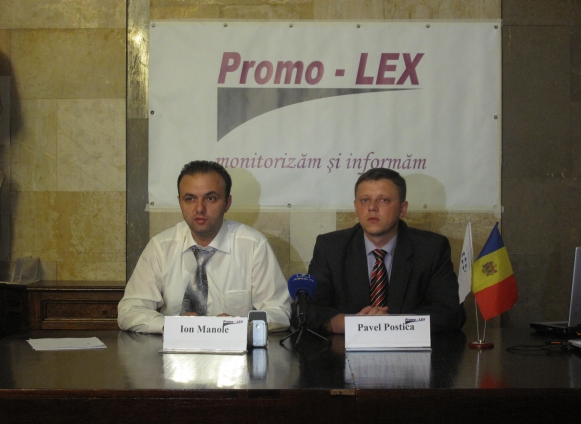


Promo-LEX launched the second pre-referendum monitoring report on the electoral campaign for the national constitutional referendum on 5 September 2010

_article_1283847897Chisinau, September 3, 2010. Promo-LEX Association launched 2 report on the electoral campaign for the national constitutional referendum on 5 September 2010. Monitoring period: August 14th- September 2nd, 2010

The Promo-LEX monitoring effort has found during the August 14th- September 2nd monitoring period that the public and electoral administrations performed in an overall non-discriminatory manner, but has also noted several shortcomings both in terms of organization of the electoral process and in terms of the performance of electoral participants.

During the monitoring period the Promo-LEX effort did not observe discriminatory treatment of the electoral participants by the public authorities. Another positive practice observed was the fact that the diplomatic missions of Moldova published on their web-sites information about the Referendum and the voting process.

At the same time the Promo-LEX effort found a series of shortcomings in the organization of the electoral run. Almost half of the voter lists have been compiled by the local public administrations and presented to the CEC with a considerable delay. The CEC itself has failed to place the lists on the CEC website as was initially planned and announced, while the precinct electoral bureaus have displayed the lists for verification by the voters with delay.

The precinct electoral bureaus have been formed late in many localities. In the case of two localities the bureaus have not yet been formed by the time of publication of the report.

A series of parties and socio-political organization registered by the CEC as participants at the referendum have submitted incomplete and late financial reports to the electoral administration. Almost half of the participants have failed to present to the CEC the requested financial reports. At the same time the CEC has taken few steps to verify the data presented by the participants in the submitted reports.

Promo-LEX observed several cases of undue influence on the voters. The observers found that representatives of some of the public institutions, including universities, exerted undue pressure on the voters. Electoral participants continue to offer the so-called electoral gifts to the voters and institutions on various occasions.

The Promo-LEX monitoring effort is implemented through direct observation that is carried out by a network of 42 long term observers from all the rayons nationwide. The findings and recommendations of the effort are written in bona fide and aim at improving the electoral process. The Promo-LEX effort is conscious that his kind of electoral exercise is conducted for the first time in Moldova and aims at contributing in a constructive manner to the establishment and improvement of democratic practices in Moldova.

Promo-LEX will monitor the electoral process on the 5th of September, through deployment of 300 observers in national, representative sample of polling stations. The Promo-LEX effort will publish intermediary reports on the Referendum day findings and a compilation of findings immediately after the day of the Referendum. The methodology of observation will not allow Promo-LEX to estimate independently the voter turnout.
The Promo-LEX will carry out a Quick Count of voting results and will release the results of the count immediately upon the availability.

This project is financially and technically supported by the Organization for Security and Co-operation in Europe (OSCE), the United States Embassy, and the East Europe Foundation, with resources from the Swedish International Development Cooperation Agency (Sida), the Ministry of Foreign Affairs of Denmark, the National Endowment for Democracy (NED), and the United States Agency for International Development (USAID) through the Eurasia Foundation. Any opinions expressed belong to the authors and do not necessarily reflect the opinions of the donors.

The report is available here.

Note: For further information contact the Legal Department Promo-LEX, Pavel Postica, tel. 211 622.


REPORT no.2 Monitoring the national constitutional referendum of 5 September 2010

Untitlesdfasdd UntitSDvSDled


Promo-LEX Association has released the first Monitoring report on the electoral campaign for the national constitutional referendum on 5 September 2010

_article_1282127231August 18, 2010. Promo-LEX Association launched the first Monitoring report on the electoral campaign for the national constitutional referendum on 5 September 2010. Monitoring period: 7 July 2010 – 13 August 2010

The monitoring of the national constitutional referendum, which will take place on September 5, is a project implemented by the Association Promo-LEX as part of the Civic Coalition for Free and Fair Elections. “Coalition 2009” is a voluntary union of non-governmental organizations aiming to enhance the electoral process and raise public confidence in this process. The programs of monitoring elections within the framework of the “Coalition 2009” are implemented by Promo-LEX as well as other member organizations.

The monitoring effort by Promo-LEX will include 42 long-term observers, who will monitor the electoral process in all the electoral constituencies in Moldova in the period from 13 August 2010 to 10 September 2010. The long-term observers will be assisted by some 300 short-term observers (covering 15% of the total polling stations, distributed across the territory of Moldova, based on a representative sample) who will monitor the electoral process on election day.

Executive summary

The lack of a dialogue among the governing parties and the parliamentary opposition in the parliament formed after 29 July 2010, in particular on the issue of the presidential vote, has led to a constitutional deadlock. The AEI member-parties agreed to concentrate the constitutional reform on the amendment of Art.78, which would allow for the election of the president by a direct popular vote.

On 5 September 2010, Moldova will hold its first ever constitutional referendum, where the voters will be asked to express their opinion about the proposal to introduce a direct vote for the president. The voters will be asked to answer the question: “Would you agree with the amendment of the Constitution which would allow for the election of the President of Moldova directly by the people?”, with two options given: “Yes” and “No”.

The monitoring reports by the Civic Coalition for Free and Fair Elections, which observed the elections in 2005, 2007 and 2009, have served as sources or inspiration for amendments to the Election Code.

The Central Election Commission has developed a series of regulations and guidelines aimed at improving the quality and transparency of the electoral process. However, some of these documents contain provisions that run counter to the provisions of the Election Code or leave room for interpretation.

For the purpose of the constitutional referendum, special polling places will be opened abroad apart from those traditionally established within Moldova’s diplomatic missions.

At the September 5 referendum, 45 polling stations will test the Electronic Voter Register.
Twenty-five political parties and sociopolitical organizations have been registered as participants in the upcoming referendum. Running afoul of its own regulations, the CEC registered participants that failed to express their option as to the question of the referendum. The CEC also banned voters from registering as participants and campaigning for the referendum.

Contrary to the legal provisions, the local authorities in some districts of the country engaged in campaigning by calling on voters to refrain from participating in the constitutional referendum.

The Timetables approved by the CEC suffer from a host of deficiencies. There were cases where the time limits for some electoral operations were exceeded.

The constitutional referendum arouses less interest among the national and international observers.
Two parliamentary parties failed to delegate representatives to electoral councils and electoral bureaus.

The voters living in the Transnistrian region and in certain settlements on the western side of the Nistru which are controlled by the secessionist authorities will continue to vote in special polling places on the territory controlled by the legitimate authorities of Moldova. The CEC hasn’t established electoral councils for those constituencies.

This project is financially and technically supported by the Organization for Security and Co-operation in Europe (OSCE), the United States Embassy, and the East Europe Foundation, with resources from the Swedish International Development Cooperation Agency (Sida), the Ministry of Foreign Affairs of Denmark, the National Endowment for Democracy (NED), and the United States Agency for International Development (USAID) through the Eurasia Foundation. Any opinions expressed belong to the authors and do not necessarily reflect the opinions of the donors.

The report is available here.

Note: For further information contact the Legal Department Promo-LEX, Pavel Postica, tel. 211 622.


REPORT no.1 Monitoring the national constitutional referendum of 5 September 2010

gggg Uddddntitled