Promo-LEX launched the second pre-referendum monitoring report on the electoral campaign for the national constitutional referendum on 5 September 2010

_article_1283847897Chisinau, September 3, 2010. Promo-LEX Association launched 2 report on the electoral campaign for the national constitutional referendum on 5 September 2010. Monitoring period: August 14th- September 2nd, 2010

The Promo-LEX monitoring effort has found during the August 14th- September 2nd monitoring period that the public and electoral administrations performed in an overall non-discriminatory manner, but has also noted several shortcomings both in terms of organization of the electoral process and in terms of the performance of electoral participants.

During the monitoring period the Promo-LEX effort did not observe discriminatory treatment of the electoral participants by the public authorities. Another positive practice observed was the fact that the diplomatic missions of Moldova published on their web-sites information about the Referendum and the voting process.

At the same time the Promo-LEX effort found a series of shortcomings in the organization of the electoral run. Almost half of the voter lists have been compiled by the local public administrations and presented to the CEC with a considerable delay. The CEC itself has failed to place the lists on the CEC website as was initially planned and announced, while the precinct electoral bureaus have displayed the lists for verification by the voters with delay.

The precinct electoral bureaus have been formed late in many localities. In the case of two localities the bureaus have not yet been formed by the time of publication of the report.

A series of parties and socio-political organization registered by the CEC as participants at the referendum have submitted incomplete and late financial reports to the electoral administration. Almost half of the participants have failed to present to the CEC the requested financial reports. At the same time the CEC has taken few steps to verify the data presented by the participants in the submitted reports.

Promo-LEX observed several cases of undue influence on the voters. The observers found that representatives of some of the public institutions, including universities, exerted undue pressure on the voters. Electoral participants continue to offer the so-called electoral gifts to the voters and institutions on various occasions.

The Promo-LEX monitoring effort is implemented through direct observation that is carried out by a network of 42 long term observers from all the rayons nationwide. The findings and recommendations of the effort are written in bona fide and aim at improving the electoral process. The Promo-LEX effort is conscious that his kind of electoral exercise is conducted for the first time in Moldova and aims at contributing in a constructive manner to the establishment and improvement of democratic practices in Moldova.

Promo-LEX will monitor the electoral process on the 5th of September, through deployment of 300 observers in national, representative sample of polling stations. The Promo-LEX effort will publish intermediary reports on the Referendum day findings and a compilation of findings immediately after the day of the Referendum. The methodology of observation will not allow Promo-LEX to estimate independently the voter turnout.
The Promo-LEX will carry out a Quick Count of voting results and will release the results of the count immediately upon the availability.

This project is financially and technically supported by the Organization for Security and Co-operation in Europe (OSCE), the United States Embassy, and the East Europe Foundation, with resources from the Swedish International Development Cooperation Agency (Sida), the Ministry of Foreign Affairs of Denmark, the National Endowment for Democracy (NED), and the United States Agency for International Development (USAID) through the Eurasia Foundation. Any opinions expressed belong to the authors and do not necessarily reflect the opinions of the donors.

The report is available here.

Note: For further information contact the Legal Department Promo-LEX, Pavel Postica, tel. 211 622.

REPORT no.2 Monitoring the national constitutional referendum of 5 September 2010

Untitlesdfasdd UntitSDvSDled


Promo-LEX Association has released the first Monitoring report on the electoral campaign for the national constitutional referendum on 5 September 2010

_article_1282127231August 18, 2010. Promo-LEX Association launched the first Monitoring report on the electoral campaign for the national constitutional referendum on 5 September 2010. Monitoring period: 7 July 2010 – 13 August 2010

The monitoring of the national constitutional referendum, which will take place on September 5, is a project implemented by the Association Promo-LEX as part of the Civic Coalition for Free and Fair Elections. “Coalition 2009” is a voluntary union of non-governmental organizations aiming to enhance the electoral process and raise public confidence in this process. The programs of monitoring elections within the framework of the “Coalition 2009” are implemented by Promo-LEX as well as other member organizations.

The monitoring effort by Promo-LEX will include 42 long-term observers, who will monitor the electoral process in all the electoral constituencies in Moldova in the period from 13 August 2010 to 10 September 2010. The long-term observers will be assisted by some 300 short-term observers (covering 15% of the total polling stations, distributed across the territory of Moldova, based on a representative sample) who will monitor the electoral process on election day.

Executive summary

The lack of a dialogue among the governing parties and the parliamentary opposition in the parliament formed after 29 July 2010, in particular on the issue of the presidential vote, has led to a constitutional deadlock. The AEI member-parties agreed to concentrate the constitutional reform on the amendment of Art.78, which would allow for the election of the president by a direct popular vote.

On 5 September 2010, Moldova will hold its first ever constitutional referendum, where the voters will be asked to express their opinion about the proposal to introduce a direct vote for the president. The voters will be asked to answer the question: “Would you agree with the amendment of the Constitution which would allow for the election of the President of Moldova directly by the people?”, with two options given: “Yes” and “No”.

The monitoring reports by the Civic Coalition for Free and Fair Elections, which observed the elections in 2005, 2007 and 2009, have served as sources or inspiration for amendments to the Election Code.

The Central Election Commission has developed a series of regulations and guidelines aimed at improving the quality and transparency of the electoral process. However, some of these documents contain provisions that run counter to the provisions of the Election Code or leave room for interpretation.

For the purpose of the constitutional referendum, special polling places will be opened abroad apart from those traditionally established within Moldova’s diplomatic missions.

At the September 5 referendum, 45 polling stations will test the Electronic Voter Register.
Twenty-five political parties and sociopolitical organizations have been registered as participants in the upcoming referendum. Running afoul of its own regulations, the CEC registered participants that failed to express their option as to the question of the referendum. The CEC also banned voters from registering as participants and campaigning for the referendum.

Contrary to the legal provisions, the local authorities in some districts of the country engaged in campaigning by calling on voters to refrain from participating in the constitutional referendum.

The Timetables approved by the CEC suffer from a host of deficiencies. There were cases where the time limits for some electoral operations were exceeded.

The constitutional referendum arouses less interest among the national and international observers.
Two parliamentary parties failed to delegate representatives to electoral councils and electoral bureaus.

The voters living in the Transnistrian region and in certain settlements on the western side of the Nistru which are controlled by the secessionist authorities will continue to vote in special polling places on the territory controlled by the legitimate authorities of Moldova. The CEC hasn’t established electoral councils for those constituencies.

This project is financially and technically supported by the Organization for Security and Co-operation in Europe (OSCE), the United States Embassy, and the East Europe Foundation, with resources from the Swedish International Development Cooperation Agency (Sida), the Ministry of Foreign Affairs of Denmark, the National Endowment for Democracy (NED), and the United States Agency for International Development (USAID) through the Eurasia Foundation. Any opinions expressed belong to the authors and do not necessarily reflect the opinions of the donors.

The report is available here.

Note: For further information contact the Legal Department Promo-LEX, Pavel Postica, tel. 211 622.


REPORT no.1 Monitoring the national constitutional referendum of 5 September 2010

gggg Uddddntitled


REPORT on the monitoring of new local elections 16 May 2010

locale noi 2010_eng


REPORT on the monitoring of new local elections – 16 May 2010

Promo-LEX salutes the special attention paid by the electoral administration (CEC) to the elections in Singera through the organization of massive voter education activities, intensive cooperation with national media and observers, direct monitoring of the elections organization by the CEC members and the use of the new technologies for the organization of the electoral process. At the same time, Promo-LEX is concerned by the reduced level of attention paid by the electoral administration to the rest of the locations, while some polling stations had inadequate infrastructure; the observers reported failures of power and telephone lines.

Promo-LEX found multiple deviations from the electoral legislation and other deficiencies related to the good organization of elections. At the same time, although this report includes a critical approach towards some of the problems in the organization of elections, Promo-LEX is conscious that the electoral administration (CEC) is making considerable efforts to establish the practices of good organization of the polls. Promo-LEX proposes a constructive collaboration between the monitors and the electoral administration towards strengthening both the good practices and the citizens’ trust in the electoral process.

The observers found shortcomings pertaining to the interpretation of the current legislation. Promo-LEX observers reported that some polling stations were formed for more than 3000 voters, which is above the maximum size for a polling station permitted by the law. While the Electoral Code leaves room for interpretation in terms of exact definition of the term “party represented in the Parliament,” at least two political formations that are currently part of Parliament (MAE and MU-EM) were not represented in the electoral bodies for the polls of May 16, 2010.

Additionally, some electoral bodies performed their duties in a less accurate manner. Because the voters’ lists were kept inside the offices of the authorities, voters had a partially limited access to verify them. With some exceptions, electoral authorities failed to organize voter education campaigns explaining the voting procedures, electoral education materials never reached some district electoral councils. Contrary to the actual legislation provisions, the operators in charge of testing the electronic register were present during the entire day in the polling station. Some members of the polling bureaus allowed voters to cast their votes in the absence of their identification documents. The quality of the voters’ lists continues to be a problem, with voters failing to find themselves on the lists or finding registration inaccuracies. Some polling stations received an insufficient number of ballot papers in comparison to the number of voters included in the voters’ lists.

Electoral contenders continue the placement of electoral posters in restricted areas, as well as during the “electoral silence” period. Some political parties failed to use their right to delegate members to the electoral bureaus.

Voters continue to take advantage massively of the voting at home option, without a suitably justified reason for making such requests. In the meantime voters in Singera proved skeptical towards the Internet voting option.

Promo-LEX put forward a list of concerns based on its findings. Promo-LEX expresses its concern towards the interpretation of legal provisions with regard to the forming of the district electoral councils and polling electoral bureaus, as well as towards the involvement of unauthorized persons in the electoral procedures and the quality of the voters’ lists. The Association is doubtful of the bona fidae of the electoral contenders regarding the placement of electoral advertisement, and is concerned with parties represented in Parliament not using their right and moral obligation to delegate members to the electoral bodies.

Promo-LEX observed local by-elections in 5 out of the 15 locations where the elections have been carried out during May 10-15, 2010. The locations were selected based on the criteria of size and diversity, as follows: town of Singera, Chisinau mun; Rusestii Noi village, Ialoveni rayon; Carpineni village, Hancesti rayon; Congaz and Copceac villages in Gagauzia. Additionally, Promo-LEX deployed mobile teams to monitor elections in all the polling stations where local by-elections have been carried out.

Promo-LEX findings reflect the situation in the monitored locations and cannot be indicative for the entire country area, although the concerns are formulated in such a manner as to be relevant for the electoral process at the national level.

In the electoral constituency of Singera, the CEC conducted the testing of the electronic voter register for the second time in the history of Moldovan elections. Internet voting test has been implemented for the first time, in Singera. Promo-LEX has monitored the first testing of the electronic register on November 15, 2009. In this regard a report with the main concerns and findings has been developed.

The report is available here.

Note: For further information contact the Legal Department Promo-LEX, Pavel Postica, tel. 211 622.


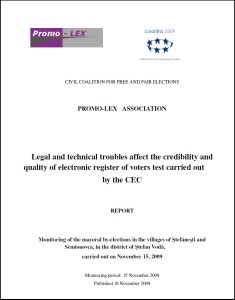
REPORT Monitoring of the mayoral byelections in the villages of Ştefăneşti and Semionovca, in the district of Ştefan Vodă, carried out on November 15, 2009

  locale SV 2009 locale SV 2009 eng    


Promo-LEX launched the final report on the monitoring of the early parliamentary elections of July 29, 2009

_article_1251268400Chisinau, August 25, 2009. Promo-LEX Association launched the final report on the monitoring of the campaign for the July 29, 2009. The monitoring was done in 7 electoral constituencies. Monitored period: June 16 – July 29, 2009

The Promo-LEX monitoring effort is pleased to note an increased interest shown by voters from the monitored area for the 29 July 2009 election. At the same time, certain disturbing trends and patterns were noted, which affected the quality of the electoral process in the monitored region.

In the monitored area, the election largely failed to meet the exigencies of a competitive process that would be comparable with the electoral practices in countries with longstanding democratic traditions, due to a tense atmosphere, unlevel field, and violations and discretional interpretation of procedures by electoral bodies and contestants. Voter lists constitute the basis of properly organized elections. In the monitored area, it was noted that the compilation, verification, use and storage of voter lists constituted a faulty practice, and affected the credibility of the entire process.

A selective accreditation of international observation missions and a systematic harassment of accredited international observers are clear derogations from Moldova’s international commitments, particularly to the OSCE. Intimidation of voters and national observers by the local authorities and electoral bodies leaves an unfavorable mark of suspicion with regard to the transparency of the authorities’ actions. Disrupting the operation of an international observation mission only confirms such suspicions.

Approximately nine percent of the total of Moldovan voters, residents of the Transnistrian region, continued to be isolated from the electoral process in the country. Electoral contestants did not conduct campaigning activities in the breakaway region, and the authorities did not use all the possible means to fully enfranchise this group of voters.

The use of public offices and resources for electoral purposes blurs the line between the activity of the state and that of the ruling party, which is in contradiction with the fundamental norms of democratic rule and violates the principle of equal opportunities. To a lesser extent, the same lack of a clear delimitation between the activities of public authorities and the campaign activities of electoral contestants is noted at a local level.

The Promo-LEX Association monitored, in the period between 16 June and 29 July 2009, the early parliamentary elections of 29 July 2009 – including the pre-electoral period, the legal framework and the Election Day – in the Transnistrian region of Moldova and the neighboring rayons (territorial districts): Floresti, Rezina, Dubasari, Anenii Noi, Causeni, and Stefan Voda. The Promo-LEX monitoring effort deployed observers to 249 polling stations of the total of 1987 polling stations opened across the country. The monitored area is populated by approximately 530 thousand voters, which accounts for approximately 20 percent of the total number of voters in Moldova, and includes the Transnistrian region.

The Promo-LEX monitoring effort would like to acknowledge the National Endowment for Democracy (NED), the National Democratic Institute for International Affairs (NDI), and the United States Agency for International Development (USAID) for the financial support and technical assistance provided for the good implementation of this effort.


DOC – FINAL REPORT MONITORING EARLY PARLIAMENTARY ELECTIONS 29 JULY 2009


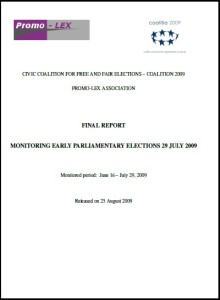
FINAL REPORT MONITORING EARLY PARLIAMENTARY ELECTIONS 29 JULY 2009

Untitdfaled Untitled


The electoral rights of the voters in Transnistria continue to be ignore, notes Promo-LEX

_article_1249034741July 30th 2009. Moldovan citizens residing in the Transnistrian region showed an increased interest for the election, notes Promo-LEX.

Although the separatist administration posed numerous obstacles, and the Moldovan constitutional authorities made insufficient efforts to provide proper information to the electorate of the region, approximately 1,500 more people voted in the early 29 July 2009 election compared to the previous time.

Representatives of the secessionist authorities blocked the roads and thoroughly checked the units of transport at every control post, limiting the free movement of the people. “The constitutional authorities failed to ensure the right to vote of the inhabitants of Corjova village of Dubasari district, on the territory of the poling station opened there,” Igor Guzun said.

Promo-LEX Association is concerned about the attempts to intimidate independent observers, thus intervening in the process of monitoring the elections. Observers were threatened and in some cases even even sworn at. Representatives of local authorities and police were seen repeatedly in 100 meters range from the polling stations.

Voter lists have not been compiled in a qualitative manner. There were many cases noted of presence in the lists of deceased persons, or of non-inclusion in the list of the ID card information. Also, a part of the electoral registers disappeared, while some of the voting certificates were issued on the basis of invalid or inexistent identification papers.

“During the voting process, voting with dubious F-9 form documents was noted: the forms either had the photo attached with scotch tape, the photo was not stamped or the form lacked a proper identification number, declared Ion Manole, president of the Promo-LEX. At the same time, issuance of voter certificates on the basis of invalid or inexistent ID documents was also noted.
Observers noted a differentiated approach at different EBPSs toward accepting or rejecting requests to vote at home. There were registered cases of negligence and irresponsibility of behalf of election bodies with regard to their attributions.

The full versions of the report attached

Contact person:
Ion Manole, president of Promo-LEX Association,
GSM: 69 07 08 00
e-mail: [email protected].

Inna Guleac, PR manager, Promo-LEX,
GSM: 69 33 78 41
e-mail: [email protected].